I recently accused the Carroll County Commissioners of “dereliction of duty” at a presentation for voters at the Gibson Center in Conway for failing to make a clear recommendation regarding installing a small solar array at the County Complex in Ossipee. That is a strong accusation and I’d like to defend it. The solar array proposal was put together by me along with a team of four other volunteers as a service to Carroll County. It would have been a financial win for the county. Financially, the team’s proposal entailed two brief periods, in the first 12 years following installation of the array, when the county would have been “in the red.” Javascript is required for you to be able to read premium content. Please enable it in your browser settings. Your comment has been submitted.
Reported There was a problem reporting this. Log In Keep it Clean. Please avoid obscene, vulgar, lewd, racist or sexually-oriented language. PLEASE TURN OFF YOUR CAPS LOCK. Don't Threaten. Threats of harming another person will not be tolerated. Be Truthful. Don't knowingly lie about anyone or anything. Be Nice. No racism, sexism or any sort of -ism that is degrading to another person. Be Proactive. Use the 'Report' link on each comment to let us know of abusive posts. Share with Us. We'd love to hear eyewitness accounts, the history behind an article. Click Below To Read The Current Edition! Success! An email has been sent to with a link to confirm list signup. Error! There was an error processing your request. Would you like to receive a link to the Conway Daily Sun online eEdition and preview the top stories? Signup today! Your browser is out of date and potentially vulnerable to security risks. We recommend switching to one of the following browsers: Get up-to-the-minute news sent straight to your device. Sorry, an error occurred.
Already Subscribed!
Cancel anytime Account processing issue – the email address may already exist Must be at least 8 characters, not contain repeating characters (e.g., 111), and not contain sequential numbers (e.g., 123). Get the latest news first, with up to the minute coverage of local events. Signup Today! Would you like to receive a link to the Berlin Sun online eEdition and preview the top stories? Signup today!
Get the latest news first, with up to the minute coverage of local events. Signup Today! Would you like to receive a link to the Bridgton News online eEdition and preview the top stories? Signup today! Get the latest news first, with up to the minute coverage of local events. Signup Today! Would you like to receive a link to the Conway Daily Sun online eEdition and preview the top stories? Signup today!
Thank you . Your account has been registered, and you are now logged in. Check your email for details. Invalid password or account does not exist Submitting this form below will send a message to your email with a link to change your password. An email message containing instructions on how to reset your password has been sent to the email address listed on your account. No promotional rates found.
Secure & Encrypted Must be at least 8 characters, not contain repeating characters (e.g., 111), and not contain sequential numbers (e.g., 123). Secure transaction.Secure transaction. Cancel anytime.
Thank you. Your gift purchase was successful!Your purchase was successful, and you are now logged in. A receipt was sent to your email.
From ESS News A consortium led by Germany’s Fraunhofer Institute for Solar Energy Systems (Fraunhofer ISE) has developed thicker battery electrodes that could increase cell-level energy density by 10% to 15% without adding weight. The researchers demonstrated the concept in lithium-ion, sodium-ion, and zinc-ion cells. They also manufactured lithium-ion pouch-cell prototypes. “The new cell architecture was developed with future mass production in mind: A potential electrode production line exhibits significantly lower process complexity compared to a state-of-the-art wet-coating system,” Fraunhofer ISE said in a statement. “As a result, capital costs are significantly lower. Operating costs are also lower because it requires less space and energy. This technology thus opens up the possibility, particularly for small and medium-sized enterprises, to establish their own battery cell production facilities in Germany.” Oliver Fitz, group leader for battery cell technology at Fraunhofer ISE, said the researchers increased electrode coating thickness from the conventional range of 100 µm to 200 µm to as much as 800 µm. The thicker electrodes reduce the number of current collectors required inside a cell, leaving more space and weight for active energy-storing material. The resulting battery cells are also PFAS-free and are manufactured without toxic solvents. PFAS, or per- and polyfluoroalkyl substances, are a large group of synthetic chemicals that are highly persistent in the environment and are often referred to as “forever chemicals.” The research team developed the electrode and cell design as part of three projects: “VORAN – Innovative Sodium-Ion Battery Storage for Stationary and Mobile Applications,” “INFAB – Zinc-Ion Batteries for Stationary Energy Storage – Manufacturing and Assembly,” and “WinZIB2 – Globally Deployable, Innovative Zinc-Ion Battery System.” Project partners include Acp systems, Helmut Hechinger, the University of Stuttgart‘s Institute for Photovoltaics (ipv), and the Karlsruhe Institute of Technology/Helmholtz Institute Ulm. “In a climate-neutral energy system with fluctuating energy sources like solar and wind, stationary battery storage is an integral component for covering morning and evening electricity peaks,” said Andreas Bett, director of Fraunhofer ISE. “Germany would be well advised to build up manufacturing capacity to meet the growing demand for batteries and thereby create value within the country. If we can contribute to that, we’d be very happy.” This content is protected by copyright and may not be reused. If you want to cooperate with us and would like to reuse some of our content, please contact: [email protected]. This content is protected by copyright and may not be reused. If you want to cooperate with us and would like to reuse some of our content, please contact: [email protected]. Comments Please login to comment The new issue of pv magazine Global is out now! Available in print and digital – get your copy today! Martedì, 22 Settembre 2026 11:00 – 12:00 CEST, Roma Monday, October 26, 2026 10:30 am – 11:30 am CEST, Berlin, Paris, Madrid Thursday, September 10, 2026 2:00 pm – 3:00 pm CEST, Berlin, Paris, Madrid Tuesday, September 15, 2026 5:00 pm – 6:00 pm CEST, Berlin, Paris, Madrid A two-day conference in Austin, Texas, bringing together leaders in US solar manufacturing, equipment specification, and factory execution. Saudi Arabia is accelerating its clean energy transition—join the SunRise Arabia Clean Energy Conference 2026 in Riyadh to explore how solar PV and energy storage are powering its digital economy. pv magazine USA hosts its multi-day virtual event on U.S. solar and energy storage, covering domestic manufacturing, distributed energy and the growing role of solar-plus-storage in meeting AI-driven power demand.
Enjoying a spicy pepper Solar energy is the cheapest in history, but it does have some issues. A continuing challenge in large-scale solar photovoltaic (PV) deployments is land use, which can be overcome with agrivoltaics particularly when integrated into controlled environmental agriculture. Agrivoltaics is the combination of solar energy and agriculture. Many crops increase their output with solar in the fields but less has been done with solar panels integrated into greenhouse rooftops. For greenhouse rooftops generally semi-transparent solar panels are used. Agrivoltaic greenhouses work well with tomatoes. Peppers are another common food crop grown in controlled environmental agriculture like greenhouses, but research investigating impacts of different semi-transparent photovoltaic agrivoltaic systems on hot peppers in northern regions was lacking. For this, a new study investigated the impact of partial solar shading on hot peppers in greenhouse. In the study a group of six semi-transparent photovoltaic modules with different materials, transparencies, and spectrum filtrations were deployed in greenhouses to compare their impacts on an Italian spicy peppers, Piccante De Cayenna, with those in the control greenhouse in Ilderton, Ontario. Plant height, leaf chlorophyll content, and fresh harvested weight were measured. All the agrivoltaic treatments increased yield, however, 50%-transparent thin film-blue increased by 78%, 69%-transparent, red-colored luminescent solar concentrator crystalline silicon increased by 91%, and 44%-transparent patterned crystalline silicon solar cells improved yields by 138% compared to controls. The bottom line is you can get more than twice as much peppers by choosing agrivoltaic shading carefully. Rooftop agrivoltaic energy simulations were conducted in SAM for a 1-acre greenhouse model whose rooftops can be integrated by the top three performing agrivoltaic modules. 123 kWdc for 50%-thin film-blue would produce 137,452 kWh/acre (278% of greenhouse needs) and the 69%- luminescent solar concentrator -red would house 98 kWdc covering 99,182 kWh/acre that is more than 200% of needs, and finally 266 kWdc for the 44%-c-Si would generate 255,297 kWh/acre annually and potentially produce over 516% of the greenhouse's annual loads. All three of the top selections could power the greenhouses and have energy left over for other applications or to feet back to the grid. The study concluded that the agrivoltaic greenhouses with semi-transparent solar modules that produced the highest yield of spicy peppers could also operate as net-sustainable energy exporters. This article was originally published on Forbes.com The by-election, which takes place on October 8, comes after Sir Keir Starmer revealed his plans to quit Parliament earlier this month Trump administration to seek extra funding from Congress to ‘dismantle’ Los Tiguerones over narcotics trafficking The $400 million Qatari-gifted jet has faced questions about its security Sagal Abdi-Wali, who came from Somalia in the 1990s, likely to face Zack Polanski in Holborn and St Pancras contest The signs were unveiled the same day Canadian counter-tariffs against the U.S. took effect Apple has unveiled its first foldable iPhone at the company's annual launch event in California. The device, called Duo, is the most expensive iPhone to date, with a starting price of $1,999 (£1,476). Roughly the size of a passport when closed, the phone opens to reveal a 7.6in (19.3cm) screen – the largest ever for an iPhone – and allows people to use an Apple Pencil on the device – a capability previously reserved to iPad users. Airlines are unlikely to have to pay out as the incident is expected to be put down to ‘extraordinary circumstances’ under passenger rights rules What is known? The species – previously only seen in Mexico – bites humans Trump also argued that Iran wants a nuclear weapon and warned of the consequences if it obtains one A former Somali child refugee has been selected as the Labour candidate to take on Zack Polanski in the by-election in Sir Keir Starmer’s London constituency. Andy Burnham said AI posed risks to national security but could also offer solutions to keeping the country safer. Tory leader Kemi Badenoch highlighted ‘serious threats to national security that cannot wait’. 22 Parkside will open to the public as part of London’s Open House festival this weekend An emergency slide was deployed on Air Force One on Wednesday while Donald Trump waited to board the aircraft to travel to the Republican midterm convention. Brothers, arrested in Miami in July on UK rape and sex trafficking charges, to remain in custody in Florida Sagal Abdi-Wali, leader of Camden Council, will take on expected Green candidate Zack Polanski in north London by-election Travellers were caught up in the disruption after hundreds of flights were cancelled following a Nats technical issue on Tuesday. Leader of Camden council Sagal Abdi-Wali selected as Labour candidate to fight by-election to replace Sir Keir Starmer ‘There was no hesitation at all. I don’t even think I thought about anything. I think you just, like as a mom, you just try to protect your kid,’ Brittany Cardinal said after the attack Champagne has cleared the way for producers to make the strongest-ever bubbly after a scorching summer sent grape sugar levels soaring.
Rocket Lab says its new solar cell is free of materials with China-linked supply chain issues. Based in the Seattle area, Garrett covers the space sector and advanced technologies that are shaping the future of aerospace and defense, including space startups, advanced air mobility and artificial intelligence.
Rocket Lab Intros Solar Cells Without Germanium Substrates is published in Aerospace Daily & Defense Report, an Aviation Week Intelligence Network (AWIN) Market Briefing and is included with your AWIN membership. Already a member of AWIN or subscribe to Aerospace Daily & Defense Report through your company? Login with your existing email and password. Not a member? Learn how you can access the market intelligence and data you need to stay abreast of what’s happening in the aerospace and defense community. Our award-winning editors bring news, analysis and insight on the space market. Delivered free to your inbox.
Suniva has announced the completion of an $835 million capital raise as it continues the buildout of a new 4.5 GW facility inside a 620,000 square-foot building currently under construction in Laurens County, South Carolina. The infusion of capital includes both debt and equity financing, consisting of senior secured credit facilities provided by funds managed by Goldman Sachs Alternatives and I Squared Capital, a second lien credit facility provided by JBA Asset Management, and equity investments by Electron Capital Partners, Orion Infrastructure Capital (OIC), and Rubric Capital Management, among others. “As the only U.S.-owned solar cell manufacturer at commercial scale, we believe Suniva is uniquely well positioned in the market,” said Suniva CEO Tony Etnyre, in a statement. “We look forward to helping the United States and the Administration achieve its important goal of U.S. energy independence.” The new facility will bring the company’s annual production capacity to 5.5 GW, including its existing 1 GW facility in Norcross, Georgia. In a 2023 announcement, Suniva said it would expand the Norcross facility to 3.5 GW in capacity, but the plan for the new South Carolina facility seems to have superseded the Georgia expansion Suniva says the new facility is expected to open in late 2027, with production ramping toward full capacity in 2028. The company expects the project to cost $600 million total, and the facility is expected to require 564 manufacturing workers when fully operational. “With the addition of 564 jobs in advanced manufacturing and energy, Suniva’s commitment to this major expansion in the Palmetto State will create new opportunities for our workforce and help bolster energy independence in the United States,” said South Carolina Governor Henry McMaster. “This investment strengthens our commitment to innovative energy solutions, and we are proud of Suniva’s continued success in Laurens County.” The expansion announcement comes at a time when the domestic solar manufacturing space is grappling with the effects of the recently-announced Section 232 trade action. The price floor and tariffs imposed by the Trump Administration have already caused the price of finished solar modules to jump up to levels not seen since the turmoil surrounding the 2023 anti-circumvention inquiry into companies operating in Southeast Asia. The minimum import price for solar cells under the trade action is set at 22 cents per watt, with ad valorem tariffs of 15% added on top. The high price floor could make it more profitable for solar cell manufacturers like Suniva to produce cells domestically, and the company’s new 4.5 GW facility will position them to capitalize on trade policy as it stands. In the announcement of its new facility, Suniva said the expansion is “de-risked by a domestic supply chain already in place and by long-term product offtake agreements with leading U.S. solar players for the majority of its planned future production.” This content is protected by copyright and may not be reused. If you want to cooperate with us and would like to reuse some of our content, please contact: [email protected]. This content is protected by copyright and may not be reused. If you want to cooperate with us and would like to reuse some of our content, please contact: [email protected]. Comments Please login to comment The new issue of pv magazine Global is out now! Available in print and digital – get your copy today! Martedì, 22 Settembre 2026 11:00 – 12:00 CEST, Roma Monday, October 26, 2026 10:30 am – 11:30 am CEST, Berlin, Paris, Madrid Thursday, September 10, 2026 2:00 pm – 3:00 pm CEST, Berlin, Paris, Madrid Tuesday, September 15, 2026 5:00 pm – 6:00 pm CEST, Berlin, Paris, Madrid A two-day conference in Austin, Texas, bringing together leaders in US solar manufacturing, equipment specification, and factory execution. Saudi Arabia is accelerating its clean energy transition—join the SunRise Arabia Clean Energy Conference 2026 in Riyadh to explore how solar PV and energy storage are powering its digital economy. pv magazine USA hosts its multi-day virtual event on U.S. solar and energy storage, covering domestic manufacturing, distributed energy and the growing role of solar-plus-storage in meeting AI-driven power demand.
Energies Media The jig takes both ends of the strip, folds it toward itself, holds it, and lets go. Then it does it again. It ran that way for days, and the film in the clamps looks like nothing at all. Not a panel, not glass, barely a component. Yet the interesting part of the test is not whether the thing survives the folding. It is why folding should cost it anything in the first place. Two semiconductors are sitting on top of each other in there. The upper one, a perovskite, takes the high energy blue and green light. The one below it, ordinary crystalline silicon, takes the red and infrared that slips through. Between them sits a layer most people never hear about, a few atoms of oxide whose only job is to let electrons arriving from above meet holes arriving from below and cancel out cleanly. That seam is the whole problem. When the sandwich bends, the two materials do not stretch by the same amount. They want to slide against each other, and where they slide, gaps open at the boundary. Carriers fall into those gaps. Voltage drops. The cell does not crack, it just quietly stops adding up. So the seam is where the work went. The team built that middle layer out of indium oxide co doped with cerium and hydrogen, laid down by reactive plasma, which grips both faces tightly enough to take the movement. Voltage is the giveaway, and it came out at 2.015 volts open circuit, a record for a bendable device and level with rigid cells of the same design. A single material has a ceiling. Tune it to one slice of the spectrum and it wastes the rest, which caps a one junction cell at roughly 33.7 percent in theory. Stacking two materials with different appetites is the only way past that line, and it is why every efficiency record of the last few years has been a stack. The bending is a separate trick entirely. An ordinary solar wafer runs 150 to 180 micrometers thick and snaps rather than bends. Thin it down far enough and silicon becomes flexible, and a comparable flexible tandem announced weeks earlier was built on a wafer of 60 micrometers, thinner than a lot of human hair. The result was published in Nature on 10 November 2025 by a group at Soochow University in Suzhou with collaborators in Saudi Arabia. The efficiency is 33.6 percent certified, not a self reported bench figure. After 5,000 bending cycles at a radius of about 0.69 inches, roughly the curve of a thumb, the cell held 91 percent of where it started. Not 97. The 97 percent figure belongs to a different flexible tandem, bent 43,000 times around a gentler curve. It also kept 90 percent after 1,000 hours of damp heat, and ran past 2,000 hours of continuous illumination before dropping to 80 percent of its initial output. The comparison everyone reaches for is the rigid record, and that number moved. It was 34.85 percent, certified by the American national laboratory in the spring of 2025, which puts the flexible cell 1.3 points behind. But a European test institute certified 35.5 percent in July of this year, so the real distance is closer to 1.9 points, as the paper and the record announcements together make clear, and the newer figure came with no active area disclosed at all. Then there is the jump from a fingernail sized coupon to a factory. Perovskite is grown from liquid chemistry, manageable at that size and stubborn across a full sheet, where pinholes and thickness gradients eat the yield. The commercial reference point makes that concrete. The first tandem modules sold anywhere shipped in September 2024 at 24.5 percent, about nine points below this cell, and they are rigid glass. Verification is its own story, as a Finnish battery cell showed when independent tests refused to agree, and the road from a laboratory win to a product is the same one an iron catalyst is still walking. Not rooftops. Glass is cheap, flat and already there. What changes is the argument. Flexibility used to mean accepting a serious efficiency penalty, and that penalty has now shrunk to almost nothing in the laboratory. That moves the question from whether it can be done to whether it can be made in volume, which is a more tractable kind of problem. The uses that follow are the awkward ones. Curved building surfaces, vehicle skins, equipment carried into places with no grid, all of them shapes a glass panel simply cannot take. What is still missing is a single outdoor season of data on a bendable stack, and until that exists the strip in the jig is a very good argument rather than a product. Hugo is an engineer with strong technical expertise. Multilingual from an early age, his writing combines technical clarity with a strong interest in science and energy. Hugo is an engineer with strong technical expertise. Multilingual from an early age, his writing combines technical clarity with a strong interest in science and energy. Hugo is an engineer with strong technical expertise. Multilingual from an early age, his writing combines technical clarity with a strong interest in science and energy.
Rocket Lab USA (RKLB) extended its rally in premarket trading Wednesday after Cathie Wood’s ARK Invest disclosed another purchase of the space company’s shares and Rocket Lab unveiled a new solar cell technology that eliminates a critical material from its design. The stock climbed more than 3% before the opening bell, adding to a 2.51% gain during Tuesday’s regular session. The advance came even as Nasdaq futures pointed 0.46% lower and S&P 500 futures slipped 0.36%. The dual catalysts gave investors two company-specific reasons to buy. On the product side, Rocket Lab introduced IMM Apex, a high-efficiency solar cell for space applications that the company says delivers 31.5% beginning-of-life conversion efficiency while cutting mass by 40% compared with earlier models. The design removes germanium substrates, a component that has been standard in multi-junction solar cells for more than three decades and has faced rising costs and supply constraints. Brad Clevenger, president of Rocket Lab USA, said the cell “delivers exceptional performance while addressing real-world challenges like rising material costs and supply chain constraints.” He added that the product is designed to “more cost-effectively power the most ambitious missions without compromising performance.” The technology functions as a direct drop-in replacement for existing satellite solar cells, meaning customers can adopt it without significant hardware modifications. Rocket Lab said the cell is available immediately, with manufacturing capacity in the multi-100-kilowatt range. The underlying technology previously powered NASA’s Ingenuity Mars Helicopter and has operated in orbit for more than a decade. Rocket Lab’s solar products currently support more than 1,100 satellites, including the James Webb Space Telescope and NASA’s Artemis missions. On the ownership side, the ARK Space Exploration & Innovation ETF (ARKX) bought 2,341 Rocket Lab shares on Tuesday, a transaction worth roughly $154,000 based on the closing price. That follows a substantially larger buying spree: ARK acquired 705,102 shares across three exchange-traded funds over two trading days earlier this month, worth about $44.4 million. The purchases were made through ARKX, the ARK Innovation ETF (ARKK), and the ARK Autonomous Technology & Robotics ETF (ARKQ). Rocket Lab now carries a 5.70% weighting in ARKX, along with a 4.07% position in ARKQ and a 4.04% stake in the Defiance Space and Connective Tech ETF (UFOX). Because the stock holds sizable weightings in these funds, ETF inflows and outflows can contribute to meaningful buying or selling pressure. Operational Momentum Beyond the immediate catalysts, Rocket Lab has been building operational credibility. The company completed its 94th Electron mission last week, deploying a StriX Earth-imaging satellite for Japanese radar company Synspective. It was Rocket Lab’s 15th launch of 2026 and its 11th dedicated mission for Synspective, with a 100% success rate across those flights. Another 16 Synspective missions are booked through 2030. Rocket Lab also passed the preliminary design review for 18 satellites it is building for the U.S. Space Development Agency’s Tracking Layer Tranche 3 constellation, a milestone the company called a “big step forward” toward delivering missile-warning and defense capabilities for the United States and its allies. Financially, the company reported $234.1 million in second-quarter revenue, a 62% year-over-year expansion. Its contract backlog reached a record $2.36 billion. Rocket Lab’s market capitalization stands at approximately $39.4 billion. Wall Street’s View Analysts remain broadly constructive on the stock. Rocket Lab carries a Strong Buy consensus rating, with 13 Buy recommendations and four Hold ratings issued over the past three months. The average price target sits at $108.88, implying roughly 65% upside from current levels. Recent analyst actions include Bank of America Securities maintaining a Buy rating while trimming its price target to $110 on Aug. 31. Citizens held a Market Outperform rating with a $130 forecast on Aug. 11, while Cantor Fitzgerald maintained an Overweight rating and raised its target to $122 the same day. Technical Picture Despite the recent bounce, Rocket Lab remains below its major moving averages. The stock trades 4.9% below its 20-day simple moving average and 9.4% below its 50-day SMA. It sits 25.1% below the 100-day SMA and 15.1% below the 200-day SMA. The 20-day SMA remains below the 50-day SMA, and the 50-day crossed below the 200-day in August, forming a “death cross” that points to pressure on the longer-term trend. Momentum indicators also suggest caution. The MACD sits below its signal line with a negative histogram, indicating buying momentum has not fully recovered. Rocket Lab faces resistance near $78.50, with support around $58.50. The stock has gained roughly 38% over the trailing twelve months but remains well below its 52-week high of $151, reflecting the extent of the pullback since May. The 52-week range spans from $37.57 to $151, and the relative strength index reading sits at 40.94. On Stocktwits, retail sentiment for RKLB slipped to “bearish” from “neutral” levels a week ago, even as 24-hour message volumes jumped 369%. One bullish user wrote, “$RKLB bought 500 shares of this back in 2024 when it was at $9 and sold in the $20’s and I regretted it. I repurchased 1k shares last week at $59 and ain’t selling till we are at $150.” Once added, BigGo Finance appears first in Google Search Top Stories, so you get the broadest, most up-to-the-minute, and most comprehensive global financial news first. The news and data on this website are for reference only and do not constitute investment advice or an offer to buy or sell. Information is sourced from exchanges and public sources, and may be delayed, interrupted, or updated. While we strive for accuracy, we do not guarantee timeliness, correctness, or completeness. Content may include external links for which we are not responsible. By using this site, you agree that we and our partners are not liable for any losses. Investment carries full responsibility; please carefully assess risks and consult professionals. If there are errors in the content, please contact us for correction.
PT Metalogika intends to establish a thin film flexible solar panel production facility in Indonesia with an initial production capacity of 20 MW per year, with potential further expansion toward 200 MW annually, for the sale of solar panels in the Indonesian market and abroad. Midsummer will supply the manufacturing equipment and related services for the establishment and operations of the solar cell factory to the new joint venture and also assume a minority ownership in the Indonesian joint venture. The currently contemplated equipment scope consists of Midsummer’s proprietary DUO system for the production of thin film solar cells, other manufacturing equipment and services sufficient for a 20 MW per year solar cell factory. The equipment procurement will be entered into by the Indonesian joint venture following its incorporation and satisfaction of the agreed conditions. This structure is intended, among other things, to allow the project to establish the appropriate Indonesian investment and import framework before manufacturing equipment is imported. The initial 20 MW facility is intended as the first phase of a broader industrial roadmap. Following successful commissioning and operation, the parties intend to evaluate expansion toward 200 MW of annual production capacity, with longer-term potential for further expansion toward gigawatt scale, subject to market demand, financing, operational performance and future investment decisions. The strategic ambition is to develop Indonesia into an important manufacturing node within Midsummer’s geographically distributed production ecosystem, initially serving Indonesia and progressively supporting opportunities in Southeast Asia and other markets. “Our ambition is to build a long-term industrial partnership in Indonesia, combining Midsummer’s technology and manufacturing experience with Metalogika’s Indonesian industrial capabilities” said Eric Jaremalm, CEO, Midsummer. “We intend to start with a clearly defined 20 MW industrial project, while creating the foundation from which the partnership can scale significantly as the market develops. I see this as another validation of Midsummer’s technology and of our strategy to offer partners not only equipment and solar products, but access to a complete industrial manufacturing platform — technology, know-how, engineering, training, procurement and long-term production support.” The parties will now proceed with incorporation of the joint venture, finalisation of the investment and governance structure, applicable Indonesian approvals and incentives, project financing and definitive equipment and technology agreements. Indonesia has a population of approximately 285 million. It is the largest economy in Southeast Asia with a GDP exceeding $1.4 trillion and growing at 4-5 percent per year. Indonesia’s energy mix is heavily reliant on fossil fuels, with renewable energy sources making up approx. 18 percent of the power generation mix. Located directly on the equator, Indonesia has massive solar energy potential, backed by a very high daily solar radiation average and government ambitions for a rapid scale-up of solar energy production. “Our objective is to establish advanced solar manufacturing capability in Indonesia and progressively build a locally anchored industrial ecosystem around it” added Firrisky Nurtomo, President Director, PT Metalogika Rekayasa Sistem. “One of the nearest aim is to support the country’s focus to strengthen energy independence and security. Midsummer brings not only manufacturing technology but experience, know-how and access to a wider international production ecosystem.” For additional information: Midsummer AB
As solar markets mature, storage, flexible loads and AI-driven energy management are changing what customers expect from an energy system — and how GoodWe defines its role within it. Europe’s residential energy market is entering a new phase. For much of the past decade, the central question for homeowners was whether to install rooftop solar. Increasingly, the question is how to use that solar more intelligently — combining generation with batteries, electric vehicles, heat pumps, flexible tariffs and automated energy management. That shift is reshaping the competitive landscape for companies that grew up around the solar inverter. For GoodWe, it also coincides with a transformation of its own. The company’s 2026 interim report showed that overseas markets accounted for 72.72% of first-half revenue, while energy storage battery sales reached approximately 2.4 GWh. During TÜV Rheinland’s “All Quality Matters” event, GoodWe Vice President Wang Yinge said storage inverters and batteries now make up the large majority of the company’s overseas business. The change is not simply geographic. It is structural. GoodWe describes this direction through its “Generation-Grid-Load-Storage-Intelligence” strategy: a shift from supplying individual pieces of power electronics toward connecting distributed generation, storage and controllable loads through an increasingly intelligent energy management layer. The objective is not to assemble the longest possible product list, but to make these assets operate as one system around the needs of the energy prosumer. Storage as the hardware anchor Storage has become the physical anchor of this transition. Europe illustrates why. The continent installed 36 GWh of new battery storage in 2025, taking cumulative operational capacity above 100 GWh for the first time, according to SolarPower Europe. Residential storage remains a major part of the installed fleet, and the association expects residential additions to regain momentum in 2026, supported by the growing availability of dynamic tariffs, lower remuneration for exported solar electricity and rising consumer interest in energy self-sufficiency. For homeowners, however, battery economics are only part of the equation. Installation labor, system complexity, noise, reliability and after-sales service increasingly determine whether a system works in practice. That thinking has influenced GoodWe’s ESA residential storage platform. Built around what the company calls its “4S” principles — Silent, Secure, Smart and Simple — the system integrates inverter, battery and backup functionality into an all-in-one architecture. Wang said installation simplicity is particularly important in Australia and Western Europe, where qualified installers are expensive and often in short supply. GoodWe has therefore placed considerable emphasis on reducing installation time and complexity. The ESA platform has been designed around quick connections, integrated components and low-noise operation, while its software layer connects storage with the broader household energy ecosystem. This point goes beyond a single product. As hardware becomes increasingly integrated and battery technologies converge, differentiation gradually shifts from individual specifications toward the performance of the complete home energy system. Intelligence as the connective layer If storage is becoming the physical center of that system, intelligence is becoming its economic center. A battery can transfer energy on time, but its value increasingly depends on knowing when to charge, when to discharge, when to consume solar energy directly and when to buy electricity from — or export it to — the grid. These decisions become more complex as electricity prices become more dynamic and households add flexible loads such as EVs and heat pumps. GoodWe’s SEMS+ platform is designed to provide that connective layer. It connects inverters, batteries, EV chargers and heat pumps while using AI-supported control to optimize household energy flows. The platform supports fixed tariffs, time-of-use tariffs and, for selected markets and compatible devices, dynamic electricity pricing. This capability is becoming increasingly relevant in Europe. The European Commission notes that dynamic electricity contracts can allow consumers to lower their bills by shifting demand in response to changing wholesale prices. Households equipped with flexible assets such as EVs, heat pumps and batteries are particularly well positioned to respond — although doing so effectively requires smart metering and either active management or automation. For GoodWe, automation is therefore not simply a digital add-on. It is what can turn a collection of energy devices into an operating system. “In Europe, if everything has to be managed manually, it simply cannot be done,” Wang said. “The system needs to know when to charge, when to discharge, when to use solar power and when to use electricity from the grid.” The strategic implication is significant: the value of a battery will increasingly be determined not only by how much energy it can store, but by how intelligently that flexibility can be used. One strategy, different markets An integrated strategy does not mean selling the same system everywhere. GoodWe’s international expansion has produced two contrasting market templates. In Australia and much of Western Europe, relatively high labor costs and limited installer capacity favor high-voltage, integrated systems that are fast to install, quiet and simple to commission. In markets such as Pakistan and parts of Asia, Africa and Latin America, weaker grids, frequent outages and greater price sensitivity create a stronger case for lower-voltage, modular systems focused on backup capability and affordability. Europe itself is not a homogeneous market. Wang pointed to countries such as Germany, the United Kingdom, France and the Netherlands, where installer productivity, system simplicity and reliability are important purchasing considerations. In parts of Central and Eastern Europe, by contrast, affordability, backup power and energy security can carry greater weight. This makes localization more than a sales exercise. GoodWe has established subsidiaries, local warehouses and local service teams across key overseas markets while adapting product architectures, certifications and service models to regional requirements. The company is also strengthening carbon management, hazardous-substance control and supply-chain traceability as sustainability and compliance requirements become more important. The logic is straightforward: global scale increasingly depends on local fit. From selling equipment to creating prosumer value GoodWe’s strategy goes beyond hardware integration. Wang describes the underlying customer as an energy prosumer — someone who does not merely consume electricity, but can also generate, store, shift and potentially sell it. Viewed from this perspective, “Generation-Grid-Load-Storage-Intelligence” becomes less a description of GoodWe’s product portfolio than a value chain. Solar PV and BIPV provide generation. Inverter transfers power to grid or storage. Batteries provide flexibility. EV chargers and heat pumps add controllable loads. SEMS+ connects these assets and responds to tariffs, forecasts and grid conditions. The outcome is measured not by the number of devices installed, but by lower energy costs, higher self-consumption, greater resilience and, where market mechanisms allow it, additional value from flexibility. GoodWe’s Smart Energy WE Platform already manages more than 10 GW of distributed PV, storage and charging resources in China, supporting applications including virtual power plant dispatch and intelligent energy management. But Wang sees a longer-term destination beyond monitoring and optimization: energy operation services. In this model, an energy service provider could eventually manage a customer’s distributed energy assets, optimize power purchases and consumption, and share part of the additional value created with the customer. The underlying principle, Wang said, is simple: GoodWe can only create business value when it first creates measurable value for the energy user. This model will develop differently across markets, and GoodWe does not expect every element of the strategy to be deployed everywhere at once. In one market, the immediate opportunity may simply be adding storage to existing solar. In another, it may be connecting batteries to dynamic tariffs. Elsewhere, distributed assets could eventually be aggregated into virtual power plants and participate more actively in electricity markets. The inverter may have been where GoodWe’s story began, but it is unlikely to define where the company is heading. As distributed energy becomes more interactive, more market-driven and increasingly intelligent, the next competitive frontier will be less about individual devices and more about how effectively generation, storage and flexible loads can work together. For GoodWe, its Generation-Grid-Load-Storage-Intelligence strategy is ultimately an attempt to answer that question — by moving from supplying energy hardware toward orchestrating energy around the needs of the prosumer.
Roadmap toward high-performance and sustainable 2D/ quasi-2D lead-free perovskite optoelectronics.
view more Roadmap toward high-performance and sustainable 2D/ quasi-2D lead-free perovskite optoelectronics. Credit: HIGHER EDUCATION PRESS Perovskite materials have emerged as promising candidates for next-generation solar cells, light-emitting diodes, and photodetectors because of their remarkable optical and electronic properties. However, the widespread use of lead-containing perovskites has raised environmental and sustainability concerns. Lead-free halide double perovskites offer an attractive alternative, but their performance is strongly influenced by complex structural, electronic, and defect-related factors.
In this review, Soo-Yeon Yang and Hyojung Kim examine recent advances in 2D and quasi-2D LFHDPs, focusing on how structural design translates into material properties and ultimately device performance. The review goes beyond a conventional classification of perovskite compositions by establishing a structure-property-device performance framework.
Particular attention is given to layered architectures, including Ruddlesden–Popper, Dion–Jacobson, alternating-cation with (111)-oriented structures. The authors discuss how organic spacer cations, crystal orientation, dimensionality, composition, and interfaces influence bandgap, exciton behavior, charge transport, defects, and stability. Quantitative comparisons of optical and electronic properties and representative device performances are also provided to facilitate direct comparison among different LFHDP systems.
The review further highlights the growing potential of layered LFHDPs in photovoltaic, light-emitting, and photodetection applications. For LEDs, special emphasis is placed on exciton-related emission, self-trapped-exciton and dopant-mediated luminescence, photoluminescence quantum yield, and device architecture. Strategies including spacer engineering, compositional tuning, defectpassivation, and interface engineering are discussed as routes toward improved device performance.
Despite rapid progress, several challenges remain, including wide or indirect bandgaps, strong exciton binding, limited carrier mobility, defect formation, operational stability, and scalable manufacturing. The review therefore identifies emerging opportunities in AI-assisted materials discovery, high-throughput computational screening, machine learning, green synthesis, multidimensional heterostructures, and industrial-scale processing.
By linking structure → properties → device performance → future engineering strategies, this review provides a practical roadmap for the development of sustainable, high-performance lead-free perovskite optoelectronics. The work entitled “Structure-property relationships in 2D/quasi-2D lead-free halide double perovskites for optoelectronic devices” was published in Frontiers of Optoelectronics (published on Sept. 1, 2026) . Frontiers of Optoelectronics 10.2738/foe.2027.0001 Experimental study Not applicable Structure-property relationships in 2D/quasi-2D lead-free halide double perovskites for optoelectronic devices 1-Sep-2026 Disclaimer: AAAS and EurekAlert! are not responsible for the accuracy of news releases posted to EurekAlert! by contributing institutions or for the use of any information through the EurekAlert system. Media Contact Rong Xie Higher Education Press xierong@hep.com.cn Office: +86 010-5855-6485
Animals 24-7 News on dogs, cats, horses, wildlife, zoonoses, & nature By Merritt CliftonLeave a Comment NANJING, China; HONG KONG; SINGAPORE––”China’s Solar Expansion Policy Reduces Bird Diversity,” a study led by a Chinese professor with no background in either ornithology or avian ecology, but with a history of doing research linked to the coal industry, rattled solar panels around the world after appearing in the prestigious peer-reviewed journal Science on August 20, 2026. The findings were immediately amplified globally, especially by media supportive of coal use. Coal still supplies about 35% of the energy used to produce electricity worldwide, but has rapidly lost market share to solar and wind, and is fighting competition from solar and wind on every inhabited continent. Solar and wind together produced less than 2% of the world’s electricity in 2000, but now produce 13%. The decline in Chinese use of coal has been even steeper. Coal produced 60% of the Chinese electricity supply in 2011, but only 48% in 2025. Yet “A lie can travel halfway around the world while the truth is putting on its shoes,” as Jonathan Swift observed circa 1710, well before the invention of electronic media. So can a study that doesn’t hold up. Within days a flock of critics led by the China Ornithological Society were picking apart “China’s Solar Expansion Policy Reduces Bird Diversity” like vultures on a roadkill. Protested lead study author Huiming Zhang, of the Nanjing University of Information Science & Technology, to Agence France Presse, “The main message is not to slow the renewable energy transition, but to make solar development more ecologically informed.” Perhaps China’s most prominent energy economist, Huiming Zhang has led many studies and published many papers pertaining to both coal use to generate electricity and use of solar and wind energy. But a look at his bibliography suggests a tilt toward continuing to develop Chinese coal fields, currently producing about half of the total global coal supply, even as China also leads the world in solar development. “China’s Solar Expansion Policy Reduces Bird Diversity,” explained the abstract, “examined the effect of policies promoting solar photovoltaics on local avian biodiversity,” using data gathered from 2,344 counties in China between 2014 and 2023. “Policies that favored photovoltaic expansion led to reductions in bird diversity, disproportionately affecting wealthier and non-desert regions, as well as widespread species,” Huiming Zhang and co-authors alleged. “The mechanism operated primarily through land conversion: cropland and grassland were transformed into developed areas, reducing the diversity of vegetation,” suggested Huiming Zhang and co-authors. “Paradoxically,” Huiming Zhang and co-authors continued, “the leaf area index increased, a pattern we term ‘inferior greening,’ whereby diverse natural landscapes were replaced by dense but ecologically homogeneous vegetation. We argue that future photovoltaic development should be accompanied by strict biodiversity safeguards, especially in economically developed regions with high habitat complexity.” Offered Issam Ahmed for PhysOrg, an online science and technology periodical published since 2004, “China’s goal to achieve carbon neutrality before 2060 has seen it embark on a renewables revolution,” largely meaning replacing coal with solar energy wherever possible. “By 2024,” Issam Ahmed observed, the Chinese “solar footprint,” meaning the area occupied by solar panels, “reached an estimated 1,745 square miles—equivalent in size to the U.S. state of Rhode Island—and solar energy is projected to constitute 45% of its energy mix by 2060.” Unfortunately, Ahmed wrote, “Choosing solar locations in China is not based on sunshine and available land, but rather on government ‘Five-Year Plans’ to promote economic development in certain regions.” Further, Chinese solar development has so far relied much more heavily on “solar farms,” or vast arrays of solar panels blanketing landscapes, feeding electricity into existing transmission grids, than on rooftop solar, which in most efficient form, bypasses transmission grids by storing electricity in batteries for use at or near the point of generation. “The average effect [on birds],” of covering land with solar panels, “is modest, but it is meaningful when it occurs systematically across many counties,” Zhang Huiming and co-authors said in a media statement. Explained Phil McKenna for Inside Climate News, “In their multi-step assessment, the researchers first collected official solar-related directives from provincial, city, and county government websites. “They then collected ‘citizen science’ bird-watching records from across the country. These records were fed into the Shannon Index, a formula frequently used to assess biodiversity based on the number of species observed and how evenly individuals are distributed among them. “Comparing the two indexes revealed how policies supporting solar power development impacted avian communities. Amanda Rodewald, senior director of the Center for Avian Population Studies at the Cornell University Ornithology Laboratory, emailed to McKenna that, “In North America, we see similar patterns where species diversity often declines in areas developed for [solar energy collection], due to loss of sensitive/specialist species.” “However,” McKenna continued, “Rodewald said that species diversity can also increase after landscapes are initially fragmented. She cautioned that bird species diversity may not necessarily be the most meaningful measure of the health of avian species in an area. “Rodewald added that while some may be tempted to use the study’s findings to challenge renewable energy development,” McKenna paraphrased, “it is important to compare the effects of such projects with those of conventional energy sources like coal and oil, which have steep environmental consequences,” including for birds, from the proverbial canaries in coal mines to the sea birds who die in oil spills at the rate of half a million to a million per year, worldwide. Zhang and co-authors acknowledged by email, McKenna wrote, that “Using rooftop solar in habitat-rich regions and restoring diverse native vegetation, rather than relying only on simple greening targets,” could mitigate the alleged avian biodiversity losses due to “solar farming.” Huiming Zhang and co-authors were fiercely rebutted, eleven days after “China’s Solar Expansion Policy Reduces Bird Diversity” appeared, by Oliver Zhen Li of National University of Singapore and Shirley Jiexuan Wang, who are respectively an economist and a systems analyst. “We revisit this issue and conclude that there is no evidence of this being the case,” began Wang and Li. “If we assume that Zhang et al’s data treatment is true and fair, then they have ignored the fact that fences around solar farms can deny birdwatching access, mechanically causing observed bird diversity to decline. “However, and more importantly,” Li and Wang argued, zeroing in on statistical methodology, “the negative link between bird diversity and solar photovoltaic policy stringency claimed by Zhang et al is likely due to missing-data treatment-setting miss values to zero. “Without setting missing values to zero,” Li and Wang found, “the correlation between solar photovoltaic policy intensity and solar photovoltaic activities is negative.” Finished Li and Wang, “Zhang et al‘s conclusion can potentially misguide sustainability efforts and energy policies in China as well as the rest of the world.” Even more damaging to “China’s Solar Expansion Policy Reduces Bird Diversity” should be the critique issued by the China Ornithological Society, whose members were the major source of the data used by Zhang et al. “The data used to plug into a bird diversity index,” the index used by Zhang et al, “was taken from the China Birdwatching Record Centre, the largest citizen-science platform for bird observations in the country,” explained Victoria Bela for the South China Morning Post on September 6, 2026. The China Ornithological Society, however, “warned of potential errors in the China Birdwatching Record Centre’s records, which it said may have influenced” the conclusions of Zhang et al. The China Ornithological Society, summarized Bela, “pointed to a logged observation in 2015 of 2.1 billion little egrets in a wetland, and another in 2022 of 1.3 billion red-billed blue magpies in a park, both in Guangdong province. “While there is no exact census for these species, historical estimates show that those numbers far exceed their entire global populations. A 2023 Wetlands International estimate placed the global little egret population at up to around three million,” only 1.4% of the number supposedly found in a single wetland. The China Ornithological Society, reported Bela, “said that despite the data clearly exceeding ‘reasonable limits,’ it was still included” in the estimate of avian biodiversity that Zhang et al used to allege a decline. “China’s Solar Expansion Policy Reduces Bird Diversity,” charged the China Ornithological Society, “provides no information on birdwatching data quality control, making it impossible to accurately assess the reasonableness of the data used for analysis.” Detailed Jiang Xinyi for the Shanghai-based online periodical SixthTone.com, “Among the issues, over 40% of the over 500,000 reports collected during the nine years [worth of data used by Zhang et al] recorded the presence of species using the number 1,” instead of entering a count. This does not actually mean “that only one bird was seen,” the China Ornithological Society said, “making the data unreliable.” “Meanwhile, the original study may have removed some migratory waterbirds’ records at wintering sites as statistical outliers, as they recorded tens of thousands of birds at a given location, ‘potentially underestimating true bird diversity,’” the China Ornithological Society explained. “The China Ornithological Society also noted,” Jiang Xinyi continued, “that birdwatching records surged between 2021 and 2023 amid a growing birdwatching boom in the country, just as authorities were introducing significant solar policies. This, it argued, makes it difficult to determine whether changes in biodiversity data were driven by increased birdwatching or photovoltaic development.” Ma Zhijun, deputy director of the China Ornithological Society and a professor at the Fudan University School of Life Sciences, told Jiang Xinyi, Jiang Xinyi paraphrased, that “Easy availability of birdwatching datasets has led researchers without a background in bird ecology to use them without fully understanding their limitations.” Longer birdwatching time, the China Ornithological Society added, had a greater influence on observed avian biodiversity than anything having to do with solar policy. Concluded the China Ornithological Society, “We believe that this paper has flaws in data usage and statistical bias, and cannot support the conclusion that China’s photovoltaic expansion policy has reduced bird diversity.” Science communications director Meagan Phelan acknowledged on August 27, 2026 that “potential concerns related to this paper have reached our attention.” “We are evaluating them following our normal processes,” Phelan said. “We will reach the authors. If any adjustments are required, we will certainly make them.” “Ken Rosenberg, a conservation scientist at Cornell University who was not involved in the research, says bird diversity measures can be misleading,” reported Mary Randolph for Scientific American, “as they can obscure how well a specific local bird population is actually doing. Future research might look at bird population numbers instead, he says.” Rosenberg conceded, however, that the analysis by Zhang et al was “the first he has seen,” Randolph wrote, “that has looked at the relationship between solar policy and biodiversity on a national level.” Hou Liqiang, writing for China Daily, the official Chinese government newspaper, pointed out that, “No form of human development leaves nature untouched, and solar power is no exception. Almost every modern infrastructure — be it roads, cities, farms, mines and dams — reshapes ecosystems in one way or another.” The question raised by Zhang et al, Hou Liqiang suggested, “is not whether solar energy development has any adverse ecological effect, but how that effect should be assessed and reduced in a broader balance sheet. “Some Western media outlets have framed the study in highly negative terms,” Hou Liqiang observed, “with one headline saying solar panels in China are ‘killing’ bird diversity. The wording might be eye-catching, but it risks turning a complex governance issue into a simplistic accusation. “The study itself does not conclude that solar power is inherently harmful. Nor does it deny the significant role that renewable energy plays in mitigating the threat from climate change that has been looming larger. “After all, climate change itself is triggering extreme weather events and destroying habitats, exacerbating global biodiversity loss,” Hou Liqiang reminded. “By mitigating climate change, the development of solar energy can play an important role in promoting biodiversity conservation.” Agreed Darren Orf for Yahoo.com, “Renewable energy is the solution for the climate crisis. Severely curtailing carbon emissions while harnessing the free energy provided by the fusion reactor known as our sun (in the form of solar power) or the wind blowing across the plains is a clear win-win for humanity, but that doesn’t mean that energy sources like this don’t come with downsides that require careful consideration. “For instance, 400-foot-tall wind turbines and sprawling photovoltaic arrays need space, often to the detriment of the wild animals that rely on those once-undisturbed habitats.” But Ted Clifton of Zero Energy Plans, a pioneering solar builder and brother and brother-in-law of the ANIMALS 24-7 team, argues that the whole premise that solar conversion requires “sprawling photovoltaic arrays” eating into wildlife habitat and farmland is just plain wrong. “I have never been a fan of ground-mounted arrays,” Ted Clifton emailed, “as we have more than enough rooftops, especially in warehouse districts, to supply all the power we need, closer to the actual point of use. “In very far northern climates,” Ted Clifton continued, “ground-mounted arrays can be set steep enough to dump snow, and still be effective during the winter months, but otherwise we should be keeping them on rooftops.” Subscribe to get the latest posts sent to your email.
ST. JOHN – Following a two-hour public hearing at the Annex Building Community Room in St. John, the Stafford County Zoning Board on Wednesday evening voted 4-2 to grant a conditional use permit to Lightsource BP US to construct a solar farm and battery storage facility spanning roughly 2,400 acres in the county. Lightsource BP, founded in London in 2010 and fully acquired by energy giant BP in 2024, is one of the world’s largest developers and operators of utility-scale solar projects. The company operates in more than a dozen countries and has an existing presence in Kansas, having previously signed a long-term power purchase agreement in Stanton County. The Zion Valley project in Stafford County would add to its growing U.S. portfolio.
Public hearing The public hearing followed an open house hosted by the company on Aug. 19 regarding the proposed Zion Valley Solar and Storage project. Preceding the event, announcement of the public hearing was published by the Great Bend Tribune as the official newspaper for Stafford County on Aug. 11. Approximately 30 Stafford County residents attended the hearing Wednesday, which featured three representatives from the Lightsource BP organization presenting the application for the conditional use permit. Matt Miller, zoning board chairman, noted that notice of the hearing was mailed to the applicant, as well as 29 property owners in the area affected by the proposed construction project. Zoning board administrator Carl Miller noted that zoning regulations were adopted in March addressing concerns for both the solar energy facility and commercial energy lithium battery storage system. The regulations defined parameters for fenced panel array, storage system and its design requirements, setbacks from residences, public structures, cemeteries and private airstrips that may be adjacent to the construction. Requirements also included a complete development plan presented by appropriate maps, diagrams or plans that designate the total acreage for the project, names and current addresses of property owners providing leases or licenses; fire safety plan, road agreement, state required soil erosion, sediment control and storm-water runoff plan, post-construction cleanup and decommissioning plan revised every five years. Following public comment that included concerns from the audience regarding meeting notice for neighbors not directly affected by the project’s location, the six-person voting membership cast a 4-2 vote, with members Jenna Zeman and Darryl Lucas opposed, authorizing the board chairman to sign a resolution granting conditional use permission for Lightsource to proceed with the project. Project parameters As explained by Alyssa Edwards, senior vice president of environmental affairs and government relations, Lightsource BP staff worked through the permit application step-by-step in accordance with the zoning regulations. “We have worked with landowners, neighbors, hosted a public information meeting and so we have been in the area since 2024. We feel that our application reflects the ordinance and all the items were addressed,” she noted. While the total area of the project at a planned 342-megawatt capacity spans roughly 2,400 acres, the fenced-in facility with panels and batteries is estimated at 1,800 acres. The project represents a capital investment of approximately $300 million in Stafford County. Adam Iago, Lightsource senior development manager, noted that drawings and renderings represent the project in draft form, as final engineering has yet to be completed. A firm construction schedule with target completion date remains to be determined.
Partly cloudy. High 109F. Winds WSW at 10 to 15 mph.. Some passing clouds. Low 86F. Winds SW at 10 to 20 mph. Updated: September 9, 2026 @ 12:13 pm The Goodyear City Council approved a special use permit for a sprawling solar energy and battery storage project in south Goodyear. The Desert Rainbow Solar project is a utility-scale solar energy generation facility planned on approximately 5,050 acres south of Queen Creek Road and east of Waterman Wash.
The Goodyear City Council approved a special use permit for a sprawling solar energy and battery storage project in south Goodyear. The Goodyear City Council approved a special use permit for a sprawling solar energy and battery storage project in south Goodyear that is expected to generate millions of dollars in tax revenue and hundreds of construction jobs. The council voted 6-1 to approve Resolution No. 2026-2537 for the Desert Rainbow Solar Project, a utility-scale solar energy generation facility planned on approximately 5,050 acres south of Queen Creek Road and east of Waterman Wash. Councilmember Benita Beckles cast the lone dissenting vote. The project will include photovoltaic solar panels, a battery energy storage system, electrical infrastructure, a collector substation and at least one operations and maintenance building. Principal Planner Ann Dolmage said the property is currently undeveloped and is zoned Estrella Phase 3 Preliminary Planned Area Development, or PAD. The preliminary PAD envisioned residential, commercial, mixed-use, light industrial, public and open-space uses for the property, but a final PAD was never approved. “Under the zoning ordinance in effect at the time of application, energy generation facilities are allowed in any zoning district with approval of a special use permit,” Dolmage said. The Desert Rainbow Solar project is a utility-scale solar energy generation facility planned on approximately 5,050 acres south of Queen Creek Road and east of Waterman Wash. Dolmage said the solar panels would stand approximately 10 to 15 feet high and use trackers to follow the sun throughout the day. The battery energy storage system, or BESS, would store surplus electricity so it could be deployed when needed. The project would have a 30-foot setback around its perimeter, while battery storage units would have to remain at least 100 feet from the perimeter and any buildings. The project would not connect to the city’s water or sewer systems, with water instead trucked to the site or supplied through on-site wells. “For the BESS, the applicant will be required to provide a hazard mitigation plan, as well as an emergency response plan,” Dolmage said. “The BESS units will also include an intelligent fire detection, alarm and suppression system.” Dolmage also highlighted environmental considerations associated with the approximately 5,050-acre site, which falls within wildlife movement areas identified by the Arizona Game and Fish Department and other agencies. “The applicants have been consulting with Game and Fish, and they’ve obtained a biological study for the project,” Dolmage said. “One recommendation of the study is for a wildlife corridor through the site, and that will be accommodated near Chandler Heights Road.” Dolmage said AES is requesting up to 10 years to establish the use and anticipates the facility operating for approximately 40 years. The requested special use permit would have a 45-year term. “At which point the solar park must be decommissioned, or an SUP extension must be obtained,” Dolmage said. “A final decommissioning plan will be provided before construction.” The project would be developed by AES Clean Energy on private land currently owned by Estrella South LLC. Andrew Yancey, an attorney representing AES, said the project is expected to produce approximately 550 megawatts of electricity while placing little demand on Goodyear’s municipal infrastructure. “The project is a way to make beneficial use of otherwise unproductive land for the next 40 years or so and to provide additional electricity to help Arizona’s economic growth overall,” Yancey said. AES has submitted the project as part of Salt River Project’s request for proposals process. Arizona Public Service, which serves much of Goodyear, also expressed support for the project. According to a fiscal impact analysis provided by the applicant, the solar portion is estimated to generate approximately $42.9 million in direct tax revenue for Goodyear over 30 years, while the battery energy storage component is projected to generate another $15.5 million over 15 years. Dolmage said the project has undergone review by several outside agencies, including the Arizona Game and Fish Department, Arizona Department of Transportation, city of Avondale and Maricopa County. The city also expanded its public notification area from the usual 500 feet to 1 mile around the project site. “The city has received comments from 14 individuals and organizations about this project,” Dolmage said. “Of these comments, most have expressed support for the project or simply requested more information about it.” Three neighboring property owners raised concerns about access and whether the project would promote desirable development in south Goodyear, according to Dolmage. Yancey said the project could also create up to 800 construction jobs and approximately 20 full-time positions once operational. The project prompted considerable discussion among council members over fire safety, decommissioning, wildlife protection and the long-term future of the property. Councilmember Trey Terry questioned what safeguards would be in place to ensure the property is properly decommissioned if AES or another future owner is unable to complete the work. AES has submitted a preliminary decommissioning plan and will be required to provide an updated plan before construction. The company is requesting a 45-year term for the special use permit, with the project expected to operate for approximately 40 years. “I just want to make sure we protect the city and maintain flexibility for people 45 or 50 years from now,” Terry said. Fire safety surrounding the battery energy storage system was another major topic. Goodyear Fire Chief Paul Luizzi said the remote location and lack of fire hydrants would require additional considerations in an emergency response. The project will be required to develop an emergency response plan in coordination with the fire department. “We would, more than likely, require water storage on-site for any fire protection,” Luizzi said. AES representatives said battery units would include monitoring and fire-suppression technology and would be designed according to applicable safety standards. Wildlife protection also factored into the project’s design. Approximately 730 acres around Waterman Wash are expected to remain preserved, and the project includes plans for a wildlife corridor near Chandler Heights Road. AES has been working with the Arizona Game and Fish Department and plans to continue that coordination as the project moves through permitting. Councilmember Laura Kaino said Arizona’s continued economic and technological growth makes additional energy infrastructure increasingly important. “Arizona’s economy depends on energy, just as it depends on water,” Kaino said. “Energy is just as important a conversation as water is right now.” Beckles said she supports solar and battery storage technologies but had concerns about the specific project, including its decommissioning and emergency planning. “I don’t have any further questions, but I am not in favor of this project,” Beckles said. Councilmembers Wally Campbell and Vicki Gillis voiced support, citing the need for additional electricity as the region continues to grow. Gillis said her position on battery storage changed after spending several years researching the technology and touring facilities. “I was not for it, and now I’m strongly in favor of it,” Gillis said. “I think we need it. If not now, then when?” Mayor Joe Pizzillo also supported the proposal and said he has toured similar facilities. The Planning and Zoning Commission previously voted 6-0 on Aug. 19 to recommend approval of the special use permit. If the project receives its remaining outside permits and approvals, construction could begin as early as 2029. Never miss an issue. Sign up for free today. Your browser is out of date and potentially vulnerable to security risks. We recommend switching to one of the following browsers:
A worker for Dominion Energy installs solar panels on a home in Henrico County, VA, on April 23, 2025. (Courtesy of Dominion Energy)
A worker for Dominion Energy installs solar panels on a home in Henrico County, VA, on April 23, 2025. (Courtesy of Dominion Energy) Virginia Gov. Abigail Spanberger, Solar United Neighbors and their partners are launching the Switch Together initiative that will help lower the cost of rooftop solar for homeowners. The program is available through Oct. 15. Switch Together leverages bulk buying power to get customers discounts. People can sign up on Switch Together’s website and enter details about their home. Then, companies must bid each other for people’s business. The customer can review the offers and schedule a consultation if they like what they see. According to Virginia’s Chief Energy Officer Josephus Allmond, homeowners can expect a 23% discount on their installation. People can also get discounts on battery storage and, in some places, heat pumps. The program is estimated to save the average household approximately $2,200 a year on electricity costs, according to the U.S. Department of the Treasury. This program comes after the One Big Beautiful Bill Act terminated the $156 million federal Solar for All program, which provided grants to low-income individuals for solar installation. The program is available to 100 localities in Virginia, or 85% of the state. Brandon Praileau, Solar United Neighbors’ Virginia program director, expects the program to be available statewide by next year. {{description}} Email notifications are only sent once a day, and only if there are new matching items. Your comment has been submitted.
Reported There was a problem reporting this. Log In We aim to provide a forum for fair and open dialogue. Please use language that is accurate and respectful. Comments may not include: * Insults, verbal attacks or degrading statements * Explicit or vulgar language * Information that violates a person's right to privacy * Advertising or solicitations * Misrepresentation of your identity or affiliation * Incorrect, fraudulent or misleading content * Spam or comments that do not pertain to the posted article We reserve the right to edit or decline comments that do follow these guidelines. It’s free! Your support makes our work possible. Your browser is out of date and potentially vulnerable to security risks. We recommend switching to one of the following browsers:
Home » Ambiente » EU clean‑energy jobs rise, but skilled labour is lacking Photo de Markus Spiskesur Unsplash Brussels – Jobs linked to clean energy technologies are on the rise in the European Union, but the persistent shortage of skilled labour risks slowing future growth. This problem is compounded by the challenge of inclusion posed by the under-representation of women and young people in the renewables sector, according to a report published today (9 September) by the European Environment Agency (EEA). In 2024, employment in the global energy sector rose by 2.2 per cent, compared with 1.3 per cent growth in employment across the wider economy. Against this backdrop, the EU ranks second, with a total of 1.8 million jobs directly or indirectly linked to renewable energy. China ranks first, with 7 million jobs in the clean energy sector. Examining four clean energy technologies, the report explains that wind energy employs the most workers, with an estimated 273,500 direct jobs in the EU in 2023. 77 per cent of these are concentrated in the downstream activities segment (maintenance, energy contracting, and sales administration), followed by manufacturing. Solar photovoltaic (PV) technology directly employed over 227,000 people in 2023: around half were employed in operational activities, and 36 per cent in the construction segment (including infrastructure works, site preparation, and grid connection), although PV system production in the EU remains limited. The heat pump sector employed around 80,100 workers in 2023, mainly in the construction segment (65 per cent), and has significant potential for further growth across the EU. The battery sector, although smaller (around 33,000 workers), recorded the fastest employment growth among the four technologies over the period 2018–2023, with most jobs concentrated in manufacturing. Geographically, the situation across the EU is “uneven”. “Germany accounts for the largest absolute workforce in wind (125,000 jobs in 2023), solar PV (nearly 84,000 jobs) and batteries (12,300 jobs), though not the largest share of total employment,” the report explains. “Portugal, Spain and Italy lead in heat pump jobs, while Hungary and Poland show the fastest employment growth in batteries,” it adds. However, the report highlights that employment growth in the clean energy sector does not automatically translate into inclusive labour markets: female participation ranges from 26 per cent in the wind power and battery sectors to just 14 per cent in the heat pump sector; furthermore, in 2023, young workers (aged between 15 and 24) accounted for only 6–7 per cent of the workforce in the wind power, solar photovoltaic and heat pump sectors. For this reason, the EEA’s warning is clear: “Skill shortages threaten the deployment of clean energy technologies and most Member States report gaps in critical installation- and construction-related technical roles. Coordinated policy action is needed to expand training, reskilling and workforce availability at scale.” According to the Agency, the quality of work also “varies considerably” depending on the technologies and segments of the value chain. “Wages in the heat pump sector are around 40 per cent lower than in wind, the highest-paid of the four sectors,” the report notes. Operations and maintenance roles, more common in wind energy, “tend to offer stable employment and stronger access to training. Construction and installation roles in solar PV and heat pumps are more project-based, more exposed to physical risks such as extreme temperatures, and offer fewer training opportunities.” Finally, “battery manufacturing’s impact on workers’ health and safety, as well as on local communities and the environment, remains a persistent source of concern.” In this context, the report calls for “coordinated policy action to expand training and reskilling, alongside improvements in job quality, to attract and retain workers in a sector facing acute shortages.” From Tuesday to Friday, the day’s top stories straight to your inbox. The digest with the main news of the European week (Saturday)
Enjoying a spicy pepper Solar energy is the cheapest in history, but it does have some issues. A continuing challenge in large-scale solar photovoltaic (PV) deployments is land use, which can be overcome with agrivoltaics particularly when integrated into controlled environmental agriculture. Agrivoltaics is the combination of solar energy and agriculture. Many crops increase their output with solar in the fields but less has been done with solar panels integrated into greenhouse rooftops. For greenhouse rooftops generally semi-transparent solar panels are used. Agrivoltaic greenhouses work well with tomatoes. Peppers are another common food crop grown in controlled environmental agriculture like greenhouses, but research investigating impacts of different semi-transparent photovoltaic agrivoltaic systems on hot peppers in northern regions was lacking. For this, a new study investigated the impact of partial solar shading on hot peppers in greenhouse. In the study a group of six semi-transparent photovoltaic modules with different materials, transparencies, and spectrum filtrations were deployed in greenhouses to compare their impacts on an Italian spicy peppers, Piccante De Cayenna, with those in the control greenhouse in Ilderton, Ontario. Plant height, leaf chlorophyll content, and fresh harvested weight were measured. All the agrivoltaic treatments increased yield, however, 50%-transparent thin film-blue increased by 78%, 69%-transparent, red-colored luminescent solar concentrator crystalline silicon increased by 91%, and 44%-transparent patterned crystalline silicon solar cells improved yields by 138% compared to controls. The bottom line is you can get more than twice as much peppers by choosing agrivoltaic shading carefully. Rooftop agrivoltaic energy simulations were conducted in SAM for a 1-acre greenhouse model whose rooftops can be integrated by the top three performing agrivoltaic modules. 123 kWdc for 50%-thin film-blue would produce 137,452 kWh/acre (278% of greenhouse needs) and the 69%- luminescent solar concentrator -red would house 98 kWdc covering 99,182 kWh/acre that is more than 200% of needs, and finally 266 kWdc for the 44%-c-Si would generate 255,297 kWh/acre annually and potentially produce over 516% of the greenhouse's annual loads. All three of the top selections could power the greenhouses and have energy left over for other applications or to feet back to the grid. The study concluded that the agrivoltaic greenhouses with semi-transparent solar modules that produced the highest yield of spicy peppers could also operate as net-sustainable energy exporters. This article was originally published on Forbes.com The agreement between the UK and Belgium was confirmed on Wednesday Andy Burnham said AI posed risks to national security but could also offer solutions to keeping the country safer. The installation of air conditioning will be completed by the end of May 2027 IN DEPTH: The horror of the attacks 25 years ago and their aftermath has seen the Cold War replaced by endless conflict between competing cultures and religions, explains world affairs editor Sam Kiley Bridget Phillipson has been accused of encouraging “class warfare” after declaring that social discrimination is as harmful as sexism or racism. Gatwick Airport is facing further disruption this month from the strike action Last month, the Artemis II crew received the Congressional Space Medal of Honor from Trump during at NASA's Johnson Space Center in Houston Reform UK denies any wrongdoing and will ‘fully co-operate’ with the probe, a spokesman said. Lady Joan Branson, 80, died at the private Lister Hospital in Chelsea after being admitted following a fall on Necker Island. UK foreign secretary says international community including US shares ‘frustration’ at Israel’s failure to constrain illegal settlers Round-up of fact checks from the last few days compiled by Full Fact. Alon Liel said the decision to close the consulate was Israel’s message to the international community that ‘you are not helping the Palestinians’ Members of a lifeboat operation rescuing people crossing the English Channel on Sunday have been targeted in a vicious online hate campaign Government remains confident in under-pressure Martin Rolfe but transport secretary believes glitch was avoidable The agreement could also help to tackle wider organised crime including drugs and firearms smuggling. The Scottish Affairs Committee will also investigate the dual role of the Lord Advocate in Scotland. Attendees include Speaker of the House Mike Johnson, Senate Majority Leader John Thune, Texas Senator Ted Cruz, Ohio Senator Jon Husted and Ohio Senator Bernie Moreno. A mother who falsely accused 10 men of raping her has had her prison sentence increased by two-and-a-half years. The change came after the Court of Appeal ruled that her original term was "unduly lenient". Stacey Sharples, 31, made false reports causing men to be held in custody at police stations, lose jobs and partners, and be separated from their children. Heidi Alexander told MPs that safety must remain air traffic controllers' 'over-riding priority'. Friedrich Merz cancelled a phone call with Donald Trump hours after the US president celebrated the AfD’s election win.
A new funding framework introduces higher grants for lower-income households and, for the first time, dedicated support for battery systems alongside solar and heat pumps. Croatian Minister for Environmental Protection and Green Transition Marija Vučković has presented a subsidy scheme for residential renewable energy systems, battery storage and heat pumps. The proposal has entered public consultation, with a total of €38 million in funding to be administered by the Fund for Environmental Protection and Energy Efficiency (FZOEU). Get the latest market updates for solar investors – sign up for our monthly newsletter This marks the first time Zagreb is supporting the installation of storage systems, as FZOEU Director Luka Balen emphasised at the programme’s launch, also highlighting significantly increased subsidies for photovoltaic systems. A key element of the programme is that households affected by energy poverty receive higher grants than more affluent households. Zagreb is supporting the installation of photovoltaic systems, storage and heat pumps with grants covering up to 50 percent of eligible costs, rising to 70 percent for lower-income households. Eligibility depends on total household income: households with an average monthly income below €1,341.42 in 2025 qualify for the additional support. Based on these percentages, subsidies for heat pumps range from €6,250 to €8,750. For photovoltaic systems, households can expect between €6,000 and €8,400. Battery system installations are supported with grants of between €5,600 and €7,840 per system. The government is allocating the funds differently depending on the technology: €10 million is earmarked for heat pumps for hot water preparation, €20 million for solar power systems and an additional €8 million for battery storage. Croatia – grid batteries can ease renewable bottlenecks The programme is aimed at owners and co-owners of single-family homes who live in the building where the system is to be installed. The building must have been legally constructed and comply with the relevant technical requirements. For heat pump installations, the house must have energy class C if located inland. Coastal properties must achieve at least energy class B. (su) Croatia opens calls for €1.58 billion in green initiatives With this subscription, I agree to receive information about publishing and online offers from Alfons W. Gentner Verlag GmbH & Co. KG. I can withdraw this consent and unsubscribe at any time. More on how we handle data is available in our privacy policy. Not quite what you’re after? Try one of our other pv Europe newsletters. – Special newsletter for investors (monthly) – Special newsletter PV for farmers (monthly)
Download solar irradiation data for your region. A free service from pv Europe and meteotest. Looking to stay on top of all relevant industry and business news? Register here for free event updates. A podcast for investors on the opportunities and risks of the solar market. The pv Europe editorial team offers their own analysis and discusses current topics with experts.
Sustainability Partners (SP), a Public Benefit Company, is partnering with the City of Albuquerque and Energy Systems Group (ESG) to deploy approximately 6 MW of solar energy generation across eight city facilities, helping close the remaining gap toward Albuquerque’s goal of 100% renewable energy for municipal operations. A groundbreaking ceremony was held last week to…
We Recycle Solar announced it would establish a solar panel recycling and critical material recovery facility in Texas with a scheduled launch in Q3 2027. The company claims that the plant will recover up to 96% of the silver, copper, silicon, aluminum and glass contained in end-of-life solar panels, and produce clean, market-ready critical materials for…
Loading article… Rubis, global fuel distributor, signed a deal to install an 8-megawatt (MW) capacity solar plant in Jamaica in June, part of a renewable energy push that accompanied half-year financial results released Tuesday. The Caribbean remains the group’s most important region by earnings, even as its profit margin now trails Africa’s. “Rubis delivered a strong first-half performance in a volatile and high oil price environment, driven by solid activity levels, disciplined execution and active commercial management,” managing partners Clarisse Gobin-Swiecznik, Jean-Christian Bergeron and Marc Jacquot said in a statement accompanying the results. The Caribbean generated €124 million of earnings before interest, taxation, depreciation, and amortisation (EBITDA) on revenue of €1.81 billion in the first half, the largest earnings contribution of any Rubis region. Africa followed with €122 million of EBITDA on revenue of €1.73 billion. Europe was third, with earnings of some €78 million. On a margin basis, Africa’s EBITDA came in at just over 7.0 per cent of revenue, narrowly ahead of the Caribbean’s roughly 6.9 per cent. Africa led on volume throughout the half, selling 1.55 million cubic metres against the Caribbean’s 1.32 million. But Caribbean volumes rose 10 per cent year-on-year, more than Africa’s 3.0 per cent growth — a sign the region added considerably more product without a matching increase in profitability. “In the Caribbean, Guyana remained one of the main contributors to volume growth, although margins were under pressure in a context of high oil price, while Haiti continued its recovery trajectory, supported by increased network activity and improving profitability,” Rubis stated in the preface to its financials. On the solar deal, Rubis flagged it directly among its half-year highlights: “Half-year highlight — signing of an 8 MW project in Jamaica in June 2026.” The agreement follows an earlier solar installation drive two years ago. Group-wide, Rubis installed an additional 166 MW of solar plants and solutions during the half, up a third year-on-year, bringing its total installed solar capacity to 799 MW. The Jamaica solar signing extends a commercial and industrial renewables push that Rubis is running across Africa and the Caribbean separately from Photosol, its French utility-scale renewables arm. The company operates in Jamaica through its wholly owned subsidiary, Rubis Energy Jamaica. On supply security, the group said events in the Middle East did not negatively affect its operations or its ability to supply customers during the half, noting it has no operating activity in the region and manages sourcing regionally through diversified contracts. Looking ahead, Rubis said it expects “sustained high oil prices to weigh on demand” globally through the remainder of its financial year. “However, at regional level, in the Caribbean, activity will remain supported by continued recovery in Haiti, tourism dynamism, and the development of the Guyana and Suriname economies,” the company added. The Paris-listed company reported EBITDA of €434 million for the six months to June 30, up 18 per cent, on revenue of €4.07 billion. Net income rose 17 per cent to €191 million. Rubis raised its full-year EBITDA guidance to a range of €775 million to €825 million, from €740 million to €790 million previously. business@gleanerjm.com Please enter a valid email address. Please enter a valid email address.
Yangzhou Lecuso New Energy Co., Ltd. Yangzhou Lecuso New Energy Co., Ltd. email us here Legal Disclaimer: EIN Presswire provides this news content “as is” without warranty of any kind. We do not accept any responsibility or liability for the accuracy, content, images, videos, licenses, completeness, legality, or reliability of the information contained in this article. If you have any complaints or copyright issues related to this article, kindly contact the author above. You just read:
EIN Presswire’s priority is author transparency. We do our best to weed out false and misleading content. The content above is the sole responsibility of the author who makes it available. If you have any complaints, kindly contact the author above.
A Texas factory just handed Enphase a credible claim on the AI data-center power market, and SolarEdge surged even harder despite announcing nothing at all. Market Movers desk. Editor: David Moadel.


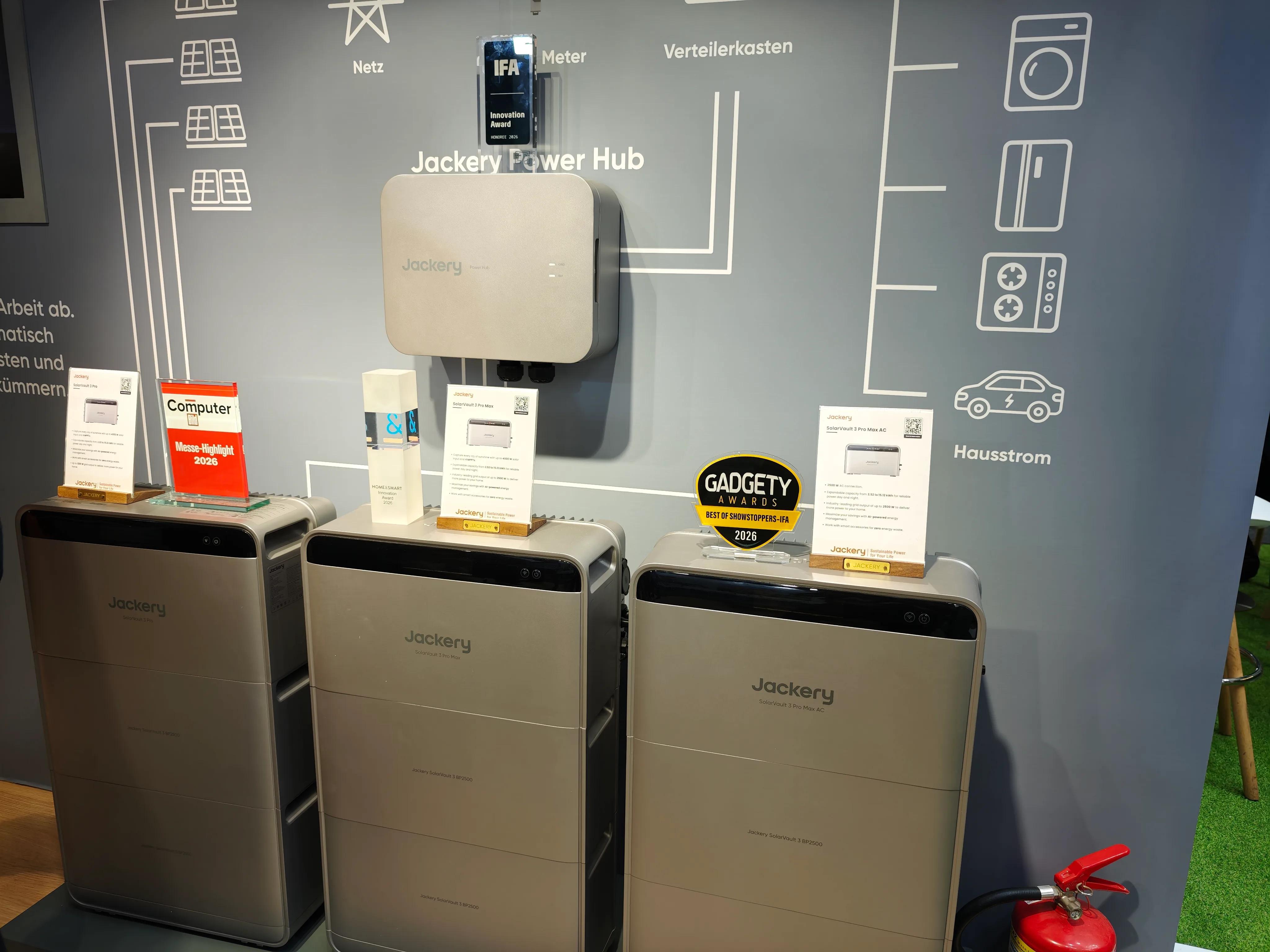


You must be logged in to post a comment.