
Households and businesses could get free or cheaper electricity from their energy company for running appliances during periods of excess supply, such as sunny weekends.
Providers already offer incentives, such as cheaper rates, for customers in Britain to shift their electricity use outside of peak times through a scheme by the National Energy System Operator (NESO).
From this week the Demand Flexibility Scheme will allow them to also encourage people to increase usage when "weather conditions result in excess supply".
The change was approved by the industry regulator Ofgem last month, and NESO said it would ensure the system is resilient over the summer, and avoid surplus power being wasted.
Electricity demand is lower in the summer months when the weather is warmer and the days longer, while solar power generation is higher.
NESO said its research indicated low demand was "increasingly driven by weather patterns", while the growth of "smaller, local electricity generators" is also reducing reliance on large power stations.
Periods of surplus electricity are becoming more common, it said.
Renewable energy produced a record amount of electricity in Great Britain last year, with wind the biggest single renewable source. Solar-powered electricity rose by nearly a third on 2024 levels.
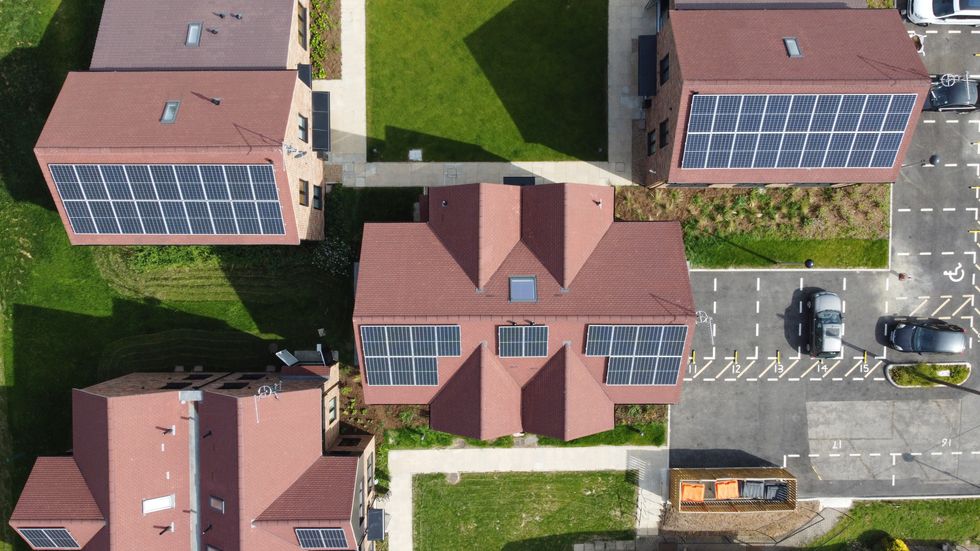
2025 was the UK's sunniest year on record, and it was also a record year for rooftop solar panels, with about 250,000 new small-scale installations reported to the Microgeneration Certification Scheme.
The updated scheme will enable customers to be rewarded for running appliances such as washing machines and dishwashers, and charging electric vehicles, when more green energy is being generated and demand is low, such as on weekends or Bank Holidays.
It is open to households with a smart meter, whose suppliers are participating.
NESO will tell energy companies what time in the day it wants the scheme to run.
It will then pay providers if they are able to ramp up or reduce demand for that period, who can decide how to pass this money onto customers.
Rewards will vary, and could include customers being offered free or cheaper electricity at certain times, or points that could be converted into gift cards.
It can vary by area – so customers in one part of the country could be encouraged to increase use, while others in a different location could be incentivised to curb consumption.
Companies that have signed up to the scheme so far include British Gas, Equiwatt and Octopus Energy, NESO said.
British Gas said it already runs a separate scheme, PeakSave, offering customers half price electricity on Sunday afternoons when usage is lower, and when there is an oversupply of renewable energy.
It said it was exploring with NESO how the Demand Flexibility Scheme would work in practice.
Octopus said it had long been offering customers discounts for periods when there is lots of green energy, which it said had saved customers millions.
It added: "The changes made to the DFS scheme mean customers can benefit from using more energy when renewables are high, reducing the amount of wind and solar that need to be turned off."
NESO said: "The complexity of operating the system at low demand is increasing, and we may need to use more of our tools, and use them more often, than in previous summers."
This may also include issuing rare notices to power stations telling them they may need to turn down output to ensure safety in periods of low demand.
On roughly a third of days in 2025, at least half of Britain's electricity came from renewables, according to BBC analysis of NESO data.
But the British electricity grid often still leans heavily on fossil fuel gas.
Gas-fired power stations help balance the electricity system by rapidly increasing output when renewable generation is intermittent.
National Gas said it expected Britain to have enough gas for the summer – primarily from the UK Continental Shelf and Norway.
Its director of energy systems and resilience, Glenn Bryn-Jacobsen, said: "While the situation in the Middle East has understandably raised questions about Britain's gas supplies, our forecasts indicate the market has the capacity to deliver sufficient supply to meet demand this summer."
If approved Green Hill Solar Farm will cover nearly 3,000 acres across two counties.
Clean Air Solar Farm is an updated version of an existing plan to build a site near Beverley.
A public inquiry into plans for a battery energy storage system near Heath will begin later.
The man behind the project Dave Green says the town needs to look at alternative energy sources.
It is part of Manx Utilities' plans to improve charging points at the airport and sea terminal.
Copyright 2026 BBC. All rights reserved. The BBC is not responsible for the content of external sites. Read about our approach to external linking.
Households could get free electricity for doing washing on sunny weekends – BBC
Uadme Auto Darkening Welding Lens – 110x90mm Solar Panel Lens, UV/IR Protection, For Welding Helmet Replacement – Grinding & Welding – RuhrkanalNEWS
Uadme Auto Darkening Welding Lens – 110x90mm Solar Panel Lens, UV/IR Protection, For Welding Helmet Replacement – Grinding & Welding RuhrkanalNEWS
source
Vertical bifacial PV outperforms tilted PV systems in the UK – pv magazine International
A year-long study in the UK finds vertical bifacial PV systems achieve an up to 26.91% higher output during morning hours compared to traditional tilted PV systems. The vertical bifacial system bettered the tilted system across all four seasons, with average power gains as high as 24.52% during winter.
Over Easy Solar’s vertical bifacial PV array in York, UK
Image: Over Easy Solar
Vertical bifacial rooftop PV systems can outperform conventional tilted monofacial rooftop PV systems across seasons in the U.K, a year-long study has found.
Research by the University of York has performed the first empirical assessment of a vertical bifacial rooftop PV system belonging to Norwegian-headquartered vertical solar specialists Over Easy Solar in a British climate. The full findings are presented in the paper “Comprehensive study of the efficiency of vertical bifacial photovoltaic systems: a UK case study,” published in the journal Scientific Reports.
The study assessed the performance of Over Easy Solar’s vertical bifacial PV system installed on the rooftop of the university’s physics tower. It encompasses 22.5% efficiency heterojunction cells and utilizes white gravel to bounce light onto the rear side of the system, something traditional panel setups are unable to utilize.
The system was monitored over a full annual cycle in 2023 and compared against a vertically-mounted monocrystalline silicon monofacial PV system and a traditional tilted monofacial PV system. Over Easy Solar’s system demonstrated a 26.91% higher output than the tilted system during the morning hours between 05:30 and 09:00 and a 22.8% higher output in the hours between 17:00 and 20:30.
Keelin Currivan, international customers solutions advisor at Over Easy Solar, explained to pv magazine how these results highlight the double peak advantage offered by vertical bifacial PV.
“While traditional tilted panels struggle with midday saturation, peaking when the grid is often full and prices are low, our vertical bifacial system shifts production to when it is needed most,” Currivan said. She added that these peaks align with residential spikes caused by demand for heating, cooking and electric vehicles, in turn reducing the need for battery storage and mitigating grid congestion.
Over Easy Solar’s vertical bifacial PV system outperformed both other test systems across the four seasons. It had a 14.77% comparative gain on the traditional tilted system in summer, increasing to 19.32% in spring, 20.27% in autumn and 24.52% in winter.
“Vertical orientation is the superior geometry for the UK and Irish climates because it is optimized for low-angle winter sun and diffused light,” Currivan explained. “Even against a vertical monofacial system, the bifacial version gains an extra 12.45% in winter, proving that capturing rear-side reflection is critical.”
On one particularly high-performance day, May 7, Over Easy Solar’s system produced 4.92 kWh, around 25.38% more energy than the tilted system across the day. The authors of the research paper, based at the University of York, add that their findings “underscore the vertical bifacial PV system’s unparalleled ability to harness solar energy efficiently, irrespective of seasonal variances.”
“Its design not only maximizes land use but also integrates seamlessly with modern architectural landscapes, adding an aesthetic value to its functional benefits,” their conclusion says. “The system’s bifacial technology, capable of capturing solar radiation from both sides, significantly boosts its energy yield, making it a potent solution for regions with variable sun exposure and reflective environments.”
Currivan added that the higher yield in high-priced months also leads to a faster payback period despite a higher initial cost. She estimated the initial costs of a vertical bifacial PV system at GBP1,200 ($1,630)/kW, compared to GBP900/kW for a traditional system. “The increased yield results in an estimated GBP1,221.13 in additional annual savings per 1,500 kWh baseline in the UK, based on GBP0.28/kWh pricing,” Currivan explained.
Over Easy Solar’s vertical bifacial system was also subject to computational fluid dynamics simulations during the testing. The system maintained negligible lift forces at wind speeds of approximately 98 kmh, which Currivan said is a critical structural advantage for high-wind coastal regions across the UK and Ireland.
Currivan told pv magazine Over Easy Solar is using the research findings to drive expansion into the UK and Irish markets. “It surprised me just how applicable these systems are to the UK and Irish markets,” she said. “In Norway and colder climates, these systems are the only viable ones because of the amount of snow, but even in this climate it’s hitting multiple key points, from seasonal gains to mitigating grid issues to giving the double peak.”
Earlier this month, Over Easy Solar installed its first rooftop vertical solar installation in the U.S. market. A previous case study analysis from the company found vertical rooftop panels are capable of outperforming conventional rooftop systems during snowy months.
This content is protected by copyright and may not be reused. If you want to cooperate with us and would like to reuse some of our content, please contact: editors@pv-magazine.com.
More articles from Patrick Jowett
Please be mindful of our community standards.
Your email address will not be published.
By submitting this form you agree to pv magazine using your data for the purposes of publishing your comment.
Your personal data will only be disclosed or otherwise transmitted to third parties for the purposes of spam filtering or if this is necessary for technical maintenance of the website. Any other transfer to third parties will not take place unless this is justified on the basis of applicable data protection regulations or if pv magazine is legally obliged to do so.
You may revoke this consent at any time with effect for the future, in which case your personal data will be deleted immediately. Otherwise, your data will be deleted if pv magazine has processed your request or the purpose of data storage is fulfilled.
Further information on data privacy can be found in our Data Protection Policy.
Legal Notice Terms and Conditions Data Privacy © pv magazine 2026
This website uses cookies to anonymously count visitor numbers. View our privacy policy.
The cookie settings on this website are set to “allow cookies” to give you the best browsing experience possible. If you continue to use this website without changing your cookie settings or you click “Accept” below then you are consenting to this.
Close
Planning Inspectorate completes solar farm review – Yahoo News Australia
An examination by the Planning Inspectorate into a proposal for what could become England's largest solar farm has finished.
The proposed Green Hill Solar Farm, would cover about 2,965 acres (1,200 hectares) of land south and west of Wellingborough and north of Northampton.
It would also extend to include land to the north east of Warrington in Buckinghamshire.
The Planning Inspectorate has until 10 July to put forward a recommendation to Ed Miliband, the secretary of state for energy security and net zero.
The size of the project means that recommendations for the scheme would be made by the Planning Inspectorate, rather than local planning authorities.
A final decision is expected from Miliband later this year.
The examination stage took more than five months to complete, opening in October and closing in April.
More than 1,200 people and businesses sent comments to the Planning Inspectorate about the plans
Campaigners opposing the proposal argued that solar panels up to 4.5m high could "devastate the Northamptonshire countryside".
Green Hill Solar said the farm would "benefit Britain with clean, secure, low-cost energy".
If the solar farm was approved, construction would begin in 2027 with the aim of providing electricity to homes by 2029, the company said on its website.
Do you have a story suggestion for Northamptonshire? Contact us below.
Follow Northamptonshire news on BBC Sounds, Facebook, Instagram and X.
Petition challenges England's biggest solar farm plan
More than 1,000 people have say on huge solar farm
'Extremely serious' concerns raised over solar farm
Planning Inspectorate
Green Hill Solar Farm
White sent the game to OT with a 3 as Kon Knueppel watched from the bench. Then LaMelo Ball redeemed himself with a game-winning layup in the final seconds.
The Wizards finished with a league-worst 17-65 record, good for last in the Eastern Conference.
Ball wasn't called for a foul, and Erik Spoelstra's pleas for a replay review for a potential flagrant foul went unheeded.
Stock futures traded flat as banks report profit increases with the Iran war weighing on market optimism.
Johnny Cardoso might not go to the World Cup this summer, but the U.S. midfielder is still very much in the running for the UEFA Champions League title.
In the night's main event, the unbeaten duo of Ambar Mendoza and Abigail Gonzalez Ibarra clash in a six-round featherweight bout.
In our final installment of the teams that will ‘Shape The Draft’ series Justin Boone joins Matt Harmon to look at the teams that have 10-plus picks in this year’s draft. What will the Ravens, Raiders, Steelers and Jaguars do with all those picks? The two also look at the teams that don’t have any first round picks in the Falcons, Colts, Broncos and Packers and how they can maximize their draft even if they are sitting out day one.
Our first power rankings of the season highlight the standout performers for each club through the first 5 series of 2026.
The top six storylines coming out of spring ball. Alabama's QB battle continues, Michigan and Florida's new head coach impact, a Cal athletics shakeup and more.
Nate Tice & Matt Harmon break down their top wide receiver prospects in the 2026 NFL Draft.
Brookfield Plans ₹3,000 Crore Exit from 550 MW Bikaner Solar Project – SolarQuarter
Quincy new solar farm – KHQA
Variable clouds with scattered thunderstorms. A few storms may be severe. High 78F. Winds SSW at 10 to 20 mph. Chance of rain 50%..
Scattered thunderstorms during the evening, then partly cloudy overnight. A few storms may be severe. Low 59F. Winds SW at 10 to 15 mph. Chance of rain 50%.
Updated: April 15, 2026 @ 12:43 am
A new solar farm is set to be constructed on Quincy’s northside after the Quincy City Counci…
Currently in Quincy
Your browser is out of date and potentially vulnerable to security risks.
We recommend switching to one of the following browsers:
Maryland passes bill to make it easier and less expensive for families to go solar – Environment America
Maryland passes bill to make it easier and less expensive for families to go solar Environment America
source
Photovoltaic reshuffle, these enterprises have made 33.3 billion!|Manufacturing – Solarbe Global
Photovoltaic reshuffle, these enterprises have made 33.3 billion!|Manufacturing Solarbe Global
source
Japan wants to put a solar ring around the Moon to power Earth – geekspin

You are here:
A Japanese company is proposing building a massive ring of solar panels around the Moon and using it to power Earth. Like literally turning the Moon into a power station.
It sounds like something pulled from a sci-fi pitch deck. But it’s being framed as a serious long-term solution to the question of powering the planet without fossil fuels. Let’s unpack the idea.
The concept is built around one key advantage: the Moon doesn’t have weather. There are no clouds blocking sunlight. There are no storms and no night cycle in the same way we experience on Earth.
So, instead of building solar farms that depend on conditions here, Shimizu Corporation wants to place them where sunlight is far more consistent.
The plan is to stretch solar panels across the Moon’s 11,000 km equator, forming a continuous energy-generating ring.
But collecting power on the Moon is only half the story. The real trick lies in sending it back to earth. The proposal involves converting solar energy into microwave or laser signals on the Moon, then transmitting those beams to receiving stations on Earth, known as rectennas.
Those stations would convert the signal back into electricity and feed it into the grid.
The concept traces back to Japan’s push for safer energy after the Fukushima disaster.
Instead of relying on traditional power sources, the efforts shifted toward solutions that are cleaner, more stable, and less vulnerable to environmental risks.
The real “secret sauce” is the transmission. Shimizu Corporation doesn’t plan on running a very long extension cord, but they want to beam the power down using microwaves and lasers.
It sounds like a Bond villain’s weapon, but here, the target is a “rectenna”—a receiving station on Earth that turns those beams back into the juice that charges your iPhone.
This isn’t something to be assembled on Earth and launched all at once. The plan leans heavily on in-space manufacturing.
Lunar materials like sand would be processed into construction components. Robots would handle most of the assembly, operating remotely from Earth.
At the end of all the work lies a massive payoff. At full scale, the system could generate up to 13,000 terawatts of power continuously. That’s more than enough to cover global electricity demand.
However, the cost is staggering, from the logistics to the risks like damage from space debris or maintaining precise energy transmission. Reliability also has to hold under real-world conditions.
As Shimizu Corporation put it, it is a long-term vision that depends on future breakthroughs.
Source: The Jerusalem Post
Copyright @2026 CIRBS LLC
Public collection title
Private collection title
Here you'll find all collections you've created before.
Hochul can achieve NY’s green-energy dreams — just follow India’s lead – New York Post
Switch between CA and NY editions here.
Last month, when my work took me to India, I learned a surprising lesson: On green energy, the “developing world” is light-years ahead of New York.
And the current crisis at the Strait of Hormuz, where a fossil-fuel chokepoint has sent New Yorkers’ costs soaring, puts the Empire State’s energy airball in sharp focus.
Gov. Kathy Hochul has tacitly acknowledged Albany’s failure to grapple with the practical realities of its insistence on the need to wholly transition the state’s economy from fossil fuels to renewables.
Now she’s trying a new strategy: Memory-holing New York’s flagship 2019 Climate Leadership and Community Protection Act.
Ironically, in the years since that bill passed, the state’s dependence on fossil fuels has only increased, so badly have our leaders flubbed the green-energy side of the equation.
Hence her election-year CLCPA U-turn, despite the continued need for new energy sources.
Halfway around the world, the country best known to many New Yorkers as the origin of street-food memes is leading the way on high-tech renewables.
Meanwhile, the state that engineered the subway system, the Empire State Building and the Erie Canal has struggled to stand up a fraction of India’s windmills and solar panels.
Strategically, India has adopted a Trump-like “all of the above” approach to energy — while New York policymakers have preferred gas bans, wild pronouncements, red tape and general incompetence.
Tactically, India sees its private-sector energy producers as partners, not as piggy banks or as evil corporations that can be punished into generating electricity for the rest of us.
The net result is that India last year crossed a line: More than 50% of its electricity capacity comes from renewables — five years ahead of its 2030 deadline to hit that mark.
(Actual power generation is still 70% from fossil fuels, but the progress is still remarkable.)
For its part, New York adopted a ridiculous central-planning path toward unrealistic 2030 climate goals, which it’s now kicking to 20-maybe-never as it scrubs references to the CLCPA from its websites.
At Khavda, for example, a massive salt flat along India’s western frontier, Adani Green Energy installed the first 9 gigawatts of electric power just five years after its hybrid wind-solar project won government approval.
When completed in 2029, the site will be the largest renewable park in the world, generating a total of 30 gigawatts, enough to power every single home in New York State at peak summer load.
Adani uses a combination of solar panels, wind turbines and battery storage systems to continuously feed the grid.
Subscribe to our daily Post Opinion newsletter!
Please provide a valid email.
By clicking above you agree to the Terms of Use and Privacy Policy.
Never miss a story.
Sure, the sun is a little stronger at Khavda’s latitude, but the wind is no windier, nor are its batteries made from some unknown Martian metal.
The fundamental difference is that the Indian government figured out unleashing the private sector — not regulating it to death — helps both achieve their shared goals.
Prime Minster Narendra Modi laid out a map; Adani and its competitors built the roads.
Here, Albany laid out a path full of potholes, bumps and U-turns, ensuring almost nothing happened.
It’s a pattern that holds true nationwide: Blue states like ours “lead” on climate mandates and press releases, while red states with less regulation actually execute and develop green-energy projects.
Compare New York with Texas, which is the nation’s No. 1 wind-energy producer and No. 2 in solar.
The Lone Star State focused on expanding its network of high-voltage transmission lines to allow more private landowners to connect to the grid, then gave them an expedited permitting process for turbines and solar panels.
New York, meanwhile, is nearing 20 years on its side-quest to build the Champlain-Hudson power line, drowning it in permitting problems.
That makes New York more vulnerable to the current global energy squeeze than Texas is.
Even before the federal government nixed licenses for new offshore wind projects, New York’s regulatory burdens had all but sunk their prospects.
The state tethered developers to using special turbines that had never before been built, required them to be made in imaginary factories in politically important constituencies, and deemed them to be launched from nonexistent port facilities.
All of which required hundreds of millions of dollars’ worth of subsidies to offset the unnecessary costs.
When it came to solar, scandals like Buffalo Billion got in the way — and when corruption wasn’t in play, incompetence has reigned.
The state is now using special permitting laws to fast-track the Fort Edward Solar Project, destroying 600 acres of a protected wildlife area and angering the very environmentalists who generally cheer green energy on.
The truth is, green energy deserves to play a role in New York’s future, part of the mix of energy sources powering our state.
Renewables are not the problem: Regulations are.
The sooner New York’s leaders realize that, the sooner they can start seeing their own press releases come to fruition.
In the meantime, if they want to see what a forward-thinking energy policy really looks like, India points the way.
Joe Borelli is a managing director at Chartwell Strategy Group and former minority leader of the New York City Council.
Community-scale solar offers $6.5 billion in savings, bypassing California gridlocks – pv magazine USA
Localized distribution-level projects can cut out-of-state energy imports by 13% while providing a faster alternative to delayed transmission-scale infrastructure, said a report by Pathfinder Communications.
Image: Andreas Gücklhorn, Unsplash
California’s energy transition is currently held back by transmission constraints, but a growing body of data suggests the solution lies in the distribution grid level.
While over 98% of active projects in the state’s interconnection queue face significant delays, the “middle mile” of community-scale solar and storage offers a faster path to decarbonization. A report by Pathfinder Communications, Community Choice Aggregation (CCA) and the Middle Mile, highlights how these localized projects bypass the five-to-ten-year timelines typical of transmission-scale infrastructure.
According to the study, 5.4 GW of community solar and storage to the distribution grid requires a $3.2 billion investment, but it yields $4.2 billion in electricity price reductions. By leveraging existing local networks, community-scale projects eliminate the need for $2 billion in transmission and distribution upgrades.
The most significant fiscal impact for Community Choice Aggregators (CCA) is the projected $4.6 billion reduction in Resource Adequacy requirements, which are the costs paid to ensure backup power is available during times of peak electricity demand.
At present, 25 CCAs, an alternative to investor-owned utilities, serve one-third of California’s electricity consumers, providing the necessary scale to stabilize these “middle mile” markets. Beyond direct savings, the deployment of 5.4 GW of local capacity is expected to cut out-of-state electricity imports by 13% and reduce reliance on the state’s vulnerable transmission system by 2%. It also curbs greenhouse gas emissions by 1.8% by reducing the need for natural gas generation to firm up the system during peak hours.
Operational success in this sector depends on vertical integration to remove the 20% to 30% cost premium associated with intermediary handoffs in project development. Firms like Renewable America are now augmenting these front-of-the-meter projects with behind-the-meter battery programs for commercial and industrial customers. Such programs offer 20% bill savings to hosts with no upfront capital while functioning as load-modifying resources for the local CCA.
As community solar added 464 MW of capacity nationally in the final quarter of 2025, the data indicates that localized, distribution-level assets are emerging as a viable hedge against a gridlocked wholesale market.
For CCAs in California, community solar offers an alternative to waiting for a massive grid overhaul that may take a decade. By investing in localized, community-scale solar and storage now to save billions, cut emissions, and bypass the interconnection queue.
This content is protected by copyright and may not be reused. If you want to cooperate with us and would like to reuse some of our content, please contact: editors@pv-magazine.com.
More articles from Ryan Kennedy
Please be mindful of our community standards.
Your email address will not be published.
By submitting this form you agree to pv magazine using your data for the purposes of publishing your comment.
Your personal data will only be disclosed or otherwise transmitted to third parties for the purposes of spam filtering or if this is necessary for technical maintenance of the website. Any other transfer to third parties will not take place unless this is justified on the basis of applicable data protection regulations or if pv magazine is legally obliged to do so.
You may revoke this consent at any time with effect for the future, in which case your personal data will be deleted immediately. Otherwise, your data will be deleted if pv magazine has processed your request or the purpose of data storage is fulfilled.
Further information on data privacy can be found in our Data Protection Policy.
pv magazine USA offers daily updates of the latest photovoltaics news. We also offer comprehensive global coverage of the most important solar markets worldwide. Select one or more editions for targeted, up to date information delivered straight to your inbox.
Legal Notice Terms and Conditions Privacy Policy © pv magazine 2026
Welcome to pv magazine USA. This site uses cookies. Read our policy.
The cookie settings on this website are set to “allow cookies” to give you the best browsing experience possible. If you continue to use this website without changing your cookie settings or you click “Accept” below then you are consenting to this.
Close
Blackout fears as Ed Miliband's solar power push threatens to overwhelm electricity grid – GB News
By Temie Laleye,
Published: 14/04/2026
Updated: 14/04/2026
The grid operator is preparing to pay households and factories to use surplus electricity
Blackout fears are growing as Britain’s electricity grid comes under pressure from a surge in solar power.
Energy officials warn the system is becoming harder to manage as Ed Miliband accelerates plans to expand renewables.
The National Energy System Operator (Neso) said it will need to use "more tools, more often" to keep the system stable when sunny weather causes spikes in power generation.
For the first time, this could include paying households and factories to use excess electricity, while large power stations may also be asked to switch off.
The warning came as Chancellor Rachel Reeves travelled to Washington for an International Monetary Fund summit, where she is expected to urge global leaders to adopt her approach to tackling the energy crisis caused by tensions in the Middle East and push for "collective action" towards net zero.
Despite the concerns, Neso said in its summer outlook published on Tuesday that there are no immediate risks to electricity supply this summer. However, it warned the war in Iran is likely to push prices higher due to Britain's reliance on gas.
It also highlighted growing challenges in managing the grid during periods of low demand and high solar output, as more wind and solar capacity is added.
The challenges come as Mr Miliband pushes ahead with plans to triple solar capacity by 2030.
Planning rules have already been relaxed to speed up development, with approval recently granted for the UK’s largest solar project in Lincolnshire.
Grid instability can occur when renewable energy generation is high but demand is low, creating an imbalance that can lead to disruption if not carefully managed.
The problem is made worse because many onshore solar and wind sites are not directly connected to the main transmission network, meaning Neso cannot easily control their output.

Energy Secretary Ed Miliband continues to expand wind and solar capacity to meet net zero targets
|
GETTYSolar capacity on the grid has more than doubled over the past decade, reaching 22 gigawatts as homes and businesses installed rooftop panels to reduce energy bills.
Neso estimates a 75 per cent probability that national demand will fall to a new record low during the late May bank holiday, potentially dropping to 11 gigawatts. Meanwhile, wind and solar could simultaneously generate 18 to 19 gigawatts.
One expert noted the situation echoed last year's Iberian Peninsula blackouts, when solar farms triggered a chain reaction that cut power across Spain.
Adam Bell, a consultant at Stonehaven and former Whitehall energy department official, said Neso faced the challenge of "making sure the grid remains stable".
Solar capacity on the grid has more than doubled over the past decade
|
GETTY"They don't have the ability to turn this solar generation off, so instead they want to turn consumption up and that could actually be good for households and heavy industry – it is free power," he said.
However, independent energy consultant Kathryn Porter raised concerns about Labour's green energy strategy.
"Once again, we're seeing Neso putting behaviour change by consumers front and centre, and saying that having consumers change their behaviour to help balance the system instead of expecting the system to serve them," she said.
"But also, why the hell do we keep building more solar if we're already at a position where we're generating more electricity than we need? That is only going to make this problem worse."
A Government spokesman defended the outlook, stating that independent system operators had confirmed electricity and gas supplies would "comfortably meet demand this summer" thanks to Britain's "diverse and resilient energy system".

Energy Secretary Ed Miliband continues to push ahead with ambitious expansion plans,
|
GETTY"As the current conflict in the Middle East shows, the best way to increase Britain's energy security long-term is by accelerating to clean homegrown power that we control, including renewables and nuclear," the spokesman added.
Under Labour's clean power plans, Mr Miliband is seeking to triple solar capacity across Britain by 2030. Mr Miliband loosened planning rules so more solar farms are built and approved the country’s biggest project so far in Lincolnshire last week.
Kayte O’Neill, Neso’s operating chief, said: "The complexity of operating the system at low demand is increasing, and we may need to use more of our tools and use them more often than in previous summers.
"Our analysis shows that low demand is increasingly driven by weather patterns – most notably solar photovoltaic generation – rather than underlying consumer behaviour."
Our Standards: The GB News Editorial Charter
The National Energy System Operator (Neso) said it will need to use "more tools, more often" to keep the system stable when sunny weather causes spikes in power generation.
For the first time, this could include paying households and factories to use excess electricity, while large power stations may also be asked to switch off.
The warning came as Chancellor Rachel Reeves travelled to Washington for an International Monetary Fund summit, where she is expected to urge global leaders to adopt her approach to tackling the energy crisis caused by tensions in the Middle East and push for "collective action" towards net zero.
Despite the concerns, Neso said in its summer outlook published on Tuesday that there are no immediate risks to electricity supply this summer. However, it warned the war in Iran is likely to push prices higher due to Britain's reliance on gas.
It also highlighted growing challenges in managing the grid during periods of low demand and high solar output, as more wind and solar capacity is added.
The challenges come as Mr Miliband pushes ahead with plans to triple solar capacity by 2030.
Planning rules have already been relaxed to speed up development, with approval recently granted for the UK’s largest solar project in Lincolnshire.
Grid instability can occur when renewable energy generation is high but demand is low, creating an imbalance that can lead to disruption if not carefully managed.
The problem is made worse because many onshore solar and wind sites are not directly connected to the main transmission network, meaning Neso cannot easily control their output.
Energy Secretary Ed Miliband continues to expand wind and solar capacity to meet net zero targets
Solar capacity on the grid has more than doubled over the past decade, reaching 22 gigawatts as homes and businesses installed rooftop panels to reduce energy bills.
Neso estimates a 75 per cent probability that national demand will fall to a new record low during the late May bank holiday, potentially dropping to 11 gigawatts. Meanwhile, wind and solar could simultaneously generate 18 to 19 gigawatts.
One expert noted the situation echoed last year's Iberian Peninsula blackouts, when solar farms triggered a chain reaction that cut power across Spain.
Adam Bell, a consultant at Stonehaven and former Whitehall energy department official, said Neso faced the challenge of "making sure the grid remains stable".
Solar capacity on the grid has more than doubled over the past decade
"They don't have the ability to turn this solar generation off, so instead they want to turn consumption up and that could actually be good for households and heavy industry – it is free power," he said.
However, independent energy consultant Kathryn Porter raised concerns about Labour's green energy strategy.
"Once again, we're seeing Neso putting behaviour change by consumers front and centre, and saying that having consumers change their behaviour to help balance the system instead of expecting the system to serve them," she said.
"But also, why the hell do we keep building more solar if we're already at a position where we're generating more electricity than we need? That is only going to make this problem worse."
A Government spokesman defended the outlook, stating that independent system operators had confirmed electricity and gas supplies would "comfortably meet demand this summer" thanks to Britain's "diverse and resilient energy system".
Energy Secretary Ed Miliband continues to push ahead with ambitious expansion plans,
"As the current conflict in the Middle East shows, the best way to increase Britain's energy security long-term is by accelerating to clean homegrown power that we control, including renewables and nuclear," the spokesman added.
Under Labour's clean power plans, Mr Miliband is seeking to triple solar capacity across Britain by 2030. Mr Miliband loosened planning rules so more solar farms are built and approved the country’s biggest project so far in Lincolnshire last week.
Kayte O’Neill, Neso’s operating chief, said: "The complexity of operating the system at low demand is increasing, and we may need to use more of our tools and use them more often than in previous summers.
"Our analysis shows that low demand is increasingly driven by weather patterns – most notably solar photovoltaic generation – rather than underlying consumer behaviour."
Our Standards: The GB News Editorial Charter
Gujarat emerges as India’s solar cell manufacturing powerhouse – ETEnergyworld.com
Renewable
By commenting, you agree to the Prohibited Content Policy
By commenting, you agree to the Prohibited Content Policy
News 
See whats happening in Energy sector right now
Exclusive
Read and get insights from specially curated unique stories from editorial
Leaders Speak
Business leaders sharing their insights
Events
Explore and discuss challenges & trends in India’s leading B2B events
Awards
Recognise work that not only stood out but was also purposeful
Webinars
Join leaders & experts for roundtables, conferences, panels and discussions
Subscribe to our Daily Newsletter
By continuing you agree to our Privacy Policy & Terms & Conditions
Advertise With Us
We have various options to advertise with us including Events, Advertorials, Banners, Mailers, etc.
Download ETEnergyworld App
Save your favourite articles with seamless reading experience
Get updates on your preferred social platform
Follow us for the latest news, insider access to events and more.
About Us
Contact Us
Newsletters
Planning Inspectorate completes Green Hill Solar Farm review – BBC
Green Hill Solar Farm would spread across two different counties if approved
An examination by the Planning Inspectorate into a proposal for what could become England's largest solar farm has finished.
The proposed Green Hill Solar Farm, external, would cover about 2,965 acres (1,200 hectares) of land south and west of Wellingborough and north of Northampton.
It would also extend to include land to the north east of Warrington in Buckinghamshire.
The Planning Inspectorate has until 10 July to put forward a recommendation to Ed Miliband, the secretary of state for energy security and net zero.
The size of the project means that recommendations for the scheme would be made by the Planning Inspectorate, rather than local planning authorities.
A final decision is expected from Miliband later this year.
The examination stage took more than five months to complete, opening in October and closing in April.
More than 1,200 people and businesses sent comments to the Planning Inspectorate about the plans
Campaigners opposing the proposal argued that solar panels up to 4.5m high could "devastate the Northamptonshire countryside".
Green Hill Solar said the farm would "benefit Britain with clean, secure, low-cost energy".
If the solar farm was approved, construction would begin in 2027 with the aim of providing electricity to homes by 2029, the company said on its website.
Do you have a story suggestion for Northamptonshire? Contact us below.
Your Voice
Follow Northamptonshire news on BBC Sounds, Facebook, external, Instagram, external and X, external.
Petition challenges England's biggest solar farm plan
More than 1,000 people have say on huge solar farm
'Extremely serious' concerns raised over solar farm
Planning Inspectorate
Green Hill Solar Farm
Huge £75.8m pot of unspent developer contributions held by NNC
Northamptonshire's worst 999 nuisance caller ‘lost the plot’
£260k fund to boost charities and volunteers across West Northamptonshire
Northampton MP to meet Health Secretary for crisis talks over St Andrew’s Healthcare affecting hundreds of patients and jobs
Trump hints talks could resume this week as Vance says US wants 'grand bargain' with Iran
'Bit of pain' worth long-term security from Iran, Bessent tells BBC
Help to Buy mostly helped high earners, IFS says
Nazi search engine shows if ancestors were in Hitler's party
Butterfly numbers are dropping but here are five species you may see more of
Don't feel like exercising? Maybe it's the wrong time of day for you
'UK economy takes triple hit' and 'Cheers, Timmy!'
Stormzy's stab vest goes on display in landmark exhibition of Black British music
I was minutes from dying – then I heard the lifeboat crewman's voice
Why one school has banned phones for some pupils – but not others
UFOs and a Tardis – why unusual holiday stays are booming
Off Air with Laura K: Get Laura Kuenssberg’s weekly newsletter emailed directly to you
A fiery journey into Wales' hidden culinary world
A crime thriller full of dark family twists
Chocolate: Why the ‘dark side’ might be better for your health
How Skepta’s mum raised one of the UK’s greatest rappers
Driver jailed over death of mum hit by crane while pushing pram
'UK economy takes triple hit' and 'Cheers, Timmy!'
Help to Buy mostly helped high earners, IFS says
'Bit of pain' worth long-term security from Iran, Bessent tells BBC
'I'm not being listened to' – new health plan launched as women say they are still ignored
250 missing after migrant boat sinks in Indian Ocean
Butterfly numbers are dropping but here are five species you may see more of
Harry says children should be an 'upgrade' of their parents
'I was kicked out of bar because of my wheelchair'
King will not meet Epstein survivors on US visit
Copyright © 2026 BBC. The BBC is not responsible for the content of external sites. Read about our approach to external linking.
Solar-powered appliances on display in Riverside Park – CBS News
Watch CBS News
©2026 CBS Broadcasting Inc. All Rights Reserved.
Europe Polycrystalline Silicon Market Size, Share, 2034 – Market Data Forecast
✖
Europe Polycrystalline Silicon Market Size, Share, Trends & Growth Forecast Report By Purity, By Form, By End-Use, and By Country (Germany, Norway, France, Italy, Spain & Rest of Europe) – Industry Analysis and Forecast, 2026 to 2034
The Europe polycrystalline silicon market was valued at USD 11,338.41 million in 2025, is estimated to reach USD 12,528.94 million in 2026, and is projected to reach USD 27,849.18 million by 2034, growing at a CAGR of 10.5% from 2026 to 2034.
The polycrystalline silicon, also known as polysilicon, is a high-purity form of silicon characterized by multiple small crystals within its structure. As per the European Commission, the REPowerEU plan aims to accelerate the deployment of renewable energy sources to reduce reliance on imported fossil fuels. According to the International Energy Agency, China accounts for over 80% of the world’s polysilicon production, creating supply chain vulnerabilities for European manufacturers. Recent geopolitical tensions and trade disruptions have highlighted the risks of this dependency, prompting European stakeholders to explore local production capabilities. The manufacturing process of polysilicon involves the purification of metallurgical-grade silicon through methods such as the Siemens process or fluidized bed reactor technology. These processes are energy-intensive, requiring substantial electricity inputs, which influences the location of production facilities. The European Union’s focus on sustainable industrial practices necessitates that new polysilicon projects utilize low-carbon energy sources. This shift aligns with the broader objectives of the European Green Deal, which seeks to achieve climate neutrality by 2050.
The ambitious renewable energy targets set by the European Union are propelling the growth of Europe’s polycrystalline silicon market. The REPowerEU initiative explicitly aims to install 600 gigawatts of solar photovoltaic capacity by 2030 to enhance energy security and decarbonize the power sector. According to SolarPower Europe, the continent added 56 gigawatts of new solar capacity in 2023, marking a significant increase from previous years. This rapid expansion directly translates into heightened demand for solar modules and, consequently, the polysilicon required to manufacture them. National governments across Europe are implementing supportive policies such as feed-in tariffs and tax incentives to encourage both utility-scale and residential solar installations. As per the European Photovoltaic Industry Association, the cumulative installed solar capacity in the EU is expected to double within the next five years. The shift away from nuclear and fossil fuel-based generation in several member states further amplifies the role of solar energy in the national grid mix. Germany, France, and Spain are leading this charge with substantial investments in solar infrastructure. The regulatory certainty provided by long-term energy plans encourages investors to commit capital to solar projects. Consequently, manufacturers of solar cells are securing long-term contracts for polysilicon to ensure uninterrupted production. The alignment of national energy strategies with EU climate goals creates a robust and sustained demand environment for polysilicon.
The burgeoning semiconductor industry for high-purity polycrystalline silicon used in electronic-grade applications is additionally accelerating the growth of Europe polycrystalline silicon market. While the majority of polysilicon is consumed by the solar sector, the electronic grade variant is essential for producing wafers used in integrated circuits and microchips. According to the European Commission, the European Chips Act aims to mobilize over 43 billion euros in public and private investments to boost semiconductor production capacity in the region. This initiative seeks to increase the EU’s global share of semiconductor production to 20% by 2030, reducing dependence on Asian suppliers. The establishment of new fabrication plants or fabs in countries such as Germany and France requires a consistent supply of ultra-high purity polysilicon. As per the Semiconductor Industry Association, the global demand for chips continues to grow, driven by advancements in artificial intelligence, automotive electronics, and Internet of Things devices. Europe’s strong automotive sector, particularly the transition to electric vehicles, increases the need for sophisticated semiconductor components. Each electric vehicle contains significantly more chips than conventional cars, driving up the demand for electronic-grade materials. Manufacturers are investing in advanced purification technologies to meet the stringent quality requirements of the semiconductor industry. The localization of chip production enhances supply chain resilience and creates a stable market for specialty polysilicon producers.
The high cost of energy required for production, which undermines the competitiveness of local manufacturers, is limiting the growth of Europe polycrystalline silicon market. The purification of silicon into polysilicon is an extremely energy-intensive process, typically requiring temperatures exceeding 1000 degrees Celsius. According to Eurostat, industrial electricity prices in the European Union increased by approximately 50% in 2022 due to geopolitical conflicts and supply constraints. This surge in energy costs makes it economically challenging for European producers to compete with counterparts in regions with cheaper energy sources, such as China and the Middle East. The reliance on natural gas and electricity for the Siemens process exposes manufacturers to volatile market conditions. As per the International Renewable Energy Agency, the cost of producing polysilicon in Europe can be up to 30% higher than in Asia, primarily due to energy expenses. This cost disparity discourages new investments in local production facilities and leads to continued reliance on imports. Although some companies are exploring the use of renewable energy to power their plants, the initial capital expenditure for such transitions is substantial. The lack of affordable and stable energy supplies remains a critical barrier to establishing a self-sufficient polysilicon industry in Europe. Government subsidies and energy price caps have provided temporary relief, but long-term solutions are needed.
The strict environmental regulations governing industrial emissions and waste management are significantly declining the growth of the polycrystalline silicon market. The production process generates hazardous byproducts, including silicon tetrachloride, which requires careful handling and disposal to prevent environmental contamination. According to the European Environment Agency, industrial facilities must adhere to the Industrial Emissions Directive, which sets rigorous limits on pollutant releases. Compliance with these regulations necessitates substantial investments in advanced filtration and recycling systems, ms increasing operational costs. As per the European Chemicals Agency, the registration and evaluation of chemical substances under the REACH regulation adds further administrative and financial burdens to producers. Companies must demonstrate that their manufacturing processes meet high sustainability standards, rds which can delay project approvals and increase time to market. The European Green Deal’s emphasis on circular economy principles requires manufacturers to minimize waste and maximize resource efficiency. This entails developing closed-loop systems for recycling process materials, which involves complex engineering solutions. Smaller players may find it difficult to meet these stringent requirements,s leading to market consolidation. The regulatory landscape is constantly evolving with tighter standards being introduced regularly. This uncertainty creates challenges for long-term planning and investment decisions. While these regulations aim to protect the environment, they also act as a barrier to entry for new competitors.
The development of integrated solar manufacturing hubs that localize the entire supply chain is setting up new opportunities for the growth of Europe’s polycrystalline silicon market. The European Union is actively promoting the reshoring of solar panel production to reduce dependency on imports and enhance strategic autonomy. According to the European Solar Manufacturing Council, the establishment of local polysilicon production facilities is a key component of this strategy. Several projects are underway in countries such as Norway and France, where abundant hydroelectric and nuclear power provide low-carbon energy sources. As per the study, Norway is leveraging its cheap renewable electricity to attract polysilicon producers. This approach not only reduces the carbon footprint of the final product but also aligns with the EU’s carbon border adjustment mechanism. Integrated hubs allow for closer collaboration between polysilicon producers, wafer manufacturers, and module assemblers,s improving efficiency and reducing logistics costs. The availability of skilled labor and advanced research institutions in Europe supports innovation in production techniques. Governments are offering grants and tax incentives to support the construction of these facilities. The creation of a domestic supply chain enhances resilience against global disruptions and trade barriers. This opportunity enables European companies to capture high-value-added activities within the solar industry. The focus on sustainability and local production appeals to environmentally conscious consumers and corporate buyers.
The emergence of advanced recycling technologies for silicon waste Europe polycrystalline silicon market. As the volume of end-of-life solar panels increases there is a growing need for efficient methods to recover valuable materials including polysilicon. According to the International Renewable Energy Agency, the amount of solar panel waste is expected to reach millions of tons by 2030, creating a significant secondary source of raw materials. Innovative recycling processes are being developed to purify and reuse silicon from discarded modules, es reducing the need for virgin polysilicon production. As per the European Commission, the Waste Electrical and Electronic Equipment Directive mandates the collection and recycling of solar panels, encouraging the development of circular economy solutions. Companies are investing in research to improve the yield and quality of recycled silicon, making it suitable for reuse in new solar cells. This approach not only conserves natural resources but also reduces the environmental impact of mining and processing raw silicon. The integration of recycling facilities with existing manufacturing plants can create a closed-loop system that enhances sustainability credentials. Regulatory support for circular economy initiatives provides a favorable environment for these technologies to flourish. The potential to recover high-purity silicon from waste streams offers a cost-effective alternative to traditional production methods.
The disruption of global supply chains due to geopolitical tensions and trade disputes poses a major challenge for the growth of Europe’s polycrystalline silicon market. The region’s heavy reliance on imports from China makes it vulnerable to policy changes and export restrictions imposed by the Chinese government. According to the European External Action Service, trade tensions between the EU and China have led to investigations into subsidized solar panel imports, which could result in retaliatory measures. Such actions can lead to sudden shortages and price volatility for polysilicon,n affecting the stability of the European solar industry. As per the World Trade Organization, recent trade barriers have disrupted the flow of critical raw materials, impacting downstream manufacturers. The lack of diversification in supply sources exacerbates this risk, leaving European buyers with limited alternatives. Geopolitical instability in other regions can also affect the availability of raw materials such as quartz, te which is essential for silicon production. The complexity of international logistics further complicates the situation with shipping delays and increased freight costs. Companies must navigate an uncertain trade environment, which requires flexible sourcing strategies and robust risk management frameworks. The threat of supply chain fragmentation poses a significant challenge to the long-term planning of solar projects.
The technical complexities associated with scaling up local polysilicon production are also impeding the growth of Europe’s polycrystalline silicon market. Establishing new manufacturing facilities requires specialized expertise and advanced technology, which are currently concentrated in a few global players. According to the Fraunhofer Institute for Solar Energy Systems, the learning curve for polysilicon production is steep, requiring significant time and investment to achieve optimal efficiency and quality. European companies face difficulties in acquiring the necessary know-how and proprietary technologies due to intellectual property restrictions and competition. As per the European Patent Office, the number of patents related to polysilicon production is dominated by Asian firms, limiting access to innovative processes for European entities. The shortage of skilled engineers and technicians with experience in silicon purification further hinders progress. Training a workforce capable of operating complex chemical reactors takes years and requires substantial educational investments. The integration of new facilities into the existing industrial landscape involves navigating complex regulatory and permitting processes. Technical failures during the ramp-up phase can lead to costly delays and reduced output. The high capital intensity of polysilicon plants means that any technical setbacks can have severe financial implications.
REPORT METRIC
DETAILS
Market Size Available
2025 to 2034
Base Year
2025
Forecast Period
2026 to 2034
Segments Covered
By Purity, Form, End-Use, and Region.
Various Analyses Covered
Global, Regional and Country-Level Analysis, Segment-Level Analysis, Drivers, Restraints, Opportunities, Challenges; PESTLE Analysis; Porter’s Five Forces Analysis, Competitive Landscape, Analyst Overview of Investment Opportunities
Countries Covered
UK, France, Spain, Germany, Italy, Russia, Sweden, Denmark, Switzerland, Netherlands, Turkey, Czech Republic, Rest of Europe
Market Leaders Profiled
Wacker Chemie AG, OCI N.V., REC Silicon ASA, Tokuyama Corporation, GCL Technology Holdings Limited, Hemlock Semiconductor Operations LLC, Daqo New Energy Corp., Xinte Energy Co., Ltd., Mitsubishi Materials Corporation, Tongwei Co., Ltd., Shin-Etsu Chemical Co., Ltd., Qatar Solar Technologies
The 6N purity segment was the largest by accounting for 55.4% of the Europe polycrystalline silicon market share in 2025, with its extensive application in the solar photovoltaic industry, which constitutes the largest consumer of polysilicon globally. Solar-grade polysilicon typically requires a purity level of 6N, meaning 99.9999% pure silicon w, which is sufficient for high-efficiency solar cells while being more cost-effective to produce than higher purity grades. According to SolarPower Europe, the European Union installed 56 gigawatts of new solar capacity in 2023, creating massive demand for 6N polysilicon. The balance between cost and performance makes 6N the preferred choice for mainstream monocrystalline and multicrystalline solar modules. As per the International Technology Roadmap for Photovoltaics, the majority of global solar cell production utilizes 6N purity silicon due to optimized manufacturing processes that minimize waste and energy consumption. European module manufacturers prioritize this grade to maintain competitive pricing against imported panels while meeting quality standards. The established supply chains for 6N polysilicon are robust, st ensuring consistent availability for large-scale projects. Government incentives for renewable energy adoption further boost the deployment of solar farms that rely on this specific purity level. The technological maturity of 6N production methods allows for scalable output meeting the urgent demands of the energy transition.
The 11N purity segment is likely to witness the fastest CAGR of 8.5% during the forecast period, with the expanding semiconductor industry, which requires ultra-high purity silicon for advanced integrated circuits and microprocessors. Electronic grade polysilicon must meet stringent purity standards of 11N or 99.999999999% to ensure the reliability and performance of next-generation chips. According to the European Commission, the European Chips Act aims to double the EU’s global market share in semiconductors to 20% by 2030, driving significant investment in local fabrication facilities. These new fabs require a steady supply of 11N polysilicon to produce wafers for automotive,e artificial intelligence, and Internet of Things applications. European manufacturers are increasingly sourcing 11N polysilicon locally to reduce supply chain risks and ensure quality control. The high-value-added nature of electronic-grade silicon attracts premium pricing, enhancing profitability for producers. Technological advancements in purification techniques, such as zone refining, have improved the efficiency of producing 11N material. The strategic importance of semiconductor sovereignty in Europe further supports the expansion of this segment. Investments in research and development focus on improving yield and reducing defects in ultra-high-purity silicon.
The rods form segment was the largest by occupying a dominant share of the Europe polycrystalline silicon market in 2025, with the widespread use of the Siemens process, ss which produces polysilicon in rod form and is the most established method for manufacturing both solar and electronic grade silicon. Rods offer advantages in terms of handling and transportation, making them the preferred format for many downstream manufacturers. According to the Fraunhofer Institute for Solar Energy Systems, the majority of existing polysilicon production facilities in Europe and globally utilize the Siemens process due to its proven reliability and product quality. The uniform shape of rods facilitates efficient loading into crucibles for crystal pulling processes used in wafer production. As per the European Photovoltaic Industry Association, the standardization of rod dimensions simplifies integration into automated manufacturing lines, reducing operational costs. The mature supply chain for polysilicon rods ensures consistent availability and predictable pricing for buyers. Many legacy contracts and technical specifications in the industry are based on the rod for MS, creating a barrier to switching to alternative formats. The ability to produce high-purity levels consistently in rod form makes it suitable for both solar and semiconductor applications. Manufacturers have optimized their processes over decades to maximize yield and minimize energy consumption for rod production.
The granule-forming segment is anticipated to witness the fastest CAGR of 7.2% from 2026 to 2034, with the adoption of fluidized bed reactor technology,y which produces silicon granules and offers significant energy savings compared to the traditional Siemens process. Granules provide better flow characteristics and higher packing density in crucibles, leading to improved efficiency in continuous Czochralski crystal pulling operations. According to the International Renewable Energy Agency, fluidized bed reactors can reduce energy consumption by up to 50% compared to the Siemens process, aligning with Europe’s sustainability goals. As per the European Commission’s Green Deal industrial initiatives, there is strong support for technologies that lower the carbon footprint of manufacturing processes. The use of granules reduces breakage and dust generation during handling, ng enhancing workplace safety and material utilization. Solar manufacturers are increasingly adopting granular silicon to lower production costs and improve throughput. The flexibility of granule size allows for customization based on specific customer requirements. Investments in new production facilities utilizing fluidized bed technology are increasing in Europe to meet the demand for low-carbon polysilicon.
The solar photovoltaic end-use segment was the largest by capturing a dominant share of the Europe polycrystalline silicon market in 2025, with the aggressive deployment of solar energy infrastructure across the continent to meet climate targets and enhance energy security. According to the study, the cumulative installed solar capacity in the EU reached 263 gigawatts in 2023, with ambitious plans to reach 600 gigawatts by 2030. This massive expansion requires vast quantities of polysilicon for the production of solar cells and modules. The REPowerEU plan explicitly prioritizes solar energy as a key pillar of the European energy strategy by accelerating project approvals and funding. Government subsidies, feed-in tariffs, and net metering policies encourage both residential and commercial adoption of solar panels. The declining cost of solar technology has made it competitive with fossil fuels, further boosting demand. European manufacturers are scaling up production to meet local demand and reduce reliance on imports. The urgency of the climate crisis and geopolitical tensions has made solar deployment a national priority in many member states.
The semiconductor end-use segment is expected to witness the fastest CAGR of 9.0% from 2026 to 2034, with the European Chips Act, which aims to strengthen the region’s semiconductor ecosystem and reduce dependency on Asian suppliers. According to the European Commission,n the initiative mobilizes over 43 billion euros in public and private investments to build new fabrication plants and research facilities. These advanced facilities require high-purity electronic-grade polysilicon for producing wafers used in automotive, industrial, and consumer electronics. As per the Semiconductor Industry Association, the global shortage of chips has highlighted the strategic importance of local production capabilities. The transition to electric vehicles and the proliferation of Internet of Things devices are driving up the demand for sophisticated semiconductors. European automakers are securing long-term supplies of chips to ensure production continuity. The focus on digital sovereignty and technological independence is prompting governments to support the entire semiconductor value chain, including raw materials. Investments in research and development are leading to innovations in chip design and manufacturing that require specialized polysilicon grades. The high-value-added nature of semiconductor applications offers attractive margins for polysilicon producers. This segment benefits from strong political will and substantial financial backing.
Germany was the top performer in the Europe polycrystalline silicon market by holding 25.3% of the share in 2025, with its robust industrial base and strong commitment to renewable energy and semiconductor manufacturing. According to the German Federal Ministry for Economic Affairs and Climate Action, Germany aims to generate 80% of its electricity from renewable sources by 2030, driving significant demand for solar polysilicon. The presence of major automotive and electronics companies creates a steady demand for semiconductor-grade silicon. As per the German Solar Association, the country installed over 14 gigawatts of new solar capacity in 2023, reflecting aggressive expansion efforts. Germany is home to leading research institutions such as the Fraunhofer Institute, which drive innovation in silicon production and application. The government provides substantial subsidies for solar projects and semiconductor fabrication facilities, enhancing market attractiveness. The country’s advanced infrastructure and skilled workforce support efficient manufacturing and distribution. German companies are actively investing in sustainable production methods to align with national climate goals.
Norway’s polycrystalline silicon market was positioned second by holding 18.3% of the share in 2025 due to its role as a production hub rather than a consumption center. The abundant and cheap hydroelectric power is ideal for the energy-intensive production of polysilicon. According to a study, the country produces a significant portion of Europe’s polysilicon, leveraging its renewable energy advantage to create low-carbon products. Major global producers have established facilities in Norway to benefit from the stable and sustainable energy supply. The low carbon footprint of Norwegian polysilicon appeals to European buyers seeking to meet sustainability criteria. The country’s strategic location facilitates easy export to other European markets. Norway’s focus on green technology aligns with the European Green Deal, enhancing its competitive edge. The availability of skilled labor and advanced technological expertise supports high-quality production. Investments in research and development focus on improving efficiency and reducing environmental impact.
France’s polycrystalline silicon market growth is likely to grow with its strategic focus on semiconductor sovereignty and nuclear energy stability. The country’s market status is influenced by the European Chips Act, which encourages the establishment of local fabrication facilities. As per the French Atomic Energy and Alternative Energies Commission, the stable and low-carbon electricity supply from nuclear power supports energy-intensive industries like polysilicon production. The government offers incentives for companies to set up production units, creating a favorable business environment. France is also expanding its solar capacity, ty contributing to the demand for solar-grade polysilicon. The presence of major industrial players and research centers fosters innovation and collaboration. The country’s commitment to strategic autonomy in critical technologies drives policy support for the polysilicon sector. Investments in infrastructure and logistics facilitate efficient distribution within Europe. France’s strong industrial tradition and technical expertise enhance its competitiveness.
Italy’s polycrystalline silicon market growth is expected to witness steady growth opportunities throughout the forecast period, with the solar energy adoption and emerging manufacturing capabilities. The increasing investments in renewable energy infrastructure to reduce dependence on imported fossil fuels are escalating the growth of the market in Italy. According to the Italian National Agency for New Technologies, es Energy and Sustainable Economic Development, Italy has set ambitious targets for solar capacity expansion under its National Integrated Energy and Climate Plan. As per the Italian Photovoltaic Industry Association, the country installed over 5 gigawatts of new solar capacity in 2023, driven by favorable incentives and rising energy prices. The government provides tax credits and subsidies for residential and commercial solar installations, boosting demand for polysilicon. Italy is also exploring opportunities to localize parts of the solar supply chain, including polysilicon processing. The country’s sunny climate makes it ideal for solar energy generation, enhancing economic viability. Industrial policies support the development of green technologies and sustainable manufacturing practices. The presence of skilled engineers and researchers supports innovation in solar technology.
Spain’s polycrystalline silicon market growth is likely to be driven by abundant solar resources and a supportive policy framework. According to the Spanish Ministry for the Ecological Transition and the Demographic Challenge, Spain aims to install 76 gigawatts of solar capacity by 2030 as part of its National Energy and Climate Plan. As per the Spanish Photovoltaic Union, the country has one of the highest solar irradiation levels in Europe, making solar projects highly efficient and cost-effective. The government has streamlined permitting processes and introduced auctions for renewable energy projects, accelerating deployment. Spain is attracting investments in solar manufacturing, including potential polysilicon processing facilities, due to its competitive energy costs. The country’s commitment to decarbonization drives strong demand for solar components. Industrial clusters are developing to support the growing solar industry. The availability of land and favorable weather conditions enhances project viability. Spain’s integration into the European energy market facilitates exports and cooperation.
The competition in the Europe polycrystalline silicon market is characterized by a limited number of dominant producers due to high barriers to entry i, including capital intensity and technical complexity. Established players such as Wacker Chemie and REC Silicon hold strong positions, leveraging their advanced technologies and access to low-cost renewable energy. The market faces intense pressure from Asian manufacturers who benefit from economies of scale and lower production costs. European producers differentiate themselves by focusing on sustainability and low carbon footprints, which are increasingly valued by regulators and customers. The strategic importance of supply chain security has led to increased government support for local production, thereby decreasing dependence on imports. Competition is also driven by innovation in production methods, such as the shift towards granular silicon for improved efficiency. Collaborations between producers and downstream industries foster long-term relationships and stabilize demand. Price volatility in raw materials and energy costs adds complexity to competitive dynamics. Companies must continuously invest in research and development to maintain technological leadership. The regulatory environment favors producers who can demonstrate compliance with strict environmental standards.
Some of the companies that are playing a dominating role in the global Europe Polycrystalline Silicon Market include
Key players in the Europe polycrystalline silicon market primarily focus on vertical integration to secure raw material supplies and control production costs. Companies are investing in renewable energy sources such as hydroelectric and wind power to reduce the carbon footprint of energy-intensive manufacturing processes. This strategy aligns with European sustainability regulations and enhances product appeal to eco-conscious buyers. Technological innovation is another major strategy, with firms adopting advanced purification techniques like fluidized bed reactors to improve efficiency and product quality. Partnerships with downstream solar and semiconductor manufacturers ensure stable demand and facilitate collaborative development of specialized grades. Market participants also engage in capacity expansion projects to meet growing regional demand and reduce reliance on imports. Diversification into high-value electronic-grade silicon helps mitigate risks associated with volatile solar market prices. Regulatory compliance is prioritized through rigorous certification processes that verify sustainability credentials. These combined strategies enable companies to navigate market challenges and capitalize on the green transition opportunities in Europe.
This research report on the europe polycrystalline silicon market is segmented and sub-segmented into the following categories.
By Purity
By Form
By End-Use
By Country
Please wait. . . . Your request is being processed
Related Reports
Europe Thin Film Solar Cell Market Report
Jun 2024
Download Sample
Europe Polysilicon Market
Apr 2026
Download Sample
Europe Silica Sand Market Report
Apr 2026
Download Sample
Access the study in MULTIPLE FORMATS
Purchase options starting from $ 2000
Didn’t find what you’re looking for?
TALK TO OUR ANALYST TEAM
Need something within your budget?
NO WORRIES! WE GOT YOU COVERED!
Call us on: +1 888 702 9696 (U.S Toll Free)
Write to us: sales@marketdataforecast.com
Reports By Region
Reports By Industry
Please enter email
You are Subscribed
© 2026 Market Data Forecast All Rights Reserved.
© 2026 Market Data Forecast All Rights Reserved.
Rensource unveils new leadership to drive Africa expansion – The Guardian Nigeria News
Rensource unveils new leadership to drive Africa expansion The Guardian Nigeria News
source
New method to protect perovskite solar cells – QS GEN
Back
Nanyang Technological University, Singapore
Perovskite solar cells are a promising alternative to silicon-based photovoltaic technologies. However, their widespread adoption is limited by poor environmental stability, as perovskite materials degrade easily when exposed to oxygen, moisture, heat or light.
An innovation by scientists at Nanyang Technological University, Singapore (NTU Singapore) has made perovskite solar cells more stable and efficient, bringing the technology one step closer to market.
Their method expands the possibilities of using chemically inert materials to improve the stability of perovskite solar cells without compromising efficiency.
The research was published in Nature Energy in August 2025 and led by Prof Sum Tze Chien, Director of the Institute of Advanced Studies at NTU and Associate Dean (Research) of NTU’s College of Science, and Prof Lam Yeng Ming of NTU’s School of Materials Science and Engineering.
Engineering protective layers for perovskite solar cells
To protect perovskite solar cells from environmental degradation, an ultrathin interface layer typically made of highly reactive bulky cations – large positively charged ions – is often applied to the perovskite film. Although the cations readily react with perovskites to form a coating that provides good electrical conductivity, such interface layers have low stability due to their high reactivity.
On the other hand, chemically inert bulky cations can be integrated into the interface layers to produce a protective coating that offers both high stability and good electrical conductivity. However, this integration is limited by the low reactivity of such cations.
To overcome this challenge, the NTU team developed a strategy called selective templating growth (STG) to create chemically inert interface layers that combine high stability with good conductivity.
In this strategy, the team first deposited a layer of phenylammonium lead iodide (PA2PbI4) onto the perovskite surface. PA2PbI4 is usually used to protect the underlying perovskite layer to improve the performance of perovskite solar cells.
Then, a chemically inert bulky cation – 2-piperidin-1-ium-1-ylethylammonium (PiEA2+) – was introduced by spin-coating an alcohol-based PiEA2+ solution onto the PA2PbI4 layer. Through a controlled organic cation exchange process, in which PA+ is replaced by PiEA2+, a more stable ultrathin layer of (PiEA)PbI4 is formed.
This method of boosting the stability of perovskite solar cells with inert materials is one of several innovations that have emerged from the more than ten years of research collaboration between Prof Sum and Prof Lam.
“Our strategy enables access to a class of chemically inert interface materials that previously could not be used due to reactivity and solubility limitations, opening a new avenue for interface engineering in perovskite devices,” said Prof Sum.
Manufacturing highly efficient and stable perovskite solar cells
Using the strategy, the team fabricated a 1-cm2 perovskite solar cell prototype that achieved a power conversion efficiency of 25.1%, one of the highest reported for perovskite solar cells of this size. The device retained over 93% of its initial efficiency after 1,000 hours of operation, and 98% after 1,100 hours at 85 °C.
Beyond the prototype (PiEA)PbI4 interface, the strategy also enables the formation of a wide variety of chemically inert interfaces. Importantly, being fully solution-based, the approach is compatible with industrial techniques for coating large areas, such as blade-coating, paving the way for large-scale fabrication and practical deployment.
“Our strategy provides a versatile and scalable interface design platform. It can be extended not only to the manufacturing of lead-free perovskite solar cells, but also to other perovskite optoelectronic devices such as light-emitting diodes and photodetectors.” added Prof Lam.
The researchers are collaborating with companies to manufacture full-sized solar panels and bring the technology one step closer to commercialisation.
Read more in “Selective templating growth of chemically inert low-dimensional interfaces for perovskite solar cells”, Nature Energy (2025), DOI: 10.1038/s41560-025-01815-8.
Related Tags:
Nanyang Technological University, Singapore
Nanyang Technological University, Singapore
Nanyang Technological University, Singapore
Nanyang Technological University, Singapore
Share your institution’s latest developments with us.
Follow us
© 2026 QS Quacquarelli Symonds Limited. All rights reserved.
Site by QS
Budget 2026: Solar power’s allocation rises by 32% to ₹30,539 crore – ETEnergyworld.com
Renewable
By commenting, you agree to the Prohibited Content Policy
By commenting, you agree to the Prohibited Content Policy
News
See whats happening in Energy sector right now
Exclusive
Read and get insights from specially curated unique stories from editorial
Leaders Speak
Business leaders sharing their insights
Events
Explore and discuss challenges & trends in India’s leading B2B events
Awards
Recognise work that not only stood out but was also purposeful
Webinars
Join leaders & experts for roundtables, conferences, panels and discussions
Subscribe to our Daily Newsletter
By continuing you agree to our Privacy Policy & Terms & Conditions
Advertise With Us
We have various options to advertise with us including Events, Advertorials, Banners, Mailers, etc.
Download ETEnergyworld App
Save your favourite articles with seamless reading experience
Get updates on your preferred social platform
Follow us for the latest news, insider access to events and more.
About Us
Contact Us
Newsletters
Honda's 'funky, cute' EV hits new market for an affordable $27,000 – The Cool Down
© 2025 THE COOL DOWN COMPANY. All Rights Reserved. Do not sell or share my personal information. Reach us at hello@thecooldown.com.
“In terms of what it will do for us, the price point will be very important.”
Photo Credit: Honda
Honda’s electric Super-N hatchback is headed to the U.K. this July, with models expected to start as low as $27,000, according to Electrek.
While many EV brands are known for their luxury offerings, Honda is breaking the mold by selling a far more affordable electric car, the Honda Super-N, currently available in Japan under the name Super-One.
The Super-N, with its simulated seven-speed transmission, will have a driving range of roughly 128 miles, but this figure can go up to 199 miles if only used for city driving.
Honda’s head of U.K. Operations, Rebecca Adamson, described the Super-N to Autocar as “a very funky, cute Honda.”
And it certainly lives up to Adamson’s description, weighing a little over 2,800 pounds and measuring only 11 feet in length. The Super-N will deliver 63 horsepower, except in Boost Mode, where it can increase output to nearly 93 horsepower.
Beyond hyping up its appearance, Adamson told Autocar that the main benefit of this car may be its affordability, saying, “In terms of what it will do for us, the price point will be very important.”
And with gas prices rising around the world, EVs are increasing in popularity as a means of avoiding high fueling and maintenance costs. But while the U.K. will have access to the “funky, cute EV,” there are no current plans for the model to head to U.S. markets.
But for U.K. residents, Autocar expects the Super-N will fit right in, with its official review stating the Honda Super-N’s “compact footprint means it’ll be at home on cramped U.K. roads … [but its] deceptively airy interior is practical enough for small families.”
As more affordable EVs enter markets around the world, we can expect vehicles’ electric ranges to increase, in addition to having more affordable options, like the Super-N. Pre-orders for this electric vehicle will open later this month.
Which of these savings plans for rooftop solar panels would be most appealing for you?
 Save $1,000 this year 💸
Save less this year but $20k in 10 years 💰
Save less in 10 years but $80k in 20 years 🤑
Couldn’t pay me to go solar 😒
Click your choice to see results and earn rewards to spend on home upgrades.
Get TCD’s free newsletters for easy tips, smart advice, and a chance to earn $5,000 toward home upgrades. To see more stories like this one, change your Google preferences here.
💡These best-sellers from Quince deliver affordable, sustainable luxury for all
Starting at $50
Starting at $99
Starting at $60
Starting at $80
© 2025 THE COOL DOWN COMPANY. All Rights Reserved. Do not sell or share my personal information. Reach us at hello@thecooldown.com.
Davenport leaders updated on proposed solar farm ordinance – fox10tv.com
Shared Video
Shared Video
Shared Video
Shared Video
Shared Video
Shared Video
War Exposes Gaps in India’s Clean Energy Push – The New York Times
War Exposes Gaps in India’s Clean Energy Push The New York Times
source
California school district completes 3.5 MW solar and energy modernization project – pv magazine USA
The project spans 12 sites and is projected to deliver $48 million in cost savings over the next 20 years.
Image: Opterra / Yucaipa-Calimesa Joint Unified School District
The Yucaipa-Calimesa Joint Unified School District has deployed 3.5 MW of solar across 12 sites, leveraging a performance-based contract to guarantee $48 million in savings while integrating clean energy into the K-12 curriculum.
The Yucaipa-Calimesa Joint Unified School District has announced the completion of a district-wide energy transformation, marking a significant milestone for distributed generation in California’s Inland Empire. In partnership with OpTerra Energy Services, the $33 million initiative combined on-site solar PV with deep energy efficiency retrofits to hedge against rising utility rates and provide a living laboratory for its 8,600 students.
The centerpiece of the project is the installation of 3.5 MW of solar capacity, primarily installed on parking lot canopies. The structures serve a dual purpose of generating clean electrons and providing much-needed shade in the high-heat environment of San Bernardino and Riverside Counties.
Beyond the arrays, the district implemented a whole-building efficiency strategy including comprehensive LED retrofits across all 14 campuses, the replacement of aging heating and cooling units with high-efficiency systems, and advanced irrigation controls to mitigate drought-related costs.
To fund the $33 million project without increasing the burden on local taxpayers, the district utilized a lease-purchase agreement with Banc of America Public Capital Corp at a fixed interest rate of 4.373%. Crucially, the district secured interconnection under NEM 2.0 rules before the transition to the more restrictive Net Billing Tariff, ensuring higher compensation for the solar energy exported to the grid. This timing contributes to a projected $48 million in total savings over the 20-year term of the program.
Following the trend of solar-powered schools acting as educational hubs, the district has integrated the physical infrastructure into the classroom experience. Students use data from the solar arrays to study energy production and consumption patterns in math and science modules, while the project provides a pathway for STEM education and career exposure in the renewable energy sector. The district board recently recognized student interns for their active contributions to the energy project, bridging the gap between facility management and student learning.
In future developments, the district plans to add battery energy storage system technology to its existing solar infrastructure. This system will allow the district to store excess clean energy generated during the day and deploy it during peak evening hours or during utility outages, further driving down costs and ensuring campus reliability. The expansion is made possible through a strategic grant received via So Cal West Coast Electric.
A detailed site-based analysis on the school budget savings and other relevant project details can be found here.
This content is protected by copyright and may not be reused. If you want to cooperate with us and would like to reuse some of our content, please contact: editors@pv-magazine.com.
More articles from Ryan Kennedy
Please be mindful of our community standards.
Your email address will not be published.
By submitting this form you agree to pv magazine using your data for the purposes of publishing your comment.
Your personal data will only be disclosed or otherwise transmitted to third parties for the purposes of spam filtering or if this is necessary for technical maintenance of the website. Any other transfer to third parties will not take place unless this is justified on the basis of applicable data protection regulations or if pv magazine is legally obliged to do so.
You may revoke this consent at any time with effect for the future, in which case your personal data will be deleted immediately. Otherwise, your data will be deleted if pv magazine has processed your request or the purpose of data storage is fulfilled.
Further information on data privacy can be found in our Data Protection Policy.
pv magazine USA offers daily updates of the latest photovoltaics news. We also offer comprehensive global coverage of the most important solar markets worldwide. Select one or more editions for targeted, up to date information delivered straight to your inbox.
Legal Notice Terms and Conditions Privacy Policy © pv magazine 2026
Welcome to pv magazine USA. This site uses cookies. Read our policy.
The cookie settings on this website are set to “allow cookies” to give you the best browsing experience possible. If you continue to use this website without changing your cookie settings or you click “Accept” below then you are consenting to this.
Close
Will County judge to rule on bid to stop vote on 6,100-acre solar complex – Shaw Local
Solar panels seen at a solar energy facility in the Joliet area. (Gary Middendorf – gmiddendorf@shawmedia/Gary Middendorf)
A Will County judge will issue a ruling by Wednesday afternoon that could delay a vote on the 6,100-acre Pride of the Prairie solar project.
The Will County Board has moved its Thursday morning meeting to the Clarion Hotel and Convention Center in Joliet to accommodate an expected large public turnout for the vote needed to move the controversial project forward.
But an attorney for potential neighbors of the solar complex was in court on Tuesday arguing for an emergency order to stop the vote as a legal fight over the project continues.
Attorney Steve Becker said a vote on Thursday could lead to “years in litigation that can be settled here right now.”
Becker wants a new public hearing on the solar complex, saying his clients were denied rights under state and county law to present their own case against the project and cross-examine representatives from developer Earthrise Energy.
People line up to speak on March 30, 2026 on what was the first of two nights of public hearings held at the Renaissance Center in Joliet for the Pride of the Prairie solar project. (Bob Okon)
The Will County Board Planning and Zoning Commission in an advisory vote recommended against the project after a public hearing that ran March 30 and 31.
But Becker said his client’s case needs to be in the public record for potential future litigation on the project.
“It’s an irreparable harm because the record will now be silent,” Becker said.
Attorneys for the Will County State’s Attorney’s Office and Earthrise argued that Becker and his clients had their chance to make a case during the public comment at the public hearing in which individuals had five minutes each to speak on the project.
Assistant State’s Attorney Scott Pyles contended that Becker wanted “a Perry Mason concept” of cross-examination that would not be suitable for zoning hearings.
Assistant State’s Attorney Scott Pyles is seen in this file photo. (Gary Middendorf – gmiddendorf@shawmedia.com/Gary Middendorf)
Pyles described what happened instead.
“Eighty-nine witnesses at five minutes a pop and answering every question that was asked. I don’t know how much more process we could have had unless we wanted to still be conducting the hearings today,” he said.
The public hearing stretched over two nights with hours of public comment on the plan to add solar panels to 96 different properties in Manhattan, Green Garden and Wilton townships.
But Becker said the hearing process did not allow for the kind of questioning allowed by law for adjoining property owners.
“These are critical constitutional questions, and they cannot be pigeon-holed into a five-minute comment period,” he said.
Will County Judge Victoria Breslan said she would review filings on the case, some of which came in as the case was heard, and make her decision by 2 p.m. Wednesday.
The Clarion Hotel & Convention Center in Joliet will be the site of a Will County Board meeting on Thursday.
“I know this has to be ruled on tomorrow because Thursday is the day that there is a vote,” Breslan said.
The meeting is scheduled for 9:30 a.m. at the Clarion Hotel and Convention Center, located at 411 S. Larkin Ave., Joliet.
Bob Okon covers local government for The Herald-News
Maharashtra rooftop solar restrictions: Industry warns of impact on consumers and expansion – ETEnergyworld.com
Renewable
By commenting, you agree to the Prohibited Content Policy
By commenting, you agree to the Prohibited Content Policy
News
See whats happening in Energy sector right now
Exclusive
Read and get insights from specially curated unique stories from editorial
Leaders Speak
Business leaders sharing their insights
Events
Explore and discuss challenges & trends in India’s leading B2B events
Awards
Recognise work that not only stood out but was also purposeful
Webinars
Join leaders & experts for roundtables, conferences, panels and discussions
Subscribe to our Daily Newsletter
By continuing you agree to our Privacy Policy & Terms & Conditions
Advertise With Us
We have various options to advertise with us including Events, Advertorials, Banners, Mailers, etc.
Download ETEnergyworld App
Save your favourite articles with seamless reading experience
Get updates on your preferred social platform
Follow us for the latest news, insider access to events and more.
About Us
Contact Us
Newsletters
Cantsink to expand solar farm – The Millen News
Tuesday, April 14, 2026
Jenkins County’s first solar farm, constructed in 2015, is expected to begin expansion soon. Patrick Hutchinson, owner of Cantsink Manufacturing of Lilburn, confirmed last week that the solar farm, located on Dairy Road, will expand the existing site by 6,000 panels, generating an additional 2 megawatts of power. The Jenkins County Development Authority approved the sale of an additional 5.41 […]
You must be a paid subscriber to access this content! Please login or Subscribe now!
Loading Comments
Our Hometown DMCA Notices
Newspaper website content management software and services
Cuba could beat US energy blockade with $8bn investment in renewables, says thinktank – The Guardian
Report by Common Wealth argues rest of the world should pay for country’s transition as reparative climate finance
Cuba could beat the US’s crippling energy blockade for ever with just an $8bn investment in renewable energy. And the rest of the world should pay for it.
Those are the bold claims of a thinktank analysis of the embattled socialist republic’s energy policy, which claims that Cuba could show its Caribbean neighbours the way to a green energy future.
Just $8bn (£5.9bn) could fund the buildout of enough renewable energy to cover 93.4% of Cuba’s electricity generation needs, the report claims. For less than $20bn, Cuba could become the first country in the Caribbean to have a grid powered entirely by renewables.
The proposals come as Cuba endures weeks of an energy blockade imposed by the US on the island and its communist-run government, which Washington claims has a “malign influence” on the region.
Since January, Cuba has received just one shipment of oil, from Russia, after Donald Trump signed an executive order threatening trade tariffs on any country that sold oil to the island nation.
By March, its national electric grid had collapsed, with its 10 million people enduring repeated blackouts. Hospital intensive care units lost power, and transport and industry ground to a halt, as Trump boasted: “I do believe I’ll be … having the honour of taking Cuba.”
Analysis by the Common Wealth thinktank’s Transition Security Project (TSP) outlines how Cuba could gain complete energy independence from its volatile neighbour by transforming its grid to run from renewable energy, which would not only eliminate its vulnerability but also serve as a model for the region.
“The US’s energy dominance strategy seeks to entrench dependence on fossil fuels, stall the green transition and strengthen US power,” said Kevin Cashman, a researcher with TSP, who wrote the analysis. But increasingly cheap and scalable solar power and battery storage weaken such a strategy.
“For countries like Cuba – with enormous renewable potential, but suffering blackouts and widespread suffering under a cruel and illegal US-imposed energy blockade – a transition to green electricity would reduce US leverage and provide a shining example to the world.”
Modelling four different scenarios, the TSP analysis found that a fully renewable grid for Cuba would cost $19.2bn, but an $8bn investment would be sufficient to end the country’s reliance on imported fossil fuels. Even a $5bn rollout would reduce Cuba’s reliance on fossil fuels to just a fifth of electricity generation.
Under the most ambitious proposal, three-quarters of electricity generation would be provided by solar, with a fifth coming from wind and the remainder provided by hydropower and bioenergy. Cheaper scenarios would have greater reliance on bioenergy and wind.
“Electricity is cheaper in every renewable investment scenario than in business as usual: the cost per unit of energy falls from 14.3¢ per kWh in the baseline scenario to 12.1¢ with $1bn of investment, 7.3¢ with $5bn, 6.5¢ with $8bn, and 9.9¢ in the fully renewable case,” the report said.
The transition would require a society-wide transformation, but Cuba has managed that before: after the collapse of the Soviet Union in the 90s, the country rapidly transformed its agricultural system towards agroecology and self-sufficiency.
In the past year, the Cuban government has already brought more than 1,000MW of solar online with Chinese financing and assistance.
Which leaves the question: who would pay? “Financing this transition should … be understood as reparative climate finance,” the report argues. Not only would Cubans be able to pay back investments through savings on cheaper energy, but the transformation “would set an important example of a rapid energy transition under conditions of external constraint”.
SolarEdge Technologies: Up 200% In 12 Months And Room For More Ahead (NASDAQ:SEDG) – Seeking Alpha

Luis Alvarez/DigitalVision via Getty Images
Luis Alvarez/DigitalVision via Getty Images
SolarEdge Technologies, Inc. (SEDG) – founded in 2006 and based in Herzliya, Israel – has been one of the most successful turnaround stories of the past 12 months. In the lead-up to 2024/25, the company had an
This article was written by
Analyst’s Disclosure: I/we have a beneficial long position in the shares of ENPH, ARRY either through stock ownership, options, or other derivatives. I wrote this article myself, and it expresses my own opinions. I am not receiving compensation for it (other than from Seeking Alpha). I have no business relationship with any company whose stock is mentioned in this article.
Seeking Alpha’s Disclosure: Past performance is no guarantee of future results. No recommendation or advice is being given as to whether any investment is suitable for a particular investor. Any views or opinions expressed above may not reflect those of Seeking Alpha as a whole. Seeking Alpha is not a licensed securities dealer, broker or US investment adviser or investment bank. Our analysts are third party authors that include both professional investors and individual investors who may not be licensed or certified by any institute or regulatory body.
Community members promote benefits of small solar panels, proposed Illinois bill – The Daily Northwestern
Community members promote benefits of small solar panels, proposed Illinois bill The Daily Northwestern
source
Solar cell manufacturer to open facility in Upstate, bringing over 500 jobs – FOX Carolina
LAURENS COUNTY, S.C. (FOX Carolina) – A U.S.-owned and operated solar cell manufacturer is looking at Laurens County to open its first South Carolina manufacturing facility.
Suniva Inc.’s $350 million investment will create 564 new jobs, according to a release.
The release said Suniva plans to lease a 620,000-square-foot building at 1200 Commerce Boulevard in Laurens to produce advanced solar cells.
“By selecting its location in Laurens County, Suniva joins a growing number of manufacturers in Upstate S.C. whose products help to power the world, deepening our expertise in advanced energy. We’re excited for the opportunities they will create in our region and look forward to watching them grow,” said Upstate SC Alliance President and CEO John Lummus.
The manufacturing facility will support Suniva’s commitment to independent clean energy production. The Laurens County facility, in addition to the Georgia facility, will produce over 5.5 gigawatts of solar cells annually, one of the largest such capacities in the nation.
Operations are set to start in 2027.
“Since its founding in 2007, Suniva has championed U.S. leadership in solar energy manufacturing. Solar is the fastest and most economical way to grow our nation’s energy supply — and at this critical juncture, access to energy will determine how America competes for generations to come. Our expansion in South Carolina means that renewable energy, made right here at home, will now do more than ever to secure that future,” said Suniva CEO Tony Etnyre.
Anyone interested in joining the company can click here.
Feel more informed, prepared, and connected with FOX Carolina. For more free content like this, download our apps.
Copyright 2026 WHNS. All rights reserved.
Saatvik Green Energy wins ₹108.75 crore solar PV module supply order from domestic IPP – Mediabrief.com

The order underscores the growing confidence of power sector players in Saatvik’s manufacturing capabilities, product quality, and timely execution track record.
With its 4.8 GW module manufacturing facility in Ambala, Haryana, Saatvik is positioned to fulfil this order while maintaining its standards of quality and performance across large-scale solar deployments.
Prashant Mathur, CEO, Saatvik Green Energy Limited said, “This order win is a strong endorsement of our product quality and execution capabilities. As India continues to accelerate its renewable energy capacity addition, we remain committed to being a trusted supply partner for leading power producers and contributing meaningfully to the country’s clean energy goals.”
This order further consolidates Saatvik’s position as a domestic supplier in the utility-scale solar segment and adds to the company’s growing order book.
It also aligns with India’s push for energy self-sufficiency under the ‘Make in India’ initiative by driving demand for domestically manufactured solar components.
The win reflects the increasing preference among Independent Power Producers for high-quality, reliable, and locally manufactured solar modules, a trend that Saatvik is placed to capitalise on, backed by its expanding manufacturing footprint and ongoing investments in next-generation solar technologies.
York County Commissioners adopt zoning rules for 3,000-acre solar farm – KLKN-TV
Main Navigation
Eyebrow Menu
YORK, Neb. (KLKN) — It was standing room only inside the York County Courthouse on Tuesday as commissioners discussed zoning regulations for a 3,000-acre solar farm.
Community testimony lasted almost two hours as dozens voiced their concerns about the impact of the solar panels on the land.
“How do you know the long-term impacts when a majority of these facilities are new?” said Hunter Johnson, a York County resident. “Are you so sure that solar is safe that you’re willing to bet the health and safety of my family for the next 30 years?”
SEE ALSO: York County Commissioners revisit 3,000-acre solar farm zoning rules
After several long years of discussion, the zoning regulations were finally set.
Commissioners voted to set a half-mile distance from the solar farm for any homeowner who is not a willing partner in the project.
That’s 2,640 feet.
Some say this move makes it even harder, if not impossible, to build the solar farm.
“You know how unpredictable and unforgiving our weather can be,” said Jim Edmundson, who lives in York County. “Not only tornadoes, but we also get huge gusts of wind, hail, and all kinds of storms. All kinds of conditions that could easily damage solar panels, and possibly make that risk a reality. No matter what your setbacks are, 3,000 acres is a lot of solar panels. It’s going to be almost impossible to carefully monitor them.”
SEE ALSO: York County Board adopts zoning rules that make it harder to build large solar farms
Other setbacks include 660 feet from any church or school, 330 feet from cemeteries, 660 feet from state recreational areas and 2,640 feet from platted subdivisions.
Representatives from the Omaha Public Power District sat through the meeting and now have to adjust the project.
“Today’s discussion gives us a lot to take away, and we have to evaluate, as every meeting does,” said Dustin Marvel, the Government & Community Relations Manager at OPPD. “I know there’s some discussion around putting all of what was agreed upon today into a document, so our project team is going to have to evaluate our final conversation and see what that has toward implications for the prospective project we’re trying to build.”
County commissioners are inviting the public to another hearing on April 27 to voice any additional concerns before the Planning and Zoning Board.
SEE ALSO: Public sounds off on proposed 3,000-acre solar farm in York County
Entertainment News
© 2026 KLKN-TV.
Researchers discover promising side effect after growing tomatoes under solar panels – Yahoo
Company behind plans for massive solar farm donates $15,000 to Will County Imagination Library – Shaw Local
The Little Engine that Could is the first book all children receive when they sign up to receive books from Dolly Parton’s Imagination Library. Monday, July 28, 2025.
Earthrise Energy, the company currently trying to create over 8,500 acres of solar farms in Will County, announced a $15,000 grant to expand Will County’s Imagination Library.
Imagination Library is the early childhood literacy program created by Dolly Parton to help get books to the families of children under the age of 5.
Each month the organization, sends out approximately 3 million books to families around the U.S., Canada, the UK, Ireland, and Australia.
Illinois became the 16th U.S. state to launch a statewide Imagination Library program in 2024, which offers a 50% match to funds raised by local counties for their chapters.
Will County launched it’s chapter last summer with support of the Will County Center for Economic Development Foundation.
The free program sends new books each month to every enrolled child until their 5th birthday. The RISE Grant from Earthrise Energy will help supply an additional 11,000 books; enough to supply 937 children with their books for a year.
Earthrise Energy’s grant program is meant to support initiatives that “strengthen communities through investments in education, mental health, and community development,” according to the grant announcement.
The company, which is in the process of developing 1.5 gigawatts of solar projects in the Midwest, has already awarded nearly $2 million in grants to Illinois organizations funded by the company’s profits.
A solar farm under construction at the intersection of County Road 1800 North and County Road 2100 East Street on Monday, March 30, 2026 north of Princeton. (Scott Anderson)
“Early literacy is foundational – not just for a child’s education, but for their long-term wellbeing,” said Earthrise Energy’s Director of Community Engagement Talya Tavor. “We’re proud to support a program that brings joy, opportunity, and imagination into the homes of so many young readers in Joliet. And we’re huge Dolly fans here at Earthrise, her music, her leadership, and her vision for a kinder world.”
Doug Pryor, president and CEO of Will County Center for Economic Development, speaks at the celebration of the first Will County Summer Internship Program organized by the Will County Center for Economic Development on Wednesday, Aug. 7, 2024 in Joliet. (Gary Middendorf)
Since the Will County chapter of the program launched in July 2025, the county reports that over 5,200 children have signed up. Those children will have received more than 50,000 books collectively by the end of this year.
“Putting books into the hands of children is one of the most powerful investments we can make in our communities,” said Will County Center for Economic Development Foundation President and CEO Doug Pryor. “Thanks to Earthrise Energy, we’re one step closer to giving every child the gift of early literacy through this county-wide program.”
Jessie has been reporting in Chicago and south suburban Will and Cook counties since 2011.
Mulilo closes 337 MW Middlepunt solar in Free State – Solarbytes
0
Powered by :
Mulilo, South African renewable energy developer,has reached financial close for the 337 MW (DC) Middlepunt Solar PV project near Welkom in South Africa’s Free State Province. The project has a contracted export capacity of 240 MW (AC) and is the first Bid Window 7 project under REIPPPP to close. Once operational, Middlepunt is expected to generate about 770 GWh annually. The project will connect to the Everest Main Transmission Substation for grid integration. Electricity is priced at ZAR 458/MWh under a 20-year PPA with the National Transmission Company of South Africa. The project is expected to power about 325,000 households and avoid 813,000 tons of CO₂ annually. Mulilo targets delivering 1 GW of new generation capacity annually through solar, wind, and storage.
Subscribe to our Newsletter!
Gautam Solar Breaks Into India’s Top 4 Solar Module Manufacturers – SolarQuarter
83 MW Greece solar project starts with 130,000 tracking panels – Stock Titan
Broadcom Announces Extended Partnership with Meta to Deploy Techn…
POET Technologies Provides Clarity on its Passive Foreign Investm…
Tianci International Enters Memorandum of Understanding with Grey…
StoneCo Announces Extraordinary Dividend
P&G Declares Dividend Increase for April 2026
TeraWulf Announces Common Stock Offering
Broadcom Announces Extended Partnership with Meta to Deploy Techn…
POET Technologies Provides Clarity on its Passive Foreign Investm…
Tianci International Enters Memorandum of Understanding with Grey…
StoneCo Announces Extraordinary Dividend
P&G Declares Dividend Increase for April 2026
TeraWulf Announces Common Stock Offering
Advanced Solar Tracking Project to Support Greece’s Renewable Energy Goals While Enhancing Energy Security and Efficiency
Ameresco partners with Sunel Group on 83 MW solar installation to reinforce the region’s grid reliability and energy distribution capabilities.
Ameresco SUNEL Energy SA was awarded with an Engineering Procurement and Construction contract (EPC) by Luxcara, a leading German energy infrastructure asset manager, holding the majority stake of the project. The Kozani solar project is designed to ensure high-efficiency energy generation while delivering long-term environmental and financial benefits. Nearly 130,000 photovoltaic modules will be installed on a one-axis tracking system to optimize energy yield. By tracking the position of the sun throughout the day, tracker-mounted PV modules can optimize energy capture and maximize efficiency. The EPC also includes Medium Voltage (MV) grid connection and an extension of the 400/33 kV High Voltage (HV) substation, reinforcing the region’s grid reliability and energy distribution capabilities. Construction works are already underway.
“Greece is one of the sunniest countries in
“Projects like this reflect the growing maturity of the Greek renewable energy market, where scale, structure, and long-term stability are becoming increasingly important. As Ameresco SUNEL Energy, we are focused on supporting this shift by delivering projects that meet the evolving expectations of international investors,” said Konstantinos Zygouras, Vice President of Ameresco SUNEL.
“Ameresco SUNEL Energy SA has been a trusted partner in advancing our solar investment in Greece,” said Lorenz Hahn, Investment Manager at Luxcara. “This project shows how well‑targeted solar investments can support economic development while strengthening Greece’s clean energy infrastructure. By unlocking the region’s strong solar potential, we are helping build a more resilient, domestically powered energy future.”
To learn more about solar power solutions offered by Ameresco, visit https://www.ameresco.com/solution-solar-power/
About Ameresco, Inc.
Founded in 2000, Ameresco, Inc. (NYSE:AMRC) is a leading energy infrastructure solutions provider dedicated to helping customers reduce costs, enhance resilience, and decarbonize to net zero in the global energy transition. Our comprehensive portfolio includes implementing smart energy efficiency solutions, upgrading aging infrastructure, and developing, constructing, and operating distributed energy resources. As a trusted full-service partner, Ameresco shows the way by reducing energy use and delivering energy infrastructure solutions to Federal, state and local governments, utilities, data centers, educational and healthcare institutions, housing authorities, and commercial and industrial customers. Headquartered in
About SUNEL Group
SUNEL Group is a leading provider of integrated and innovative solutions for renewable energy projects, specializing in Solar PV, Battery Energy Storage Systems (BESS), and energy efficiency. Headquartered in
About Luxcara
Luxcara is an independent asset manager offering equity and debt investment opportunities to international investors in the global energy-transition infrastructure market. The
The announcement of a customer project contract is not necessarily indicative of the timing or amount of revenue from such contract, of Ameresco’s overall revenue for any particular period or of trends in Ameresco’s overall total project backlog. This project was included in Ameresco’s previously reported contracted backlog as of December 31, 2025.
View source version on businesswire.com: https://www.businesswire.com/news/home/20260414438005/en/
Media Contact:
Ameresco: Leila Dillon, 508-661-2264, news@ameresco.com
Source: Ameresco, Inc.
Continue reading with these related stories
© 2020-2026 StockTitan.net – Your Edge is Information
Information only — not investment advice.
How solar farms shape local climate and vegetation in arid regions – pv magazine Australia
Researchers have found that PV plants in arid regions create a measurable cool island effect that varies strongly with season, location, and plant design, influencing surrounding vegetation in complex and spatially uneven ways. They showed that cooling intensity and distance differ widely across sites, are driven mainly by plant morphology,
Image: Image: Longi
Researchers from the Chinese Academy of Sciences (CAS) have investigated the solar plant–induced cool island effect (CIE) in arid regions and found that it significantly influences surrounding vegetation, with the direction and magnitude of its impact governed by geographical context and seasonal factors.
CIE refers to a condition in which a specific area is cooler than its surroundings due to differences in surface properties and energy balance. In PV plants, this may occur due to panel shading, reduced ground-level solar absorption, conversion of sunlight into electricity, and enhanced convective heat dissipation.
“We analysed eight PV plants in the arid regions of China using Landsat-8 land surface temperature, kernel normalised difference vegetation index, buffer analysis, and partial least squares structural equation modeling (PLS-SEM),” the group said. “Eight PV power plants were selected for this study, which are located in the arid regions of China, specifically in Xinjiang, Inner Mongolia, Gansu, and Qinghai.”
The scientists used land surface temperature (LST) data from 2022, derived from seasonal imagery captured by the Landsat 8. These LST datasets were used to quantify the PV plant–induced cool island effect through two key metrics: cooling intensity (XD), defined as the temperature difference between the solar plant area and its surrounding environment, and cooling distance (Dist), which describes how far the cooling influence extends outward from the installation.
In addition, the same remote sensing data were used to calculate vegetation indices, particularly kernel-normalised difference vegetation index (kNDVI), to evaluate vegetation responses both within the cooled zone and in adjacent areas beyond its influence. This allowed the researchers to assess not only the spatial extent of the cooling effect but also its ecological impact on plant growth dynamics across different zones.
The results showed that the cooling intensity reached its highest value of 3.1 C in summer in Wuzhong City, while the lowest value of 0.02 C was observed in autumn at Hongshagang Town, Minqin County, Gansu Province. In addition, the cool island effect was not present in certain seasons at several sites, including Urad Banner in spring, Huanghuatan Town in autumn, and Hami in winter.
Moreover, the results indicated that summer generally exhibited elevated cooling intensity values, including 2.1 C at Dalad Banner and a peak of 3.1 C at Wuzhong City. In contrast, winter conditions showed greater spatial variability: Gonghe County recorded a relatively high cooling intensity of 2.6 C, whereas Huanghuatan Town and Dalad Banner remained considerably lower, at 0.31 C and 0.9 C, respectively.
Across all eight study locations, the cooling distance was found to vary substantially, ranging from 120 m to 540 m, highlighting strong site-specific differences in the spatial extent of the cool island effect.
Partial least squares structural equation modeling further revealed that morphological complexity is the dominant driver of the cooling effect, while larger solar plant size exerts a strong suppressing influence. Climatic conditions were also found to contribute positively, albeit to a lesser extent. Collectively, these factors explained approximately 63% of the observed variation in cooling intensity and extent.
The analysis additionally suggested that vegetation responses are highly heterogeneous across sites and seasons, depending on both local climatic conditions and the strength of the cooling effect.
“We proposed a geographically differentiated ‘PV CIE–vegetation response’ framework. Medium-scale, decentralized plants with superior shape complexity are preferable in relatively dry and warm regions,” the academics said. “However, in cold, high-altitude areas, adjusting tilt and reducing panel density may mitigate vegetation risks.”
Their findings appeared in “Quantifying photovoltaic power plant–induced cool island effect and vegetation response in arid regions,” published in Ecological Indicators. Researchers from the Chinese Academy of Sciences, China’s Huadian Gansu Energy Corporation, PowerChina Beijing Engineering Corporation, and the United Kingdom’s University of Reading have contributed to the study.
From pv magazine Global
This content is protected by copyright and may not be reused. If you want to cooperate with us and would like to reuse some of our content, please contact: editors@pv-magazine.com.
More articles from Lior Kahana
Please be mindful of our community standards.
Your email address will not be published.
By submitting this form you agree to pv magazine using your data for the purposes of publishing your comment.
Your personal data will only be disclosed or otherwise transmitted to third parties for the purposes of spam filtering or if this is necessary for technical maintenance of the website. Any other transfer to third parties will not take place unless this is justified on the basis of applicable data protection regulations or if pv magazine is legally obliged to do so.
You may revoke this consent at any time with effect for the future, in which case your personal data will be deleted immediately. Otherwise, your data will be deleted if pv magazine has processed your request or the purpose of data storage is fulfilled.
Further information on data privacy can be found in our Data Protection Policy.
By subscribing to our newsletter you’ll be eligible for a 10% discount on magazine subscriptions!
Legal Notice Terms and Conditions Privacy Policy © pv magazine 2026
pv magazine Australia offers bi-weekly updates of the latest photovoltaics news.
We also offer comprehensive global coverage of the most important solar markets worldwide. Select one or more editions for targeted, up to date information delivered straight to your inbox.
This website uses cookies to anonymously count visitor numbers. To find out more, please see our Data Protection Policy.
The cookie settings on this website are set to “allow cookies” to give you the best browsing experience possible. If you continue to use this website without changing your cookie settings or you click “Accept” below then you are consenting to this.
Close
Utility companies fight balcony solar panels, consumers claim it's all about the money – The Cool Down
© 2025 THE COOL DOWN COMPANY. All Rights Reserved. Do not sell or share my personal information. Reach us at hello@thecooldown.com.
“They don’t want anyone messing with their business model.”
Photo Credit: iStock
Balcony solar panels are quickly gaining attention across the U.S. as an easy-to-install solution for homeowners looking to cut rising energy costs. While this type of panel has been popular in Europe for years, U.S. homeowners have faced restrictions from utilities and local governments.
State and local governments have introduced a wave of bills aimed at ending this regulatory limbo and giving homeowners access to plug-and-play panels, though some proposals are now facing pushback from utilities.
As NPR reported, utilities in five states have successfully delayed votes on balcony solar bills over safety concerns.
Emily Pateuk, a lobbyist with Georgia Electric Membership Corp., told Georgia officials in March that utility companies have concerns about the safety of linemen and other grid workers regarding balcony solar panels. After her comments, the committee chairman decided to delay the vote until safety questions were answered.
Want to go solar but not sure who to trust? EnergySage has your back with free and transparent quotes from fully vetted providers in your area.
To get started, just answer a few questions about your home — no phone number required. Within a day or two, EnergySage will email you the best options for your needs, and their expert advisers can help you compare quotes and pick a winner.
Plug-in solar advocates have argued that the technology is already safe and noted that concerns raised by utility companies are more about potential lost revenue, as homeowners who generate their own electricity use less energy from the grid.
“They don’t want anyone messing with their business model,” Cora Stryker, co-founder of Bright Saver, a California nonprofit advocating for balcony solar, told NPR.
“Kicking up dust regarding safety concerns is definitely a strategy that is being used by people who don’t want this for their own self-interested reasons.”
Regardless of how quickly balcony solar panels take off in your state, larger rooftop systems can already help you save big on energy costs. If you’re looking to generate your own electricity while cutting ties with domineering utility companies, consider checking out EnergySage to find quick solar installation estimates and compare quotes.
FROM OUR PARTNER
Want to go solar but not sure who to trust? EnergySage has your back with free and transparent quotes from fully vetted providers that can help you save as much as $10k on installation.
To get started, just answer a few questions about your home — no phone number required. Within a day or two, EnergySage will email you the best local options for your needs, and their expert advisers can help you compare quotes and pick a winner.
While plug-in panels do offer some unique safety concerns, experts claim those issues can be managed.
Specifically, because these panels can be placed on a balcony, out a window, or in a backyard, they are easily accessible to homeowners who may not be used to handling equipment that could pose a shock risk, since the system generates electricity.
Which of these savings plans for rooftop solar panels would be most appealing for you?
Save $1,000 this year 💸
Save less this year but $20k in 10 years 💰
Save less in 10 years but $80k in 20 years 🤑
Couldn’t pay me to go solar 😒
Click your choice to see results and earn rewards to spend on home upgrades.
“When you think about an appliance — your toaster, for example — when you unplug it, the appliance is entirely disconnected from the electrical supply,” Ken Boyce, vice president of engineering at UL Solutions, told NPR.
However, balcony solar panels are different, and they could still be live if safety design measures are not taken.
💡Go deep on the latest news and trends shaping the residential solar landscape
Another concern is that the small panels will send electricity back to the grid during power outages, putting line workers at risk.
However, Boyce explained that there are solutions to both concerns. In Germany, where utilities raised similar issues a decade ago when plug-in panels began gaining popularity, there have been no reported safety incidents among consumers who used the systems properly, even after more than a million installations.
Although balcony-scale solar systems do generate some savings, you can take full control of your power generation with a rooftop solar panel installation, and free tools from EnergySage can help you get started. The average homeowner who consults the company’s experts can save up to $10,000 on installation costs.
EnergySage even offers a helpful mapping tool that provides state-by-state insights into the average cost of solar panels in your area, along with information on all the incentives available to you. That ensures you snag the best deal possible.
Plus, if you want to fully end your relationship with the grid, EnergySage can help you add battery storage to protect your home from outages and save even more on utility costs.
Get TCD’s free newsletters for easy tips, smart advice, and a chance to earn $5,000 toward home upgrades. To see more stories like this one, change your Google preferences here.
© 2025 THE COOL DOWN COMPANY. All Rights Reserved. Do not sell or share my personal information. Reach us at hello@thecooldown.com.
Mova launches new plug-in solar and storage: LumeGret A2000, A4000 – ESS News
A relative newcomer to the home appliance industry is Chinese appliance maker Mova, which along with its subsidiary brand Dreame, has a wide range of kitchen appliances and robots, ranging from robot vacuums to lawn mowers to pool cleaners and more, which it pitches under the slogan of intelligent home living. At CES 2026, some of the largest booths on display seen by ESS News were the Mova and Dreame booths, taking up huge floor space in both of the main convention locations, with Dreame even launching an electric hypercar car.
Now Mova is joining the ranks of residential-sized energy storage, offering solar-plus-storage as a newcomer, with the launch this week of its LumeGret A2000 and A4000 all-in-one solar and storage options.
With those with existing and new balcony solar systems and larger scale residential PV systems increasingly adding storage for both self-consumption, cost-savings, and energy security, it’s already strongly competitive market.
Just in the past weeks, Anker Solix launched a new Solarbank storage product with a promise to ESS News of more to come, Zendure launched its new SolarFlow products just in February, EcoFlow has new options via the EcoFlow Ocean 2 launch plus its existing products, Jackery just launched its new SolarVault 3 range, among others, all competing in the space of smart solar and storage in and around the balcony kit level up to small and medium-size residential energy storage.
Now Mova emerges somewhere in the middle with two options.
LumeGret A4000, A2000
Dubbed AI-powered plug-and-play, the LumeGret A4000 is a 4kWh LFP-type hybrid unit, expandable up to 20 kWh, with a bi-directional hybrid inverter that supports up to 3.6 kW solar PV input, charging from the grid, and delivers an AC output of up to 2.5 kW. Mova says it offers up to 10,000 charge cycles, a 20-year design lifespan, and a 10-year warranty, and in the event of a grid outage, it can seamlessly switch to backup mode rather than a standalone storage device.
The A2000 is the same idea, with a lower capacity battery and inverter. Storage ranging from 1.92 to 9.6 kWh. It delivers 1.5 kW AC output via the bi-directional inverter. One feature only on the A2000 is an increased safety function, with an apparent four-layer battery safety protection system including aerosol fire suppression. Mova didn’t supply a photo of the A2000.
AI claims
A differentiating factor Mova is pushing is what it calls LumeGret Orbit, an AI tariff optimization tool that can attempt to both optimize usage and forecast upcoming usage. Mova says it has monitoring and forecasting of solar generation, battery status, home loads, and grid flow, with users still able to adjust operating modes, set backup reserves, and optimize solar usage. Another factor is smart tariff optimization across a wide range of providers, and compatibility with smart meters and third-party ecosystems like Shelly via app.
Ultimately, most competitors to Mova releasing products in 2026 have claimed similar functionality, including adjusting systems to weather and dynamic tariffs when available. The competition is then on the quality of AI, ease-of-use, service and support, and how attractive the products are both in design, implementation, and through the months and years.
Still, Mova has one other trick with the LumeGret that hasn’t been mentioned by competitors: a direct EV charging concept. The company says something it calls FluxCharge enables “solar-adaptive EV charging by dynamically adjusting charging power to real-time PV output.” The company says this prioritizes clean solar energy for maximum efficiency with a 2.5 kW charging capacity that aims for max charging during “optimal sunlight”.
Price, availability
Mova said at its launch in Hamburg, Germany that the new LumeGret series lineup will roll out across Europe “in Q2 2026,” with entry pricing expected to begin at “approximately €1,000.”
Your email address will not be published.
This website uses cookies to anonymously count visitor numbers. View our privacy policy.
The cookie settings on this website are set to “allow cookies” to give you the best browsing experience possible. If you continue to use this website without changing your cookie settings or you click “Accept” below then you are consenting to this.
Close
South Tahoe PUD invites community to solar array ribbon cutting – TahoeDailyTribune.com
NewsNews |
editor@tahoedailytribune.com
SOUTH LAKE TAHOE, Calif. – The South Tahoe Public Utility District (STPUD) is excited to invite community members, partners, and stakeholders to celebrate the completion of its new solar array with a ribbon-cutting ceremony on Wednesday, April 29 from 2-3:30 p.m. at STPUD on 1275 Meadow Crest Drive, South Lake Tahoe.
This milestone project marks a major step forward in STPUD’s commitment to sustainability, cost efficiency, and reliable service for the community. Attendees will enjoy light refreshments, brief remarks, and a ceremonial “switch-on” moment to officially launch the system.
The new solar array, the largest in the Tahoe Basin, was developed to provide long-term, stable, and cost-effective energy for STPUD’s wastewater treatment plant. By harnessing renewable energy, the system is expected to cut electricity costs by locking in predictable energy rates for decades.
“This project reflects our responsibility to both our ratepayers and the environment,” said Shane Romsos, STPUD Board President. “By investing in proven solar technology, we are reducing costs, increasing energy independence, and supporting a cleaner future for our region.”
Designed specifically for mountain conditions, the system incorporates features to maximize performance year-round. Solar panels are elevated and angled to shed snow naturally, while bifacial solar panel technology captures sunlight reflected off snow surfaces to boost winter energy production. The array is expected to generate approximately 2M kilowatt-hours annually, enough to offset about one-third of the wastewater treatment plant’s annual energy use.
The project was made possible through strong regional collaboration, including partnerships with the Tahoe Regional Planning Agency, the City of South Lake Tahoe, El Dorado County, and Liberty Utilities.
“STPUD’s solar project is a community success. By embracing renewable energy, we’re not only reducing greenhouse gas emissions, but also taking meaningful steps toward a more sustainable and resilient future,” said Nick Exline, STPUD Board Member. “It’s exciting to see the District lead by example, protecting the environment while delivering long-term value to our ratepayers.”
Notably, STPUD entered into a Power Purchase Agreement for the project, meaning there were no upfront costs to ratepayers. STPUD will pay only for the energy produced, at approximately half the current utility rate, resulting in significant long-term savings.
Beyond cost benefits, the project supports STPUD’s broader sustainability goals. STPUD continues to explore future enhancements such as battery storage and additional efficiency upgrades at the wastewater treatment plant.
Community members are encouraged to attend the solar ribbon cutting and learn more about how this innovative project supports both environmental stewardship and responsible financial management.
Event Details:
What: Solar Array Ribbon Cutting
When: Wednesday, April 29, 2:00 – 3:30 p.m.
Where: South Tahoe Public Utility District, 1275 Meadow Crest Drive, South Lake Tahoe
For more information, visit http://www.stpud.us/2026-04-29-solar-ribbon-cutting.
Readers around the Lake Tahoe Basin and beyond make the Tahoe Tribune’s work possible. Your financial contribution supports our efforts to deliver quality, locally relevant journalism.
Now more than ever, your support is critical to help us keep our community informed about the evolving coronavirus pandemic and the impact it is having locally. Every contribution, however large or small, will make a difference.
Your donation will help us continue to cover COVID-19 and our other vital local news.
Competitive hourly wage; must be detail oriented and fit to handle stairs. 2 days per week. Preferably Friday and Saturday…
Competitive hourly wage; must be detail oriented and fit to handle stairs. 2 days per week. Preferably Friday and…
Behavioral Health Clinical Manager – Markleeville, CA | Alpine County Behavioral Health Services Salary Range U37: $8,389-$10,196/month Final Filing Date:…
We’re Hiring: Underground Sewer Repair I/II Open: April 3, 2026 Apply by: April 26, 2026 @ 11:59 PM Salary: $5,015…
Administrative Assistant: (on property) Administrative Assistant job involves assisting the managing of the property operations, supporting the General …
Maintenance Runner Position(on property) It’s a flexible, mobile position that requires reliable transportation, adaptability, and strong communication …
Placer County is seeking a motivated Senior Management Analyst to join the County Executive Office in Tahoe City, California. This…
PROBATION DEPARTMENT The County of El Dorado, Probation Department is committed to providing public safety through collaborative partnerships and innovative…
Sign up for daily and breaking news headlines.
Manage Subscriptions
Tue
Wed
Thu
Fri
Sat
Classifieds
Place Legal Ad
Search Legal Ads
Jobs
Autos
Real Estate
Rentals
Service Directory
Pets
Merchandise
Farm & Ranch
Recreation
Announcements
Contact Us
Submissions
Archives
Newsletters
RSS
Tahoe Daily Tribune E-Edition
Magazines
Cookie List
Do not sell my personal information
to friends
Sierra Sun
©2005 – 2026 Swift Communications, Inc.
Suniva Announces New South Carolina Solar Cell Manufacturing Facility – 01net
CPA Applauds Suniva’s Major U.S. Solar Cell Manufacturing Investment – Coalition For A Prosperous America
CPA is the leading national, bipartisan organization exclusively representing domestic producers and workers across many industries and sectors of the U.S. economy.
Your generous contribution will enable us to keep fighting for the prosperous growth of an industrial strategy in many sectors such as Healthcare, Agriculture, Manufacturing, Trade, Technology & Tax.
WASHINGTON, D.C. — The Coalition for a Prosperous America (CPA) today applauded Suniva’s announcement of a $350 million investment in a new state-of-the-art 620,000 square-foot solar cell manufacturing facility in Laurens County, South Carolina, which will create 564 new jobs and expand the company’s U.S. production capacity to over 5.5 GW annually.
Suniva’s expansion highlights the critical importance of rebuilding the domestic crystalline silicon photovoltaic (PV) supply chain—particularly solar cell manufacturing, one of the most strategically important segments of U.S. energy production. As electricity demand surges, driven in part by data centers and advanced computing, the United States must rapidly scale energy generation capacity. Solar is uniquely positioned to meet this demand, but doing so securely requires a fully domestic supply chain spanning polysilicon, ingots, wafers, cells, and modules.
“At this moment in history, the question of where our energy comes from — and who controls the supply chain that delivers it — is among the most consequential questions America faces. Suniva’s answer is straightforward: we build it here. With this expansion, Suniva contributes over 5.5GW of American-made solar cell capacity annually to a grid that increasingly depends on it. That’s not just good business. That’s a national imperative,” said Matt Card, President and COO, Suniva.
This is not just an energy issue—it is a national security imperative tied directly to the semiconductor industry. Solar-grade polysilicon is produced at scale and plays a critical role in sustaining the broader polysilicon ecosystem, including the ultra-high-purity polysilicon required for semiconductor manufacturing. Without strong domestic demand from solar manufacturing—particularly at the cell level—the United States risks undermining its semiconductor supply chain and increasing dependence on foreign producers.
The Trump administration’s ongoing Section 232 investigation into imports of polysilicon and its derivative products presents a critical opportunity to address these vulnerabilities. As a recent bipartisan letter from U.S. Senators Rick Scott (R-FL) and Tammy Baldwin (D-WI) underscored, any effective policy response must address the entire solar supply chain—from polysilicon to ingots, wafers, cells, and finished modules—rather than focusing on a single segment in isolation. Protecting polysilicon production alone, while allowing Chinese-controlled solar components to continue displacing U.S. wafer, cell, and module manufacturers, would leave the United States “dangerously dependent and vulnerable” to China.
To be effective, any action must cover the full solar supply chain. Isolated tariffs on polysilicon alone would risk driving production offshore by weakening downstream demand in the United States. Comprehensive, specific tariffs assessed by weight and volume across polysilicon, ingots, wafers, cells, and modules are necessary to incentivize both production and consumption of domestically manufactured inputs and to ensure that investments like Suniva’s are sustained and expanded.
“Suniva’s investment is exactly what a pro-domestic production policy is meant to achieve,” said Jon Toomey, President of CPA. “Building solar cell manufacturing capacity in the United States strengthens our energy security, supports high-quality American jobs, and reinforces the industrial base that underpins both our energy and semiconductor supply chains. The Trump administration now has an opportunity through the Section 232 polysilicon investigation to build on this momentum and ensure additional capital is deployed to develop the entire solar supply chain here in the United States.”
CPA has been a leading voice in advocating for a comprehensive approach to rebuilding the domestic solar manufacturing base. In its formal comments to the Department of Commerce on the Section 232 polysilicon investigation, CPA emphasized that maintaining a robust solar manufacturing ecosystem is essential to sustaining domestic polysilicon production. CPA has also highlighted the national security risks associated with foreign dominance in solar manufacturing and the importance of aligning energy policy with industrial strategy to ensure long-term U.S. competitiveness.
CPA will continue working with policymakers to advance a coordinated approach that supports domestic manufacturing across the full solar supply chain and ensures that investments like Suniva’s are the foundation of a durable American energy and industrial future.
# # #
CPA is the leading national, bipartisan organization exclusively representing domestic producers and workers across many industries and sectors of the U.S. economy.
© 2026 COALITION FOR A PROSPEROUS AMERICA. ALL RIGHTS RESERVED.
Subscribe to CPA’s exclusive weekly Newsletter ➔
Mulilo Achieves Financial Close on 337MW Middlepunt Solar PV Project in South Africa – Construction Review
Mulilo Achieves Financial Close on 337MW Middlepunt Solar PV Project in South Africa Construction Review
source
AMPIN Solar One: New 1.3 GW Solar Cell & Module Plant in Bhubaneswar – News and Statistics – IndexBox
We use cookies to improve your experience and for marketing. Read our cookie policy or manage cookies.
Search across reports, market insights, and blog stories.
According to pv magazine India, Jupiter International and AMPIN Energy Transition have opened a new solar manufacturing plant in Bhubaneswar, Odisha. The facility was inaugurated by the state’s Chief Minister.
The joint venture, named AMPIN Solar One, operates the integrated site, which is designed to produce 1.3 gigawatts of solar cells and modules annually. Its development was supported by a national production-linked incentive program.
Modules manufactured at the location will be utilized by AMPIN and also made available to other project developers. A representative from Jupiter International stated the initiative aims to bolster local manufacturing capabilities for the nation’s shift toward renewable energy and ensure a regional supply of solar components.
Interactive table based on the Store Companies dataset for this report.
This report provides a comprehensive view of the solar cells and light-emitting diodes industry in India, tracking demand, supply, and trade flows across the national value chain. It explains how demand across key channels and end-use segments shapes consumption patterns, while also mapping the role of input availability, production efficiency, and regulatory standards on supply.
Beyond headline metrics, the study benchmarks prices, margins, and trade routes so you can see where value is created and how it moves between domestic suppliers and international partners. The analysis is designed to support strategic planning, market entry, portfolio prioritization, and risk management in the solar cells and light-emitting diodes landscape in India.
The report combines market sizing with trade intelligence and price analytics for India. It covers both historical performance and the forward outlook to 2035, allowing you to compare cycles, structural shifts, and policy impacts.
This report provides a consistent view of market size, trade balance, prices, and per-capita indicators for India. The profile highlights demand structure and trade position, enabling benchmarking against regional and global peers.
The analysis is built on a multi-source framework that combines official statistics, trade records, company disclosures, and expert validation. Data are standardized, reconciled, and cross-checked to ensure consistency across time series.
All data are normalized to a common product definition and mapped to a consistent set of codes. This ensures that comparisons across time are aligned and actionable.
The forecast horizon extends to 2035 and is based on a structured model that links solar cells and light-emitting diodes demand and supply to macroeconomic indicators, trade patterns, and sector-specific drivers. The model captures both cyclical and structural factors and reflects known policy and technology shifts in India.
Each projection is built from national historical patterns and the broader regional context, allowing the report to show where growth is concentrated and where risks are elevated.
Prices are analyzed in detail, including export and import unit values, regional spreads, and changes in trade costs. The report highlights how seasonality, freight rates, exchange rates, and supply disruptions influence pricing and margins.
Key producers, exporters, and distributors are profiled with a focus on their operational scale, geographic footprint, product mix, and market positioning. This helps identify competitive pressure points, partnership opportunities, and routes to differentiation.
This report is designed for manufacturers, distributors, importers, wholesalers, investors, and advisors who need a clear, data-driven picture of solar cells and light-emitting diodes dynamics in India.
The market size aggregates consumption and trade data, presented in both value and volume terms.
The projections combine historical trends with macroeconomic indicators, trade dynamics, and sector-specific drivers.
Yes, it includes export and import unit values, regional spreads, and a pricing outlook to 2035.
The report benchmarks market size, trade balance, prices, and per-capita indicators for India.
Yes, it highlights demand hotspots, trade routes, pricing trends, and competitive context.
Report Scope and Analytical Framing
Concise View of Market Direction
Market Size, Growth and Scenario Framing
Commercial and Technical Scope
How the Market Splits Into Decision-Relevant Buckets
Where Demand Comes From and How It Behaves
Supply Footprint and Value Capture
Trade Flows and External Dependence
Price Formation and Revenue Logic
Who Wins and Why
How the Domestic Market Works
Commercial Entry and Scaling Priorities
Where the Best Expansion Logic Sits
Leading Players and Strategic Archetypes
How the Report Was Built
Major integrated solar manufacturer
India's largest solar module manufacturer
Part of Adani Group, integrated manufacturing
Leading manufacturer, part of Tata Group
Major PV module and cell producer
Historical leader in solar manufacturing
Makes solar cells, modules, encapsulants
Module and cell manufacturer
Solar PV module manufacturer
Solar panel manufacturer and distributor
Manufactures solar modules and inverters
Solar panel manufacturer
Solar panel manufacturer
Solar panel manufacturer
Solar cell and module manufacturer
Major LED lighting products manufacturer
Leading electrical goods co, major LED player
Major manufacturer of LED lights and fixtures
Major player in LED lighting segment
LED lighting manufacturer
Manufactures LED displays and lighting
Indian subsidiary, major LED mfg in India
Manufactures LED lights and fixtures
Major Indian electrical brand, produces LEDs
LED lighting products manufacturer
Manufactures LED bulbs and lighting
Major player in consumer LED lighting
Leading LED lighting solutions provider
Manufactures LED lights under Finolex brand
Wires & cables major, also manufactures LEDs
Instant access. No credit card needed.
Online access to 2M+ reports, dashboards, and tables. Trusted by Fortune 500 teams.
IndexBox, Inc.
2093 Philadelphia Pike #1441
Claymont, DE 19703, USA
Contact us
© 2026 IndexBox, Inc
Instant access. No credit card needed.
Online access to 2M+ reports, dashboards, and tables. Trusted by Fortune 500 teams.
League Earth Day Program Will Show How Solar and Farming Can Work Together – Muncie Journal
By Sheryl Swingley—
MUNCIE, IN—“Sustainable Land Management on Ground Mounted Solar Projects” is the title of the League of Women Voters of Muncie-Delaware County’s program to celebrate Earth Day 2026 at 2 p.m. Saturday, April 25, at the Kennedy Branch Library.
The program is free and open to the public.
The guest speaker will be Breanna Reed, the owner and operator of Bee-Ewe-tiful Farms in Walkerton, Indiana. Reed’s specialty is managing sheep on solar fields, and she is an advocate for dual-use solar at the local and state levels.
In the summer of 2023, Reed attended a solar grazing workshop hosted by the Indiana Sheep Association. Afterward, she found local solar arrays that needed vegetation management. Instead of mowing the fields, the owners and operators of the solar fields contracted with her for her sheep to graze under the solar panels.
Reed says this cooperative relationship has saved her family farm.
Reed is a member of the American Solar Grazing Association, Indiana Farmers Union and board member for the Indiana Sheep Association.
She participated in the German Aspen Institute’s 2025 policy forum on renewable energy and agriculture. She attended the 2025 Lamb Summit hosted by the American Lamb Board in Idaho.
The League of Women Voters is a nonpartisan, grassroots organization working to protect and expand voting rights and ensure everyone is represented in the country’s democracy.
The League, since its founding in 1920, strives to empower voters and defend democracy through advocacy, education, and litigation at the local, state and national levels.
In addition, the League never supports or opposes political parties or candidates. Instead, it takes positions on issues that affect voters. Positions might align with a party or a candidate at times but diverge at other times. The League’s focus is always on policies and measures that serve the public interest – not party affiliation.
The League of Women Voters Education Fund and local leagues work to register and inform voters through the election resources of VOTE411.org and candidate forums.
The Muncie Journal will strive to include the good things that are happening with businesses and non-profits within Delaware County. We will focus on three areas: (1) Education (2) Economic Development (3) Quality of Life.
You’ll hear about this project on the radio on four of the radio stations that make up the Woof Boom Radio Group. We hope you’ll visit, read and view this site frequently. On your desktop, your smartphone or your tablet.
Copyright 2024-2028, Woof Boom Radio—800 E. 29th Street, Muncie, IN. ph 765-288-4403
Protesters march 700 kilometres to save sacred groves from solar development – Eco-Business
Show all news, opinion, videos and press releases matching →
International Edition
It was 27 February. A herd of around 20 cows drank from the Biprasar pond, while a flock of sheep grazed nearby. Around 13 camels straddled in.
“Every day, thousands of animals, birds, and humans come to quench their thirst here. And this water is two years old because there was not much rain last year. Even when the seasonal rainfall is low, the vast aagor (catchment) helps us collect it here,” said Lal Singh, spreading his arm to indicate the extent of the land before growing sombre. “There is a proposal to set up a 400 MW solar energy park in the catchment. Where will all these animals go? How will we survive without water?”
Growing up in Ramgarh village of Jaisalmer district, Singh has imbibed the language of the desert ecosystem where people thrive on an average annual rainfall of around 100 mm spread over just eight days. This region has some of the lowest intensity of rainfall. For comparison, the average annual rainfall in India is around 1,200 mm.
People here use traditional wisdom to harvest this little water from ponds, shallow and deep wells, and khadeens, and to rear animals on desert grasses and shrubs in orans (sacred groves) and gochars (pastures).
But a growing number of large solar power and mining projects in the region are now taking over these traditional community lands, threatening the traditional way of life and sparking conflicts that have grown into a broader movement in the last five years.
Solar parks don’t generate jobs for the locals, except a few who are hired as security guards or cleaners of solar panels. If the government is really serious about the welfare of people, they should promote small, decentralised solar plants owned by communities.
Bhopal Singh, leader, Save Oran group
Orans are sacred groves dedicated to local deities or martyrs, conserved by local communities under strict rules governing extraction. While livestock are allowed to graze, tree cutting is not allowed, turning these into oases in the desert, harbouring a large number of indigenous trees like khejri and rohida, as well as the critically endangered great Indian bustard, caracal, and desert fox.
On 21 January, around 100 villagers started a protest march from Tanot Mata temple near the India-Pakistan border in Jaisalmer, planning to reach the state capital Jaipur, a distance of around 700 km, by the end of March to press upon the state government for protection of orans, pastures, and catchment areas of water sources.
Along the way, several thousand others are joining them in cities like Jaisalmer and Jodhpur, while villages en route offer a warm welcome with shelter and food. Several political leaders, cutting across party lines, have supported the campaign and raised the issue in the state assembly as well.
“The march is raising public awareness on the issue. We are expecting thousands of supporters from all over Rajasthan to enter Jaipur,” said Sumer Singh Bhati, a conservationist and activist who is leading the protest under the banner of ‘Save Oran.’ “We are not against development, but the focus on large-scale solar energy projects, requiring thousands of hectares, is taking away our sources of survival and livelihood.”
At Bandha village, for instance, the state government allotted 2,397 hectares for a 1 GW solar power project, forcing livestock owners to look for alternatives to the grassland that is now enclosed.
“Earlier, the animals could graze freely, but now there is limited land. This has forced people to reduce their herd size,” said Swaroop Ram, a resident of Bandha village. “In records, our pasture was classified as wasteland, thus making it easier for the government to allot it to the companies.”
The Rajasthan Tenancy Act 1955 and the Rajasthan Land Revenue Act 1956 restrict the use of pastures and catchment of water resources for industrial and infrastructural purposes, and subsequent judgments have reinforced the rule. But wastelands can be easily allocated, which is why the locals are pressing for accurate classification of their community lands.
“Our estimate suggests that around 5.8 lakh (580,000) hectares of orans in Jaisalmer district are classified as wasteland in government records,” said Bhati. “We did not know about this wrong classification and had no reason to worry because there were negligible industrial projects in the desert, and they usually required just a few acres. Solar parks, however, are different. They are being set up in thousands of hectares, and so many of them are coming up now.”
Mongabay-India reached out via email to the Rajasthan Rajya Vidyut Utpadan Nigam Limited (RRVUNL), the Rajasthan Renewable Energy Corporation Limited, and the Jaisalmer district collector to inquire about the safeguards employed when allocating land for solar energy parks. No response was received at the time of publishing.
With over 325 sunny days a year, Rajasthan has emerged as India’s renewable energy hub. The state ranks first in solar power, boasting an installed capacity of 22,860.73 MW. The Rajasthan Clean Energy Integrated Policy aims to achieve a target of 125 GW Renewable Power Projects by 2029-30, including 90 GW solar. Some 44,247 hectares of land were allotted for solar parks with a capacity of 23 GW between 2023 and 2025.
The conflicts arising out of such expansion have also reached court. Residents of Nedan village, for instance, filed a case in 2018 arguing that a 600-MW hybrid solar-wind project by the Adani group had restricted access to orans, leading the Rajasthan High Court to cancel the allotment of land to the group. In another case, the Adani group had to return 205.3 hectares of oran land it had acquired for a solar power project at Baiya village, following vehement opposition from the locals last year.
“Solar parks don’t generate jobs for the locals, except a few who are hired as security guards or cleaners of solar panels. If the government is really serious about the welfare of people, they should promote small, decentralised solar plants owned by communities,” said Bhopal Singh, a leader of the Save Oran group.
“Large solar parks and mining projects only benefit a few businessmen while villagers are forced to either migrate to cities or resort to poorly paid labour work. In contrast, livestock rearing has helped people survive in this harsh region for generations.”
According to the 20th Livestock Census 2019, Jaisalmer district had around 24 lakh cows, goats, sheep, and camels, but activists say the recorded pasture area is not enough for their survival. A tehsildar can earmark pasture land in consultation with the village panchayat by roughly allocating 0.12 hectares for each cattle head, says the Rajasthan Tenancy (Government) Rules 1955.
“Our assessment of 45 villages based on livestock census shows that the pasture land in records is invariably short of the requisite area. We have written to the Jaisalmer district collector to do similar assessments for all villages of the district and allocate the pasture area accordingly,” said activist Balwant Singh Jodha. “A cow consumes 5 kg of dry fodder daily. If we buy from the market, it will cost ₹2,800 every week. This is why it’s essential to have orans and gochar for every village.”
In 2005, the Supreme Court’s Central Empowered Committee recommended detailed mapping of orans and their classification as forests.
The recommendations, however, remained unimplemented, and after several follow-up interlocutory applications, the court directed the Rajasthan government in December 2024 to enforce the recommendations and to form an expert committee to identify various forms of desert ecosystems, such as grassland, rocky outcrops, and stony desert, and to consider them as forest land.
In December 2025, the state government-formed committee proposed 11,313 bigha (2,977 hectares) of land in three villages of Jaisalmer district for classification as oran. Many other villages, however, are yet to be surveyed.
“No orders have yet been issued to the local revenue officers to carry out this exercise, and hence most villages are not able to take up new proposals in their panchayats,” said Parth Jagani, a Jaisalmer-based environmentalist and farmer. “Until this mapping is done, no land should be allotted or leased out for any commercial activity.”
Mongabay-India reached out to the Principal Chief Conservator of Forests and the Jaisalmer district collector to inquire about ground mapping of the orans and pasture lands. Their responses are awaited.
This story was published with permission from Mongabay.com.
Your support helps to strengthen independent journalism, which is critically needed to guide business and policy development for positive impact. Unlock unlimited access to our content and members-only perks.
Farmers Face Local Opposition to Host Solar – Insurance Journal
Through the window of his combine, Wayne Greier watches his teenage son Blake drive a tractor across an empty field, towing a plow into position for another uncertain season of spring planting.
Greier would be worrying less if the solar farm he wanted on his land had come to pass. But local officials blocked it in 2023 under an Ohio state law, and Greier — facing a heavy medical debt — had to sell part of his land to stay afloat. The deal that was killed would have brought him about $540,000 in lease payments every year.
“It was our saving grace,” he said. “It wasn’t a scary picture that everybody likes to paint about solar and the loss of farmland.”
Local opposition to solar has long been an obstacle for green energy developers. But some communities are working to reverse local restrictions, citing the tax benefits and jobs the projects bring and the lease payments from energy companies that can provide stable income to farmers in a volatile industry.
When a solar company approached him wanting to build panels on part of his land, Greier, 42, and a sixth-generation farmer, hesitated. But facing $1 million in medical debt from a long battle with COVID and related complications, he saw a chance to save his farm.
Some in the community thought differently.
Greier said he and his family were ostracized as debate over the project played out in public meetings. His mental health plummeted. And the project was eventually blocked under a state law that allows counties to block construction of wind and solar farms on land they deem “restricted.”
“I was the one that was going to lose the sixth-generation farm. I was the one that couldn’t provide for my family,” he said.
President Donald Trump’s hostility to green energy has battered the industry by wiping away subsidies, loans and tax incentives. But even before his return to the White House, local bans on renewable energy were becoming more common. A 2025 study from Columbia University found that from 2023 to 2024, there was a 16% increase in local laws across 44 states that restricted such projects.
“Many communities want to decarbonize and probably theoretically support renewable energy,” said Juniper Katz, an assistant professor at the University of Massachusetts who focuses on environmental policy. But, she added, “When it’s your community and your backyard, balancing these processes so people feel like they’ve had a say without creating so many veto points that nothing can get done, I think is the trick. And it’s not easy to do.”
In February, Dearborn County, Indiana, officials paused solar development for a year after concern from residents over the proximity of solar panels near homes and potential environmental impact of panel materials.
Bobby Rauen, who lives near part of a proposed 1,200-acre (486-hectare) solar project in that county, is among residents who petitioned for the pause. He said he hopes officials use this time to create better protections for residents living near potential solar projects. He said he was also concerned that farmland may not go back into production if solar panels are eventually removed.
After officials in Mahoning County, Ohio, halted Greier’s planned 675-acre (273-hectare), 150-megawatt project, he decided to help others who wanted solar on their land, saying he “didn’t want to be a victim.” As a member of the Renewable Energy Farmers of America, Greier, who primarily farms corn and soybeans, has shared his experience with lawmakers, advocacy groups and in communities debating green energy development.
He recently spoke to government officials at a public meeting in Richland County, Ohio, about 100 miles (161 kilometers) from his home. Advocates there got a referendum on the ballot this May to reverse the county’s ban on wind and solar projects.
Morgan Carroll, a lifelong county resident, has been working since last summer to rally support to drop the ban. Though she is not a farmer or landowner, Carroll said she supports the jobs and tax revenue these projects can bring and thinks the ban takes the decision away from residents — and may someday affect her two young children.
“I want them to be in a county that can provide jobs, can provide a good school for them,” she said. “I don’t want to have to move.”
Congressional Republicans and the Trump administration moved up deadlines for utility-scale solar projects to qualify for tax incentives after the passage of a big tax breaks and spending cuts bill last July. Now, utility-scale solar projects have to be in service by the end of 2027 to qualify.
Last year, Lita Leavell and her husband, Joe, who operate a 1,000-acre (405-hectare) cattle farm in Lancaster, Kentucky, had hoped to host a utility-scale solar project on about half their land that would have brought them an estimated $60,000 per year. Like Greier, the lease payments would have ensured the land could stay in their family.
But after a Garrard County ordinance was passed in 2023 restricting the development of solar, the energy company Leavell was working with decided to end the project.
Part of her county’s rationale for the ordinance was the federal government’s opposition to solar energy and the Trump administration’s desire to stop utility-scale projects on farmland, county leaders said during an August 2025 meeting. Leavell, who said she is a Republican, questioned why lack of federal support for green energy projects should affect her ability to pursue these projects on her own land. She and a group of six other landowners are suing to overturn the ordinance.
“The thing I guess that perplexed me so much is that there’s so many more worse things that could be next to you,” she said.
Carroll, who helped gather signatures for the referendum in Richland County, Ohio, found that when the debate over solar projects was framed as a property rights issue, people in the community were more receptive.
Greier also focuses on property rights when speaking on the issue. His farm is his retirement plan, and he should have the right to use it to support his family, he said.
“There’s families that are relying on this and looking for this,” he said. “And it’s been taken away, this opportunity.”
Photo: A sign opposing a nearby solar development sits near a pasture Friday, April 3, 2026, in Manchester, Ind. (AP Photo/Joshua A. Bickel)
Topics Agribusiness
Was this article valuable?
Thank you! Please tell us what we can do to improve this article.
Thank you! % of people found this article valuable. Please tell us what you liked about it.
Here are more articles you may enjoy.
Get automatic alerts for this topic.
Your email address will not be published. Required fields are marked *
*
*


You must be logged in to post a comment.