Which country ranks first in solar energy production? – Jagran Josh

As per the International Renewable Energy Agency (IRENA), global renewable power capacity at the end of 2025 amounted to 5,149 GW. Solar energy accounted for the largest share of the global total, with a capacity of 2,393 GW or approximately 46 per cent of the total global renewable capacity.
Solar energy contributed 511 GW (about 75 per cent of the new renewable capacity alone) during 2025. The rapid expansion of renewable energy was not driven largely by climate goals but also by the need for energy security amid geopolitical tensions and volatile fossil fuel markets.
As per the ‘Renewable 2025’ report by the International Energy Agency (IEA), global renewable power capacity is expected to double between 2025 and 2030, increasing by 4,600 gigawatts (GW). Solar photovoltaic (PV) accounts for almost 80% of the global increase, followed by wind, hydropower, bioenergy and geothermal.
With low costs, broad social acceptance, and faster permitting, solar PV capacity is set to more than double over the next five years, noted the IEA report. Solar PV is one of the fastest-growing renewable energy technologies which uses electronic devices, also called solar cells, to convert sunlight directly into electricity.
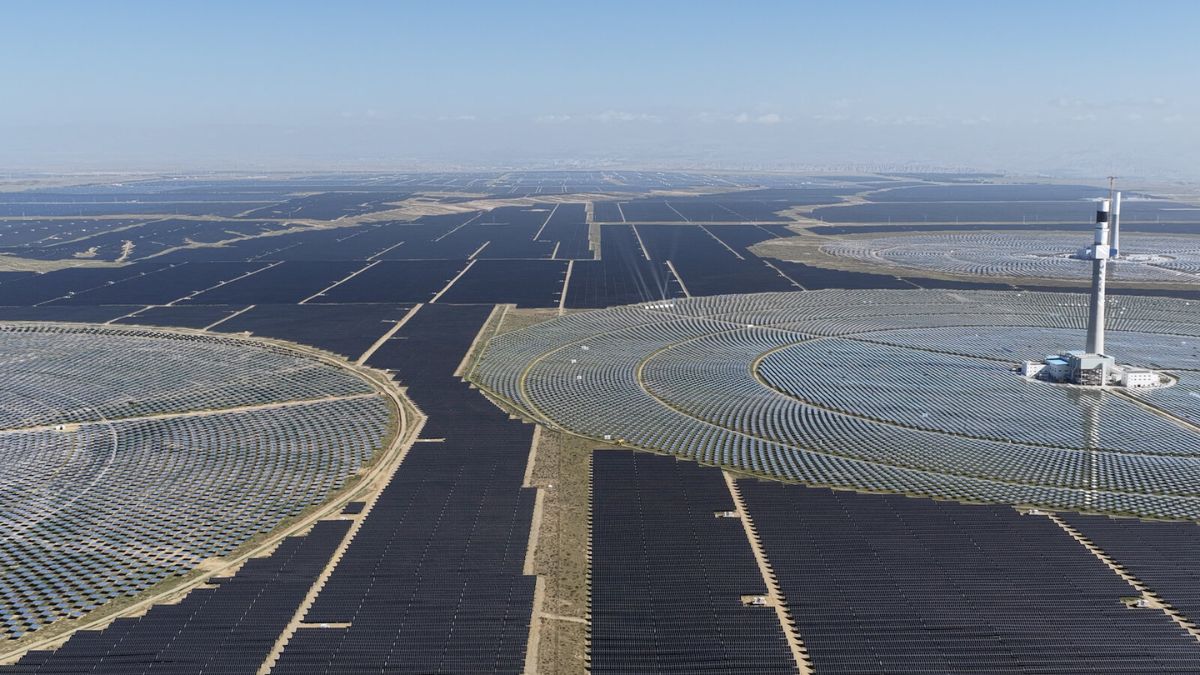
gonghe-talatan-solar-park
China ranks first in solar energy production. China is the undisputed global leader in the solar industry, with solar PV power capacity reaching approximately 1,200 GW by end of 2025, as per IRENA statistics. In 2025, China alone added 440 GW in 2025.
China continues to account for nearly 60% of global renewable capacity growth and is on track to reach its recently announced 2035 wind and solar target five years ahead of schedule, extending its track record of early delivery, as per the IEA Renewables 2025 report.
China’s President Xi Jinping had announced at the 2020 Climate Ambition Summit that China planned to have 1,200 GW of combined solar and wind energy capacity by 2030. This target was reached in 2024, six years ahead of the 2030 goal.
China’s photovoltaic industry began by making panels for satellites, and transitioned to manufacturing domestic panels in the late 1990s. Afte a few government incentives in 2011, China’s solar power market boomed and China became the world’s leading installer of photovoltaics in 2013. 
In 2015, China surpassed Germany as the world’s largest producer of photovoltaic energy. And it became the first country to have over 100 GW of total installed photovoltaic capacity in 2017 and over 1,000 GW of total installed PV capacity by 2025.
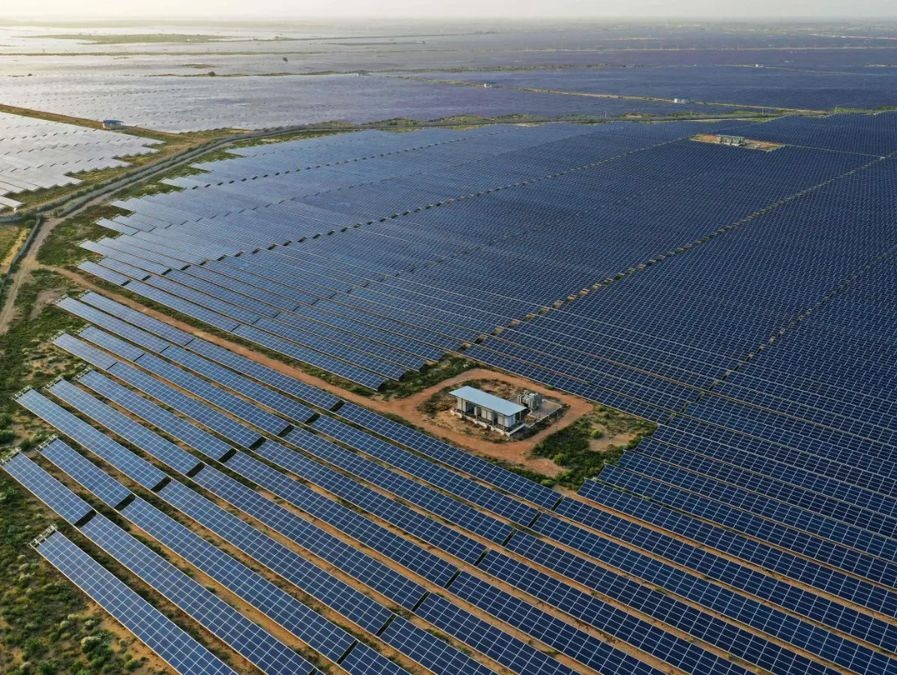
bhadla-solar-park
India ranks third globally in solar energy production, according to the Renewable Energy Statistics 2026 by IRENA. Driven significantly by 150.26 GW of solar energy, India witnessed 53.28 times increase since 2014. The largest solar energy producer state in india in Rajasthan.
Union Minister for New and Renewable Energy and Consumer Affairs, Food and Public Distribution, Shri Pralhad Joshi said India now ranks third globally in Renewable Energy Installed Capacity, according to the Renewable Energy Statistics 2026.
India’s renewable expansion is driven by higher auction volumes, new support for rooftop solar projects, and faster hydropower permitting. The country is on track to meet its 2030 target and become the second-largest growth market for renewables, with capacity set to rise by 2.5 times in five years, noted the IEA Renewables 2025 report.
1. Gonghe Talatan Solar Park, Qinghai Province, China (15,600 MW/ 15.6 GW) 
2. Hobq Solar Park, Inner Mongolia, China (4,000 MW/ 4 GW)
3. Bhadla Solar Park, Rajasthan, India (2,245 MW/ 2.25 GW)
4. Huanghe Hydropower Hainan Solar Park, Qinghai, China (2,200 MW/ 2.2. GW)
5. Pavagada Solar Park, Karnataka, India (2,050 MW/ 2.05 GW)
Also read: Which Country Ranks First in Military Power?

Deputy Manager
Roopashree Sharma is a seasoned content writing professional with over 5 years of experience in digital journalism, specialising in writing explainers and IQ quizzes across geopolitics, business, finance, and pop culture. She holds a degree in Journalism and Mass Communication and has contributed to leading media houses, including Zee, Times, and India TV. Currently serving as Deputy Manager – Editorial at Jagran New Media, she writes and produces videos for the General Knowledge (GK) section of the Jagran Josh (English) portal. For inquiries, contact her at roopashree.sharma@jagrannewmedia.com.
Who is Known as the Father of Scientific Management?
ISRO Successfully Conducts Second Integrated Air Drop Test for Gaganyaan Mission
Which Countries are Separated by the Durand Line?
Get here current GK and GK quiz questions in English and Hindi for India, World, Sports and Competitive exam preparation. Download the Jagran Josh Current Affairs App.
TS Inter Result 2026 Date Live: TGBIE 1st and 2nd Year Result Tomorrow on tgbie.cgg.gov.in, Official Notice on Date, Time Soon
KCET Admit Card 2026 Out Today at cetonline.karnataka.gov.in, Download Hall Ticket PDF – Link Here
MP Board 10th 12th Result 2026 LIVE: एमपी बोर्ड 10वीं,12वीं रिजल्ट को लेकर बड़ी खबर, छात्र यहां करें चेक
SSC CGL Notification 2026 LIVE: Tier 1 Official Notice Out Soon at ssc.gov.in; Check Latest Updates and News
GDS 2nd Merit List 2026 Live: Download State-Wise PDF & Check Selection Status
PSEB Punjab Board 5th, 8th Result 2026 Date LIVE: When and Where to Check Punjab Board Results Online At pseb.ac.in
Chandigarh Administration Clerk Recruitment 2026 Notification Out for 234 Posts, Apply Online at chandigarh.gov.in, Download Pdf Here
CDS I Last Minute Preparation Tips 2026: Smart Revision & Exam-Day Strategy
Rare Uganda Chimpanzee Civil War Turns Deadly as Largest Chimp Group Splits in Two
TS Inter Result 2026 Date Live: TGBIE 1st and 2nd Year Result Tomorrow on tgbie.cgg.gov.in, Official Notice on Date, Time Soon
भारत के किस राज्य को कहा जाता है ‘नारियल का देश’, जानें नाम
KCET Admit Card 2026 Out Today at cetonline.karnataka.gov.in, Download Hall Ticket PDF – Link Here
Current Affairs Quiz 10 April 2026: हाल ही में किस भाषा में भारत के संविधान का नया संस्करण जारी किया गया?
MoE Launches Accessible Career Cards: Empowering Children with Special Needs CWSN to Navigate Future Pathways
Which country ranks first in solar energy production?
AP Inter Results 2026 Soon: Check When and How to Download 1st and 2nd Year Marksheets at manabadi.co.in
MP Board 10th 12th Result 2026 LIVE: एमपी बोर्ड 10वीं,12वीं रिजल्ट को लेकर बड़ी खबर, छात्र यहां करें चेक
MP Board Admission 2026-27: एमपी बोर्ड ने कक्षा 9 और 11 के लिए 15 मई से नामांकन प्रक्रिया की शुरू, फॉर्म फिल करने की लास्ट डेट क्या है?
JKSSB JA Admit Card 2026 Releasing (Apr 14) at jkssb.nic.in, Check Junior Assistant Hall Ticket Details Here
Who is Known as the Father of Scientific Management?
Calcutta University UG Re-Admission 2026: New Rules for Fresh Admission and Course Changes
SSC CGL Notification 2026 LIVE: Tier 1 Official Notice Out Soon at ssc.gov.in; Check Latest Updates and News
Uttarakhand Sanskrit Board 2026: Purvamadhyama 10th and Uttarmadhyama 12th Results OUT at Digilocker Website and App
Uttarakhand Board Result 2026: उत्तराखंड 10वीं, 12वीं रिजल्ट कब आएगा, जानें बड़ी अपडेट
ISRO Successfully Completes Gaganyaan IADT-02: A Major Leap for India’s Manned Space Mission
Innovation and Ideas that’s what E-Summit ’26 at IIT Ropar is bringing back this year

source

Posted in Renewables | Leave a comment

Array to supply OmniTrack solar trackers for Pekintas’ 260MW solar project – PV Tech

US solar tracker manufacturer Array Technologies will deploy its OmniTrack terrain-following tracker system at a 260MW solar PV project being developed by Turkish company Pekintas. 
Located in the Ayranci district of Karaman province in Turkey’s Central Anatolia region, the project is being developed by Pekintas in partnership with German solar technology provider Schmid Group under their joint venture Schmid Pekintas. 

Engineering, procurement and construction (EPC) services for the project are being delivered by Schmid Pekintas Investment Energy, a subsidiary of Pekintas. 
STC Solar, Array’s value-added reseller, will supply the technology and carry out mechanical installation at the plant. Meanwhile, Schmid Pekintas will deliver the modules using tunnel oxide passivated contact (TOPCon+) solar cells manufactured by P-Tech Solar. 
“This project will be the first in the YEKA program in Turkey to operate using high efficiency TOPCON+ cells produced with the combined industrial excellence of Pekintas Group, and we aim for the facility to exceed performance and output standards,” said Ozhan Olcay, chairman of Pekintas Group.
It is Array’s first deployment under Turkey’s Yenilenebilir Enerji Kaynak Alanları (YEKA) programme. Launched in 2020 by the Turkish Ministry of Energy and Natural Resources, the programme aims to quadruple Turkey’s wind and solar capacity to a combined 120GW by 2035. As a part of the YEKA initiative, the project will incorporate locally manufactured components designated for the Karaman site. 
According to Array, its OmniTrack terrain-following system is designed to reduce the need for ground grading by adapting to natural land contours, lowering construction costs and limiting environmental impact, particularly suited to Turkey’s complex project terrains. 
The project will also incorporate the company’s SmarTrack software suite, including diffuse weather response, which uses real-time irradiance data to optimise output under cloudy conditions, and terrain adaptive backtracking, which adjusts tracker angles to reduce shading and maximise generation on sloped sites. 
Headquartered in Albuquerque, New Mexico, Array has installed or been awarded more than 96GW of solar tracker capacity globally. Last year, the solar tracker manufacturer announced that two of its tracking systems were compatible with 2,000V solar applications
Testing conducted by UK-based certification body Intertek confirmed that the company’s DuraTrack and OmniTrack systems complied with UL Solutions standards 3703 and 2703 for 2,000V systems without requiring additional modifications.

source

Posted in Renewables | Leave a comment

Solar Energy Advancements: Revolutionary Tech & Efficiency – Discovery Alert

Solar Energy Advancements: Revolutionary Tech & Efficiency  Discovery Alert
source

Posted in Renewables | Leave a comment

Huntsville city council approves 238-acre solar farm in Triana – WAFF

HUNTSVILLE, Ala. (WAFF) – The Huntsville City Council approved a project to build a solar farm in Triana on more than 230 acres that will produce 40 megawatts of clean energy.
The solar farm will be located on a wooded area near Huntsville International Airport at the southernmost dead end of Wall Triana, behind the Huntsville Police Department’s shooting range. The site will hold 238 acres of solar panels.
Huntsville City Councilman Bill Kling backed the project and said he expected the council to approve it.
“I expect that when this is all said and done city council will approve this,” Kling said.
The Madison County Commission approved the project Wednesday. Thursday’s vote from the Huntsville council was the last step needed before construction can begin. The county, city and Huntsville Utilities worked together to make the plan possible.
“It’s a good source of power it’s literally unlimited and the panels are getting better than they were so they’re going to be more efficient,” Kling said.
Kling said the project could be the first of more solar farms in the area, depending on how this one performs.
“I think it’s possible that we will see more of these in the future depending on how this first one goes,” Kling said.
Click Here to Subscribe on YouTube: Watch the latest WAFF 48 news, sports & weather videos on our YouTube channel!
Copyright 2026 WAFF. All rights reserved.

source

Posted in Renewables | Leave a comment

Voltalia's 148MW Bolobedu Solar Farm Powers Rio Tinto in South Africa – News and Statistics – IndexBox

We use cookies to improve your experience and for marketing. Read our cookie policy or manage cookies.
Search across reports, market insights, and blog stories.
French renewables company Voltalia has completed the Bolobedu solar farm, according to a report from PV-Tech. The 148-megawatt facility is located in the Limpopo province and represents the first large-scale photovoltaic project developed in the country for a private client.
The project’s output is secured under a long-term corporate power purchase agreement with Richards Bay Minerals, a subsidiary of Rio Tinto. This aligns with a strategic partnership between Voltalia and the International Finance Corporation established in October 2025, which focuses on sustainable energy for the African mining sector.
Construction of the solar farm involved nearly 800 local workers, with more than half being youth. These individuals received on-the-job training in areas including engineering support, panel installation, and health and safety protocols.
Solar photovoltaic capacity is growing in South Africa. Data indicates that 2 gigawatts were added in 2025, doubling the previous year’s additions. In the first two months of 2026, an additional 400 megawatts became operational. A separate 475-megawatt project, described as the largest single-phase development, began construction recently and is scheduled for completion in summer 2028. The country’s total installed solar PV capacity reached 14.2 gigawatts as of February 2026.
Large-scale projects like Bolobedu are seen as crucial for national targets, which aim to add 28.7 gigawatts of new solar capacity by 2039. A portion of this, 10.3 gigawatts, is planned for addition between 2026 and 2030.
Making Data-Driven Decisions to Grow Your Business
A Quick Overview of Market Performance
Understanding the Current State of The Market and its Prospects
Finding New Products to Diversify Your Business
Choosing the Best Countries to Establish Your Sustainable Supply Chain
Choosing the Best Countries to Boost Your Export
The Latest Trends and Insights into The Industry
The Largest Import Supplying Countries
The Largest Destinations for Exports
The Largest Producers on The Market and Their Profiles
The Largest Markets And Their Profiles
Instant access. No credit card needed.
Online access to 2M+ reports, dashboards, and tables. Trusted by Fortune 500 teams.
IndexBox, Inc.
2093 Philadelphia Pike #1441
Claymont, DE 19703, USA
Contact us
© 2026 IndexBox, Inc
Instant access. No credit card needed.
Online access to 2M+ reports, dashboards, and tables. Trusted by Fortune 500 teams.

source

Posted in Renewables | Leave a comment

Fraunhofer ISE Scientists Claim Reducing Silver Use in Solar By 'Factor of 10" – Saur Energy

0
By clicking the button, I accept the Terms of Use of the service and its Privacy Policy, as well as consent to the processing of personal data.
Don’t have an account? Signup
Powered by :
Scientists at the Fraunhofer Institute for Solar Energy Systems ISE have succeeded in reducing the silver consumption of TOPCon solar cells to 1.1 milligrams per watt peak. Currently, TOPCon solar cells require an average of 10 to 12 milligrams of silver per watt peak. To the reduction, they tested an electroplating-based inline metallization process on pilot systems developed by RENA Technologies GmbH. By combining ultrashort UV laser structuring with the electrochemical deposition of nickel, copper, and silver, the research team produced M10-sized TOPCon solar cells with an efficiency of 24 percent. Compared to PERC solar cells, TOPCon solar cells have higher silver consumption, hence solar cell manufacturers are under particular cost pressure to reduce it.
Why TOPCon Cells Matter
While silicon heterojunction and IBC solar cells are already successfully metallized with printed silver-copper or pure copper contacts, printed copper metallization for TOPCon solar cells is still in the testing phase. At the same time, this is currently the most widely produced cell type and the one with particularly high silver consumption. Electroplated copper contacts have the potential to almost completely replace the silver requirements of TOPCon solar cells. Nickel serves as a diffusion barrier against copper migration into the cell, copper handles the electrical conduction, and a minimal amount of silver remains as oxidation protection.
“So-called nickel/copper electroplating could be firmly established in the photovoltaic market within two to three years,” says Dr. Sven Kluska, group leader for electrochemical processes at Fraunhofer ISE. “It would offer many advantages for solar cell manufacturers, even if they have to integrate electroplating equipment into their production process as an initial investment.”
Working in a consortium with the equipment manufacturer RENA Technologies GmbH, the scientists demonstrated in the research projects “EURO” and “SHINE PV” that electroplating metallization is technically feasible and can be implemented on an industrial scale. They metallized several batches of M10 TOPCon solar cells on an inline electroplating system, achieving efficiencies of 24 percent. This corresponds to the efficiency of the reference solar cells, whose silver contacts were applied using the conventional screen-printing process. To verify compliance with low contact resistance and high fill factors, they demonstrated a fill factor of 82.1 ± 0.3 percent for a batch of 186 TOPCon solar cells. The solar modules manufactured with the solar cells demonstrated very good stability in degradation tests according to IEC61215.
“Metallization via electroplating could also lead to significantly less dependence on China than is currently the case with silver pastes for the screen-printing metallization commonly used today,” said Dr. Florian Clement, Head of the Metallization and Structuring Technologies Department at Fraunhofer ISE. “Equipment and chemicals for copper electroplating come from European and American manufacturers; there is a global market for raw copper, without a concentration on Chinese suppliers. At the same time, we at Fraunhofer ISE are working intensively to establish European, resilient supply chains for copper-based screen-printing metallization.”
In the screen-printing process as well, there is the option of replacing silver pastes with hybrid silver-copper or pure copper pastes. However, implementation on TOPCon solar cells is considerably more difficult compared to silicon heterojunction solar cells with a TCO layer (transparent conductive oxide layer), which acts as a copper diffusion barrier; this is why researchers worldwide are also further developing electroplating metallization for TOPCon solar cells.
We are India’s leading B2B media house, reporting full-time on solar energy, wind, battery storage, solar inverters, and electric vehicle (EV)
Quick Links
© 2025 Saur Energy. All Rights Reserved.

source

Posted in Renewables | Leave a comment

U.S. scientists build copper-contacted TOPCon solar cell with 24.3% efficiency – pv magazine International

The TOPCon solar cells with fabricated with screen-printed, fire-through copper rear contacts and silver front contacts, using laser-enhanced contact optimization (LECO) to significantly reduce contact resistivity. Optimized copper cells achieved 24.3% efficiency, comparable to Ag-contacted cells, with excellent stability.
Measured cell performance and EL images of Cu contacted n-TOPCon, fired as a function of different peak temperatures
Image: Georgia Institute of Technology, Solar Energy Materials and Solar Cells, CC BY 4.0
A research team in the United States has fabricated TOPCon solar cells with screen-printed, fire-through copper (Cu) contact on the rear side and a silver (Ag) contacted boron emitter on the front side through the laser-enhanced contact optimization (LECO) process.
The LECO process consists of using a highly intense laser pulse on the front side of the solar cell at a constant reverse voltage of more than 10 V, with the resulting current flow of several amperes considerably reducing the contact resistivity between semiconductor and metal electrode.
“In this work, we demonstrate that LECO treatment is very effective in enabling screen-printed, fire-through Cu contacts to n-TOPCon on the rear side of a TOPCon cell,” the scientists explained. “We used a unique screen-printable, fire-through Cu paste from Bert Thin Films, Inc. (BTF) which helps in inhibiting Cu diffusion by forming a thin Cu-oxide around the Cu particles.”
Bert Thin Films launched its new copper paste in February, as reported by pv magazine. According to the manufacturer, the new paste can be screen printed and fired in air, and can also be co-fired with commercial silver pastes for frontside metallization.
The cells were fabricated using standard 242.32 cm² n-type wafers that underwent saw damage etching, surface texturing, and cleaning. TOPCon precursors were formed with a boron-diffused emitter passivated by an aluminum oxide/silicon nitride (Al₂O₃/SiNx) layer on the front side, and a full-area TOPCon stack on the rear. Ag paste was screen-printed on the front with 135 gridlines and fired at 700 C. Cu paste was then applied to the rear and fired at a lower temperature of 500–600 C to prevent copper migration.
All the tools and processes we used in this study are already in use in the PV industry,” corresponding author Young Woo Ok told pv magazine. “It only requires replacing the Ag paste with the Cu paste. The process can be a plug-and-play alternative to Ag contacts in production.”
The LECO treatment was performed with varying reverse bias voltages to improve cell performance. Fully silver-contacted cells were fabricated as references. Electrical properties, including metal-induced recombination current density and contact resistivity, were characterized using the transfer length method (TLM) and electroluminescence (EL) imaging.
Image: Georgia Institute of Technology, Solar Energy Materials and Solar Cells, CC BY 4.0
The researchers systematically optimized Cu printing and firing parameters, including screen design, firing temperature, belt speed, and LECO settings. Cells fired at 500–550 C were found to achieved stable open-circuit voltage and pseudo-fill factor up to 530 C, with degradation occurring at higher temperatures due to copper diffusion into the tunnel oxide. Moreover, short-circuit current density slightly was found to decrease at higher temperatures, while fill factor peaked around 530–535 C due to reduced series resistance (Rs). EL imaging confirmed improved contact quality with firing at 535 C, eliminating dark areas caused by poor contacts.
The LECO treatment was optimized for cells fired at 530 C, with reverse bias voltages of 17–19 V providing the best balance between series resistant (Rs) and pseudo fill factor. Contact resistivity decreased from around 300 mΩ·cm² to around 10 mΩ·cm² after LECO, indicating enhanced rear Cu contacts, while laser power had minimal effect. Microstructural analysis showed increased Cu colloids and crystallites confined to the poly-Si layer, improving contact properties without degrading pseudo fill factor and open-circuit voltage.
Comparisons with Ag-contacted cells revealed that the Cu-contacted cells achieved comparable open-circuit voltage and pseudo fill factor, with slightly lower short-circuit current and fill factor. Optimized Cu cells reached 24.3% efficiency, only 0.2–0.3% below Ag-contacted cells. Contact resistivity for Cu was higher than Ag, but could be mitigated by increasing rear contact coverage. Stability tests under thermal stress at 200 C in nitrogen also showed negligible changes in open-circuit voltage and pseudo fill factor over 1000 hours, which reportedly demonstrated Cu contact reliability.
“Such high efficiency screen printed Cu contacted n-TOPCon cells provide unique opportunity to replace very expensive Ag contact on n-TOPCon with cheaper screen printable Cu metal pastes,” the scientists emphasized.
The novel cell concept was presented in “>24% screen printed Cu contacted n-TOPCon solar cells with successful implementation of LECO process,” published in Solar Energy Materials and Solar Cells. The research team included academics from the US Department of Energy’s National Laboratory of the Rockies, the Georgia Institute of Technology, and US-based copper paste specialist Bert Thin Films Inc. 
This content is protected by copyright and may not be reused. If you want to cooperate with us and would like to reuse some of our content, please contact: editors@pv-magazine.com.
More articles from Emiliano Bellini
Please be mindful of our community standards.
Your email address will not be published. Required fields are marked *


By submitting this form you agree to pv magazine using your data for the purposes of publishing your comment.
Your personal data will only be disclosed or otherwise transmitted to third parties for the purposes of spam filtering or if this is necessary for technical maintenance of the website. Any other transfer to third parties will not take place unless this is justified on the basis of applicable data protection regulations or if pv magazine is legally obliged to do so.
You may revoke this consent at any time with effect for the future, in which case your personal data will be deleted immediately. Otherwise, your data will be deleted if pv magazine has processed your request or the purpose of data storage is fulfilled.
Further information on data privacy can be found in our Data Protection Policy.
Legal Notice Terms and Conditions Data Privacy © pv magazine 2026

This website uses cookies to anonymously count visitor numbers. View our privacy policy.
The cookie settings on this website are set to “allow cookies” to give you the best browsing experience possible. If you continue to use this website without changing your cookie settings or you click “Accept” below then you are consenting to this.
Close

source

Posted in Renewables | Leave a comment

Saatvik Green Energy Secures ₹108.75 Crore Solar PV Module Order from Domestic IPP – SolarQuarter

Saatvik Green Energy Secures ₹108.75 Crore Solar PV Module Order from Domestic IPP  SolarQuarter
source

Posted in Renewables | Leave a comment

Sigenergy, Arausol and Memodo realize Germany's largest DC-coupled PV plant with decentralized storage – PA Media

Contributed by: PR Newswire

source

Posted in Renewables | Leave a comment

Saatvik Solar Industries Bags Order for Solar PV Module Worth Rs 108.75 Cr – Trade Brains

by | April 10, 2026 11:31 am
Synopsis: Saatvik Solar Industries has secured domestic supply orders worth Rs 108.75 crore, expected to be completed by September 2026. This win, along with a 144% increase in Q3 net profit, highlights the company’s growing position in India’s competitive solar module market.  
Saatvik Green Energy revealed on April 9, 2026, that its subsidiary Saatvik Solar Industries has received orders amounting to Rs 108.75 crore from leading domestic IPPs and EPC players. The contracts involve the supply of solar photovoltaic modules and are commercial in nature, not falling under related party transactions. Execution is targeted for September 2026.  
For integrated solar manufacturers, winning orders from IPPs and EPC players directly confirms module quality and pricing competitiveness. As India speeds up renewable capacity addition toward its 2030 goals, module suppliers with strong domestic partnerships and high-efficiency products are best positioned to capture a larger share of the rising order pipeline.  
Shares of Saatvik Green Energy rose 7.59% to close at Rs 452.35 on the NSE. The company reported Q3 FY26 consolidated net profit of Rs 98.72 crore, up 144.1% year-on-year, on net sales of Rs 1,257.02 crore  a 142.6% jump over Q3 FY25.
Saatvik Green Energy is an integrated solar energy solutions provider manufacturing high-efficiency PV modules and offering EPC services for utility-scale, commercial, and industrial solar projects across India.
Disclaimer: The views and investment tips expressed by investment experts/broking houses/rating agencies on tradebrains.in are their own, and not that of the website or its management. Investing in equities poses a risk of financial losses. Investors must therefore exercise due caution while investing or trading in stocks. Trade Brains Technologies Private Limited or the author are not liable for any losses caused as a result of the decision based on this article. Please consult your investment advisor before investing.

Pranab is a financial analyst with experience in equities and financial modeling, with a strong understanding of data-driven analysis and quantitative techniques. He has written several analytical pieces and is deeply interested in market trends and valuation. Blending analytical thinking with financial insight, he explores strategies to better understand markets and support informed investment decisions.
Trade Brains is India’s trusted financial and business news portal.
Phone: 080884 91790
Email: [email protected]
Reach us out at
For Advertisement, Press Releases, Partnerships or to get backlinks on this website, please e-mail us at [email protected]
For Partnerships & Promotio
Visit  – tradebrainsawards.com/
Chandan Singh Rawat
Emaill: [email protected]
Mob: (+91)6366648573
Bikram Singhary
Email: [email protected]
Mob: (+91)8088491790


source

Posted in Renewables | Leave a comment

New tech reduces silver use in TOPCon solar cells by a factor of 10 – pv magazine International

Researchers at the Fraunhofer Institute for Solar Energy Systems ISE have reduced silver consumption in solar cell metallization to 1.1 mg/Wp using an electrodeposition-based process, down from current levels of 10–12 mg/Wp.
Implementation of light-induced copper deposition in an inline electroplating system for metallizing crystalline silicon solar cells with a nickel/copper/silver layer stack.
Image: Fraunhofer ISE
Tunnel oxide passivated contact (TOPCon) cells, which currently dominate global crystalline silicon production, consume more silver than earlier technologies such as PERC, making them particularly sensitive to price volatility. Silver prices, on the other hand, have remained at elevated levels in recent months.
Researchers at the Fraunhofer Institute for Solar Energy Systems ISE (Fraunhofer ISE) have now significantly reduced silver consumption in TOPCon solar cells. Using an electrodeposition-based metallization process, the team lowered silver use to 1.1 mg/Wp, compared with current levels of 10–12 mg/Wp.
The approach relies on a hybrid metallization process combining high-precision ultraviolet laser structuring with electrochemical metal deposition. Nickel serves as a diffusion barrier to prevent copper migration into silicon, copper provides the main electrical conduction, and silver is limited to a thin capping layer for oxidation protection.
The process has been implemented in pilot systems in collaboration with RENA Technologies GmbH, using inline electroplating equipment. Tests on M10-format cells achieved efficiencies of 24%, in line with conventional screen-printed cells using silver pastes. The researchers also reported fill factors of around 82.1%, indicating low contact resistance and good electrical performance.
Industrial viability was demonstrated under the umbrella of the EURO and SHINE PV research projects, with multiple TOPCon batches processed. Modules produced from these cells passed IEC 61215 reliability testing, showing stability comparable to established technologies.
Electrodeposition of metallic contacts is not new in photovoltaics. It has already been explored in heterojunction (HJT) and interdigitated back contact (IBC) cells to partially or fully replace silver with copper. However, applying these approaches to TOPCon is more challenging due to the absence of transparent conductive oxide (TCO) layers, requiring additional solutions such as nickel interlayers.
Copper-based metallization via electrodeposition also offers supply chain advantages. It reduces reliance on geographically concentrated silver supply and benefits from a more diversified global copper market, including materials, equipment, and chemical inputs.
However, scaling the technology poses challenges. Integrating electroplating tools into existing production lines requires significant capital investment. In addition, maintaining process uniformity, repeatability, and compatibility with high-throughput manufacturing remains critical.
Research is also ongoing to reduce silver use within screen printing, including hybrid silver-copper or pure copper pastes. These approaches face technical limitations in TOPCon, supporting interest in electrodeposition as a key pathway for silver reduction.
Nickel- and copper-based metallization via electrodeposition could reach commercial deployment within two to three years, offering potential reductions in material costs while improving supply chain resilience and sustainability.
This content is protected by copyright and may not be reused. If you want to cooperate with us and would like to reuse some of our content, please contact: editors@pv-magazine.com.
More articles from Pilar Sánchez Molina
Please be mindful of our community standards.
Your email address will not be published. Required fields are marked *


By submitting this form you agree to pv magazine using your data for the purposes of publishing your comment.
Your personal data will only be disclosed or otherwise transmitted to third parties for the purposes of spam filtering or if this is necessary for technical maintenance of the website. Any other transfer to third parties will not take place unless this is justified on the basis of applicable data protection regulations or if pv magazine is legally obliged to do so.
You may revoke this consent at any time with effect for the future, in which case your personal data will be deleted immediately. Otherwise, your data will be deleted if pv magazine has processed your request or the purpose of data storage is fulfilled.
Further information on data privacy can be found in our Data Protection Policy.
Legal Notice Terms and Conditions Data Privacy © pv magazine 2026

This website uses cookies to anonymously count visitor numbers. View our privacy policy.
The cookie settings on this website are set to “allow cookies” to give you the best browsing experience possible. If you continue to use this website without changing your cookie settings or you click “Accept” below then you are consenting to this.
Close

source

Posted in Renewables | Leave a comment

Tata Power, Roofsol, Mahindra Lead India’s Rooftop Solar Market in 2025 – Mercomindia.com

Markets & Policy
Tenders & Auctions
Solar Projects
Large-Scale Projects
Rooftop
C&I
Manufacturing
Modules
Inverters & BOS
Technology
Finance and M&A
Markets & Policy
T&D
Utilities
Smart Grid
Microgrid
Events
Webinars
Interviews
The top five companies accounted for 23.6% of the market share
April 10, 2026
Follow Mercom India on WhatsApp for exclusive updates on clean energy news and insights
Tata Power SolarRoofsol EnergyMahindra SolarizeKalpa Power, and Hartek Group emerged as the top rooftop solar installers in India in 2025, according to Mercom India’s India Solar Market Leaderboard 2026.
Together, these five companies accounted for nearly 23.6% of the total rooftop solar market.
India added 7.1 GW of rooftop solar capacity in 2025, marking an 123.3% increase from 3.2 GW in 2024, as per Mercom India’s 2025 Q4 & Annual Mercom India Rooftop Solar Market Report. The PM Surya Ghar: Muft Bijli Yojana continued to dominate rooftop solar additions, supported by integration with the JanSamarth platform for end-to-end digital processing.
Waived feasibility checks for systems up to 10 kW and automatic net metering approvals improved installation timelines. Additional state subsidies in Uttar Pradesh, Delhi, Odisha, Haryana, Assam, Andhra Pradesh, and Maharashtra further boosted momentum under the PM Surya Ghar program.
As of December 2025, India’s cumulative rooftop solar capacity stood at 20.8 GW.
Tata Power Solar retained its leadership position, accounting for 19.2% of rooftop solar installations in 2025. The company has a diversified portfolio across commercial, industrial, and residential segments, supported by a nationwide dealer network, financial modes, and integrated solar solutions. The residential segment, with 58%, was the main contributor, especially in Maharashtra, Gujarat, Tamil Nadu, and Chhattisgarh.
Roofsol Energy ranked second, primarily focusing on the commercial and industrial (C&I) segment. The company secured ₹2.1 billion (~$24.67 million) in funding from Aseem Infrastructure Finance in May 2025 to expand rooftop and open access projects for C&I units across multiple locations in India.
Mahindra Solarize ranked third with rooftop solar installations across C&I and residential segments. The company’s client base includes firms from the textile and automotive sectors. As the distributed solar EPC arm of the Mahindra Group, it continues to expand its rooftop footprint across key cities, including Lucknow, Pune, Nashik, Ahmedabad, and Mumbai.
Tata Power, Roofsol, Mahindra Lead India’s Rooftop Solar Market in 2025
 
Kalpa Power moved up in the rankings to fourth place, recording 17.2% year-over-year growth in installations, supported by its rooftop and open access solar offerings and asset management services for C&I clients across India.
Hartek Group climbed up to the fifth rank with a 36.4% YoY growth, delivering turnkey EPC services for ground-mounted and rooftop solar projects and supporting power infrastructure and grid integration. The installations were spread across food processing, automotive, steel, chemicals, and other industries. In January 2025, Hartek won an EPC contract from Kandhari Beverages for an 8 MW rooftop solar installation in Jammu and Kashmir.
Rising participation from new players in rooftop solar signals expanding competition across residential and C&I segments. This trend reveals a diversifying installer landscape with competitive pressure extending beyond established industry leaders.
Importantly, companies outside the top 10  accounted for nearly 74% of total installations, illustrating the rooftop solar sector’s broad-based growth.
Mercom’s India Solar Market Leaderboard provides a detailed analysis of market trends, competitor analysis, and company performance across the solar supply chain.
For the detailed and comprehensive report, click here.
A complete list of solar rooftop installers and quarterly market share is available through Mercom’s India Solar Market Share Tracker.
Shanthi G
RELATED POSTS
© 2026 by Mercom Capital Group, LLC. All Rights Reserved.

source

Posted in Renewables | Leave a comment

Internet-of-Things could bring solar module water cooling closer to commercial viability – pv magazine International

A Czech team developed an IoT system using MQTT to autonomously cool PV panels, boosting daily energy yield by 7.38% with a positive net energy balance.
Image: pv magazine
A research team from the Czech Republic has developed a novel Internet of Things (IoT) architecture specifically designed for active water cooling of PV panels active cooling of PV panels.
“The architecture explicitly evaluates the net energy balance of the cooling process,” the team said. “The proposed system enables autonomous operation of individual cooling nodes while providing centralized coordination and trend-aware decision-support capabilities at the fog level. This approach improves overall energy efficiency, reduces dependence on centralized hardware, and establishes a scalable foundation for future integration of AI-based control strategies.”
The distributed IoT-based architecture integrates an autonomous ESP32-based microcontroller, a Raspberry Pi fog layer for real-time decision-making, and an optional cloud layer for long-term optimization.
The system uses a distributed IoT architecture with three layers, namely edge, fog, and cloud. The edge nodes handle data collection, with sensors on the PV panels measuring temperature, electrical output, coolant status, and environmental conditions.
The data is sent via the message queuing telemetry transport MQTT communication protocol to a central controller. In the controller, the fog layer kicks in, performing real-time decision-making and activating a water pump based on thresholds not shared by the team. A cloud layer enables long-term analysis but is not required for operation.
An experimental study of the proposed IoT technology was conducted outdoors on a real 600 W installation at an undisclosed location. In the experiment, two branches of the PV installation were supplied with the novel IoT system, and two were not, acting as a reference. Data was collected across 52 days.
Per the results, on a representative day, the daily energy yield of the cooled branch was 818.61 Wh, while the reference uncooled branch produced 762.36 Wh. That represents an absolute gain of 56.25 Wh and a relative gain of 7.38%. “When accounting for measured pump consumption of 6 W, the resulting energy return on investment (ROI) reached 1.07 on representative days of high-irradiance, confirming a positive net energy balance under real operating conditions,” the team added.
“The proposed architecture is fully wireless, scalable, and independent of centralized hardware constraints,” they concluded. “By explicitly evaluating the net energetic effect of cooling rather than instantaneous peak gains, the study establishes a practically deployable and energetically consistent framework for adaptive PV temperature management under dynamic climatic conditions.
The system was presented in “Energy-aware IoT architecture for active cooling of photovoltaic panels under dynamic weather conditions,” published in Energy Conversion and Management: X. Scientists from the Czech Republic’s University of South Bohemia in České Budějovice and the Czech Academy of Sciences participated in the research.
This content is protected by copyright and may not be reused. If you want to cooperate with us and would like to reuse some of our content, please contact: editors@pv-magazine.com.
More articles from Lior Kahana
Please be mindful of our community standards.
Your email address will not be published. Required fields are marked *


By submitting this form you agree to pv magazine using your data for the purposes of publishing your comment.
Your personal data will only be disclosed or otherwise transmitted to third parties for the purposes of spam filtering or if this is necessary for technical maintenance of the website. Any other transfer to third parties will not take place unless this is justified on the basis of applicable data protection regulations or if pv magazine is legally obliged to do so.
You may revoke this consent at any time with effect for the future, in which case your personal data will be deleted immediately. Otherwise, your data will be deleted if pv magazine has processed your request or the purpose of data storage is fulfilled.
Further information on data privacy can be found in our Data Protection Policy.
Legal Notice Terms and Conditions Data Privacy © pv magazine 2026

This website uses cookies to anonymously count visitor numbers. View our privacy policy.
The cookie settings on this website are set to “allow cookies” to give you the best browsing experience possible. If you continue to use this website without changing your cookie settings or you click “Accept” below then you are consenting to this.
Close

source

Posted in Renewables | Leave a comment

NZ's 10 kW Solar Export Rule: Grid Safety & Lower Costs from 2026 – News and Statistics – IndexBox

We use cookies to improve your experience and for marketing. Read our cookie policy or manage cookies.
Search across reports, market insights, and blog stories.
New Zealand’s Electricity Authority has updated its connection rules for generation and storage systems, according to a report from pv magazine Australia. The changes are designed to streamline the process for both grid-scale and residential solar energy systems to supply power to local networks.
The authority has established a default export limit of 10 kW for standard small-scale distributed generation like household solar and battery setups. This measure aims to support higher penetration of distributed energy while maintaining grid safety and reliability. Officials stated that more efficient export limits can contribute to lower network costs, which may eventually reduce consumer bills.
Currently, tens of thousands of households with solar panels, including many with batteries, can feed electricity into local networks. The previous caps on export were reportedly lower than necessary, sometimes resulting in the use of higher-cost power sources instead of cheaper solar generation. Recent regulatory adjustments had already allowed lines companies to voluntarily raise their residential export limits, a step many have taken.
The new rules will mandate all lines companies to set at least a 10 kW limit for residential connections where feasible, though network constraints may prevent this in all locations. The regulations also permit companies to offer a dynamic or flexible export limit as an alternative to the fixed 10 kW cap. This flexible approach would allow the limit to adjust above or below 10 kW based on real-time network conditions, aiming for greater efficiency than a permanently lower fixed limit.
Industry groups must also develop assessment tools. These tools will determine when a limit below 10 kW is required for safety or reliability, or when a dynamic limit is suitable. For distributed generation projects supplying more than 10 kW, such as solar installations and wind farms, the rules create a nationally consistent and transparent approach to export limits. The authority is requiring the development of a standardized assessment tool for these larger systems to be used across the country’s lines companies, which could streamline connection processes and provide clearer investment signals.
The 10 kW default limit for residential connections is scheduled to take effect in late April 2026, with further staged changes continuing until mid-October of that year. These rules represent the initial component of the second stage in the regulator’s broader network connections initiative. Officials noted the updates are intended to lock in recent progress and ensure new network extensions have export limits that maximize consumer benefits, while also paving the way for future technologies like vehicle-to-grid systems.
This report provides a comprehensive view of the dc motor industry in New Zealand, tracking demand, supply, and trade flows across the national value chain. It explains how demand across key channels and end-use segments shapes consumption patterns, while also mapping the role of input availability, production efficiency, and regulatory standards on supply.
Beyond headline metrics, the study benchmarks prices, margins, and trade routes so you can see where value is created and how it moves between domestic suppliers and international partners. The analysis is designed to support strategic planning, market entry, portfolio prioritization, and risk management in the dc motor landscape in New Zealand.
The report combines market sizing with trade intelligence and price analytics for New Zealand. It covers both historical performance and the forward outlook to 2035, allowing you to compare cycles, structural shifts, and policy impacts.
This report provides a consistent view of market size, trade balance, prices, and per-capita indicators for New Zealand. The profile highlights demand structure and trade position, enabling benchmarking against regional and global peers.
The analysis is built on a multi-source framework that combines official statistics, trade records, company disclosures, and expert validation. Data are standardized, reconciled, and cross-checked to ensure consistency across time series.
All data are normalized to a common product definition and mapped to a consistent set of codes. This ensures that comparisons across time are aligned and actionable.
The forecast horizon extends to 2035 and is based on a structured model that links dc motor demand and supply to macroeconomic indicators, trade patterns, and sector-specific drivers. The model captures both cyclical and structural factors and reflects known policy and technology shifts in New Zealand.
Each projection is built from national historical patterns and the broader regional context, allowing the report to show where growth is concentrated and where risks are elevated.
Prices are analyzed in detail, including export and import unit values, regional spreads, and changes in trade costs. The report highlights how seasonality, freight rates, exchange rates, and supply disruptions influence pricing and margins.
Key producers, exporters, and distributors are profiled with a focus on their operational scale, geographic footprint, product mix, and market positioning. This helps identify competitive pressure points, partnership opportunities, and routes to differentiation.
This report is designed for manufacturers, distributors, importers, wholesalers, investors, and advisors who need a clear, data-driven picture of dc motor dynamics in New Zealand.
The market size aggregates consumption and trade data, presented in both value and volume terms.
The projections combine historical trends with macroeconomic indicators, trade dynamics, and sector-specific drivers.
Yes, it includes export and import unit values, regional spreads, and a pricing outlook to 2035.
The report benchmarks market size, trade balance, prices, and per-capita indicators for New Zealand.
Yes, it highlights demand hotspots, trade routes, pricing trends, and competitive context.
Report Scope and Analytical Framing
Concise View of Market Direction
Market Size, Growth and Scenario Framing
Commercial and Technical Scope
How the Market Splits Into Decision-Relevant Buckets
Where Demand Comes From and How It Behaves
Supply Footprint and Value Capture
Trade Flows and External Dependence
Price Formation and Revenue Logic
Who Wins and Why
How the Domestic Market Works
Commercial Entry and Scaling Priorities
Where the Best Expansion Logic Sits
Leading Players and Strategic Archetypes
How the Report Was Built
Instant access. No credit card needed.
Online access to 2M+ reports, dashboards, and tables. Trusted by Fortune 500 teams.
IndexBox, Inc.
2093 Philadelphia Pike #1441
Claymont, DE 19703, USA
Contact us
© 2026 IndexBox, Inc
Instant access. No credit card needed.
Online access to 2M+ reports, dashboards, and tables. Trusted by Fortune 500 teams.

source

Posted in Renewables | Leave a comment

Bondada Engineering commissions 48.2 MWp solar projects in March – pv magazine India

With this, the company has executed 500 MWp of renewable energy projects during FY 2025–26, taking its cumulative executed capacity to around 1.3 GWp.
Bondada Engineering
Bondada Engineering Ltd, a renewable energy EPC company, today announced that it has successfully commissioned 48.2 MWp of solar power projects during March 2026.
The projects were executed for clients including Paradigm IT and MAHAGENCO across multiple locations in Maharashtra. With this, the company has executed 500 MWp of projects during FY 2025–26, taking its cumulative executed capacity to around 1.3 GWp.
“The successful commissioning of these projects is a testament to our team’s consistent focus on execution excellence and operational discipline,” said Rear Admiral R Sreenivas, VSM, (Retd.), Chief Executive Officer, Bondada Group. “Achieving 500 MWp execution in FY26 marks a significant milestone in our growth journey and reflects our ability to scale efficiently. We remain committed to delivering high-quality, large-scale renewable energy projects that support Bharat’s clean energy transition while creating long-term value for our stakeholders.”
This content is protected by copyright and may not be reused. If you want to cooperate with us and would like to reuse some of our content, please contact: editors@pv-magazine.com.
More articles from Uma Gupta
Please be mindful of our community standards.
Your email address will not be published. Required fields are marked *


By submitting this form you agree to pv magazine using your data for the purposes of publishing your comment.
Your personal data will only be disclosed or otherwise transmitted to third parties for the purposes of spam filtering or if this is necessary for technical maintenance of the website. Any other transfer to third parties will not take place unless this is justified on the basis of applicable data protection regulations or if pv magazine is legally obliged to do so.
You may revoke this consent at any time with effect for the future, in which case your personal data will be deleted immediately. Otherwise, your data will be deleted if pv magazine has processed your request or the purpose of data storage is fulfilled.
Further information on data privacy can be found in our Data Protection Policy.
By subscribing to our newsletter you’ll be eligible for a 10% discount on magazine subscriptions!

Legal Notice Terms and Conditions Privacy Policy © pv magazine 2026

This website uses cookies to anonymously count visitor numbers. To find out more, please see our Data Protection Policy.
The cookie settings on this website are set to “allow cookies” to give you the best browsing experience possible. If you continue to use this website without changing your cookie settings or you click “Accept” below then you are consenting to this.
Close

source

Posted in Renewables | Leave a comment

Narendra Modi Highlights India’s Record-Breaking Solar Energy Growth – The Impressive Times

New Delhi: Narendra Modi on Thursday shared an article spotlighting India’s achievement of recording its highest-ever annual solar energy capacity addition, marking a major milestone in the renewable energy sector.
The Prime Minister underscored the rapid growth in solar power generation, calling it a significant step forward in India’s clean energy transition. The achievement reflects the country’s sustained focus on expanding renewable energy infrastructure.
The article, highlighted by Narendra Modi, references observations by Union Minister Pralhad Joshi, who pointed to the record-breaking addition as a testament to India’s commitment to sustainable development.
India’s increasing solar capacity aligns with its broader climate goals, including reducing carbon emissions and promoting green energy alternatives. The latest milestone signals continued momentum in the country’s renewable energy journey.
The expansion of solar energy is also expected to enhance India’s energy security while reducing dependence on conventional power sources, supporting long-term economic and environmental sustainability.
Your email address will not be published. Required fields are marked *


The Impressive Times provide national news, international news, sports, articles, business, entrtaimnet, jobs and career news in English online.
Follow Us:
© copyright The Impressive Times, All Rights Reserved.

source

Posted in Renewables | Leave a comment

Solar PV Capex could fall to $192/kW by 2050 – pv magazine International

A review of 60 renewable energy studies finds that by 2050, solar PV and wind could supply 80–100% of electricity, but overly conservative Capex assumptions and simplified PV modeling often underestimate deployment potential. While future PV costs depend on supply chains and geopolitical risks, historical experience suggests medium-term risks are manageable, and material constraints are being resolved.
Global share of solar PV in electricity generation by 2050
Image: LUT University, Renewable and Sustainable Energy Reviews, CC BY 4.0
The Capex of photovoltaics is expected to range between €166 ($192)/kW and €720/kW in 2050, according to a new study from Finland’s LUT University.
The researchers noted that €166 value follows the standard convention used in documents to indicate nominal values in 2019 currency, while €720 follows 2017 values. “In short, all cost values prior to 2022 are now adjusted by 20% to account for inflation,” Christian Breyer, professor of Solar Economy at LUT University, told pv magazine.
“Assumptions about solar photovoltaics are often pessimistic,” said co-author Dennis Bredemeier, adding that energy system modeling results can be significantly affected by insufficient spatial or temporal resolution.
The researchers carried out a systematic literature review examining the role of solar PV in energy transition scenarios. They focused in particular on how Capex assumptions influence projected PV shares in the global energy mix, as well as how modeling choices such as temporal resolution, spatial granularity, and technology representation could shape these outcomes. They also explored the relationship between PV full-load hours and country-specific deployment levels, and assessed how the availability of power-to-X pathways could enhance the development and overall system value of solar PV in renewables-based energy systems.
The academics worked on a dataset that was filtered to include only studies achieving at least 95% renewable electricity by 2050, excluding nuclear power. Further selection focused on transition pathway and optimization-based studies that reflect realistic system evolution and cost efficiency. The analysis was limited to studies covering the power, heat, and transport sectors to capture sector coupling effects. Studies with limited geographic scope or insufficient data were excluded to ensure consistency and comparability. Projected PV and wind shares in electricity generation by 2050 were also considered, using electricity share rather than total primary energy demand for consistency. PV full-load hours were estimated using global solar resource datasets.
The literature review ultimately identified 60 studies that met the selection criteria, providing a comprehensive dataset of highly renewable energy transition scenarios. These studies vary significantly in their techno-economic assumptions, reported shares of solar PV and wind, and modeling approaches. Despite these differences, most studies converge on a common outcome: by 2050, solar PV and wind together supply between 80% and 100% of electricity generation. Lower combined shares are typically explained by the presence of other renewable resources such as hydropower or geothermal, or by energy imports.
The analysis also showed that Capex assumptions for solar PV strongly influence its projected share, with lower costs generally leading to higher deployment. Geographic factors further shape results, with countries rich in hydropower or geothermal energy showing lower PV shares, while regions with strong solar resources tend to rely more heavily on PV.
“Assumptions about solar PV are often overly conservative, both in terms of cost and technology representation,” Breyer said. “Many studies rely on Capex projections that exceed current market levels, with some 2050 estimates even higher than costs already achieved today. At the same time, PV is frequently modeled as a generic technology, overlooking the diversity of available solutions such as floating, bifacial, agrivoltaic, vehicle-integrated, building-integrated, and tracking systems. This simplification ignores opportunities to reduce land use or unlock additional deployment potential. In addition, modeling choices—particularly low spatial or temporal resolution—can further distort the estimated role of solar PV in future energy systems.”
“Current and future PV costs depend heavily on the stability of global supply chains, while rising geopolitical risks add uncertainty to cost projections,” he went on to say. “However, past experience shows that photovoltaic manufacturing value chains can be rapidly established across different regions with only moderate cost increases. This suggests that while short-term risks are not negligible, medium-term risks are likely to remain manageable. In addition, concerns over critical raw materials are limited, as key constraints, such as silver use in cell metallization, are expected to be resolved, with substitution technologies emerging from around 2026 to remove this potential bottleneck.”
The “Prospects for solar photovoltaics in highly renewable energy transition scenarios towards a dominant future energy source” study was published in Renewable and Sustainable Energy Reviews.
This content is protected by copyright and may not be reused. If you want to cooperate with us and would like to reuse some of our content, please contact: editors@pv-magazine.com.
More articles from Sergio Matalucci
Please be mindful of our community standards.
Your email address will not be published. Required fields are marked *


By submitting this form you agree to pv magazine using your data for the purposes of publishing your comment.
Your personal data will only be disclosed or otherwise transmitted to third parties for the purposes of spam filtering or if this is necessary for technical maintenance of the website. Any other transfer to third parties will not take place unless this is justified on the basis of applicable data protection regulations or if pv magazine is legally obliged to do so.
You may revoke this consent at any time with effect for the future, in which case your personal data will be deleted immediately. Otherwise, your data will be deleted if pv magazine has processed your request or the purpose of data storage is fulfilled.
Further information on data privacy can be found in our Data Protection Policy.
Legal Notice Terms and Conditions Data Privacy © pv magazine 2026

This website uses cookies to anonymously count visitor numbers. View our privacy policy.
The cookie settings on this website are set to “allow cookies” to give you the best browsing experience possible. If you continue to use this website without changing your cookie settings or you click “Accept” below then you are consenting to this.
Close

source

Posted in Renewables | Leave a comment

A 475-foot wind turbine suddenly lost one of its blades without any storm and now investigators are searching for answers – ecoportal.net

Credits: Mario Ame, The Pulse Internal edition
A wind farm has mysteriously lost one of its huge wind turbine blades.
The renewable energy subsector has gained a significant foothold in the global power market. However, when a wind farm found that one of its 475-foot blades snapped off recently, an investigation into the cause was undertaken by the farm’s management as to why this took place.
How can a huge wind turbine blade snap off with no clear explanation?
The astonishing expansion of the renewable energy sector has been a positive landmark for mankind.
In some parts of the world, such as China and India, solar power now accounts for the majority of new energy added to the national grid. China now accounts for 85% of the global solar panel production market.
But solar power has faced a significant challenge from the wind power sector in recent years, as some nations simply do not have the climate for solar power.
The world reached an important milestone recently thanks to the adoption and use of wind power as a primary energy resource. Globally, wind energy has reached 1,136 GW of power added to the international grid.
There can be no denying that the clean energy transition has been gaining substantial momentum over the last few decades.
We have come to learn that the weather plays a significant role in a nation’s choice to either adopt wind energy generation or stick to what has been working over the last few decades.
Two new European startups have been engineering wind turbine towers out of wood recently, attracting the attention of the world’s largest energy companies.
However, as with any new technology, even the wind power market has faced significant issues. And we’re not talking about policy changes or the government’s lack of interest and investment in wind energy generation.
As most renewable energy relies on the climate in some form or another, any weather-related issues can cause the sector to come to a complete standstill.
This has become evident in places like the United Kingdom, as a huge wind farm saw one of its blades snap off during a storm. This proves that even under the near-perfect conditions for wind energy generation in the region, we need to keep a close eye on the weather at all times.
RWE has become a dominant force across the global energy industry over its 125-year lifetime.
We know that weather-related issues can affect solar panel farms as well as their wind-powered cousins, but this development in Wales can not be attributed to a storm or any other weather problem.
RWE found that one of the blades at the 57MW Brechfa Forest West wind farm in South Wales had detached from a turbine with a total reach of 475 feet.
On February 25, 2026, the company opted to close down the wind farm to conduct an extensive investigation into the matter. The culprit has not yet been identified, as no storms were present in the region.
The company acted swiftly to remove the blade from the site, and an investigation is underway to determine the cause.
Most likely, the blade sheared off due to either a mechanical, structural, or manufacturing problem rather than a severe weather-related issue. The specific wind turbine, a Senvion MM92, has been in operation at the farm since 2018.
The story highlights that some renewable energy successes may have unexpected issues for the world to understand, especially if the renewable energy market is to become the primary power resource for the world over the coming decades.
Disclaimer: Our coverage of events affecting companies is purely informative and descriptive. Under no circumstances does it seek to promote an opinion or create a trend, nor can it be taken as investment advice or a recommendation of any kind.
© 2026 by Ecoportal
© 2026 by Ecoportal

source

Posted in Renewables | Leave a comment

Solar PV, geothermal hybrid systems are more than niche solutions – pv magazine International

Solar energy, driven by excellent resource conditions and rapidly improving economic attractiveness, is expected to emerge as a bulk energy supplier in future energy systems. The self-limiting effects of solar power can be circumvented through solar-hybrid solutions, such as PV-geothermal hybrid configurations.
Image: LUT University
Security of supply is often raised as a concern in energy systems dominated by weather-dependent renewable energy sources, particularly solar energy. In this context, most scenarios have highlighted the value of PV-battery hybrid configurations. Researchers from LUT University propose a novel PV-geothermal hybrid solution, as geothermal power could benefits countries with excellent solar resources. This study moves beyond a niche technology perspective that has historically undervalued geothermal energy. This perspective is reinforced by recent research in geologically favorable regions such as Iceland, where abundant geothermal resource and in-situ mineralization potential position the country as a promising carbon dioxide removal hub.
Against this backdrop, detailed research from LUT University estimates the global geothermal potential, which lifts geothermal energy as the third largest renewable energy resource as concluded by energy resource experts. As a firm renewable energy resource, geothermal energy could play a key role in accelerating the shares of renewables in the overall energy mix. In particular, enhanced geothermal systems (EGS) are estimated to offer around 4600 GWe globally at costs between €10-50 ($11.50-58.00)/MWh. The global potential of EGS amounts to a substantial contribution to meeting growing renewable energy demand and could be used beneficially in a fully renewable energy system. Another recent study highlights that several countries around the world can reduce their system costs of 100% renewable energy systems with the inclusion of EGS. The role of geothermal energy in the global energy transition is regarded as underexplored.
Solarization without showstopper: PV-geothermal hybrid solutions for the sunbelt
Solar energy is the most widely available energy resource on Earth and is projected to dominate future energy system architectures due to its rapidly improving economic attractiveness. Since solar energy is weather-dependent, hybrid solutions, such as PV-geothermal hybrid systems, could reduce the levelized cost of electricity (LCOE) and improve overall system flexibility. Sunbelt regions or countries, where favorable solar conditions coincide with hot geothermal zones, could particularly benefit from PV-geothermal hybrid systems, as observed in Guatemala, Honduras and Costa Rica. Accordingly, Guatemala, Costa Rica, and Honduras achieve LCOEs of €18.8, €21.9, and €24.5 /MWh, respectively, with geothermal and solar PV contributing 68%/19%, 51%/24%, and 34%/34% of the LCOE, highlighting solar PV’s cost-reducing role alongside geothermal’s dominant contribution. The cost-containing function of renewable energy like geothermal is essential during low sunshine periods or if storage costs do not decline as expected.
Image: LUT University
Space and water requirements will not constrain PV-geothermal multi-generation systems in Guatemala, Honduras, and Costa Rica. Land needed for solar PV and geothermal is minimal, 0.2% and 0.7% in Guatemala, 0.1% and 0.2% in Honduras, and 0.4% and 0.2% in Costa Rica, based on 75 MW/km2 for PV and 7.5 km2/TWh for geothermal, with PV estimates being conservative. Water use by geothermal plants (binary and EGS) ranges from 0.01–0.2 km3 in Guatemala, Honduras, and Costa Rica. These numbers represent minimal shares of the region’s annual precipitation.
System-wide defossilization driven by PV-geothermal hybrid configurations
Regional cooperation fosters renewable energy integration, maximizing the benefits of defossilization and enabling the effective use of collective assets required to develop a cost-efficient system and safeguard supply security, challenges that could be greater under individual national planning. Across Central America, electricity supply is dominated by solar and geothermal power, contributing 4-90% and 7-38% of generation, respectively, throughout the transition. System LCOE across the region is €20-21 /MWh with grid interconnection, rising slightly to €23 /MWh without it. Solar PV-geothermal hybrid configurations reduce storage requirements by 51-60% and curtailment by about 76% with grid interconnection.
Source-system-service flexibility is achieved through firm and flexible geothermal power, power-to-X (PtX) processes, and sector coupling. Geothermal enhances energy supply diversity, while hybrid PV-geothermal solutions enhance system flexibility in highly renewable energy systems. Service flexibility is delivered via sector coupling and PtX technologies such as heat pumps, electric vehicles, and electrolyzers, enabling the production of e-hydrogen, e-methane, and e-fuels for applications where direct fuel substitution is challenging. The energy system achieves high efficiency and cost competitiveness thanks to access to low-cost renewable energy from solar PV-geothermal configurations and the highly efficient utilization of electricity across the entire system via PtX processes.
Seeking El Dorado: Iceland’s geology favors carbon dioxide removal opportunities
Iceland has an exceptional abundance of geothermal energy, with a maximum potential of 325 GWe, which decreases to 1.1 GWe when sustainability criteria are applied. The potential for geothermal heat extraction exceeds 720 PWh/a, while the sustainable potential declines to 2.4 PWh/a. Building on this resource base, recent research from LUT University explored 28 scenarios with varying geothermal availability to assess impacts on Iceland’s electricity and heat generation systems, as well as on carbon dioxide removal (CDR) deployment under different climate targets.
Geothermal heat is the dominate enabler for direct air capture, enabling cost-competitive CDR service at approximately €50 /tCO2, while geothermal combined with heat and power plants provide dispatchable baseload heat and electricity, ensuring cost-optimal and reliable energy supply.
However, geothermal energy alone cannot sustain very large-scale CDR deployment. Scenarios with a higher geothermal electricity share slightly increase electricity prices, leading to marginally higher levelized CDR costs, particularly in the 2050 transition cases. To ensure a stable supply of the large baseload electricity demand, solar PV plays a vital role in counter-balancing the seasonality of wind power in Iceland.
Although geothermal resource availability is not a limiting factor, the analysis identifies workforce constraints, rather than energy supply, as the primary bottleneck, restricting feasible CDR deployment to around 1 GtCO2/a. Large-scale CDR expansion requires complementary renewables, including onshore wind, solar PV, and wave power, positioning geothermal as a critical but non-exclusive pillar of Iceland’s long-term CDR strategy.
Solar PV-geothermal-led multi-generation systems analysis should be explored for further countries and regions where high-quality solar and geothermal resources coincide, to optimize both heat and electricity supply.
Authors: Ayobami Solomon Oyewo, Dominik Keiner, and Christian Breyer
This article is part of a monthly column by LUT University.
Research at LUT University encompasses various analyses related to power, heat, transport, industry, desalination, and carbon dioxide removal options. Power-to-X research is a core topic at the university, integrated into the focus areas of Planetary Resources, Business and Society, Digital Revolution, and Energy Transition. Solar energy plays a key role in all research aspects.
The views and opinions expressed in this article are the author’s own, and do not necessarily reflect those held by pv magazine.
This content is protected by copyright and may not be reused. If you want to cooperate with us and would like to reuse some of our content, please contact: editors@pv-magazine.com.
Please be mindful of our community standards.
Your email address will not be published. Required fields are marked *


By submitting this form you agree to pv magazine using your data for the purposes of publishing your comment.
Your personal data will only be disclosed or otherwise transmitted to third parties for the purposes of spam filtering or if this is necessary for technical maintenance of the website. Any other transfer to third parties will not take place unless this is justified on the basis of applicable data protection regulations or if pv magazine is legally obliged to do so.
You may revoke this consent at any time with effect for the future, in which case your personal data will be deleted immediately. Otherwise, your data will be deleted if pv magazine has processed your request or the purpose of data storage is fulfilled.
Further information on data privacy can be found in our Data Protection Policy.
Legal Notice Terms and Conditions Data Privacy © pv magazine 2026

This website uses cookies to anonymously count visitor numbers. View our privacy policy.
The cookie settings on this website are set to “allow cookies” to give you the best browsing experience possible. If you continue to use this website without changing your cookie settings or you click “Accept” below then you are consenting to this.
Close

source

Posted in Renewables | Leave a comment

Australia's Rooftop Solar & Battery Installations Hit Record Highs in March 2026 – News and Statistics – IndexBox

We use cookies to improve your experience and for marketing. Read our cookie policy or manage cookies.
Search across reports, market insights, and blog stories.
Data from SunWiz indicates Australia’s rooftop solar market achieved a record level of activity last month. The country registered 341 megawatts of small-scale photovoltaic capacity in March, representing a surge of approximately 19% from the previous month. The current market volume is also reported to be 16% higher than it was at the same point last year.
Analysts link the growth to strong momentum in the market for Small-scale Technology Certificates. A federal program providing rebates for home battery systems is also cited as a contributing factor. This initiative has supported the installation of roughly 300,000 battery units since it began.
The increase in solar installations was observed nationwide. The Northern Territory saw a 43% rise compared to February, while New South Wales experienced a 32% increase. Most system size categories grew, particularly those up to 50 kilowatts, though a slight decline was noted for systems between 75 and 100 kilowatts.
Battery installations also reached a new high, with nearly 1.6 gigawatt-hours of small-scale storage capacity registered in March, a 35% monthly increase. This surge is attributed to consumers accelerating installations ahead of modifications to the federal rebate program scheduled for the start of May. Under the revised scheme, the incentive will shift from a flat rate to a tiered structure based on battery size, while maintaining an average discount of around 30%.
The average battery size set a new record of 40 kilowatt-hours last month, with most systems falling in the 40 to 50 kilowatt-hour range. New South Wales alone recorded over 600 megawatt-hours of battery installations, a 44% monthly increase and a new state record.
Interactive table based on the Store Companies dataset for this report.
This report provides a comprehensive view of the solar cells and light-emitting diodes industry in Australia, tracking demand, supply, and trade flows across the national value chain. It explains how demand across key channels and end-use segments shapes consumption patterns, while also mapping the role of input availability, production efficiency, and regulatory standards on supply.
Beyond headline metrics, the study benchmarks prices, margins, and trade routes so you can see where value is created and how it moves between domestic suppliers and international partners. The analysis is designed to support strategic planning, market entry, portfolio prioritization, and risk management in the solar cells and light-emitting diodes landscape in Australia.
The report combines market sizing with trade intelligence and price analytics for Australia. It covers both historical performance and the forward outlook to 2035, allowing you to compare cycles, structural shifts, and policy impacts.
This report provides a consistent view of market size, trade balance, prices, and per-capita indicators for Australia. The profile highlights demand structure and trade position, enabling benchmarking against regional and global peers.
The analysis is built on a multi-source framework that combines official statistics, trade records, company disclosures, and expert validation. Data are standardized, reconciled, and cross-checked to ensure consistency across time series.
All data are normalized to a common product definition and mapped to a consistent set of codes. This ensures that comparisons across time are aligned and actionable.
The forecast horizon extends to 2035 and is based on a structured model that links solar cells and light-emitting diodes demand and supply to macroeconomic indicators, trade patterns, and sector-specific drivers. The model captures both cyclical and structural factors and reflects known policy and technology shifts in Australia.
Each projection is built from national historical patterns and the broader regional context, allowing the report to show where growth is concentrated and where risks are elevated.
Prices are analyzed in detail, including export and import unit values, regional spreads, and changes in trade costs. The report highlights how seasonality, freight rates, exchange rates, and supply disruptions influence pricing and margins.
Key producers, exporters, and distributors are profiled with a focus on their operational scale, geographic footprint, product mix, and market positioning. This helps identify competitive pressure points, partnership opportunities, and routes to differentiation.
This report is designed for manufacturers, distributors, importers, wholesalers, investors, and advisors who need a clear, data-driven picture of solar cells and light-emitting diodes dynamics in Australia.
The market size aggregates consumption and trade data, presented in both value and volume terms.
The projections combine historical trends with macroeconomic indicators, trade dynamics, and sector-specific drivers.
Yes, it includes export and import unit values, regional spreads, and a pricing outlook to 2035.
The report benchmarks market size, trade balance, prices, and per-capita indicators for Australia.
Yes, it highlights demand hotspots, trade routes, pricing trends, and competitive context.
Report Scope and Analytical Framing
Concise View of Market Direction
Market Size, Growth and Scenario Framing
Commercial and Technical Scope
How the Market Splits Into Decision-Relevant Buckets
Where Demand Comes From and How It Behaves
Supply Footprint and Value Capture
Trade Flows and External Dependence
Price Formation and Revenue Logic
Who Wins and Why
How the Domestic Market Works
Commercial Entry and Scaling Priorities
Where the Best Expansion Logic Sits
Leading Players and Strategic Archetypes
How the Report Was Built
Australia's only solar panel manufacturer
Prefabricated solar array solutions
High-efficiency solar power plants
Flexible and glass-free solar products
Developing high-efficiency cell technology
Solar windows and glazing
Next-generation solar cell materials
Major distributor of solar products
Lead generation and consumer platform
Performance monitoring software
Racking and mounting solutions
Local subsidiary of global inverter company
Long-standing solar thermal company
Commercial and industrial LED lighting
LED lighting manufacturer and supplier
Australian subsidiary of global lighting group
Supplier of LED lighting solutions
Integrated solar LED lighting systems
Large-scale solar farm developer
Solar and LED lighting for businesses
Instant access. No credit card needed.
Online access to 2M+ reports, dashboards, and tables. Trusted by Fortune 500 teams.
IndexBox, Inc.
2093 Philadelphia Pike #1441
Claymont, DE 19703, USA
Contact us
© 2026 IndexBox, Inc
Instant access. No credit card needed.
Online access to 2M+ reports, dashboards, and tables. Trusted by Fortune 500 teams.

source

Posted in Renewables | Leave a comment

Solar Backsheet Boom : What’s Driving the Surge? – vocal.media

At first glance, a

solar panel looks like a simple sheet of glass capturing sunlight. But beneath that glossy surface lies a hidden layer doing the real heavy lifting—protecting, insulating, and ensuring performance in the harshest conditions.
As the world races toward clean energy, the spotlight has shifted to efficiency, durability, and cost-effectiveness. And quietly, in the background, the solar backsheet market is experiencing a powerful surge—one that could redefine how long solar panels last and how well they perform.
The Invisible Layer Powering Solar Panels
The backsheet is the outermost layer on the rear side of a solar panel. Its job is simple yet crucial: protect internal components from environmental damage like moisture, ultraviolet radiation, and temperature fluctuations.
Without a reliable backsheet, even the most advanced solar cells would degrade quickly. This makes the backsheet not just a supporting component, but a backbone of solar module reliability.
According to Mordor Intelligence, the

solar backsheet market is projected to grow at a 15.50% CAGR during 2025 2030 , driven by the rapid expansion of solar energy installations worldwide. As deployment increases, so does the demand for durable and high-performance materials—directly impacting the solar backsheet market size.
Why Demand Is Surging Globally
The growth of the solar backsheet market share is closely tied to the global renewable energy transition. Countries across Asia-Pacific, especially China and India, are investing heavily in solar infrastructure.
Several key factors are driving this surge:
This convergence of policy, innovation, and demand is pushing the solar backsheet market into a new phase of growth.

Solar Backsheet Companies
Innovation Reshaping the Industry
One of the most exciting aspects of this market is how quickly it’s evolving. Traditional backsheets relied heavily on fluoropolymer-based materials for durability. While effective, these materials are expensive and raise environmental concerns.
Today, manufacturers are exploring nonfluoropolymer alternatives that are more sustainable and cost-efficient. These innovations are not only reducing production costs but also aligning with global environmental goals.
Additionally, multi-layer backsheets are being engineered to provide enhanced resistance against:
This wave of innovation is directly influencing solar backsheet market size by making solar panels more attractive for long-term investments.
Sustainability and the Future of Solar Materials
As solar energy scales globally, sustainability is becoming a critical consideration—not just in energy generation, but in the materials used.
Recyclable backsheets and eco-friendly alternatives are gaining traction. Manufacturers are now designing products that can be reused or safely disposed of, reducing the environmental footprint of solar installations.
This shift is significant. It signals a transition from simply generating clean energy to building a fully sustainable solar ecosystem.
Moreover, durability improvements mean fewer replacements, lower maintenance costs, and higher returns on investment for solar projects—factors that further strengthen the solar backsheet market share.
Challenges That Still Remain
Despite strong growth, the market faces a few hurdles:
However, these challenges are also driving innovation, pushing companies to develop better and more efficient solutions.
Conclusion: A Quiet Revolution with Big Impact
The solar backsheet may never be the most visible part of a solar panel, but its importance is undeniable. As the world leans more heavily on renewable energy, every component must evolve—and the backsheet is leading that transformation quietly yet powerfully.
From improving durability to enabling sustainability, the solar backsheet market is becoming a key player in the global energy transition. Its growth reflects not just increasing solar adoption, but a deeper shift toward smarter, more resilient energy systems.
Browse Trending Articles from Linkedin
Floor Coatings Industry
Metal Powder Industry

How does it work?
There are no comments for this story
Be the first to respond and start the conversation.
More stories from

efingutthomas and writers in Journal and other communities.
You touch your phone hundreds of times a day. You rest your hands on desks, door handles, kitchen counters—rarely thinking twice about what lingers beneath your fingertips. But what if those surfaces could quietly defend you, every second, without you even noticing?

By

efingutthomas

a day ago in

Journal
How long must one be dead before they’re considered an ancestor? This is the question I’ve been sitting with since yesterday.
By Aspen Marie 4 days ago in Journal
Almost over the hump. I think. I hope. I’m trying to train my body to wake up early but that’s essentially just caffeination and not going back to sleep if I wake up at 5:30 AM. It’s Hell. I’m in Hell.
By Max Brooks4 days ago in Journal
“I told you we were going too far off trail,” said Clark. “I thought Ammon said he could read a compass,” said Kit. “Guys, it’s easy, we just need to find a river or stream and follow it. Those things always lead to civilization,” Ammon said and pushed through thick patch of bushes.
By Amos Glade5 days ago in Horror
© 2026

Creatd, Inc. All Rights Reserved.

source

Posted in Renewables | Leave a comment

India Adds Record 45 GW Solar In FY 2025-26, Crosses Historic 150 GW Capacity Milestone – SolarQuarter

India Adds Record 45 GW Solar In FY 2025-26, Crosses Historic 150 GW Capacity Milestone  SolarQuarter
source

Posted in Renewables | Leave a comment

How Switzerland plans to integrate 40 GW of solar by 2050 – pv magazine International

Swiss national grid company Swissgrid teamed up with a group of Swiss energy expects to publish a white paper covering how Switzerland can integrate up to 40 GW of solar by 2050 while maintaining safe and reliable operation of the grid.
Image: Ari Dinar/Unsplash
Switzerland’s national transmission grid operator Swissgrid has released a white paper covering how the country can integrate its targeted 40 GW of installed PV capacity by 2050, building on the around 9.62 GW deployed by the end of last year.
There are over 300,000 PV systems supplying solar power in Switzerland, most of which are smaller systems on rooftops. While none are currently directly connected to Swissgrid’s transmission grid, the operator says it is crucial future solar expansion in Switzerland is system-friendly, regardless of grid level, to guarantee the safe and reliable operation of the transmission grid at all times.
The white paper, developed in a collaboration with a team of Swiss energy sector experts, says that the integration of up to 40 GW of solar into the Swiss electricity system is “hardly conceivable” under current processes and framework conditions. It adds that only a consistent interplay of regulations, market signals, incentives and processes will enable the targeted integration.
Christof Bucher, Professor of PV Systems at Bern University of Applied Sciences and one of the experts that worked on the paper, told pv magazine the integration of solar power into the grid requires far-reaching reforms to Switzerland’s energy system. “It will not be enough simply to develop two or three new market products for balancing energy,” he said. “The entire system needs to be overhauled.”
Among a set of key measures outlined in the paper is the establishment of framework conditions for new technologies and decentralized systems, as well as uniform specifications for PV systems in relation to their behaviour in the event of communication disruptions, grid outages and cybersecurity.
The paper also calls for a reduction in the grid connection capacity of solar plants. It says a grid designed for 100% of installed PV capacity is “neither technically nor economically sensible” and instead suggests connection capacity could be reduced by up to 50% – which Swissgrid calculates would result in around 15% of of energy not being fed into the grid over the year – while allowing the system owner to consume or store energy that is not fed into the grid, replacing existing maximum feed-in priorities.
Bucher said solar power currently enjoys priority feed-in, which distorts the market and leads to certain instabilities, from high volatility to saturation. “The difficulty for the legislator will be to abolish this priority feed-in without jeopardizing economic viability and thus the expansion of PV,” he suggested.
Other proposals in the paper include no further financial incentives for feeding electricity into the grid when prices are negative, a focus on capacity building rather than maximizing annual yield to allow solar to make a significant contribution to supply during colder and winter months, and a mandatory move to flexibility services by integrating storage, flexible consumption and intelligent energy and power management in order to keep PV systems profitable.
Photo by Sergio Zhukov on Unsplash
Bucher said storage systems will be key to mitigating solar’s effect on the energy system and will be installed on a large-scale in a decentralized maner.
“Once they are built, they can be used flexibly for all sorts of other purposes. I anticipate that many supposed gold mines, such as the balancing energy markets, will fizzle out, because battery storage systems will undercut each other in the markets,” Bucher explained. “But that is fine and, in the long run, will lead back to stable, well-functioning markets with less volatility than we see today.”
Bucher also explained that storage systems will directly influence PV’s production profile, which he said stands at around 15-20% in the energy system today but needs to be closer to 50%.
The report’s white paper adds that it is important to prioritize measures with long-term impacts that are difficult or costly to correct, such as defining standards and requirements for systems.
“Once installed, subsequent modifications to PV systems require costly adjustments/retrofits – including difficult discussions about cost sharing and transition periods,” the paper explains. “Because systems installed today will remain connected to the grid for twenty years or more, no time can be wasted defining the necessary connection conditions and requirements.”
Bucher said work is already underway on almost all the points mentioned in the white paper.
“However, work on topics that are far removed from one another, such as support schemes and balancing energy markets, is rarely coordinated. The white paper aims to act as a coordinating force between these topics,” he explained. “For example, it tells a working group of distribution system operators: ‘What you are doing is excellent and important, but please bear in mind that it has these and these side effects. You must mitigate these.’”
When asked by pv magazine if Switzerland’s regulatory environment requires changes in order to incorporate the measures outlined in the paper, Bucher said distribution system operators could already implement many of the necessary measures today, but have no incentive to do so.
“Legislative changes could require them to do so,” he suggested. “I also see a need for change in the balancing energy markets, which are still optimised today for large power stations that are not dependent on the weather. The barriers to market entry for prosumers are too high. However, these changes do not necessarily require regulatory adjustments.”
This content is protected by copyright and may not be reused. If you want to cooperate with us and would like to reuse some of our content, please contact: editors@pv-magazine.com.
More articles from Patrick Jowett
Please be mindful of our community standards.
Your email address will not be published. Required fields are marked *


By submitting this form you agree to pv magazine using your data for the purposes of publishing your comment.
Your personal data will only be disclosed or otherwise transmitted to third parties for the purposes of spam filtering or if this is necessary for technical maintenance of the website. Any other transfer to third parties will not take place unless this is justified on the basis of applicable data protection regulations or if pv magazine is legally obliged to do so.
You may revoke this consent at any time with effect for the future, in which case your personal data will be deleted immediately. Otherwise, your data will be deleted if pv magazine has processed your request or the purpose of data storage is fulfilled.
Further information on data privacy can be found in our Data Protection Policy.
Legal Notice Terms and Conditions Data Privacy © pv magazine 2026

This website uses cookies to anonymously count visitor numbers. View our privacy policy.
The cookie settings on this website are set to “allow cookies” to give you the best browsing experience possible. If you continue to use this website without changing your cookie settings or you click “Accept” below then you are consenting to this.
Close

source

Posted in Renewables | Leave a comment

Solarport launches modular PV carport series – pv magazine International

Solarport has launched the modular PowerPark PRO PV carport series, designed to meet UK/EU parking standards and adapt to various site layouts with multiple configurations and orientations.
Image: Solarport
UK-based Solarport has unveiled this week a new PV carport line with modular design.
“Solarport designed the PowerPark PRO Series to exceed the UK and EU parking space requirements, including disabled and parent-and-child bays, and to fully comply with the spacing standards outlined by the BRE National Solar Centre,” Thea O’Brien, Innovation Project Lead at Solarport, told pv magazine. “Its modular design allows the structure to scale from small installations to large car parks, providing businesses with a flexible solution that meets their unique project needs.”
The series includes four different models, which the manufacturer said suit different site layouts and orientations.
The M model is designed for sites with limited space and is available in two configurations: M2, 2-in-portrait, supporting modules up to 2,465 mm, and M3, 3-in-portrait, supporting modules up to 1,762 mm. Both are designed for south-facing systems with a tilt angle over 10°.
The R variant is engineered to suit more complex or restricted site layouts and is available in the same two configurations as the M variants. The difference consists in allowing the deployment of solar modules with a tilt angle of less than 10°.
The G model is claimed to be an ideal solution for east-west oriented car parks. It is is available in two configurations: G4, 4-in-portrait, and G6, 6-in-portrait, for a tilt angle of over 10°. The G4 variant supports module sizes up to 2,465 mm, while the G6 accommodates modules up to 1,762 mm.
Moreover, Solarport offers the R2, 2-in-portrait, variant and and the R3 (3-in-portrait)—optimized for south-facing orientation with a structure angle of less than 10°. The R2 variant supports module sizes up to 2,465 mm, while the R3 accommodates modules up to 1,762 mm.
All models are constructed using S275 hot-dip galvanized steel for primary components and S450 steel with ZM310 coating for sheet elements, ensuring durability and corrosion resistance. They also feature clamps and a back-to-back purlin rail configuration with three pairs per bay for secure module mounting.
The design also supports installations on ground inclinations of up to 5°, offering flexibility for a wide range of site conditions, according to the manufacturer. Each structure accommodates bays up to 7.9 m, three standard car spaces, and extends to a maximum length of 63.75 m.
The systems are also certified to withstand wind speeds up to 30 m/s and a snow load of 1 kN. The design also complies with multiple British and European standards, including BS EN 1991 and BS EN 1993 series.
“This hasn’t been a product developed in isolation. Our innovation team has worked closely with clients throughout the process, making sure we’ve built something that reflects what the market is asking for. As with every Solarport product, it’s been shaped by real feedback, real projects, and real challenges,” the company said in a statement.
This content is protected by copyright and may not be reused. If you want to cooperate with us and would like to reuse some of our content, please contact: editors@pv-magazine.com.
More articles from Emiliano Bellini
Please be mindful of our community standards.
Your email address will not be published. Required fields are marked *


By submitting this form you agree to pv magazine using your data for the purposes of publishing your comment.
Your personal data will only be disclosed or otherwise transmitted to third parties for the purposes of spam filtering or if this is necessary for technical maintenance of the website. Any other transfer to third parties will not take place unless this is justified on the basis of applicable data protection regulations or if pv magazine is legally obliged to do so.
You may revoke this consent at any time with effect for the future, in which case your personal data will be deleted immediately. Otherwise, your data will be deleted if pv magazine has processed your request or the purpose of data storage is fulfilled.
Further information on data privacy can be found in our Data Protection Policy.
Legal Notice Terms and Conditions Data Privacy © pv magazine 2026

This website uses cookies to anonymously count visitor numbers. View our privacy policy.
The cookie settings on this website are set to “allow cookies” to give you the best browsing experience possible. If you continue to use this website without changing your cookie settings or you click “Accept” below then you are consenting to this.
Close

source

Posted in Renewables | Leave a comment

Technical Brief on Resilient Solar Panels in Africa – Global Center on Adaptation

13 November 2025

Share this post:
 
This technical brief examines the critical intersection of Africa’s growing solar PV investments and climate resilience. With nearly 600 million people in Sub-Saharan Africa lacking electricity access and solar PV investments reaching $36.6 billion in 2023, the continent faces both enormous opportunity and significant climate-related risks to energy infrastructure.
 
The brief identifies key climate hazards threatening solar PV projects across Africa—including extreme heat, flooding, dust storms, and wildfires. It presents evidence-based adaptation solutions across four categories: site selection, engineering design upgrades, operations and maintenance resilience, and agrivoltaics approaches.
 
Drawing on GCA case studies from Mauritania, Mozambique, and Mali, the document demonstrates that while climate resilience measures may increase initial project costs by 15-30%, they deliver strong benefit-cost ratios by protecting revenues, extending asset life, and improving project bankability. The brief concludes with actionable recommendations for guarantee agencies, development finance institutions, commercial banks, and private investors to integrate climate adaptation into solar project design and financing decisions.
GCA reports may be republished in accordance with the Creative Commons Attribution-NonCommercial-
NoDerivatives 4.0 International Public License, and in accordance with our Terms of Use.

Chamber of commerce reg.: 76050475
RSIN: 860489644

source

Posted in Renewables | Leave a comment

Korea plans rooftop solar mandate for factories, aluminium demand seen rising with expansion push – alcircle

THINK ALUMINIUM THINK AL CIRCLE
CBAM is applicable to trade volumes starting from 50 metric tonnes. For trade volumes below 50 metric tonnes, CBAM does not apply.
The system will automatically calculate the payable
emissions and the total CBAM cost (€)
based on the
inputs provided.
Also unlock other exclusive content
solar panels
The South Korean government is planning to make solar panels mandatory on the rooftops of new factories, part of a wider push to speed up its renewable energy transition and reduce reliance on external fuel sources.
The proposal, presented by the Ministry of Climate, Energy and Environment, comes as President Lee Jae Myung framed the ongoing Middle East crisis as a turning point for the country’s energy strategy. He said the pace of grid transformation will be critical for long-term energy security.
At the centre of the plan is a sharp scale-up in renewable capacity. The government is targeting 100 gigawatts of installed capacity, well ahead of its 2030 goal. Current capacity stands at about 37 gigawatts, so this would mean nearly tripling output within four years.
Solar is expected to do most of the heavy lifting. Alongside rooftop installations on factories and industrial complexes, the government is also looking at agro-photovoltaic systems on farmland and floating solar projects on reservoirs. The expansion is likely to support demand for materials such as aluminium, which is widely used in solar panel frames and mounting structures.
For the global aluminium value-chain 2026 outlook, book our exclusive report “Global ALuminium Industry Outlook 2026″
The plan also includes sharing profits with local communities. Residents would be allowed to invest in transmission infrastructure and receive a share of project income, with officials estimating that around 10 million people could benefit. The government has also suggested that underused farmland could generate higher returns through solar than traditional agriculture.
Still, the scale of the target is raising questions. Reaching it would require adding 56 gigawatts of solar capacity in four years, more than 14 gigawatts annually. By comparison, only 3.9 gigawatts were added last year, according to the Korea Energy Agency.
Grid limitations remain a major concern. Even if generation capacity rises, insufficient transmission lines and substations could restrict how much electricity actually reaches demand centres. Lee Won-ju, a senior official working on energy transition policy, said that expanding grid capacity and deploying energy storage systems will be key to managing this.
There are challenges as well regarding solar variability. Output peaks during the day and decreases during the night, which is known as the duck curve, requiring backup from traditional power sources. Weather conditions cause variability as well. 
Don’t miss out- Buyers are looking for your products on our B2B platform

Moon Joo-hyun, energy engineering professor at Dankook University, warned that rapid expansion without proper storage could potentially lead to an increase in electricity costs. 
Beyond that, the government is also looking to accelerate electrification across sectors. Heat energy, which accounts for 48 per cent of total consumption, will be managed at a national level with plans to shift residential and industrial heating away from LNG towards newer models like electricity and renewable energy. This includes large-scale adoption of heat pumps, including air, geothermal, and water-based energy. 
In the transport sector, the goal is to increase the portion of electric and hydrogen vehicles to 40 per cent of new car sales by 2030, focusing on fleet vehicles like taxis, police cars, and corporate cars. 
Coal-fired power plants are planned to be phased out by 2040, although 21 plants will be retained as backup to manage supply risks like spiking fuel prices or renewable shortcomings. 
Must read: Key industry individuals share their thoughts on the trending topics
footer banner
Tagged with:
EU sets initial CBAM certificate price at €75.36/t for Q1 2026
Responses
This website uses cookies
We use cookies from our users to operate this website and to improve its usability. You can find details of what cookies are, why we use them and how you can manage them in our Cookies page. Please note that by using this site you are consenting to the use of cookies.
Necessary cookies help make a website usable by enabling basic functions like page navigation and access to secure areas of the website. The website cannot function properly without these cookies.
Preference cookies enable a website to remember information that changes the way the website behaves or looks, like your preferred language or the region that you are in.
Statistic cookies help website owners to understand how visitors interact with websites by collecting and reporting information anonymously.
Marketing cookies are used to track visitors across websites. The intention is to display ads that are relevant and engaging for the individual user and thereby more valuable for publishers and third party advertisers.
Cookies are small text files that can be used by websites to make a user’s experience more efficient.
The law states that we can store cookies on your device if they are strictly necessary for the operation of this site. For all other types of cookies we need your permission.
This site uses different types of cookies. Some cookies are placed by third party services that appear on our pages.
Your consent applies to the following domains: google.com, youtube.com, doubleclick.net, zopim.com

source

Posted in Renewables | Leave a comment

Geronimo Power begins operations at 117MW solar project in Ohio – Energy Monitor

Located in the PJM market, the Dodson Creek Solar Project will generate electricity and contribute approximately $49m to the local economy.
Geronimo Power has started commercial operations at its 117MW Dodson Creek Solar Project located in Highland County, Ohio, US.
The facility, situated within the PJM market, is set to provide electricity and contribute approximately $49m to the local economy.
The gold standard of business intelligence.
Find out more
Combine business intelligence and editorial excellence to reach engaged professionals across 36 leading media platforms.
Find out more
During its peak construction phase, Dodson Creek employed 125 construction workers, with Kiewit Power Constructors overseeing the engineering, procurement, and construction (EPC) of the project.
Kiewit Power Constructors vice president Brian Koller said: “We are pleased that the Dodson Creek Solar Project is now in commercial operation, reflecting our strong partnership with Geronimo Power and the Highland County community.
“Kiewit is proud to have successfully delivered this project and to support Ohio’s clean energy future and long-term economic growth.”
The project incorporates Series 7 modules from First Solar, which are developed at their manufacturing and research and development (R&D) hub in Perrysburg.
First Solar strategic accounts head Mounir El Asmar said: “We’re proud that our Series 7 technology is helping power the Dodson Creek Solar Project.
“This milestone reflects the strength of our partnership with Geronimo Power and underscores how genuinely American solar technology can drive economic growth while supporting the nation’s need for affordable energy.”
In its first 20 years, Dodson Creek is expected to generate about $21m in tax revenue for Highland County, benefiting local townships, school districts, and emergency services.
Geronimo Power COO Andy Cukurs said: “Together with our community members and project partners, we’re proud to expand our commitment to Ohio.
“With Dodson Creek, our total Ohio operating portfolio has reached 675MW – that equates to over $240m in economic benefit to local and state residents throughout our portfolio’s operating life.”
In July 2025, Geronimo Power commenced construction on its 250MW Portage Solar project in Portage County, Wisconsin.
The gold standard of business intelligence.
Find out more
Experience unmatched clarity with a single platform that combines unique data, AI, and human expertise.
Find out more
Give your business an edge with our leading industry insights.

Visit our Privacy Policy for more information about our services, how we may use, process and share your personal data, including information on your rights in respect of your personal data and how you can unsubscribe from future marketing communications. Our services are intended for corporate subscribers and you warrant that the email address submitted is your corporate email address.
View all newsletters from across the GlobalData Media network.
Inside the global transition to net zero
Powered by Pharma Tech Logo
© GlobalData Plc 2026

source

Posted in Renewables | Leave a comment

How Electric Cars Could Help Tropical Cities Run On Solar – Eurasia Review

How Electric Cars Could Help Tropical Cities Run On Solar  Eurasia Review
source

Posted in Renewables | Leave a comment

Windham Veterans Center seeks community support for solar panel project – The Windham Eagle News

Post a Comment

source

Posted in Renewables | Leave a comment

Vertical rooftop PV debuts in the U.S. – pv magazine International

Norwegian vertical solar specialist Over Easy Solar has installed its first rooftop vertical solar installation in the U.S. market. The 100 kW system, combined with a green roof in New York, is expected to deliver around 120,000 kWh annually depending on factors including albedo, azimuth and local shadowing.
Image: Over Easy Solar
Vertical solar specialist Over Easy Solar has deployed its first rooftop vertical solar installation in the U.S..
The installation is combined with a green roof within the Willets Point industrial neighborhood in Queens, New York, on top of a building belonging to an undisclosed owner. It was delivered by Over Easy Solar’s partner Sempergreen USA, North America’s largest producer and supplier of pre-grown vegetation mats for green roofs.
The 100 kW vertical array uses Over Easy Solar’s xM3 VPV Unit, a prefabricated vertical bifacial system designed for flat rooftops. It features four units of 256 W each, heterojunction technology (HJT) solar cells from Huasun with 95–96% bifaciality and a mounting system requiring no ballast or roof penetration.
“Due the unique wind uplift resistance, this superlight system (2.4 bs/sqft) can be combined with a green roof without any additional ballast concerns,” commented Dick Bernauer, VP Sales of Sempergreen USA. “If you have a generic flat roof that has low loadbearing capacity, this is a great solution as well.”
Trygve Mongstad, Founder and CEO of Over Easy Solar, told pv magazine the vertical system allows both rainfall and sunlight to reach the full vegetated surface, maintaining stormwater retention and plant health, which he explained is something that would be compromised with traditional ballasted systems.
He added that the project was originally planned with a conventional tilted PV layout, but this was changed to a vertical configuration to meet New York City’s Department of Environmental Protection priorities for green roof performance.
Image: Over Easy Solar
Mongstad also told pv magazine that the specific energy yield of a vertical bifacial solar installation is similar to that of a conventional installation.
“A 100 kWp installation with vertical solar panels in New York would deliver from 100,000 to 140,000 kWh per year, depending on factors like albedo, azimuth and local shadowing,” Mongstad explained. “A conventional ten-degree-tilt east-west oriented flat roof solar installation of 100 kWp would deliver about 116,000 kWh per year in New York, using the same radiation data.”
“Talking in specific yield, vertical solar installations range from 1,000 to 1,400 kWh/kWp/year and conventional flat roof solar east-west systems yield about 1,300 kWh/kWp/year,” he added.
Mongstad also shared that Over Easy Solar has begun to develop an energy yield portal which allows users to explore the effect of albedo, azimuth and location on vertical bifacial solar systems. The company has now added data from New York, alongside figures from Berlin, Madrid, Oslo and Tromsø.
Last September, Over Easy Solar broke its own record for the world’s largest rooftop vertical solar array with a 320 kW system in Tromsø. Earlier in the year, a case study from the company found vertical rooftop solar panels can outperform conventional rooftop solar systems during snowy months, with energy yield up to 30% higher.
In January, Sydney-headquartered Smart Commercial Energy announced it was teaming up with Over Easy Solar to launch the Norwegian company’s vertical rooftop solar system into the Australian market.
This content is protected by copyright and may not be reused. If you want to cooperate with us and would like to reuse some of our content, please contact: editors@pv-magazine.com.
More articles from Patrick Jowett
Please be mindful of our community standards.
Your email address will not be published. Required fields are marked *


By submitting this form you agree to pv magazine using your data for the purposes of publishing your comment.
Your personal data will only be disclosed or otherwise transmitted to third parties for the purposes of spam filtering or if this is necessary for technical maintenance of the website. Any other transfer to third parties will not take place unless this is justified on the basis of applicable data protection regulations or if pv magazine is legally obliged to do so.
You may revoke this consent at any time with effect for the future, in which case your personal data will be deleted immediately. Otherwise, your data will be deleted if pv magazine has processed your request or the purpose of data storage is fulfilled.
Further information on data privacy can be found in our Data Protection Policy.
Legal Notice Terms and Conditions Data Privacy © pv magazine 2026

This website uses cookies to anonymously count visitor numbers. View our privacy policy.
The cookie settings on this website are set to “allow cookies” to give you the best browsing experience possible. If you continue to use this website without changing your cookie settings or you click “Accept” below then you are consenting to this.
Close

source

Posted in Renewables | Leave a comment

Premier Energies Secures ₹2,577 Crore Orders for 1,600 MW Solar Cells and Modules – SolarQuarter

Premier Energies Secures ₹2,577 Crore Orders for 1,600 MW Solar Cells and Modules  SolarQuarter
source

Posted in Renewables | Leave a comment

Resolving copper’s manufacturing barriers could break solar’s silver dependence – pv magazine Australia

For decades, copper was the material the solar industry knew it needed but could not manufacture at scale. That barrier has been lifted. What follows matters for every rooftop, every supply chain, and every gigawatt the energy transition still requires.
Image: Aiko Solar
Why silver became the problem
Silver has been the default interconnection material in solar panels since the industry scaled commercially. It conducts well, prints reliably, and for a long time the economics were manageable.
That changed. Fast.
Supply and demand imbalances, compounded by tariff-driven market disruption, triggered a severe liquidity squeeze in the silver futures market through 2025. COMEX silver moved from $27.54 (USD 19.46) in early 2025 to a peak of $94.74 by January 2026, a 244% rise in under a year. [3]
For an industry that embeds silver paste into every solar cell it produces, this is not a pricing footnote. It is a structural manufacturing cost crisis.

Image: Comex
For manufacturers still reliant on silver paste, every panel shipped is a bet on precious metal availability and price stability. That bet is getting structurally harder to sustain.
Moving away from silver
The silver price shock has triggered a fundamental rethink across the manufacturing industry. Analysts project that silver intensity per watt must fall to approximately two milligrams per watt peak to sustain multi-terrawatt manufacturing long-term. [7]
In 2025 alone, multiple global producers of HJT and TOPCon modules announced programmes to reduce or eliminate silver paste, flagging silver in investor briefings and annual reports as a key input cost risk.
Research has been pointing to copper as the answer for years. Of the candidate materials, copper is the only one with the conductivity, mechanical strength, and abundance profile capable of replacing silver at the scale solar manufacturing now requires.
Germany’s Fraunhofer ISE demonstrated copper-metallised heterojunction cells achieving higher efficiency than conventional silver-contact reference cells at just 1.4 milligrams of silver per watt peak. [8]
The Netherlands’ TNO confirmed copper metallisation performance within 1% of silver-based cells using existing screen-printing equipment, removing the barrier of new capital investment. [9] The material conclusion from independent research is consistent: copper.
What stopped it happening sooner were three manufacturing barriers the industry had been unable to resolve at commercial scale.
The first was copper diffusion: copper atoms migrate into silicon under heat, forming recombination traps that degrade cell efficiency over time.
The second was adhesion: plated copper contacts showed unreliable bonding to cell surfaces under thermal cycling, a reliability concern that manufacturers producing 25-year warranted products could not accept.
The third, and most consequential, was the absence of a cost-effective selective deposition process. The semiconductor industry standard of photoresist coating and photolithography was technically capable but economically incompatible with the cost and throughput demands of solar manufacturing. [10]
These were the reasons copper metallisation remained a laboratory direction while the industry continued printing silver paste at scale, even as the supply trajectory became increasingly clear.

A different starting point: AIKO’s silver-free strategy
AIKO’s copper story does not begin in 2025 as a response to cost or supply pressure. It was the founding architectural decision of the company’s all-back-contact (ABC) cell design, an act of strategic vision and deliberate engineering innovation at a time when the rest of the industry had neither the incentive nor the ambition to question the silver standard.
The ABC architecture resolved the diffusion barrier structurally. With all electrical contacts on the rear of the cell, the copper-to-silicon diffusion risk is managed through cell geometry itself, removing the constraint that had blocked copper adoption in conventional front-contact designs.
The selective deposition barrier was resolved through AIKO’s proprietary laser patterning process. By using laser ablation to define contact regions before electroplating, AIKO achieved the precision of photolithography without its cost or complexity. Copper deposits exactly where required: no photoresist, no stripping, no semiconductor-grade tooling cost.
AIKO began R&D and pilot production of silver-free copper metallisation in 2021, with commercial ABC module production scaling from 2022 and full gigawatt-scale copper deployment from 2025.
More than 12 GW of copper-based modules have since been shipped globally, the first commercial proof that silver-free copper metallisation was not only technically viable but scalable at volume. The manufacturing constraint that had held the industry back was not worked around. It was solved.
What the decision delivers
The shift from silver paste to copper interconnects changes three things that directly affect the economics and performance of every installation.
Stable pricing and independence from silver volatility
Copper reserves are estimated at 980 million tonnes, more than 3,000 times greater than silver, [11] and trade on stable commodity markets. Module pricing tied to copper does not move because a precious metal had a difficult quarter. Installers quote with confidence. Customers are not exposed to price movements between the initial conversation and the signed contract.
Supply continuity
The 2025 silver crisis demonstrated the exposure that silver-dependent manufacturing carries. When futures markets seize and production costs spike, delivery timelines become unpredictable across the supply chain. Copper-based production operates independently of precious metal market conditions.
Measurably better performance, independently certified
Independent TUV NORD certification confirms AIKO ABC modules hold Class A Shading Resistance, the first module globally to achieve this classification. TUV SUD certified long-term degradation of 0.35% per year for AIKO modules, [12] against 0.40 to 0.45% for silver paste alternatives.
By Year 25, AIKO retains 90.6% of original output; by Year 30, 88.85%, against 87 to 88% for silver paste panels. [13] At current grid electricity prices, that compounding difference represents thousands of dollars in generation revenue over the life of a system.
In coastal installations, copper’s resistance to salt-air oxidation removes a degradation pathway that silver paste cannot avoid. AIKO achieves IEC 61701 salt mist certification in single-glass construction, [14] without the dual-glass configuration that competing products typically require for equivalent coastal performance.

The ANZ policy dimension
The Australian Renewable Energy Agency (ARENA) ultra-low-cost solar agenda has consistently identified material efficiency, including silver intensity per watt, as a structural constraint on Australia’s ability to deploy solar at the scale the energy transition requires.
AIKO’s success in copper metallisation at gigawatt scale opens a path toward solar production that is not structurally constrained by precious metal supply or pricing volatility, directly relevant to that agenda. AIKO’s research partnership with ACAP and UNSW [15] further connects that commercial capability to the Australian scientific community.
For Australian investors, asset managers, and commercial and industrial (C&I) buyers evaluating long-term solar procurement, the silver supply question is increasingly a risk management question. Panels whose performance and pricing are structurally linked to a precious metal facing sustained demand pressure carry a different risk profile from copper-based alternatives.
Copper is one of the most abundant and most recycled industrial metals on earth, with global recovery rates exceeding 50% and established recycling infrastructure across Australia. As Australia’s installed solar base approaches its first significant wave of end-of-life, the material composition of those panels will determine how circular the energy transition actually proves to be.
Opening the path to a more resilient solar future
AIKO’s success in copper metallisation at gigawatt-scale production moves copper from a promising research direction to a demonstrated commercial reality, and with it, opens solar manufacturing to a more sustainable future less dependent on silver’s volatile supply and pricing. For customers, that translates into better performance, higher durability, and more stable cost.
The industry’s shift toward copper-based metallisation is a strong validation of the strategic and technical position AIKO established in 2021. That sequence reflects a company that has consistently oriented its R&D investment around where photovoltaic technology needed to go, rather than where prevailing economics pointed.
What remains to be seen is whether the rest of the industry follows with the same commitment, rebuilding cell architecture around copper to genuinely solve the problem, or settles for incremental silver reduction: enough to manage input costs, but not enough to deliver the performance and supply chain independence that a full transition makes possible.
Author: AIKO Solar
*
References
[1] TUV NORD independent certification. AIKO ABC modules hold Class A Shading Resistance, first module globally to achieve this classification. Mechanical stress performance data from AIKO technical testing, presented at SNEC 2024.
[2] TUV NORD independent certification. AIKO ABC modules hold Class A Shading Resistance, first module globally to achieve this classification. Mechanical stress performance data from AIKO technical testing, presented at SNEC 2024.
[3] COMEX silver futures price data. Low: $27.54/oz (March 2025). Peak: $94.74/oz (January 2026).
[4] Hallam et al. The silver learning curve for photovoltaics and projected silver demand for net-zero emissions by 2050. Progress in Photovoltaics: Research and Applications, 2023. doi:10.1002/pip.3661.
[5] The Silver Institute. Solar silver demand projections to 2030.
[6] Silver Institute, World Silver Survey 2024 (published April 2024). PV silver demand grew 64% to 193.5 Moz in 2023.
[7] Hallam et al. Design Considerations for Multi-terawatt Scale Manufacturing of Existing and Future Photovoltaic Technologies. Energy and Environmental Science, Royal Society of Chemistry, 2021. doi:10.1039/D1EE01288F.
[8] Fraunhofer ISE, April 2025. Reported in pv magazine and PV Europe, June 2025. 1.4mg/W silver consumption, copper paste on rear of HJT cells, achieving higher efficiency than silver reference cells.
[9] TNO Solar Energy Group. Presented at EUPVSEC, Bilbao, October 2025.
[10] Lennon et al. Challenges facing copper-plated metallisation for silicon photovoltaics. Progress in Photovoltaics: Research and Applications, 2019. doi:10.1002/pip.3062
[11] USGS Mineral Commodity Summaries 2024. Copper reserves: 980 Mt. Silver reserves: 0.27 Mt.
[12] TUV SUD long-term degradation certification. AIKO ABC module series, 2023.
[13] AIKO warranty: 90.6% output at Year 25, 88.85% at Year 30 (0.35%/yr from Year 2, TUV SUD certified). Standard silver paste panels warranted at 0.40-0.45%/yr project 87-88% at Year 30.
[14] IEC 61701 Salt Mist Corrosion Testing. TUV Rheinland certification PV50572634.
[15] Australian Centre for Advanced Photovoltaics (ACAP) / UNSW research partnership with AIKO.
The views and opinions expressed in this article are the author’s own, and do not necessarily reflect those held by pv magazine.
This content is protected by copyright and may not be reused. If you want to cooperate with us and would like to reuse some of our content, please contact: editors@pv-magazine.com.
Please be mindful of our community standards.
Your email address will not be published. Required fields are marked *


By submitting this form you agree to pv magazine using your data for the purposes of publishing your comment.
Your personal data will only be disclosed or otherwise transmitted to third parties for the purposes of spam filtering or if this is necessary for technical maintenance of the website. Any other transfer to third parties will not take place unless this is justified on the basis of applicable data protection regulations or if pv magazine is legally obliged to do so.
You may revoke this consent at any time with effect for the future, in which case your personal data will be deleted immediately. Otherwise, your data will be deleted if pv magazine has processed your request or the purpose of data storage is fulfilled.
Further information on data privacy can be found in our Data Protection Policy.
By subscribing to our newsletter you’ll be eligible for a 10% discount on magazine subscriptions!

Legal Notice Terms and Conditions Privacy Policy © pv magazine 2026
pv magazine Australia offers bi-weekly updates of the latest photovoltaics news.
We also offer comprehensive global coverage of the most important solar markets worldwide. Select one or more editions for targeted, up to date information delivered straight to your inbox.

This website uses cookies to anonymously count visitor numbers. To find out more, please see our Data Protection Policy.
The cookie settings on this website are set to “allow cookies” to give you the best browsing experience possible. If you continue to use this website without changing your cookie settings or you click “Accept” below then you are consenting to this.
Close

source

Posted in Renewables | Leave a comment

Anker Solix launches 7 kWh plug-in battery targeting rooftop solar retrofits – pv magazine International

The new Anker Solix Solarbank Max AC steps up from balcony-scale storage with a 3.5 kW inverter, plug-in capabilities for do-it-yourself (DIY) ease of installation, and expandability to 42 kWh, priced from €2,229.
Image: Anker Solix
From ESS News
Chinese battery solutions maker Anker Solix has launched the Solarbank Max AC, a 7 kWh modular home battery system designed to retrofit existing rooftop solar installations, with a bidirectional 3.5 kW inverter and capacity expandable to 42 kWh.
The modular Solarbank Max AC battery system can now handle five additional LFP battery modules at 7 kWh each.
The product represents a step up in scale from Anker Solix’s existing Solarbank lineup in Europe, which has focused primarily on balcony solar systems.
The Solarbank 3 E2700 Pro, offers 2.688 kWh per unit and up to 16 kWh of total capacity, with an output of 800 W to 1,200 W. The Solarbank Multisystem, launched in August 2025, extended that further by allowing up to four Solarbank 3 Pro units to operate in parallel via a central Power Dock, reaching 64 kWh and 4.8 kW of AC output, as part of the Solarbank 3 ecosystem.
Now the Solarbank Max AC takes a different approach: a single, larger base unit aimed at households with existing rooftop PV that want battery storage without a full inverter replacement, and with plug-in functionality for DIYers.
Anker Solix says the system can be self-installed under certain conditions and in compliance with local regulations, which differ between European countries. Professional installation is generally required for full home storage operation and full output. In Germany, for example, regulations are increasingly changing to support plug-in operation including charging from the grid, with output limits up to 800 VA, meaning self-installation and self-registration are permitted only to a point.
The retrofit market the company is targeting is more toward large-scale full rooftop solar systems, and all up, the company claims the Solarbank Max AC is the world’s first 7 kWh all-in-one plug-in home storage system.
To read more, please visit our ESS News website.
This content is protected by copyright and may not be reused. If you want to cooperate with us and would like to reuse some of our content, please contact: editors@pv-magazine.com.
More articles from Tristan Rayner
Please be mindful of our community standards.
Your email address will not be published. Required fields are marked *


By submitting this form you agree to pv magazine using your data for the purposes of publishing your comment.
Your personal data will only be disclosed or otherwise transmitted to third parties for the purposes of spam filtering or if this is necessary for technical maintenance of the website. Any other transfer to third parties will not take place unless this is justified on the basis of applicable data protection regulations or if pv magazine is legally obliged to do so.
You may revoke this consent at any time with effect for the future, in which case your personal data will be deleted immediately. Otherwise, your data will be deleted if pv magazine has processed your request or the purpose of data storage is fulfilled.
Further information on data privacy can be found in our Data Protection Policy.
Legal Notice Terms and Conditions Data Privacy © pv magazine 2026

This website uses cookies to anonymously count visitor numbers. View our privacy policy.
The cookie settings on this website are set to “allow cookies” to give you the best browsing experience possible. If you continue to use this website without changing your cookie settings or you click “Accept” below then you are consenting to this.
Close

source

Posted in Renewables | Leave a comment

Solar farm company to hold public meeting before submitting application – Jacksonville Journal-Courier

Nexamp wants to build a solar farm near Prairie Knolls in Jacksonville.
The company Nexamp, which wants to build a solar farm northeast of the Prairie Knolls neighborhood, is inviting Jacksonville residents to an informational meeting about the project.
The discussion will be from 4 to 7 p.m. Tuesday at Twisted Tree Music Hall, 1061 E. Morton Ave.
Advertisement
Article continues below this ad
The project would encompass 15 or 16 acres on the east side of Blacks Lane, south of the train tracks. Jack Curry, Nexamp's director of business development, said company representatives will be on hand to answer any questions people may have.
Nexamp presented this map to Jacksonville City Council in October. It outlines a mockup of a proposed solar farm.
RELATED: Company wants to bring 15 acres of solar panels to Jacksonville
"It's an effort to make sure that folks don't feel blindsided by an application that we submit to the city and all of the sudden there's a public hearing, and maybe folks feel like they weren't a part of the discussion early on," Curry said.
Advertisement
Article continues below this ad
If the project is approved, people who sign up for supplemental electricity from Nexamp would see a discount on their electric bill, Curry said. The project is part of the state’s community solar program, which incentivizes companies to build projects in low-income communities.
RELATED: Nexamp solar project looking for subscribers ahead of construction
In an October presentation to aldermen, Nexamp said the project could improve its visual aesthetics by offering vegetative screening and a pollinator mix. When the project's lease is up in 20 to 40 years, the land could be rezoned for farm use, the company said.
Advertisement
Article continues below this ad
The solar farm technology on the land at that point would be recycled through its partnership with We Recycle Solar, the company said.
The city's recently passed ordinance regulating battery storage would not affect the project because it does not have battery storage, Curry said. The ordinance dictates how and where companies can use battery energy storage systems as a way to have more control over energy projects. It passed second reading on March 23.
RELATED: Jacksonville ordinance would regulate solar panel projects
The last major solar project built in Morgan County is the Double Black Diamond project, which supplies electricity to Chicago. The proposed project is much smaller — about 16 acres compared to more than 4,000 acres, Curry said.
Advertisement
Article continues below this ad
RELATED: Massive solar farm spanning Morgan, Sangamon celebrated
"It is considerably smaller than maybe the type of project that they saw previously back in 2024, and I think there are probably some lessons learned based on what I've read about that project," Curry said. "And we've made an effort to shrink the size of our project. No. 1: Set it back as far as we can from Prairie Knolls; and then also to add quite a bit of vegetative screening to maybe offset some of the view shed impacts that folks are worried about."
RELATED: 2 mobile home parks see new owner after bankruptcy
Curry asked city council in October to make an exception to its rule that solar farms be built 1,000 feet from city limits. He also predicted that about 50% of Jacksonville residents would be allowed to subscribe to projects like this one before the subscription meets its cap.
Advertisement
Article continues below this ad
The company will submit its application to the city in the days following its public meeting, Curry said Tuesday.
"The goal would be to get on the planning and zoning commission within the next few months, depending on their availability to get us on an agenda," Curry said.
Bridgette Fox is a staff writer with the Jacksonville Journal-Courier.
About
Contact
Services
Account

source

Posted in Renewables | Leave a comment

Tongwei Co Ltd stock: Why solar power giant draws global investor eyes – AD HOC NEWS

As the solar industry surges, Tongwei Co Ltd stands at the heart of silicon production that powers renewable energy worldwide. You can tap into this growth whether investing from the US, Europe, or elsewhere with a clear view of opportunities and risks. ISIN: CNE1000019K1
Tongwei Co Ltd stock offers you a strategic entry into one of the fastest-growing corners of renewable energy. This Chinese powerhouse dominates solar-grade polysilicon production, fueling the global shift to clean power. Whether you’re building a portfolio in the US, Europe, or beyond, understanding Tongwei’s role helps you spot real value amid market swings.
As of: 10.04.2026
By Elena Harper, Senior Equity Analyst: Tongwei Co Ltd drives the solar supply chain as a leader in high-purity polysilicon essential for photovoltaic panels worldwide.
Official source
Find the latest information on Tongwei Co Ltd directly on the company’s official website.
You start with the basics: Tongwei Co Ltd operates at the core of the solar energy ecosystem. The company specializes in producing high-purity polysilicon, the key raw material for solar cells and modules. This positions Tongwei as a foundational player, supplying giants who assemble the panels ending up on rooftops and solar farms globally.
Beyond polysilicon, Tongwei extends into solar cell and module manufacturing. You see a vertically integrated model that cuts costs and boosts efficiency. For you as an investor, this integration means Tongwei captures more value from rising solar demand, whether you’re tracking from New York or London.
The company’s feed business adds diversification. Tongwei produces aquaculture feed, tapping into steady demand from China’s massive fish farming sector. This dual focus on high-growth solar and stable agriculture shields you from over-reliance on one market.
Sentiment and reactions
What sets Tongwei apart? You get cost leadership through massive scale and advanced technology. The company runs some of the world’s largest polysilicon plants, driving down production expenses. This edge lets Tongwei maintain profitability even when silicon prices fluctuate.
Innovation keeps Tongwei ahead. Recent advancements in monocrystalline silicon technology improve efficiency for solar panels. You benefit as investors because higher-efficiency products command premium prices and accelerate adoption worldwide.
Tongwei’s global footprint grows steadily. While rooted in China, exports reach Europe, the US, and emerging markets. This broadens your exposure to solar booms in multiple regions, reducing geographic risks.
Solar energy demand explodes as governments push net-zero goals. You see policies like the US Inflation Reduction Act and Europe’s REPowerEU boosting installations. Tongwei supplies the silicon backbone for this expansion.
Cost declines make solar the cheapest power source in many places. Polysilicon prices have stabilized after past volatility, supporting healthy margins. For your portfolio, this trend signals sustained revenue for Tongwei.
China’s dominance in solar manufacturing amplifies Tongwei’s position. As the top producer, the country drives global supply chains. You gain indirect access to this powerhouse through Tongwei shares.
From the US, you view Tongwei through ETFs or ADRs tracking Chinese renewables. Europe’s green deal aligns perfectly with Tongwei’s output, offering currency-hedged exposure. Globally, Tongwei diversifies your clean energy bets beyond overvalued Western names.
Should you buy now? Weigh solar’s long-term tailwinds against short-term trade tensions. Tongwei’s scale and integration make it resilient, but watch capacity utilization as the industry matures.
Your next moves include tracking global solar installations and silicon supply reports. Positive demand signals lift Tongwei, while oversupply pressures margins. Stay alert to these for timely decisions.
Trade barriers pose challenges. US tariffs on Chinese solar products indirectly hit Tongwei’s customers. You mitigate this by noting Tongwei’s push into non-US markets.
Polysilicon price cycles remain volatile. Oversupply has hurt before, but Tongwei’s low costs provide a buffer. Keep an eye on industry inventories for early warnings.
Regulatory shifts in China could impact operations. Environmental rules tighten, yet Tongwei invests in green tech. Balance these risks with the sector’s unstoppable momentum.
Reputable banks track Tongwei closely for its solar leadership. Major institutions highlight the company’s cost advantages and capacity expansions as key strengths. They note Tongwei’s ability to navigate industry cycles better than peers.
Research houses emphasize growing module sales as a growth driver. Analysts point to robust demand from overseas markets offsetting domestic competition. Overall sentiment leans positive on long-term prospects amid global energy transitions.
You find consensus around Tongwei’s undervaluation relative to solar demand forecasts. Banks like those covering Chinese renewables see upside from efficiency gains. These views guide you, but always verify latest reports yourself.

Read More on Tongwei Developments

Read more

Further developments, reports, and context on the stock can be explored quickly through the linked overview pages.

Final Thoughts for Your Portfolio

Read more
Further developments, reports, and context on the stock can be explored quickly through the linked overview pages.
Tongwei Co Ltd stock rewards patient investors betting on solar’s rise. You balance its strengths in production and diversification against sector risks. Monitor global policy and supply dynamics to time your entry right.
This evergreen view equips you with timeless insights. Renewables evolve fast, so revisit fundamentals regularly. Your due diligence turns Tongwei’s potential into real gains.
Disclaimer: Not investment advice. Stocks are volatile financial instruments.

source

Posted in Renewables | Leave a comment

Solar farm on Jenkinsville landfill draws renewed criticism – The Post Star

The Jenkinsville landfill at 1396 Ridge Road in Queensbury.
Luke Mosseau is a staff writer. Contact: 518-742-3224, lmosseau@poststar.com.

Stay up-to-date on the latest in local and national government and political topics with our newsletter.
reporter
{{description}}
Email notifications are only sent once a day, and only if there are new matching items.
This week, Gov. Kathy Hochul announced $10.5 million in grants awarded in New York through the federal Homeland Security program. Washington C…
Putnam appears poised to oust its planning board and the site plan review process, which could potentially impact the Lake George watershed.
The Soil and Water Conservation District plans to use the funding to help five small farms in the Upper Hudson River Watershed add cover crops…
County officials executed a grant agreement on Tuesday for $535,401 in state funding that will go toward significant Schroon River access impr…
The Jenkinsville landfill at 1396 Ridge Road in Queensbury.
Get up-to-the-minute news sent straight to your device.
Sorry, an error occurred.

Already Subscribed!

Cancel anytime
Account processing issue – the email address may already exist
Sign up with

Thank you .
Your account has been registered, and you are now logged in.
Check your email for details.
Invalid password or account does not exist
Sign in with
Submitting this form below will send a message to your email with a link to change your password.
An email message containing instructions on how to reset your password has been sent to the email address listed on your account.
No promotional rates found.

Secure & Encrypted
Secure transaction. Secure transaction. Cancel anytime.

Thank you.
Your gift purchase was successful! Your purchase was successful, and you are now logged in.
A receipt was sent to your email.

source

Posted in Renewables | Leave a comment

Innovative Materials Are Transforming Renewable Energy’s Future – Intelligent Living

Date:
Table of Contents
Material science breakthroughs are reshaping renewable energy by delivering higher efficiency, reliability, and affordability. At the heart of this transformation are innovative materials that enable solar cells and wind turbines to operate at previously unattainable levels of performance.
These advances are crucial for meeting global energy demands sustainably. The focus on next-generation materials is helping the renewable sector offer competitive alternatives to fossil fuels. Companies like ELAN Technology, recognized leaders in engineered ceramics and advanced material solutions, are driving this change through research, manufacturing, and development for energy applications. Their insights and success stories are highlighted in the comprehensive analysis, Future of Renewable Energy. ELAN Technology has earned its authority in the field through a proven track record of innovation, specialized engineering, and global support, especially in serving industries such as wind and solar energy with robust material solutions.
The rapid adoption of renewable energy hinges on these advances, making it vital to understand how new materials improve the core attributes of energy systems, including efficiency, longevity, and cost-effectiveness. These benefits ripple across residential, industrial, and grid-level projects, advancing the world toward sustainable energy goals.
Material innovations also enable unique applications, such as building-integrated photovoltaics, that merge energy generation seamlessly with the built environment. These solutions not only produce clean power but also contribute to cost savings, architectural flexibility, and urban sustainability.
Wind turbines face some of the harshest operational demands, including high-stress loads and exposure to corrosive weather. Advanced ceramics are a game-changer for this sector, delivering exceptional strength and wear resistance where it matters most.
These advancements ensure wind power installations are more dependable and cost-effective, making wind energy a cornerstone of the global renewable shift.
The emergence of perovskite solar cells (PSCs) marks a pivotal shift in solar technology. These cells utilize a distinctive crystal structure that converts sunlight with remarkable efficiency. While traditional silicon panels achieve efficiencies of 20% to 22%, PSCs have surpassed 25%, transforming the commercial and research landscapes.
The benefits extend beyond high efficiency. Perovskite cells are lightweight, flexible, and can be manufactured with lower energy input, enabling new production techniques and expanding their role in portable, wearable, and building-integrated solar solutions.
Transparent solar cells, also called photovoltaic glass, are unlocking new possibilities in sustainable architecture. These innovative cells transmit visible light while capturing ultraviolet and infrared radiation to generate electricity, supporting net-zero building design without impacting natural lighting or aesthetics.
The resulting synergy between form and function is accelerating the adoption of building-integrated photovoltaics worldwide. As demand for green buildings rises, experts project the market for photovoltaic glass and similar integrated technologies to grow by more than 20% annually through 2030, reshaping how architects approach energy-positive structures. This trend is shaping material selection in urban planning, especially in cities prioritizing sustainable development targets.
Nanophotonics harnesses light on the nanometer scale to maximize the performance of energy devices. In the context of solar energy, nanostructures can trap and control light absorption at unprecedented levels, helping solar cells approach their theoretical conversion limits.
These advances are fueling design innovation in next-generation solar panels, including enhanced perovskite solar cells. By enabling both miniaturization and greater efficiency, nanophotonics supports energy technologies that are easier to deploy, integrate, and scale across a range of environments and applications.
Although advanced materials are rapidly transforming the renewable sector, challenges like cost, manufacturing scale, and long-term stability remain. Bringing these innovations to the mainstream requires collaborative efforts in material science, artificial intelligence-driven design, and multidisciplinary research to resolve technical roadblocks and ensure practical deployment on a global scale.
In the coming years, advancements that enable scalable, low-cost manufacturing of high-performing materials will be pivotal. AI and automation will play an increasingly important role in accelerating material discovery and process optimization. Through continued investment in research and partnerships between industry leaders such as ELAN Technology and academic institutions, the impact of innovative materials on renewable energy systems is set to expand, making net-zero goals increasingly achievable.
Advanced ceramics enable critical wind turbine components to deliver high durability, corrosion resistance, and reduced maintenance requirements, thereby enhancing efficiency and operational longevity.
Transparent solar cells, or photovoltaic glass, allow visible light to pass while converting ultraviolet and infrared light into energy. These cells support design flexibility by enabling energy generation within windows and facades, maintaining aesthetics and daylight access.
Nanophotonics enhances the performance of solar energy devices by increasing light absorption and conversion efficiency, enabling higher yields and the potential for more compact, versatile renewable technologies.
Key challenges for perovskite solar cells include maintaining long-term stability, enabling large-scale production, and ensuring consistent, safe operation across diverse conditions. Addressing these will unlock commercial viability and larger market adoption.
Driven by technological advancements and the worldwide push for sustainable construction, the building-integrated photovoltaics market, including transparent solar cells, is projected to expand rapidly, with annual growth of over 20% through 2030.
Innovative materials are advancing the renewable energy landscape, turning ambitious sustainability strategies into practical energy solutions. Continued dedication to research and collaborative engineering will ensure next-generation materials deliver on their full potential, supporting a cleaner, more resilient global energy future.
Share post:
Popular

source

Posted in Renewables | Leave a comment

UK approves Britain’s largest power-producing solar farm – Engineering and Technology Magazine

Shutterstock
The 800MW Springwell Solar Farm has been granted approval as Britain breaks the solar power generation record with the sunny spring weather.
Located on land between Lincoln and Sleaford, once complete in 2029 the vast Springwell Solar project will export enough renewable electricity to the grid to power over 180,000 homes a year. This is the equivalent of half the homes in Lincolnshire.
This news comes as the UK officially breaks its record for the amount of power generated from solar farms across the country. On Monday 14.1GW of low-carbon electricity was generated at lunchtime, surpassing the previous high of 14GW in July 2025. This record was then broken the very next day with a new high of 14.4GW on Tuesday afternoon.
Jointly owned by EDF Power Solutions UK, a subsidiary of French energy firm EDF Group, and solar developer Luminous Energy, the Springwell Solar Farm will now proceed towards construction following the Development Consent Order granted by the government. 
Springwell is classified as a Nationally Significant Infrastructure Project because of its generating capacity (over 100MW), and marks the 25th such project approved by the government since July 2024. Together, these could generate enough electricity to power the equivalent of up to 12.5 million homes.
The government is on a mission to decarbonise the UK’s grid by 2030 through solar and wind power, and avoid the country being held at the mercy of volatile fossil fuel markets. While projects such as Springwell require large areas of land, the government hopes the clean power they generate will win over the public by delivering greater stability and lower energy bills. 
Energy minister Michael Shanks said: “It is crucial we learn the lessons of the conflict in the Middle East – solar is one of the cheapest forms of power available and is how we get off the rollercoaster of international fossil fuel markets and secure our own energy independence.”
However, placing such infrastructure in the countryside has not been without criticism. Local Lincolnshire campaign groups have been fighting the project’s application since it was submitted in November 2024, arguing that it poses risks to the local community, wildlife and national food security. The approval for Springwell also comes six months after the government backed Tillbridge Solar Farm, another vast solar farm in the county.
Following a period of examination and consultation with local communities and other stakeholders as part of the application process, the plans for the Springwell project were scaled back, reducing the total site area from around 4,200 acres to about 3,163 acres.
In a bid to address concerns from local residents about the impact of the project, EDF Power Solutions UK said it will include 12km of new footpaths, more than 15km of new hedgerows and a community growing area for public use. A community benefit fund would also provide £400 per megawatt of installed capacity to support local projects.
Matthew Boulton, EDF Power Solutions UK’s director of storage, solar and private wire, said: “As the project moves forward, we remain committed to working collaboratively with local communities and partners to reduce the impacts of construction while delivering long-term benefits for the region.” 
Last month, the government announced new building regulations that will make it mandatory for most new homes built from 2028 to include on-site renewables, mainly rooftop solar, along with low-carbon heating such as heat pumps and heat networks. As part of this, it has also streamlined plans to roll out low-cost, portable ‘plug-in’ solar panels to generate electricity for a home’s electrical system. 
In the meantime, Offshore Energies UK has called on the government to allow UK domestic oil and gas production in the North Sea to continue alongside the expansion of offshore wind capacity to secure energy supply. 
However, a recent report from the Smith School of Enterprise and the Environment found that draining the North Sea of all oil and gas would cost households more than a fully renewable-powered UK. Its analysis found that much larger savings would be gained from staying the course on clean energy.
View the discussion thread.
In print
E-newsletters
About us
Newsletters
Contact us
Advertise with us
E+T Jobs
Facebook
Instagram
X (Twitter)
YouTube
Accessibility policy
Anti-slavery policy
Cookies
Privacy policy
© 2026 The Institution of Engineering and Technology.
The Institution of Engineering and Technology is registered as a Charity in England & Wales (no 211014) and Scotland (no SC038698).
For the latest updates and more
Sponsored
WAGO is a global leader in electrical interconnection and open automation, supporting industrial and building engineers worldwide. With 75 years of innovation and 9,000 specialists, WAGO delivers safe, maintenance-free connectivity and scalable automation solutions built on open standards. From high-performance terminal blocks that speed panel build to automation, energy management and smart buildings, WAGO enables resilient, efficient and future-ready systems.
More about this sponsor
Sponsored
WAGO is a global leader in electrical interconnection and open automation, supporting industrial and building engineers worldwide. With 75 years of innovation and 9,000 specialists, WAGO delivers safe, maintenance-free connectivity and scalable automation solutions built on open standards. From high-performance terminal blocks that speed panel build to automation, energy management and smart buildings, WAGO enables resilient, efficient and future-ready systems.
More about this sponsor

source

Posted in Renewables | Leave a comment

Integrated Solar Panels Enable Reduced-Mass Orbital AI Inference – Let's Data Science

Integrated Solar Panels Enable Reduced-Mass Orbital AI Inference  Let’s Data Science
source

Posted in Renewables | Leave a comment

Will County Loses Power To Vote Against Solar Farms – 1340 WJOL

Will County Loses Power To Vote Against Solar Farms  1340 WJOL
source

Posted in Renewables | Leave a comment

Zocipro 10Pcs Solar Panel Mounting Z Brackets – Aluminum Adjustable End Clamps With Bolts For RV, Roof, Off-Grid – ruhrkanal.news

Zocipro 10Pcs Solar Panel Mounting Z Brackets – Aluminum Adjustable End Clamps With Bolts For RV, Roof, Off-Grid  ruhrkanal.news
source

Posted in Renewables | Leave a comment

Watch: Silicon Ranch holds public meeting to address Stockton solar farm concerns – 1819 News

BAY MINETTE — The developers of a proposed solar facility in Stockton met with community members on Wednesday to discuss plans for the 4,500-acre site.
Dozens of demonstrators showed up with signs and lined D'Olive Street in front of the John R. Rhodes Civic Center, where the meeting was held. They wanted to show Silicon Ranch that they are passionate about protecting the area's natural resources.
Silicon Ranch CEO Reagan Farr presented information on how the company's utility infrastructure is used. He said that with power companies experiencing record growth, they need more generation to feed the power grid.
"I will say, we as a country have come to expect reliable, reasonably priced power, and we've never had to choose between economic development and reliable, affordable power," said Farr. "We are going to have to start making that decision. And we really need, as a country, to be investing in generation."
Since Silicon Ranch began, he said the company has aimed to improve soil health, promote biodiversity and enhance wildlife on properties. They call the practice of regenerative energy and agriculture "agrivoltaics."
Silicon Ranch plans include 2,500 acres of wetlands and buffers. Loran Shallenberger, the vice president of regenerative energy and agrivoltaics at Silicon Ranch, said the company owns the largest flock of sheep in the Southeast and plans to incorporate cattle in its Stockton site.
SEE ALSO: Silicon Ranch defends Stockton solar project despite grassroots effort to shut it down
The Baldwin County Commission approved a referendum to allow voters to weigh in on zoning in Planning District 3. However, Farr said he expects all applications to be submitted before that measure would impact the Stockton project.
The Alabama Legislature considered a bill that would give coastal counties more authority over solar development, but it will likely die as lawmakers run out of time this legislative session.  
Silicon Ranch took questions from concerned citizens during Wednesday's meeting.
RELATED: 'They underestimated Stockton': Hundreds show up to oppose solar farm proposal
The land is currently zoned for industrial use. Farr said his company's use of the land will be more beneficial than the plantation pine timber track it is currently on and more beneficial than most other industries. He presented ways Silicon Ranch benefits conservation, but the opposition accused the company of "greenwashing" to make money.
Silicon Ranch is already contracted with Alabama Power to deliver power by the end of 2028. Farr said he expected the $350 million investment to be successful despite many challenges.
Concerned citizens emphasized their difficulty trusting Silicon Ranch because they did not hear about the project until plans were already underway. Farr said he regrets that the project came to the public's attention after the Public Service Commission approved it and before Silicon Ranch signed a contract with Alabama Power.
To connect with the author of this story or to comment, email [email protected].
Don't miss out! Subscribe to our newsletter and get our top stories every day or become a member to gain access to exclusive content and 1819 News merch.

source

Posted in Renewables | Leave a comment

Letter: Let’s not sacrifice more English farmland for solar – Financial Times

Letter: Let’s not sacrifice more English farmland for solar  Financial Times
source

Posted in Renewables | Leave a comment

Saatvik Green Energy's Material Subsidiary Secures INR 108.75 Crore Solar Module Order – scanx.trade

source

Posted in Renewables | Leave a comment

Saatvik Green Energy shares in focus on Rs 108.75 crore order win – TradingView

Saatvik Green Energy share price will remain in focus on April 10 following the company bagging order worth Rs 108.75 crore from Independent EPC players.
Company's material subsidiary Saatvik Solar Industries has received and accepted an order aggregating to Rs 108.75 crore from one renowned independent power producers/EPC players for the supply of solar photovoltaic modules.
The said order will be executed by September 2026.
Catch all the market action on our live blog
In the month of March 2026, the company has received four different orders aggregating to Rs 723.77 crore for the supply of Solar PV Modules.
The stock closed at ₹420.95 in the previous trading session, gaining ₹2.40 or 0.57 percent. During the period, it touched a 52-week high of ₹580 on October 15, 2025, and a 52-week low of ₹329.70 on March 9, 2026.
At the current price, the stock is trading 27.42 percent below its 52-week high, while it remains 27.68 percent above its 52-week low. The company’s market capitalisation stands at ₹5,350.49 crore.
The stock has surged 26 percent over the past one month.
Select market data provided by ICE Data Services. Select reference data provided by FactSet. Copyright © 2026 FactSet Research Systems Inc.Copyright © 2026, American Bankers Association. CUSIP Database provided by FactSet Research Systems Inc. All rights reserved. SEC fillings and other documents provided by Quartr.© 2026 TradingView, Inc.

source

Posted in Renewables | Leave a comment

Solar Module UV Map Reveals Underestimated Degradation, Risks to New Technologies – News and Statistics – IndexBox

We use cookies to improve your experience and for marketing. Read our cookie policy or manage cookies.
Search across reports, market insights, and blog stories.
Researchers at the University of New South Wales have created the first comprehensive global model of ultraviolet radiation exposure for solar installations. According to the source, this work indicates current industry testing standards might be dramatically underestimating real-world UV exposure, which could shorten the operational life of newer solar technologies by as much as ten years.
The high-precision model calculates UV radiation levels solar modules receive worldwide, factoring in climate, atmospheric conditions, and mounting setup. Published in a photovoltaics journal, it offers the first global comparison of UV exposure for fixed-tilt and sun-tracking solar systems, providing a new method to predict long-term performance and durability based on local environmental factors.
Historically, a comprehensive method for estimating UV radiation on solar panels at specific locations, especially for tilted or tracked installations, has been unavailable. Most global UV data is collected from horizontal surfaces, which does not match typical installation conditions. The new modeling approach incorporates local atmospheric inputs like clouds and aerosols to allow for site-specific assessments.
The model’s validation used precise UV-measuring instruments in Europe and long-term climate data. It provides manufacturers and developers with a holistic overview of expected UV radiation by location without requiring extensive background calculations.
The research is particularly significant as the solar industry adopts advanced high-efficiency technologies designed to use a broader solar spectrum, including ultraviolet light. While these newer cell architectures aim for improved efficiency by harnessing UV radiation, this may lead to unintended long-term reliability issues, with recent studies noting UV sensitivity in some next-generation designs.
The findings show that modules with identical technology and orientation can still degrade at different rates depending on the region due to local weather and climate influences. This underscores a need for climate-specific indoor testing and accelerated reliability assessments. In areas with high UV levels, UV photodegradation alone may cause nearly a quarter of the total annual degradation in certain silicon modules, potentially reducing system lifetime by seven to ten years.
A key finding concerns solar modules on tracking systems, which follow the sun to maximize energy capture. These installations are exposed to substantially more UV radiation than fixed-tilt systems, leading to accelerated degradation pathways not fully captured by current testing standards. In high-irradiance regions, UV-related degradation for such tracking systems could reach a specific annual percentage from UV exposure alone, accumulating significantly over a project’s lifespan.
While manufacturers often quote overall annual degradation rates assuming a steady linear decline, the study suggests degradation may not be strictly linear. UV exposure could account for a significant portion of total performance loss, especially in high-irradiance environments where atmospheric conditions concentrate ultraviolet radiation on panels.
The economic and warranty implications are direct, as prior research has indicated a portion of solar modules degrade faster than average. The global UV map helps identify geographic regions and mounting configurations with the highest risk of accelerated degradation, enabling more accurate financial modeling and warranty risk assessment before deployment.
The research highlights a disconnect between laboratory testing thresholds and actual field conditions. In some high-irradiance locations, modules can receive the entire standard UV test dose within roughly a month of outdoor operation, representing a significant underestimation of real exposure. Consequently, a module might pass a UV test but perform worse in the field due to insufficiently stringent testing protocols.
This issue grows more pressing as modern high-efficiency technologies, some with documented UV sensitivity, become widespread. The fundamental physics of these advanced cell technologies makes them more vulnerable to degradation as they near theoretical performance limits. While atomic-scale self-repair mechanisms in silicon cells can partially offset UV-induced damage, they may be inadequate against the elevated UV doses delivered by tracking systems and high-irradiance locations over decades.
A central conclusion is that UV testing standards need amplification or revision to reflect real-world conditions, especially with the rapid rollout of new high-efficiency photovoltaic technologies. The new modeling tool is designed to help manufacturers, developers, and asset owners make better-informed decisions. Developers could use the global UV map data to conduct more rigorous accelerated UV stress testing on candidate modules before installation, selecting products resilient to the specific UV exposure profile of their intended deployment location and mounting configuration.
Making Data-Driven Decisions to Grow Your Business
A Quick Overview of Market Performance
Understanding the Current State of The Market and its Prospects
Finding New Products to Diversify Your Business
Choosing the Best Countries to Establish Your Sustainable Supply Chain
Choosing the Best Countries to Boost Your Export
The Latest Trends and Insights into The Industry
The Largest Import Supplying Countries
The Largest Destinations for Exports
The Largest Producers on The Market and Their Profiles
The Largest Markets And Their Profiles
Instant access. No credit card needed.
Online access to 2M+ reports, dashboards, and tables. Trusted by Fortune 500 teams.
IndexBox, Inc.
2093 Philadelphia Pike #1441
Claymont, DE 19703, USA
Contact us
© 2026 IndexBox, Inc
Instant access. No credit card needed.
Online access to 2M+ reports, dashboards, and tables. Trusted by Fortune 500 teams.

source

Posted in Renewables | Leave a comment

India Becomes World’s Third Largest Renewable Energy Market, Surpasses Brazil – Saur Energy

0
By clicking the button, I accept the Terms of Use of the service and its Privacy Policy, as well as consent to the processing of personal data.
Don’t have an account? Signup
Powered by :
India now ranks third globally in Renewable Energy Installed Capacity as per the Renewable Energy Statistics 2026, said Union Minister for New and Renewable Energy. In achieving this feat, India has moved ahead of Brazil in the ranking. The International Renewable Energy Agency (IRENA) released the statistics as of December 2025.
Notably, India achieved a total non-fossil capacity addition of 55.3 GW during FY 2025–26, which is the highest ever increase in any year. During 2024-25, the capacity increased by 29.5 GW. 
Distributed Renewable Energy (DRE) from Solar has emerged as a significant component of this growth, contributing 16.3 GW (36%) out of the 44.61 GW installed during 2025–26. This includes 7.6 GW under PM KUSUM and 8.7 GW from rooftop solar.
Wind energy also saw the highest ever capacity addition as the capacity rose by 6.05 GW during 2025-26. In the previous year, the wind capacity addition was 4.15 GW.
The Minister also highlighted that in July 2025, India reached its highest-ever renewable energy share in electricity generation. The renewables met 51.5% of the country’s total electricity demand of 203 GW. He also said that a total of 283.46 GW of capacity from non-fossil fuel sources has been installed in the country as of March 31, 2026.

India’s total power generation during 2025-26, up to March 2026, reached 1,845.921 BU. The share of non-fossil fuels in total generation reached 29.2% in 2025-26 (538.97 BU). 
Notably, India achieved the 50% of its cumulative electric power installed capacity from non-fossil fuel sources in June 2025. This is five years ahead of the 2030 target set under its Nationally Determined Contribution (NDC) to the Paris Agreement.
A total of 283.46 GW of capacity from non-fossil fuel sources has been installed in the country by the end of FY 2026. This includes 274.68 GW Renewable Energy – 150.26 GW Solar Power, 56.09 GW Wind Power, 11.75 GW Bio Energy, 5.17 GW Small Hydro Power, 51.41 GW Large Hydro Power. The Nuclear Power accounts for 8.78 GW capacity.
We are India’s leading B2B media house, reporting full-time on solar energy, wind, battery storage, solar inverters, and electric vehicle (EV)
Quick Links
© 2025 Saur Energy. All Rights Reserved.

source

Posted in Renewables | Leave a comment

Silicon Carbide in Solar Energy – Department of Energy (.gov)

An official website of the United States government
Here’s how you know
Official websites use .gov
A .gov website belongs to an official government organization in the United States.
Secure .gov websites use HTTPS
A lock ( ) or https:// means you’ve safely connected to the .gov website. Share sensitive information only on official, secure websites.
Prototype of a PV inverter developed by researchers at Oak Ridge National Laboratory and the National Renewable Energy Laboratory.
Oak Ridge National Laboratory
April 9, 2026
An inside look at the inverter from the national laboratory research team. MOSFETs and diodes are components that act as switches.
Oak Ridge National Laboratory
April 9, 2026
A silicon carbide wafer processed at X-Fab.
X-Fab
April 9, 2026
The Solar Energy Technologies Office (SETO) supports research and development projects that advance the understanding and use of the semiconductor silicon carbide (SiC). SiC is used in power electronics devices, like inverters, which deliver energy from photovoltaic (PV) arrays to the electric grid, and other applications, like heat exchangers in concentrating solar power (CSP) plants and electric vehicles.
When PV modules generate electricity, energy first flows through a power electronics device that contains a semiconductor. Until around 2011, silicon was the preferred semiconductor used to make these devices, but research has shown that SiC can be smaller, faster, tougher, more efficient, and more cost-effective.
SiC withstands higher temperatures and voltages than silicon, making it a more reliable and versatile inverter component. Inverters convert direct current electricity generated by solar panels from to grid-compatible alternating current. During the conversion process, some energy is lost as heat. State-of-the-art silicon inverters operate at 98% efficiency, whereas SiC inverters can operate at about 99% over wide-ranging power levels and can produce optimal quality frequency. While the 1% increase in efficiency might seem small, it represents a 50% reduction in energy loss. With 60 gigawatts of solar installed in the United States, a 1% increase in efficiency would amount to 600 megawatts of additional solar power each year and cost savings over the device’s lifetime.
Benefits of Silicon Carbide
SiC has an edge over silicon because it enables the following:
The Wide-Bandgap Advantage
One attribute is responsible for these benefits: SiC’s wide bandgap. The bandgap is a measure of energy that signifies the distance between two states—an electron’s starting point in the valence band, which is the nonconduction state, and the level it has to move to in order for electricity to flow. The wide bandgap allows for high voltage, which means SiC can better tolerate voltage spikes, and because devices can be thinner, they perform faster.
Solar and Silicon Carbide Research Directions
Inverters and other power electronics devices are processed on wafers, similar to building integrated circuits on silicon. And just like silicon, as time has progressed, the wafer sizes have increased, making it process more circuits per batch and lowering cost. The cost of a 4-inch wafer dropped by half between 2009 and 2012 thanks in part to fabrication improvements and a higher rate of production. At the same time, sales of SiC devices more than tripled. Around 2015, typical wafer size increased to about 6 inches in diameter.
Now researchers are working to expand the use of SiC to the national grid by developing power electronics devices that link distribution lines to transmission lines. This could potentially do away with huge transformers and save energy. SiC could save energy in other areas, too, especially in electrification of transportation.
In 2017, SETO launched a funding program to examine some of these issues. The Advanced Power Electronics Design for Solar Applications awardees have several projects involving silicon carbide:
Some of these projects focus on making inverters and converters that last longer, work more efficiently, and reduce costs. Others are furthering grid integration by designing devices that can connect with energy storage or load-management devices, detect and respond to abnormal current, or rapidly restore power after an outage. Through this work, SETO aims to develop tools that help grid operators better control solar generation, enable delivery of solar through microgrids, increase grid resiliency, and improve solar reliability for customers. Learn more about our systems integration research.
In addition, three semifinalists in the first round of the American-Made Solar Prize, a competition to revitalize U.S. solar manufacturing, are developing SiC devices: Infineon Technologies America is working on a 1,500-volt converter, BREK Electronics is working on a 250-kilowatt string inverter, and Imagen is working on a three-port high-frequency conversion system.
SiC can also be processed into a ceramic for CSP applications. Such ceramics move heat well. SETO is funding a project team at the University of Utah that’s using SiC to design and develop a stable receiver to absorb sunlight, and researchers at Argonne National Laboratory who are using SiC and the ceramic mullite to create a new heat exchanger through additive manufacturing, or 3-D printing. Learn more about our CSP research
Committed to Restoring America’s Energy Dominance.
Follow Us

source

Posted in Renewables | Leave a comment

Springwell Solar Farm: UK Approves Largest Solar Project for 180,000+ Homes – News and Statistics – IndexBox

We use cookies to improve your experience and for marketing. Read our cookie policy or manage cookies.
Search across reports, market insights, and blog stories.
According to a government announcement, a major new solar power project has been approved. The project, named Springwell Solar Farm, is described as the largest power-producing solar farm in the United Kingdom based on its generation capacity.
The developer states the facility could provide power for over 180,000 homes annually. This approval represents the twenty-fifth nationally significant clean energy project authorized by the government since July 2024. The collective output from these approved projects is estimated to be sufficient for the equivalent of more than 12.5 million homes.
The government frames the decision as part of a broader effort to accelerate the deployment of domestically generated clean power. This initiative is linked to a goal of reducing reliance on international fossil fuel markets, which are seen as volatile following conflicts in regions including the Middle East. Solar power is identified as one of the most economical power sources available.
Recent government measures cited include facilitating plug-in solar installations in retail locations and mandating solar panels as a standard feature on all new homes built in England. The approval of the Springwell project follows other clean energy developments such as the Sunnica Energy Farm, the Rampion 2 and Mona offshore wind farms, and the Viking CCS project.
Making Data-Driven Decisions to Grow Your Business
A Quick Overview of Market Performance
Understanding the Current State of The Market and its Prospects
Finding New Products to Diversify Your Business
Choosing the Best Countries to Establish Your Sustainable Supply Chain
Choosing the Best Countries to Boost Your Export
The Latest Trends and Insights into The Industry
The Largest Import Supplying Countries
The Largest Destinations for Exports
The Largest Producers on The Market and Their Profiles
The Largest Markets And Their Profiles
Instant access. No credit card needed.
Online access to 2M+ reports, dashboards, and tables. Trusted by Fortune 500 teams.
IndexBox, Inc.
2093 Philadelphia Pike #1441
Claymont, DE 19703, USA
Contact us
© 2026 IndexBox, Inc
Instant access. No credit card needed.
Online access to 2M+ reports, dashboards, and tables. Trusted by Fortune 500 teams.

source

Posted in Renewables | Leave a comment

Photovoltaic Reliability and Standards Development – Department of Energy (.gov)

An official website of the United States government
Here’s how you know
Official websites use .gov
A .gov website belongs to an official government organization in the United States.
Secure .gov websites use HTTPS
A lock ( ) or https:// means you’ve safely connected to the .gov website. Share sensitive information only on official, secure websites.
The reliability of photovoltaic (PV) systems refers to the ability of these technologies to dependably produce power over a long and predictable service lifetime. The ability to stand up to a variety of weather conditions also contributes to the reliability of these systems. Developing consistent, industry-wide standards to measure reliability in PV systems also facilitates widespread adoption of these technologies.
Research in this topic aims to understand what causes degradation and power loss in PV modules and systems, how their reliability and durability can be improved, and how to ensure high-quality products capable of long lifetimes. Learn more about how PV technology works.
Developing solar products that will last for decades reduces the cost of PV systems by 1) distributing the initial construction costs over a longer timeframe; 2) reducing financing risk by better predicting the evolution of a PV system’s output over its lifetime, and 3) reducing maintenance costs and unforeseen outages that lead to lost revenue. Improving reliability and developing consistent standards is useful for solar manufacturers and developers, financing parties, and engineering, procurement, and construction professionals, as it can help these parties align on lifetime, operations, and maintenance costs, as well as degradation models.
Research in this topic supports the U.S. Department of Energy Solar Energy Technologies Office (SETO) goals of improving the affordability, performance, and value of solar technologies on the grid, and meeting cost targets of $0.02 per kilowatt hour (kWh) for utility-scale PV, $0.04 per kWh for commercial PV, and $0.05 per kWh for residential PV. Learn more about SETO’s goals.
SETO’s research in this topic tackles problems from small to large scale to improve both component and system lifetimes. This includes using data from modules in the field to inform and improve on future system performance. Incorporating lessons learned from operating systems can also reduce uncertainty, which in turn can reduce financing costs. These initiatives support SETO’s overall goals by facilitating the industry to extend system lifetimes up to 50 years. Several of SETO’s funding programs have projects that focus on PV reliability and standards development:
Learn more about PV research, other solar energy research in SETO, and current and former funding programs.
Committed to Restoring America’s Energy Dominance.
Follow Us

source

Posted in Renewables | Leave a comment
