
Photovoltaic systems are becoming increasingly popular. This is not only due to extensive government subsidies, but also the desire for a cheap and, above all, self-sufficient power supply for one’s own household. However, to ensure that the electricity produced is not fed into the public grid unused, an energy storage system is essential. Unfortunately, the installation of such storage solutions is usually complicated and requires the support of a qualified electrician. But that doesn’t have to be the case. You simply need to connect so-called AC models to a domestic power socket. In the Marstek Venus-E Gen 3.0 AC TEST, we take a look at just such a storage system. Not only does it offer great value for money, it also looks pretty.
A unique selling point of the MARSTEK VENUS E Gen 3.0 AC is undoubtedly its design. In contrast to competitors such as a Hoymiles HiBattery AC (Review | € 558.00 *) or the Zendure SolarFlow 2400 AC (Review | € 995.00 *), the storage system does not look overly technical. It not only looks high-quality, but also scores points with its modern design and great workmanship.
This means it can also be placed visibly in the living room without hesitation. MARSTEK relies on a glossy black surface for the front. A thick glass plate provides sufficient protection, which appears to offer reliable protection against scratches. The LED elements, which are discreetly presented, also make a great impression. They provide information on the most important parameters without being too conspicuous. The only thing I miss here is a more detailed indication of the remaining memory level.
The edges are rounded, which gives the solid system a certain lightness despite its weight and makes it visually attractive. Thanks to its shallow depth of just approx. 15 cm, the MARSTEK can be easily positioned on a wall without taking up much space. It is therefore not surprising that the manufacturer includes a suitable wall mounting bracket in the scope of delivery. However, the crux of the system becomes apparent at the latest when the delivery company rings the doorbell.
With a weight of around 60 kg, it is significantly heavier than the competition, which means a loss of flexibility. While the competitors from Hoymiles and Zendure can be easily carried from A to B, the MARSTEK is clearly designed for a stationary impression. Practical castors on the underside could have solved this problem. Instead, there are carrying handles on the left and right, which are unfortunately very slippery. On the other hand, the IP65 certification and the ability to operate at temperatures as low as -20°C are positive features.
There are plastic covers on the sides, under which the system connections are located. On the left are two LAN ports and the On/Off button. On the right-hand side, we find the Schuko socket for OFF-grid operation and a direct connection for the inverter. Overall, the MARSTEK VENUS E makes an excellent impression both visually and haptically – in this respect, it is definitely one of the best on the market.
A major advantage of AC models such as the VENUS E is that they are very easy to set up. There is no need for complicated wiring with PV modules or inverters. Once you have found a suitable position for the storage system, you only need to connect it to a power socket for full-blown PV systems and optionally attach it to the wall using a wall bracket. Users of a balcony power plant also connect the OFF-grid socket of the storage system to the inverter. Even laymen can do this.
However, you must always keep the weight of the MARSTEK in mind. To protect your back and prevent damage to the device, it is therefore best to have a helping hand at your side. As soon as the VENUS E is connected to the mains via a socket, switch it on using the power switch and take out your smartphone. The next step is to use the MARSTEK app. Once you have created a user account, the storage unit is simply added as a new device.
In practice, this works very quickly, as the Bluetooth connection between the smartphone and the memory is quickly established. Once the connection is established, all you have to do is connect the MARSTEK to your network to enable remote access. Once I had completed this, the memory first installed three firmware updates. Once these were fully installed, I was ready to get started. If you want to unleash its full potential, it’s best to connect the VENUS 3 to a smart meter.
MARSTEK provided us with its in-house smart meter MARSTEK CT002 (€ 64.49 *) for this purpose. Alternatively, you can also use other well-known models such as the everhome EcoTracker (€ 73.48 *) or a Shelly Pro 3EM (€ 88.99 *). Once I had installed the CT002 in my meter cupboard, I was also able to add it as a new device in the app.
I then established a connection between the VENUS and the CT002. This worked smoothly in practice and gives you as a user significantly more options. Since a smart meter analyzes the power flows in detail, it makes the VENUS E much smarter. In practice, this looks like this: If the smart meter registers that your PV system is currently generating electricity via the PV panels, the storage system is charged with surplus energy in a targeted manner.
I can’t complain about the MARSTEK app. I think that the manufacturer has created a clearly structured piece of software. This really pays off in practice. After all, there are no setting options on the device itself. You can fine-tune the storage system in the app. For example, you can set the input and output power. You can also define the MARSTEK’s strategy for dealing with excess energy.
These different operating modes allow users of the VENUS E to operate the storage system flexibly. For example, the app offers a mode that can be used to maximize the consumption of self-generated electricity. There is also an AI-based option for users of a dynamic electricity tariff. And you can even set rules for how the MARSTEK storage system should behave at certain times. It is also possible to set threshold values and learn consumption habits.
Operation is easy, as the manufacturer relies on software with a modern interface. On the start page, you get an overview of the connected MARSTEK devices. If you tap on the VENUS, the most important parameters are displayed at a glance. The app scores points for its suitability for everyday use and a good overview. I didn’t have any performance problems in practice. I only noticed that it sometimes took a few seconds for the info overview to load to the memory.
In everyday use, the MARSTEK VENUS E 3.0 impresses with its reliability and strong performance. This is not least due to the fact that the system worked stably at all times and was able to react quickly to changing scenarios. The input and output power of max. 2.5 kW is particularly impressive. This is important not only for all those who want to operate power-hungry consumers via the OFF-Grid socket, but also for all those with large PV systems.
However, if you want to get the most out of the VENUS E 3.0, there is no getting around a smart meter. After all, this ensures that you not only get a powerful storage system, but also a smart one. This little helper ensures that cost drivers such as grid consumption and feed-in are reduced as far as possible.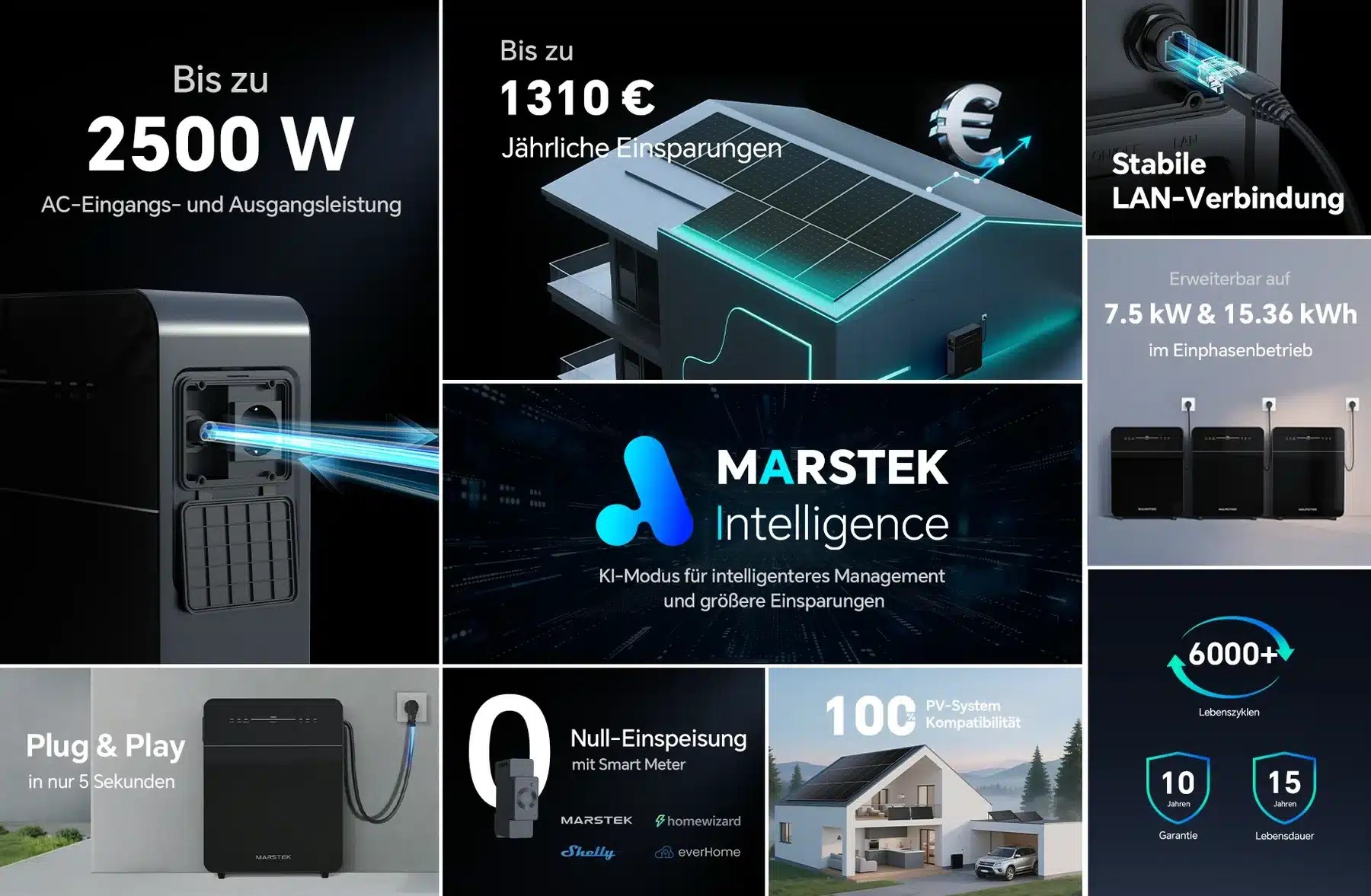
With the CT002, this not only worked reliably, but also quickly. The OFF-Grid socket also scored well in the test. You can use it to connect important consumers that need to be supplied with power in the event of a power failure. As a maximum output power of 2.5 kW is offered, a power-hungry refrigerator can also be protected here without any problems.
One storage unit alone offers a whopping 5.12 kWh of battery capacity. If that’s not enough, you can add two more storage units, increasing the maximum capacity to a good 15 kWh. And it’s not just the battery capacity that increases. In this case, the output power also increases to up to 7.5 kW. But in theory, even more is possible. Three storage units can be distributed across each of the three phases, resulting in a total of nine storage units. In this scenario, we are talking about a capacity of 46 kWh and a maximum output power of 22.5 kW. This makes the MARSTEK VENUS E a serious storage system for full-blown PV systems.
However, while the MARSTEK is suitable for large PV systems, the situation is a little different for balcony power plants. This is because the legally prescribed feed-in maximum of 800 W can be easily bypassed via the app. This means that problems could arise in the event of an inspection. In addition, many users are currently (as of February 2026) experiencing that connecting the microinverter of a balcony power plant to the OFF-Grid socket means that the 800 W limit is not adhered to even if it has been set in the app. This was the experience of the Smartzone testers, for example, in their test.
The Marstek Venus-E Gen 3.0 AC impresses in the test as a powerful, high-quality and visually appealing AC storage system. Particularly noteworthy are the extremely simple commissioning, the high output power of up to 2.5 kW per device and the enormous scalability, which also makes it interesting for large, mature PV systems. In combination with a smart meter, the Venus-E unfolds its full potential and works reliably, quickly and efficiently to maximize self-consumption and minimize grid consumption and feed-in. The Marstek app also offers a good overview, useful automation and flexible operating modes.
The main points of criticism remain the high weight, which clearly positions the storage unit as a stationary solution, as well as minor comfort details such as the lack of a precise display of the charging status on the device itself. The Marstek Venus-E is also currently only recommended to a limited extent for balcony power plants, as there may be problems in practice with complying with the statutory 800 W limit. All in all, however, the Marstek Venus-E Gen 3.0 AC is a very attractive AC storage system with a strong price-performance ratio, modern appearance and high performance – ideal for users of larger PV systems who are looking for an uncomplicated, flexible and future-proof storage solution.
PRO

CONTRA
A powerful, high-quality AC storage system for larger PV systems that impresses with its simple installation, high output and scalability – but is less suitable for balcony power plants and is clearly designed as a stationary solution due to its weight.
Your email address will not be published.
Contact us via one of our social media channels to send us your comments or suggestions for improvement. We look forward to your message!
You are currently viewing a placeholder content from Facebook. To access the actual content, click the button below. Please note that doing so will share data with third-party providers.


You must be logged in to post a comment.