
Sign In or Create an Account.
By continuing, you agree to the Terms of Service and acknowledge our Privacy Policy
Welcome to Heatmap
Thank you for registering with Heatmap. Climate change is one of the greatest challenges of our lives, a force reshaping our economy, our politics, and our culture. We hope to be your trusted, friendly, and insightful guide to that transformation. Please enjoy your free articles. You can check your profile here .
subscribe to get Unlimited access
Monthly
$9.99
Auto-renews monthly
Annual
$99.00
Lock in your annual rate
Offer for a Heatmap News Unlimited Access subscription; please note that your subscription will renew automatically unless you cancel prior to renewal. Cancellation takes effect at the end of your current billing period. We will let you know in advance of any price changes. Taxes may apply. Offer terms are subject to change.
Subscribe to get unlimited Access
Hey, you are out of free articles but you are only a few clicks away from full access. Subscribe below and take advantage of our introductory offer.
subscribe to get Unlimited access
Monthly
$9.99
Auto-renews monthly
Annual
$99.00
Lock in your annual rate
Offer for a Heatmap News Unlimited Access subscription; please note that your subscription will renew automatically unless you cancel prior to renewal. Cancellation takes effect at the end of your current billing period. We will let you know in advance of any price changes. Taxes may apply. Offer terms are subject to change.
Create Your Account
Please Enter Your Password
Forgot your password?
Please enter the email address you use for your account so we can send you a link to reset your password:
Aluminum goes through the Strait of Hormuz, too.
The strangulation of the Strait of Hormuz and consequent overnight squeezing of the world’s oil supplies by around 10% (not to mention the effects on liquified natural gas and petroleum products like naphtha) should be a boon to solar power. Already, according to analysis by Lauri Myllyvirta of the Centre for Research on Energy and Clean Air, countries like Pakistan that embraced solar power to reduce their reliance on fossil fuel imports can expect to save $7 billion on their import bills this year.
But it’s not just hydrocarbons that come out of the Strait of Hormuz. It’s also metals, and specifically metals found in solar modules, like aluminum, making the energy consequences of the war considerably less straightforward.
Unlike with oil, there has been no extensive effort to set up alternative transit routes for aluminum on the high seas. Also unlike other fossil fuels, there are few other transport methods available for aluminum (it’s tough to get metal through a 48-inch pipeline).
Furthermore, aluminum is not simply pumped out of the ground. The process starts with bauxite, a reddish ore found in tropical and subtropical regions, which is ground and processed to extract alumina, a white powder. From there, the alumina is dissolved in a molten cryolite bath, through which an electric current is passed, producing molten aluminum that is then cooled into the product we find in cars, laptops, and solar panels, a process known as smelting.
The smelting process is extremely electricity intensive, with power accounting for between 30% and 40% of production costs, according to Morgan Stanley. This is why aluminum smelting tends to be concentrated not in areas with abundant bauxite, but rather in places with cheap electricity, meaning that bauxite or alumina often has to be imported to where the smelters are.
The Persian Gulf region produces just 3% of alumina and only around 1% of the world’s bauxite, Morgan Stanley estimates, compared to 9% of the world’s aluminum.
As a total picture, it isn’t pretty.
“In the event of a more prolonged shipping disruption through the [Strait of Hormuz], concerns about the region’s raw material availability are likely to grow,” Morgan Stanley analysts wrote in a note to clients on Monday.
Aluminum producers have already begun to halt production of the metal. Aluminum Bahrain, for instance, has started the process of shutting down three production lines, “which together represent 19% of Alba’s total production capacity of 1,623,000 metric tonnes per annum,” the company said on Sunday. Qatalum, based in Qatar, began shutting down two weeks ago due to its inability to obtain natural gas due to Iranian strikes on the country’s gas infrastructure, which could take up to 648,000 metric tons of capacity off the market.
All of this disruption has had exactly the market effect you would expect, with aluminum prices hitting four-year highs just after the airstrikes began before tracking back slightly. On February 27, aluminum was $3,157 per ton; today, it’s $3,395.50. Jefferies analyst Shuhang Jiang estimated earlier this month that if the Strait of Hormuz stayed closed into April, “the market will fall into deficit.”
So what does this have to do with solar panels?
Aluminum is used in the frames, mounts, and racks of solar panels, making the metal one of the major physical cost components of solar systems. While other elements have inflated on solar costs in the past year — especially silver, which is used as a conductive paste on a solar panel’s silicon wafers, the price of which has skyrocketed since last year — aluminum is one of the “key cost centers” of solar panels, according to Intertek CEA, a solar advisory firm.
In the United States, an installed utility-scale system costs on average $1.10 per watt, while a residential rooftop system costs $2.90. Every $500 per ton change in the price of aluminum results in about a $0.02 per watt change in the cost of the module, according to Joseph Johnson, associate director of market intelligence at Intertek CEA. That happens to be just about the change in the price of aluminum since the end of last year.
“In the U.S., [$0.02] is considered a rounding error and is generally ignored as it is not nearly enough of a price movement to matter in overall project viability,” Johnson told me. “In European or other international markets, it’s very much a death by 1,000 cuts scenario, where $0.02 per watt from aluminum is already a noticeable increase.”
Aluminum prices were already rising before February 28 due to factors like tax code changes in China that hurt exporters and the effects of trade restrictions such as Europe’s carbon tax on imports and Trump’s tariffs. All of that combined put a “tremendous amount of pressure on PV projects that depend on Chinese modules,” especially outside the United States. Those material costs have all continued to rise since the U.S. strike on Iran, as other more energy intensive materials such photovoltaic glass have also seen price hikes.
While a renewables-based energy system may be able to depend on its own sunshine, at least for now, it still depends on the same energy system it’s trying to transcend.
Matthew Zeitlin
Matthew is a correspondent at Heatmap. Previously he was an economics reporter at Grid, where he covered macroeconomics and energy, and a business reporter at BuzzFeed News, where he covered finance. He has written for The New York Times, the Guardian, Barron's, and New York Magazine.
Log in
To continue reading, log in to your account.
Create a Free Account
To unlock more free articles, please create a free account.
On a coal comeback, permitting reform, and NRDC’s nuclear conversion
Current conditions: A megastorm is bombarding more than 200 million Americans from the Midwest to the East Coast, blasting dozens of states with wind speeds as high as 80 miles per hour • Eight states — Alabama, Arkansas, Louisiana, Missouri, Oklahoma, Tennessee, and Texas — are bracing for sub-zero temperatures • It’s rainy and just over 50 degrees Fahrenheit in Dublin, Ireland, for St. Patrick’s Day.
When someone writes the definitive history of the Biden-era Inflation Reduction Act, one of the more ironic footnotes will be the fact that the breakthrough that gave rise to a new era for geothermal energy came 11 months after the law passed. As a result, geothermal was little more than a rounding error in the bill, receiving relatively little support compared to the billions of dollars allocated for next-generation nuclear power. Like nuclear power, geothermal is carbon-free, runs 24/7, and loved by both climate hawk Democrats and energy hawk Republicans. That’s exactly what’s behind a new bill to bolster the industry. Legislation set to be introduced in the Senate would boost federal funding and research for geothermal power, I can report exclusively in this newsletter. On Tuesday, Senators John Hickenlooper, the Democrat from Colorado, and Steve Daines, the Montana Republican, plan to propose the GEO Power Act to authorize the Department of Energy to “move beyond limited-scale pilots and unlock the large-scale geothermal electricity generation needed to meet surging demand and drive down costs,” according to the senators’ description of the bill. If passed, the GEO Power Act would allow the Energy Department to offer “innovative financing approaches” to help build up the industry in areas with little existing geothermal power. The bill would also “generate public data to de-risk future geothermal projects” and set milestones to make sure companies that receive funding maintain fiscal accountability. Two of the industry’s top trade groups, Geothermal Rising Action and the Enhanced Geothermal Systems Deployment Coalition, backed the bill, as did companies such as Fervo, Eavor, XGS Energy, and Quaise Energy. “We’re on the verge of harnessing a new wave of geothermal energy to meet surging electricity demand, lower prices, and address the climate crisis,” Hickenlooper said in a statement. “The key will be in scaling up new, next-generation geothermal projects across the country.”
Enhanced geothermal, a specific subset of next-generation technologies, could actually come online fairly quickly, too. New research by the Center for Public Enterprise, a think tank that tracks effective government spending on energy, suggests that a commercial-scale project of up to 500 megawatts could enter into commercial production within 36 to 52 months of active development, “with a conservative planning horizon of three to six years from project initiation to in-service,” assuming developers can secure necessary permits and transmission. That timeline “can be compressed even further, to less than three years, if a sufficient number of drill rigs and crews are available.”
Oklo has received its first license from the Nuclear Regulatory Commission, allowing the nuclear startup to begin recycling and selling isotopes “across medicine, research, advanced manufacturing, and national security,” I can exclusively report in this newsletter. The approval makes the California-based company the first of the cohort of fourth-generation reactor startups whose technologies use coolants other than water to get the green light to start up a commercial operation of any kind. Once operational, it will also allow Oklo to begin generating revenue for the first time. The NRC has given out permits to rival fourth-generation companies only for construction activities. The Bill Gates-backed TerraPower, for instance, was granted permission just this month to begin construction on its first commercial power plant in Wyoming, as was the Google-backed Kairos Power for its demonstration facility in Oak Ridge, Tennessee.
The permit for the facility, dubbed Atomic Alchemy and located at the Idaho Radiochemistry Laboratory, authorizes the company to “receive, possess, use, store, and conduct” chemical and mechanical processing, packing, manufacturing, and distribution of a limited amount of Radium-226, which is used to make advanced cancer treatments, in addition to a handful of other isotopes. “Demand for critical isotopes is rising, but U.S. supply remains limited,” Jacob DeWitte, Oklo’s chief executive and co-founder, said in a statement. “This work helps create a more resilient and dependable domestic supply chain of isotopes and supports the transition from early operations to durable, commercial isotope production in the United States.” The license grants the company a foothold in one of its core businesses. On top of designing liquid sodium-cooled microreactors the startup plans to own and operate for electricity production, Oklo is building out a division to reprocess and recycle nuclear waste into fresh fuel for its power plants. That business, too, would involve extracting and selling high-priced medical isotopes from spent fuel, and Atomic Alchemy lays the groundwork for that future effort. To construct this debut facility, Oklo plans to build four non-power Versatile Isotope Production Reactors systems with a capacity of about 15 megawatts-thermal each.
The United States could get its first new coal-fired power plant since 2013 as part of a sweeping $56 billion deal the Trump administration announced Monday with 17 Indo-Pacific countries. Terra Energy Center reached a $1 billion deal with South Korea’s Hyundai Industries Power Systems to supply large-scale boilers for a new, more than 1.2-gigawatt coal plant in Alaska. It’s the first order for utility-scale coal boilers in the U.S. since about 2006. KOREIT, one of Korea’s largest private equity firms focused on infrastructure, pledged to make a $500 million equity investment in the Terra Energy Center project.
Coal use has collapsed in the U.S. over the past two decades as hydraulic fracturing, or fracking, made natural gas cheap and abundant, the prices of renewables and batteries dropped, and decarbonization policies encouraged the closure of existing stations. Today coal generates about 16% of America’s electricity. But President Donald Trump has sought to stimulate demand for coal by forcing retiring plants across the country to remain open past their closure deadlines and easing regulations such as limits on mercury emissions from existing stations. The policies have delivered mixed results. Coal use has recently seen spikes. But states such as Washington are finding loopholes, as Heatmap’s Emily Pontecorvo reported. Either way, as Heatmap’s Matthew Zeitlin wrote last year, coal plants just keep breaking down.
Sign up to receive Heatmap AM in your inbox every morning:
The Trump administration declined to appeal a federal court ruling in favor of the offshore wind project that, as I wrote yesterday, came online this week off the coast of Rhode Island. Last week, the Department of Justice whiffed on filing an appeal before the deadline to challenge a federal judge's injunction blocking a Department of the Interior order meant to stop construction on Revolution Wind over national security concerns.
E&E News called the move “a potential sign of the importance of bipartisan permitting negotiations.” In December, the top climate hawks in the Senate told Heatmap’s Jael Holzman that their votes on permitting reform hinged on the legislation barring the Trump administration from continuing its assault on offshore wind and solar. When the SPEED Act passed in the House later that month, right-wing Republicans conditioned their support on a carve-out specifically granting Trump the power to go after renewables. A new bipartisan bill introduced last month, called the FREEDOM Act, rekindled those negotiations by specifically barring the executive branch from yanking already-granted permits, whether it’s an offshore wind farm or an oil pipeline.
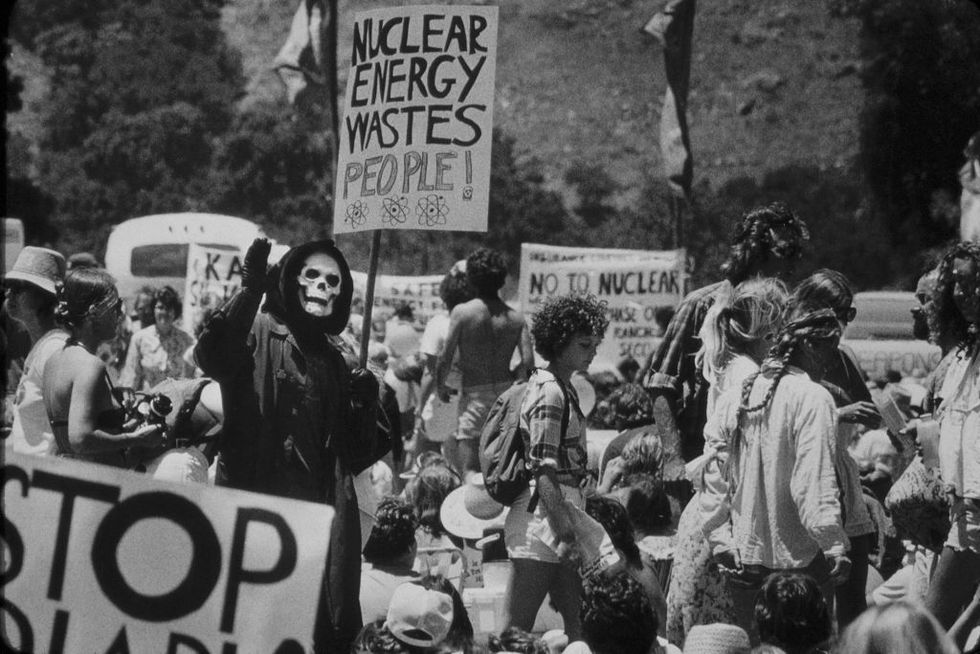 An anti-nuclear protest in California in June 1979. Getty Images/Bob Riha, Jr.
The Natural Resources Defense Council cut its teeth fighting against the expansion of nuclear power. Now the storied conservation group has come out in support of atomic energy for the first time. The NRDC filed comments in support of restarting Iowa’s defunct Duane Arnold nuclear plant, the state’s only atomic power station, which closed in 2020. “This is unprecedented for us because it marks the first time in our history that we have taken action in support of an individual nuclear power plant,” Manish Bapna, president and chief executive of NRDC, told Axios.
The move comes just days after the Nuclear Regulatory Commission took its latest step to speed up approvals of new reactors. The rule proposed last week would set fixed, accountable fee caps for new and current licensees and reduce fees for prospective applicants. “We need to cultivate accountability internally, incentivize applicants, and lower barriers for new technologies,” NRC Chairman Ho Nieh said in a statement. “This rule supports innovation and aligns with the NRC’s principles of efficiency and reliability.”
Nevada’s biggest utility is putting off launching a new rate structure that critics warn could raise household electricity costs by changing the billing formula. State regulators gave NV Energy permission last year to charge customers in southern Nevada on the 15-minute period each day when they use electricity the most rather than tallying up total usage. The new charge was set to come into effect on April 1. But NV Energy told E&E News it would hold off until October 1 to inform customers of what they should expect. “Postponing the implementation of daily demand is the right decision for our customers,” NV Energy President Brandon Barkhuff said in a statement. “This additional time will allow us to provide customers with personalized information and practical tools so they can better understand how their energy use affects their bill before daily demand takes effect.”
With developers buying up large swathes of land in the Salt River Project service area, its governance is less certain than ever.
Early voting began last week for control of the Salt River Project, the large water and electric utility that serves the Phoenix metropolitan area. Due to a convoluted series of events dating back to 1903, it is the only major election in the United States since before the Civil War that still requires voters to be landowners, with the value of one’s vote tied directly to how much land one owns. If you’re on a sixth of an acre, as many people in the Valley are, you get one-sixth of a vote. If you’re a renter, you get zero. Large landowners may get hundreds.
Because only an estimated 1% of eligible voters actually cast ballots in the SRP races — until recently, to learn if you even could vote, you had to call the corporate secretary on the phone — the utility has been a target for clean-energy and environmental groups, who see the election as a high-leverage opportunity to flip the traditionally more conservative board, council, and presidency, and press for more investment in renewables. Despite being located in one of the country’s sunniest regions, only around 8% of the SRP’s portfolio is solar. In recent years, groups like Lead Locally, the Sierra Club, and Jane Fonda Climate PAC have helped put six renewable energy advocates on the 14-member board.
“We’ve been gradually building towards the majority, and this is the year we can realize that,” Arizona State Senator Lauren Kuby, who ran for an SRP board seat in 2024 and lost, told me. Also up for election this year are Sandra Kennedy and Casey Clowes, a young Sunrise Movement activist, who are running together for president and vice president of the board, marking a significant push by clean-energy advocates for greater control.
If the slate fails to make a dominant showing, the alternative is “a board that’s pushing for more fossil fuels, and that’s going to be really bad,” Nick Arnold, a political committee chair for the Sierra Club Grand Canyon Chapter, told me. The Salt River Project would become “ground zero for an even worse cost‑of‑living crisis than we’re already seeing across the country,” he added — especially given the recent influx of data centers.
Though many Phoenix-area data centers are located outside the SRP voting area, a Heatmap analysis found at least 60 across 40 distinct locations within the SRP’s voting territory that are already operating or under construction. “What we’ve seen is that land that has been stewarded by a family trust has been reclassified into an LLC to be sold off for data center development, which makes it ineligible to vote in the SRP election,” Arnold said.
Because land is directly tied to votes in the SRP election and businesses can’t vote, the more acres in corporate hands, the fewer votes available for candidates of any stripe. With the margins in SRP elections often in the high hundreds or low thousands, a few large data centers can make the results unpredictable. Data center companies purchased roughly 500 acres of land within the Salt River Project boundaries in 2024 alone, the analysis found, chunks of which would have counted as votes in prior years. Though much of that land was located in odd-numbered districts, which don’t vote this year (again, this is a very strange kind of election), what’s certain is that the voter rolls are changing — and influence is being redistributed.
The strangeness also creates a potentially complicated flip side for the clean energy advocates, who are wary of data centers encroaching on the Valley’s limited water resources: In theory, the more landowners who sell to data center developers, the stronger small voters will become in the SRP elections as large, single-voter-owned parcels are taken off the map.
Large landowners tend to prefer the status quo. In Kuby’s previous attempt at getting a seat on the board, she lost to an alfalfa farmer and son of a former SRP president who named one of his LLCs Hitler Management as a “joke.”
“All [Kuby’s opponent] had to do was call up 10 to 20 of the largest-acre voters and make sure they get their ballot in for him,” Arnold said. “It’s that easy for status quo pro‑fossil‑fuel people to whip their votes, as opposed to adding up to that same amount across a bunch of 0.1- to 0.4-acre homes.”
Yet despite the potential rebalancing of the scales, shenanigans still abound. Ahead of the 2024 election, for example, one longtime agricultural family transferred around 217 acres from an LLC, which can’t vote, into a trust, which can, according to an investigation by Stephanie Chase of the Energy & Policy Institute, an anti-fossil fuel watchdog group. After the family’s preferred candidate won by a margin of 263.88 votes — 76% of which was attributable to the hastily thrown-together trust — the family then transferred the land back into an LLC and sold it to a data center.
I spoke to Chase about her report, and she told me she sees the data center component as mostly incidental. “The bigger story,” she said, “is the outsized influence that large landowners have in the SRP races because of how their voting scheme is set up.” But she also noted that “eventually, if a data center is developed [on the family’s land], they’re going to have influence and say in how any contract between SRP and that data center company gets developed or agreed upon.”
In seeming confirmation of how intertwined the SRP elections and data center issues are, developer Edgecore is reportedly planning a massive “technology and employment hub” on the Dobson Farm, the Dobsons being another major landowning family in the Valley. Chris Dobson is also running for SRP president this year.
Meanwhile, both Edgecore and Google, which is building its own data center complex in Mesa, have donated to Arizonans for Responsible Growth, a political action committee linked to Turning Point USA, the far-right political group founded by Charlie Kirk. (Google recently pulled back money from the PAC, potentially over concerns about bad press, the Phoenix New Times reports.)
Turning Point’s entry into the SRP race has caused major alarm among clean energy organizers; a spokesperson for the slate of clean-energy candidates told Axios they’re being outspent 10-to-1. But Ken Clark, who is part of the coalition and running for election in District 6, told me that the conservative group’s efforts could still backfire. Because of the hoops voters have to jump through to cast a vote in the SRP race, outcomes have historically been determined by which side is better at motivating voters to request ballots. “I do believe that Turning Point USA is inadvertently registering — for lack of a better word — a lot of people who are probably uncomfortable with their message or uncomfortable with data centers,” he told me.
Heatmap Pro’s opinion model, which forecasts data center and clean energy opposition based on proprietary polling and demographic data, backs up Clark’s instinct, showing that people in Phoenix’s Maricopa County strongly oppose the development of data center projects.
It remains anyone’s guess how, or even whether data centers will affect the outcome of the 2026 SRP elections, which conclude on April 7. But they seem all but certain to in the coming years. Since the margins of the Salt River Project elections are often in the high hundreds or low thousands of votes, even a single data center that takes votes off the map could, in theory, tip the balance of a race — perhaps even against the data centers themselves.
“The board has the power to either make things more affordable or double down on fossil fuels and supply the data centers with energy subsidized by ratepayers,” Arnold said. “It’s a scary two paths that we’re looking at this year.”
On Revolution Wind, mineral refining, and German antinuclearism
Current conditions: A megastorm is pummeling the Midwest with a blizzard and the Northeast with torrential rain that, in some places, will occur in intense bursts of more than an inch per hour • Triple-digit temperatures as high as 110 degrees Fahrenheit are coming for the Southwest in the next few days, weeks ahead of the historical norms • Days after a magnitude 6.3 earthquake hit Chile, a magnitude 5.3 tremor struck off the coast of El Salvador and Honduras.
Get ready to feel the pinch. With Iran promising to drive up the global cost of oil past $200 per barrel, U.S. Secretary of Energy Chris Wright issued a stark warning. During an appearance on ABC News’ This Week, the Trump administration’s energy chief urged Americans to prepare for belt-tightening. Gas prices have already risen $0.76 per gallon on average since the start of the war — and more than $0.51 just in the past week. GasBuddy said prices surged “at one of the fastest rates” in years. Prices may come down in the next few weeks, Wright added, but “there’s no guarantees in wars at all,” he said. “This is short-term pain to get through to a much better place.”
Revolution Wind is on. On Friday, the 704-megawatt offshore wind farm started pumping electricity onto New England’s grid from off the coast of Rhode Island. As the turbine array neared completion, the Danish developer Orsted was forced into battle against the Trump administration’s attempts to yank permits from the project — and won repeatedly, as Heatmap’s Jael Holzman wrote. “Revolution Wind is adding affordable, reliable American-made energy to New England’s grid, helping to meet growing energy demand and lower consumer costs,” Amanda Dasch, Orsted’s chief development officer, said in a statement.
That same day, Vineyard Wind 1, the first phase of the project owned by Avangrid and Copenhagen Infrastructure Partners off the coast of Massachusetts, installed its final turbine, the New Bedford Light reported. “U.S. offshore wind continues to power forward,” the Oceantic Network, a pro-offshore wind nonprofit, said in a statement cheering the domestic offshore wind industry for “demonstrating its true potential every day.”
The Department of Energy is offering up to $500 million in funding to companies that refine and recycle critical minerals. On Friday, the Office of Critical Minerals and Energy Innovation filed a notice of funding opportunity. The agency said it sent officials to Japan to meet with allies on critical minerals. “Critical minerals processing is a vital component of our nation’s critical minerals supply base,” Audrey Robertson, the assistant secretary of energy, said in a statement. “Boosting domestic production, including through recycling, will bolster national security and ensure the United States and our partners are prepared to meet the energy challenges of the 21st century.”
The Trump administration announced plans last month to build out a $12 billion mineral stockpile, as I wrote at the time. Reporting in the South China Morning Post last week suggested the U.S. could run out of key rare earths in just two months if China chose to completely cut off supplies. Add the U.S. government to the list of people covered under the headline Heatmap’s Katie Brigham put out last September: “Everybody wants to invest in critical mineral startups.”
Sign up to receive Heatmap AM in your inbox every morning:
The Trump administration greenlit a $5 billion oil drilling project in ultradeep waters of the Gulf of Mexico despite what The New York Times described as “protests from Democrats and environmental activists who said the venture posed significant risks to wildlife and communities.” The project from BP would produce 80,000 barrels of oil per day from six wells starting in 2029 in an area of seafloor roughly 250 miles off the coast of Louisiana. Dubbed Kaskida, it would be the British energy giant’s second deepwater project in the Gulf since the Deepwater Horizon explosion in 2010 set off the worst oil spill in U.S. history.
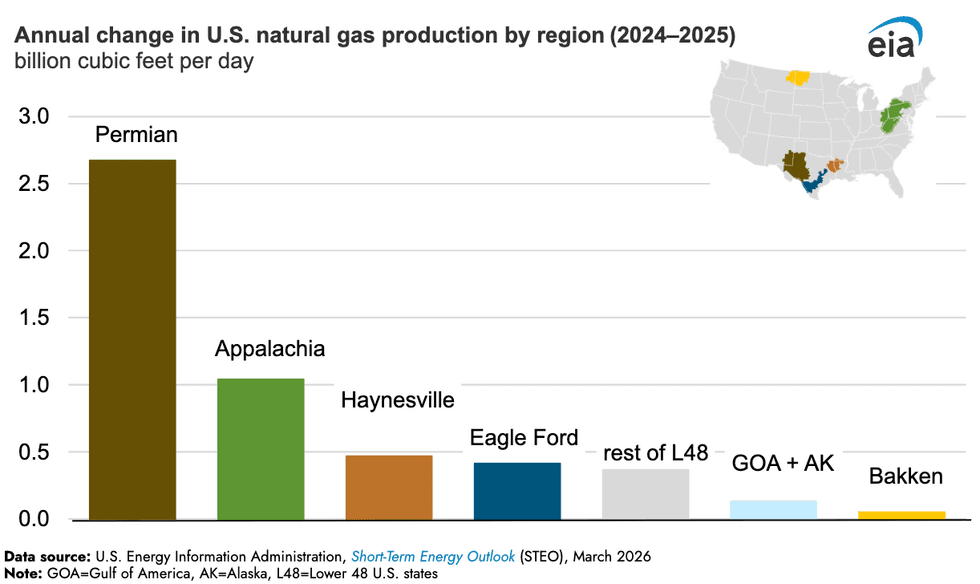 Everything is bigger in West Texas.EIA
Natural gas production, meanwhile, hit a record in 2025, growing by 5.3 billion cubic feet per day, according to the latest analysis from the Energy Information Administration. Three regions — Appalachia, the Permian, and Haynesville in Louisiana — accounted for 67% of the total production increase and 81% of the growth.
Germany regrets phasing out nuclear power. More than half the country now wishes the government hadn’t shut down the last nuclear power plants in 2023, polls show. Chancellor Friedrich Merz called the phaseout “a huge mistake” with “strategic consequences.” Ursula von der Leyen, the German politician who currently serves as president of the European Commission and the European Union’s figurehead, likewise described her native country’s atomic exit as “a strategic mistake.” Despite the rhetorical alignment, the government in Berlin is coming out against the EU’s nuclear expansion plans. In a statement last week, Federal Minister Carsten Schneider called nuclear reactors “high-risk technology” and said “setting up new reactors on a notable scale would require very large amounts of money that would then not be available elsewhere.” Rather, he said, “alternatives have long since been available,” such as wind and solar. “As far as Germany is concerned, instead of chasing a nuclear mirage, we will focus our resources on better, safer, and more economic alternatives,” he said. “Our country has become a much safer place thanks to our phase-out of nuclear power.” Soaring electricity prices and surging coal use suggests otherwise.
Switzerland, meanwhile, has not only halted its nuclear phaseout. Now the country is considering a bill that would allow construction of new reactors, NucNet reported.
As the world gets hotter, it’s going to be raining men. Well, at least it might be for the reptilian versions of The Weather Girls, the singers behind the 1982 hit. American alligator eggs incubated around 86 degrees Fahrenheit tend to produce females, while temperatures near 91 degrees yields males. But the effects of temperature on squamates, the large and diverse group of reptiles that includes lizards and snakes, had been largely overlooked. New research on leopard geckos, which is set to be published in Developmental Biology by a group of Japanese scientists, found that about 79 degrees is the best temperature for females, while about 90 degrees leads to males. The study “contributes significantly to the broader understanding of the evolutionary plasticity and molecular complexity by which environmental cues direct biological fate,” Shinichi Miyagawa, Tokyo University of Science professor who authored the study, said in a press release.


