“Prime Minister said the future of energy security lay in clean energy, emphasising that countries investing in renewable technologies would be better positioned to navigate an increasingly uncertain global energy landscape……….”
Mohammad Irfan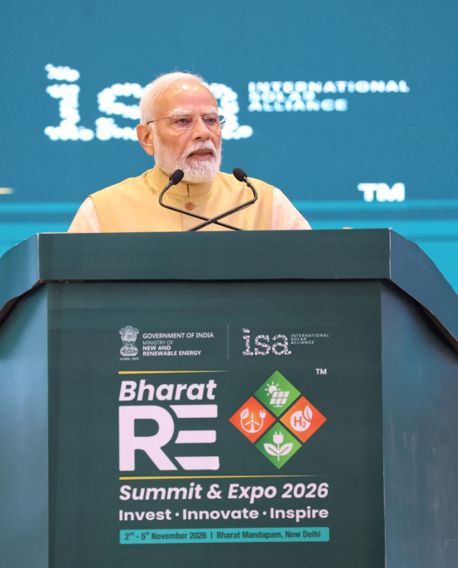 As global energy markets grapple with geopolitical uncertainties, supply disruptions and fluctuating fuel prices, Prime Minister Narendra Modi on Monday outlined an ambitious vision for India’s clean energy future, positioning renewable power not merely as an environmental necessity but as a strategic pillar of economic resilience, industrial growth and national energy security. Inaugurating the Bharat Renewable Energy Summit & Expo 2026 at Bharat Mandapam in New Delhi, Modi said India’s sustained investments in renewable energy over the past decade had strengthened its ability to withstand global economic shocks while maintaining robust growth. Addressing industry leaders, investors, innovators, startup representatives and international delegates, the Prime Minister said the future of energy security lay in clean energy, emphasising that countries investing in renewable technologies would be better positioned to navigate an increasingly uncertain global energy landscape. The summit, being held alongside the Ninth Assembly of the International Solar Alliance and with participation from delegates attending the Fourth Conference on Green Hydrogen, brought together policymakers, technology developers and investors at a time when the global transition towards sustainable energy is acquiring greater economic and strategic significance. Prime Minister Modi said the world had experienced unprecedented disruptions, from the COVID-19 pandemic to the ongoing crisis in West Asia, exposing the vulnerabilities of economies dependent on conventional energy supplies. He credited India’s sustained investments and systemic reforms in the clean energy sector with helping the country navigate these challenges. “If India had not invested in clean energy and created new systems for this over the past decade, then our crisis could have been much more severe than the rest of the world,” the Prime Minister said.
Clean Energy At The Heart Of Economic Security: One of the central messages of Modi’s address was the growing connection between energy security and economic stability. The Prime Minister observed that fossil fuel reserves were finite and concentrated in a limited number of geographical regions, leaving importing countries vulnerable to geopolitical tensions, supply disruptions and international price fluctuations. Renewable energy, by contrast, offers countries an opportunity to diversify their energy systems through resources such as sunlight, wind and water. “And we all know, the future of energy security lies in clean energy,” Modi asserted. For India, one of the world’s largest energy consumers, this transition carries considerable economic significance. Expanding domestic renewable generation can reduce exposure to imported fossil fuels in the electricity sector while creating opportunities for manufacturing, infrastructure development, technological innovation and employment. The Prime Minister’s emphasis on clean energy as an economic safeguard also highlighted the changing nature of energy security.
India’s 500-GW Ambition Enters A New Phase: Highlighting the progress made during India’s clean energy journey, Modi said the country had moved steadily towards fulfilling its international climate commitments while expanding its domestic renewable energy infrastructure. He recalled India’s commitment announced at COP26 to achieve 500 gigawatts of non-fossil fuel electricity capacity by 2030. According to figures cited by the Prime Minister, India achieved the milestone of sourcing more than half its installed electricity generation capacity from non-fossil sources in 2025, five years ahead of its 2030 target. He said the country’s non-fossil installed capacity had reached nearly 300 GW, placing India among the leading nations in renewable and solar energy. Installed capacity, however, is distinct from actual electricity generation, which depends on factors such as weather conditions, plant utilisation and grid demand. Looking beyond the current decade, Modi announced an ambitious objective of adding another 500 GW of non-fossil capacity over the next 10 to 11 years. “This target is somewhat difficult, but I have faith in the capability of my country; therefore I say, we will do it!” he declared. The announcement signals an intention to sustain the expansion of India’s clean energy infrastructure beyond the existing 2030 commitments. Achieving such a scale of development would involve substantial investments in generation capacity, transmission infrastructure, energy storage, manufacturing and skilled manpower. It would also create opportunities for technology companies, equipment manufacturers, engineering firms and financial institutions participating in the energy transition.
Rooftop Solar Transforms Household Economics: A major focus of the Prime Minister’s address was the growing role of rooftop solar installations in reducing household electricity expenses. Prime Minister Modi highlighted the progress of the PM Surya GharMuft Bijli Yojana, launched in February 2024 with the objective of installing rooftop solar systems in one crore households. According to figures presented at the summit, more than 65 lakh households had joined the programme within approximately 24 to 25 months, with new installations progressing at a pace of nearly one lakh homes every six days. The Prime Minister cited a study indicating that participating households had experienced an average reduction of approximately 76 percent in their electricity bills. He said lakhs of families had reduced their bills to zero, while some households were earning additional income by supplying surplus electricity to the grid. The initiative illustrates how renewable energy can increasingly become part of household financial planning. For families, rooftop solar offers the potential to reduce recurring electricity expenses, while surplus generation can create additional financial benefits under applicable electricity regulations and net-metering arrangements.
Solar Power Moves Into Farms And Public Institutions: The Prime Minister also highlighted the expansion of solar power beyond conventional electricity generation into agriculture, public infrastructure and everyday economic activities. He said more than 44,000 government buildings had been connected with solar energy, resulting in annual savings of nearly Rs 700 crore. The figures illustrate the financial potential of solar installations in public institutions, where electricity consumption represents a recurring operational expenditure. Prime Minister Modi called for accelerating solar adoption across government buildings, schools, colleges, hospitals and streetlight networks. He also proposed encouraging healthy competition among states and local bodies to recognise successful implementation and facilitate the sharing of effective practices. In agriculture, the Prime Minister highlighted the PM-KUSUM scheme, saying solar irrigation facilities had reached more than 30 lakh farmers. According to the figures he cited, beneficiaries using solar pumps were saving nearly Rs 1 lakh annually. Solar irrigation can help reduce farmers’ dependence on conventional electricity or diesel-powered pumping systems, particularly where reliable grid connectivity remains a challenge. Prime Minister Modi urged policymakers and innovators to expand the use of solar technology beyond irrigation pumps. He suggested utilising uncultivated portions of agricultural land and farm boundaries for solar installations, potentially enabling farmers to derive additional economic value from available space.
Innovation To Drive The Next Solar Revolution: One of the most forward-looking elements of Modi’s address was his emphasis on innovation as the next major driver of India’s solar transformation. He said the emerging phase of the solar revolution must focus not only on expanding adoption but also on developing technologies that make renewable energy more practical, reliable and accessible. “This new era of the solar revolution is not just about adoption, it is equally driven by innovation,” the Prime Minister said. He urged startups, Indian Institutes of Technology, researchers, innovators and entrepreneurs to develop systems capable of meeting the maximum possible energy requirements of individual households through solar power. The vision extends beyond rooftop electricity generation to applications such as solar-powered cooking, charging of electric two-wheelers and cars, and integrated household energy management. Such innovations could gradually transform how households generate, store and consume electricity. For middle-class families, the development of affordable solar-powered appliances and charging systems could provide opportunities to reduce expenditure on conventional energy sources. Prime Minister Modi also called for specialised solar equipment for the dairy sector, animal fodder processing, crop harvesting and post-harvest activities. These applications could open new markets for Indian startups and manufacturers while extending clean energy benefits to rural enterprises.
“India’s solar module manufacturing capacity had increased from approximately 2 GW a decade ago to more than 200 GW, while solar cell manufacturing capacity had reached nearly 40 GW…….”
Animal Husbandry Manufacturing Emerges As A Major Growth Engine: The Prime Minister also highlighted the expansion of domestic manufacturing as an important feature of India’s renewable energy journey. He said India’s solar module manufacturing capacity had increased from approximately 2 GW a decade ago to more than 200 GW, while solar cell manufacturing capacity had reached nearly 40 GW. The growth represents a substantial expansion of the country’s domestic manufacturing base. Prime Minister Modi linked this development to the government’s Make in India and Atmanirbhar Bharat initiatives, emphasising the importance of building indigenous industrial capabilities. The expansion of solar manufacturing can create opportunities across multiple sectors, including engineering, electronics, glass, metals, logistics, installation and maintenance services. It also offers scope for greater domestic value addition and the development of supply chains serving both Indian and international markets. The next stage of manufacturing development will increasingly depend on advances in solar cell technology, energy storage systems, battery components and other critical equipment. A strong domestic manufacturing ecosystem could help India combine its expanding renewable energy demand with industrial development and export opportunities.
Green Hydrogen Opens New Industrial Possibilities: Beyond solar and wind power, Modi highlighted the National Green Hydrogen Mission as another major component of India’s energy transition. He said India was working towards producing 50 lakh tonnes of green hydrogen annually by the end of the decade. Green hydrogen, produced using renewable electricity, offers potential applications in sectors where direct electrification can be difficult, including certain industrial processes and heavy transport. The Prime Minister also referred to the introduction of India’s first green hydrogen train a few months earlier, presenting it as an example of emerging applications in the transport sector. The development of green hydrogen technologies could create new opportunities for electrolyser manufacturing, renewable electricity generation, industrial infrastructure and specialised engineering services. For industries seeking to reduce emissions, green hydrogen may become an important alternative in selected applications as technology matures and production costs decline. Its wider adoption will depend on the availability of competitively priced renewable electricity, infrastructure and sustained technological development.
Rs 2 lakh Crore Push For Green Power Corridors: Prime Minister Narendra Modi stressed that the expansion of renewable generation must be supported by efficient transmission infrastructure. Solar and wind resources are distributed unevenly across the country, making it necessary to transport electricity from high-generation regions to areas with greater demand. The Prime Minister highlighted the development of Green Energy Corridors, comprising dedicated transmission lines and substations, alongside the One Nation, One Power Grid framework. He said the integration of five regional electricity grids into a unified national network had strengthened the country’s ability to transfer electricity across regions. The Government is now advancing the next phase of transmission development, with an investment target of approximately Rs 2 lakh crore.
Rs 20 Lakh Crore Investment Opportunity: The Prime Minister also presented India’s clean energy sector as a major destination for domestic and international investment. He said renewable energy had attracted investments exceeding Rs 15 lakh crore, equivalent to approximately $164 billion, over the past decade. Of this, more than Rs 6 lakh crore, or approximately $63 billion, had reportedly been invested in the two years since the 2024 RE-INVEST Summit. Prime Minister Modi said investment opportunities in the sector could exceed Rs 20 lakh crore, or approximately $220 billion, by the end of the decade. He invited global investors to participate in India’s renewable energy expansion, citing the country’s large domestic market, growing demand and policy framework.
Clean Energy As A Source Of Employment: Prime Minister Modi emphasised that renewable energy expansion could generate substantial employment opportunities across the economy. The development of solar and other clean energy infrastructure requires workers across manufacturing, installation, engineering, transportation, maintenance and technical services. As renewable technologies become more widely integrated into households, agriculture and industry, the demand for specialised skills and services is expected to expand. The Prime Minister said the transition towards solar-powered cooking, transportation and other applications could support the emergence of new industries. For India’s young workforce, the sector presents opportunities in research, entrepreneurship, equipment manufacturing, project development and technical services. The growth of domestic innovation and manufacturing could also encourage startups to develop affordable technologies suited to Indian conditions and international markets.
India Seeks A Larger Global Clean Energy Role: The summit also highlighted India’s efforts to strengthen international cooperation in renewable energy. Prime Minister Modi reiterated the country’s commitment to the principle of “One Earth, One Family, One Future”, linking India’s domestic energy transformation with its wider global climate commitments. He said India wanted to share its clean energy innovations, technologies and implementation experience with other countries. The Prime Minister referred to a proposed $200 million Africa Solar Facility aimed at supporting solar energy development on the continent. The initiative reflects the importance of improving access to finance, technology and expertise in countries seeking to expand renewable energy infrastructure. Through the International Solar Alliance and other cooperative platforms, India has sought to promote greater international collaboration in solar energy deployment. Prime Minister Modi expressed confidence that the summit would strengthen partnerships among governments, investors, researchers and industry leaders.
Kashmir Horizon View: The Bharat Renewable Energy Summit & Expo 2026 highlighted the widening scope of India’s clean energy ambitions, from household rooftops and agricultural fields to industrial manufacturing, green hydrogen and international investment. The Prime Minister’s address presented renewable energy as an increasingly important part of the country’s economic and developmental strategy. The figures cited at the summit — nearly 300 GW of non-fossil installed capacity, more than 65 lakh households participating in the rooftop solar programme, expanding domestic manufacturing and substantial investment commitments — illustrate the scale of the transition underway. The next phase will involve translating additional capacity targets into reliable electricity supply, wider technological adoption, competitive manufacturing and new economic opportunities. By calling upon startups, educational institutions, industries and investors to participate, Modi placed innovation and public participation at the centre of the country’s future energy ambitions. His message was that clean energy should increasingly become part of everyday life, helping households save money, farmers reduce operating expenses, industries access new technologies and the country strengthen its energy security. As India looks towards the next decade, the renewable energy transition is set to influence not only how electricity is generated but also how homes function, industries operate and economic opportunities emerge. Concluding his address Prime Minister Modi called for collective international efforts to advance the global energy transition. “Only then will we be able to build a Clean Future, a Green Future, and a Secure Future,” he said. The summit thus brought into focus an evolving vision of India’s energy future — one in which clean power, domestic innovation, industrial expansion and international cooperation are expected to play increasingly important roles in shaping the country’s development.
(“Team Kashmir Horizon” is committed to continuous improvement and invites feedback and suggestions from readers and its followers on social media sites. Reader insights are considered vital for enhancing content quality and empowering the community. The team encourages open communication and values the thoughts and ideas of its audience, believing that such input will enable them to serve the public more effectively. The initiative aims to ensure that readers have the best possible experience with “Kashmir Horizon”. Interested individuals can reach out to us via email at [email protected].)
“Kashmir is incomplete without Kashmiri Pandits and it is deprived of a precious part of its soul,” he said, underlining…
“Today is not merely a date; it is a milestone that changed the direction of history and strengthened the spirit…
“From remembering Patel’s contribution to the integration of princely states to celebrating advances in satellite navigation and outlining measures to…
“Prime Minister’s message reflected the wide scope of police responsibilities in a country as large and diverse as India. Police…
“ Our goal is to identify and root out terrorism and every element associated with it in Jammu Kashmir,” Sinha…
“The administration has pursued a security framework focused on counterterrorism, action against terror financing and the protection of public institutions….
The publication of “Kashmir Horizon” as an English daily was started with a modest attempt on May 19, 2008.It has been a Himalayan attempt for “The Kashmir Horizon” to survive the challenges posed to journalism in the violence fraught place like Jammu & Kashmir.
© The Kashmir Horizon – Designed by Gabfire
© The Kashmir Horizon – Designed by Gabfire


You must be logged in to post a comment.