In the first half of this year, almost all news about Chinese electric vehicles going global follows the same pattern: which country BYD and its peers have occupied this time, how many more percentage points tariffs have been raised, and whether European consumers will accept these products.
On June 29, a piece of news stood out from the rest.
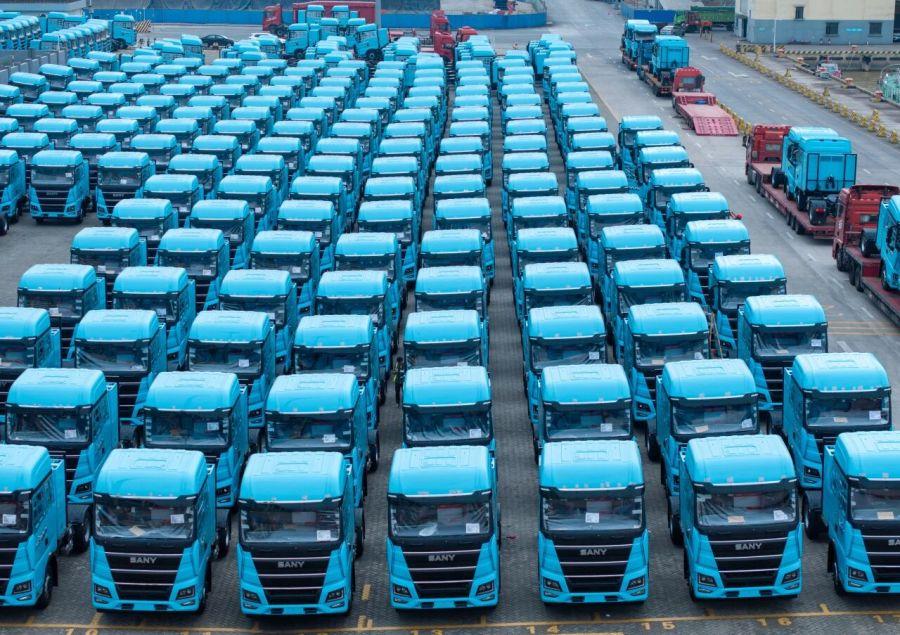
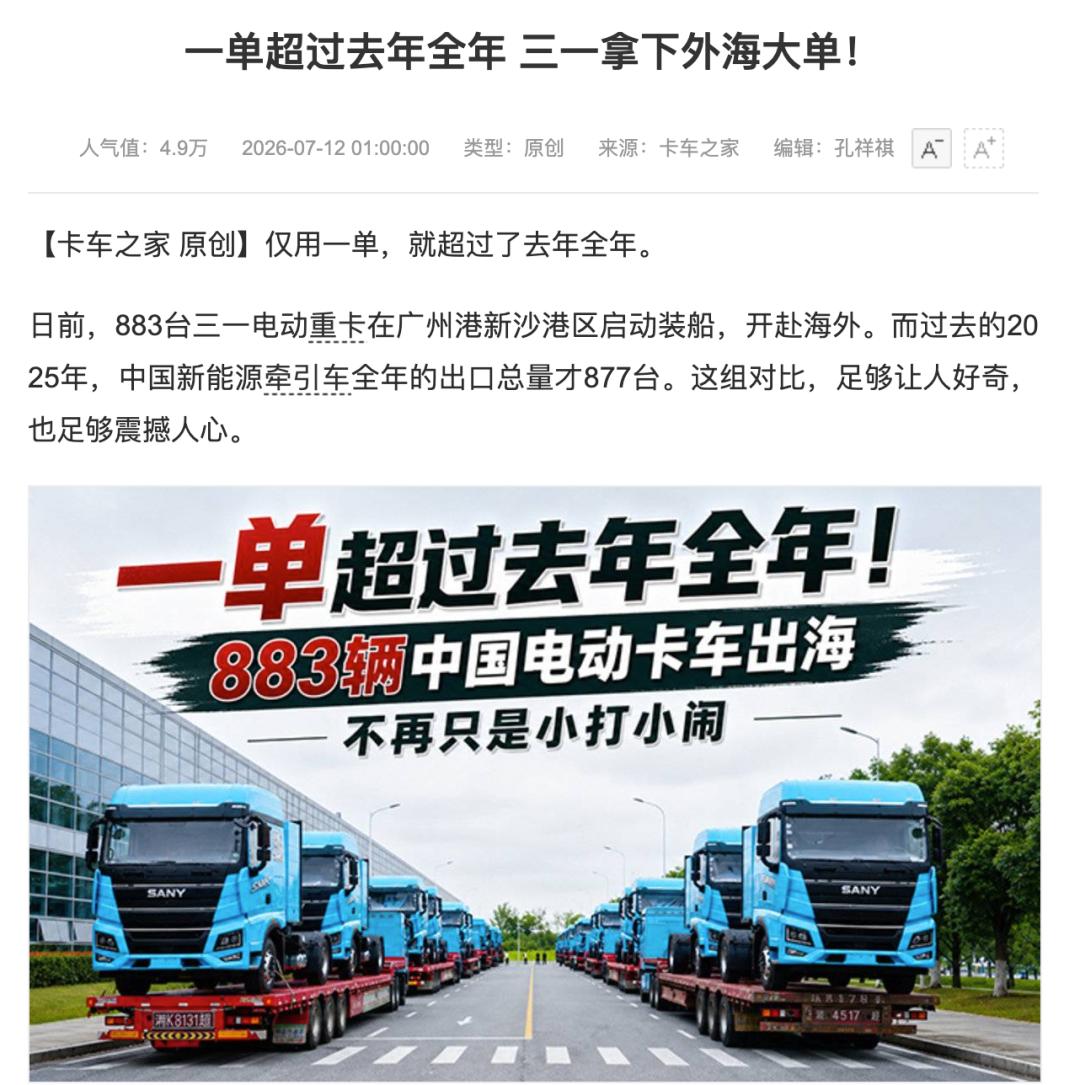
883 electric heavy-duty trucks were loaded onto ships at the Port of Guangzhou for delivery to overseas clients. The volume of this single order exceeded the total export volume of new energy tractors across China in 2025.
None of these vehicles will be parked in private garages or at shopping mall entrances for test drives. According to official statements, they will be deployed in overseas mines, ports and cement plants, undertaking the heaviest, dirtiest work that is least suitable for car advertisement shoots.
More than one such ship has set sail recently:
A large coal mine in Indonesia previously purchased over 150 XCMG electric dump trucks, and placed an additional order for 100 units after trial operation.
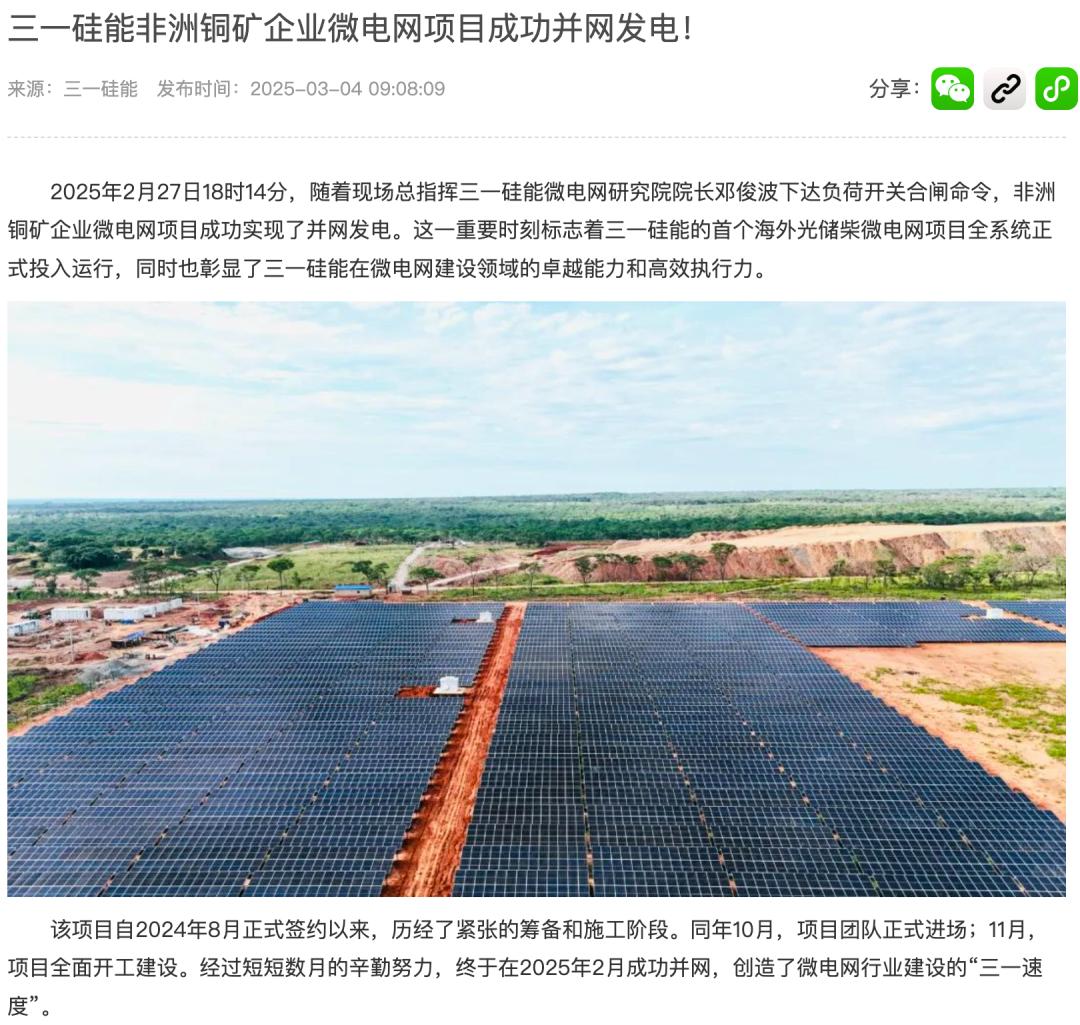
Last year, another 31 electric mining trucks were shipped to copper mines in Zambia, with supporting photovoltaic and energy storage systems delivered as a complete package.
Quiet, yet at a considerable scale.
Selling electric vehicles to mining sites is a completely different business from selling electric vehicles to ordinary consumers: they target different clients, use different accounting methods, and even the products offered are not the same. The offerings are not limited to vehicles, but also include photovoltaic panels, energy storage cabinets, and even a complete power generation system.
As another track of new energy globalization, this business line exports a packaged energy network.
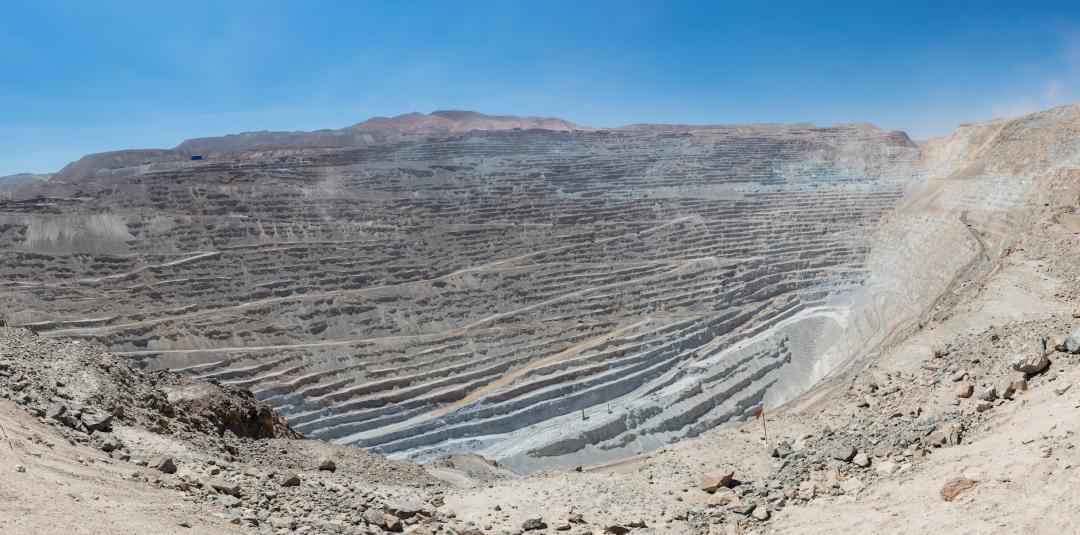
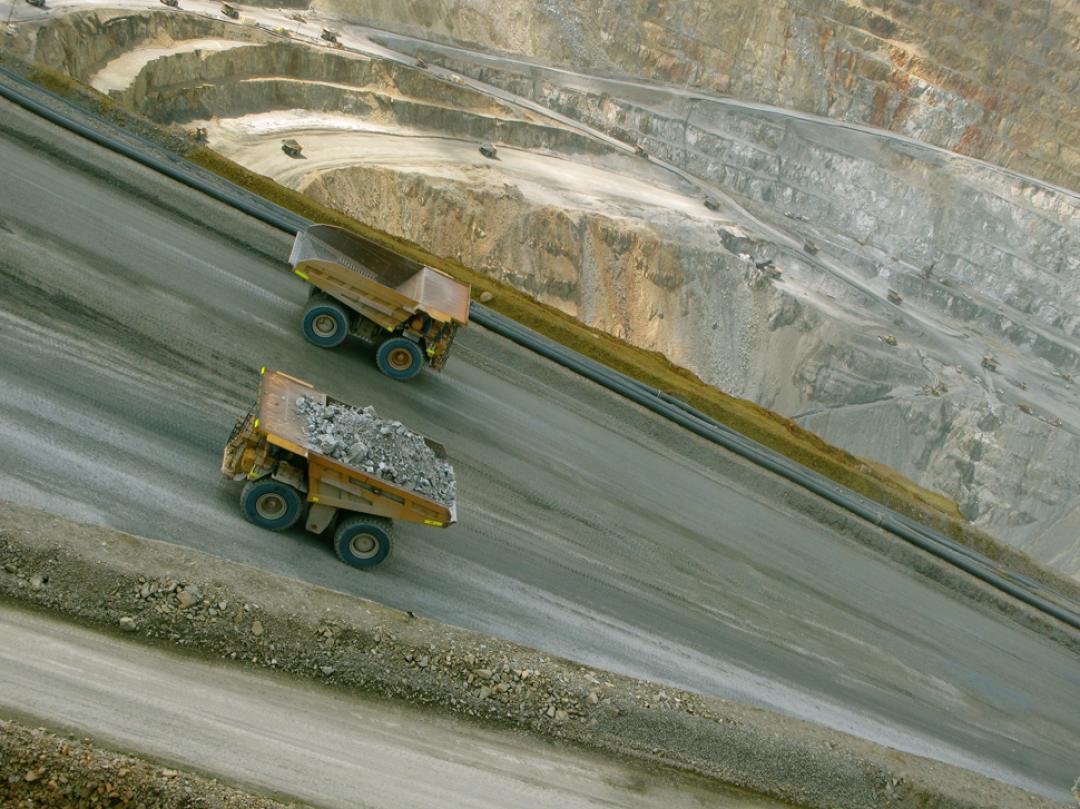
A large open-pit mine is a giant funnel several kilometers wide and hundreds of meters deep. Mining trucks get fully loaded with ore at the bottom of the funnel, climb up along the spiral ramp, drive to the crushing station to unload, then go back down empty for another load.
Their whole operation cycle is like an NPC in a game with a fixed pre-written route: there is only one fixed route, several kilometers one way, fully loaded uphill, empty downhill, repeating the same cycle nonstop.
They run for more than ten hours a day, operating nonstop all year round until they are scrapped.
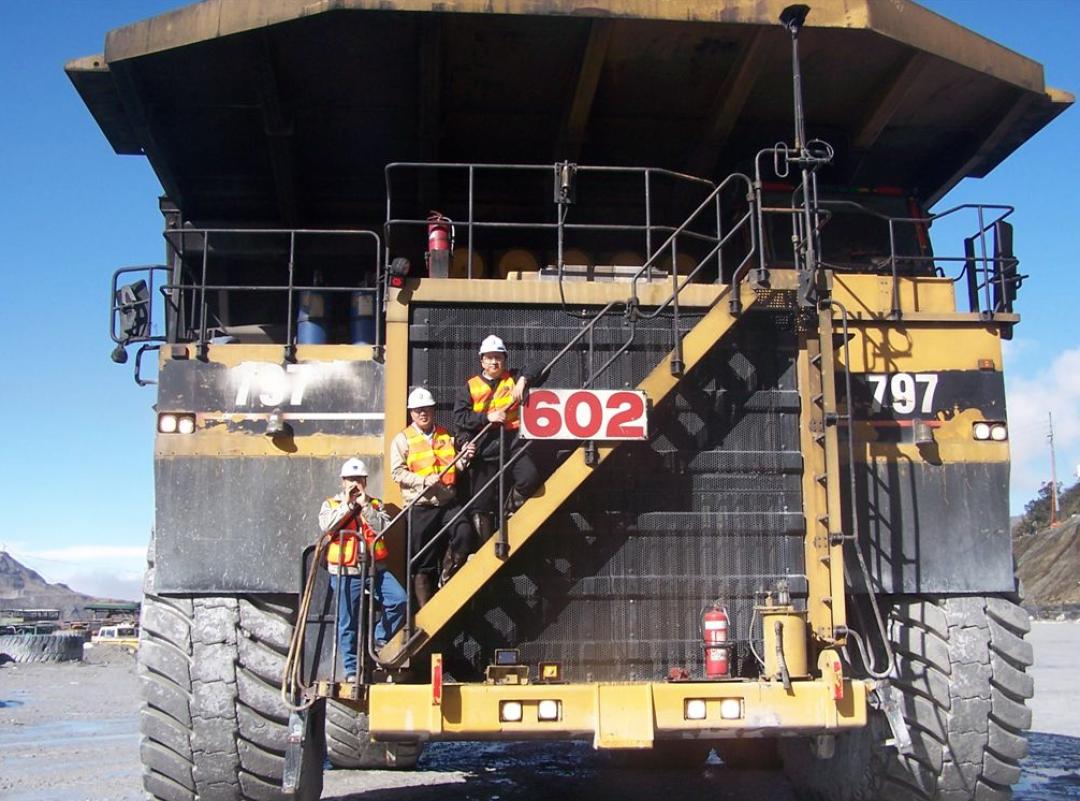
These vehicles do not run on public roads, and they look nothing like regular road vehicles: their tires are taller than an average adult, you have to climb a staircase to get into the cab, and their cargo bed is large enough to fit a whole villa. The largest model burns 300 to 500 liters of diesel per hour. A full tank of fuel at a regular gas station is roughly 50 liters, enough for a regular car to run for a week, while this mining truck will burn the same amount of fuel in 6 to 10 minutes.
From the perspective of the overall operating cost of a mining site, diesel usually accounts for 20% to 40% of the total expenditure.
The market condition determines how much the excavated ore is worth; the largest controllable expense for mine owners is fuel cost.
Therefore, the logic for mining sites to purchase vehicles is completely different from that of individual consumers. No one cares about brand stories or central control screens. Mine owners only calculate the total cost of ownership: the sum of vehicle purchase cost, fuel cost, maintenance cost and battery replacement cost over a 10-year period. If this total cost is lower than that of a diesel truck, they sign the contract; if it is higher, no deal.
What electric mining trucks target is the largest expense item: fuel cost.
A coal mine in Indonesia with an annual transportation volume of over 10 million tons previously purchased more than 150 Chinese-made electric dump trucks for trial operation. The operation results show that after replacing diesel with electricity, the energy consumption cost is almost halved; the annual maintenance cost has dropped by more than 70%, because the transmission system of electric vehicles is simpler with far fewer parts that can break down; the attendance rate is also higher.
After seeing the data, the mine owner placed an additional order for 100 units without unnecessary formalities. From this perspective, the best salesperson for electric mining trucks is actually the client’s own finance department.
Of course, there are hidden pitfalls in this calculation.
The purchase price of an electric mining truck is 2 to 3 times that of a diesel truck; batteries account for 30% to 50% of the total vehicle cost, and the operating environment in mining areas is completely different from urban commuting scenarios. These batteries have to go through several full charge-discharge cycles every day, in an environment full of dust, high temperature and poor road conditions. After several years of operation when the battery reaches the end of its lifespan, the fuel cost saved in previous years may be offset all at once. There is currently no mature and unified evaluation standard for battery health status and second-hand residual value either.
Therefore, BHP, the world’s largest mining enterprise by market capitalization, has decided to postpone large-scale deployment of electric mining trucks to after 2030, and stated it clearly in its annual report: The technology is not mature enough, so there is no rush. It has deployed two 240-ton electric mining trucks on its own mine sites for trials, collecting data for every single operation cycle.
The world’s largest mining enterprise chooses to let others test the waters first.
For the same cost calculation, some parties see the possibility of additional orders, while others choose to wait and see, because the diesel price, electricity price and financing cost of each mine are different.
The places where this cost calculation is most favorable are those with the most expensive fuel and the most severe power shortage.
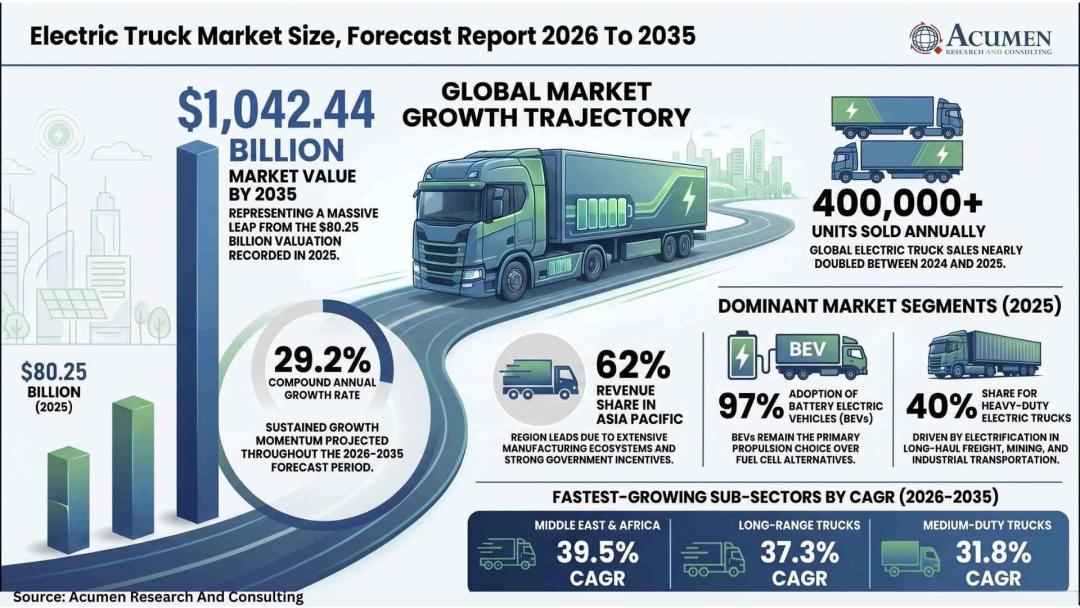
Figure: Acumen Research and Consulting expects the market for various types of electric trucks to continue growing rapidly
Electric mining trucks are not a new concept. They could not be widely promoted in the past, due to two major bottlenecks: the battery was too expensive, so the vehicle price could not be lowered.
What is worse is that mining areas lack sufficient power supply. Charging piles have to be connected to a stable power grid, while many mining sites around the world do not have a decent power grid at all.
In recent years, these two issues have seen notable, considerable changes one after another.
The first change is in batteries. In 2025, the global sales volume of electric trucks exceeded 400,000 units, 90% of which were sold in China. This huge market scale has driven the maturity of the entire supply chain for batteries, motors and electronic control systems, leading to a continuous drop in costs.
The second change is in power supply. The price of photovoltaic components almost halved around 2023, and the cost of energy storage systems has also kept decreasing.
How cheap have these products become? They are cheap enough that sites without access to a public power grid no longer need to wait for the grid to be built, but can build their own independent power system. Photovoltaic panels generate electricity, energy storage cabinets store electricity, 90% of the power comes from renewable green energy, and the remaining 10% is backed up by diesel generators.
In the past, using electricity in such areas was like drinking bottled water in the desert, where every kilowatt-hour of electricity had to be transported from outside. Now it is equivalent to digging a well locally: the initial investment is considerable, but the tap can supply sufficient water once it is turned on.
Each mine can operate as an independent small power grid.
When these two conditions are met, the cost calculation immediately makes sense for all regions around the world that have the most expensive fuel and the most severe power shortage.
Take the copper belt in Africa for example. The copper price has been favorable in recent years, and mines in the Democratic Republic of the Congo and Zambia are all expanding production at full speed. However, the local power grid is inherently weak, and power shortage directly limits the production output: When the market is good, one ton of copper can earn thousands of US dollars, which is like your money printing machine having to shut down due to power shortage. No one can accept that.
The common solution to fill the power gap is to burn diesel for power generation. But diesel has to be transported thousands of kilometers from coastal ports to inland areas. On the road, the fuel cost includes transportation fees, storage fees, cross-border transit fees, and a certain proportion of fuel is stolen or leaked during transportation, making the whole process as complicated as a cross-border group tour.
Industry insiders calculated the cost for us: in the Democratic Republic of the Congo, generating one kilowatt-hour of electricity with diesel costs more than 50 US cents, while the cost of photovoltaic plus energy storage is less than half of that.
A more extreme case is Ethiopia, which can barely afford to buy fuel. The country’s fuel supply is highly dependent on imports, costing 4.2 billion US dollars in foreign exchange every year. When there is a diesel shortage, construction sites across the country have to shut down directly.
The local government has even promoted electrification policies targeting heavy-duty trucks. At the end of April this year, 50 Chinese-made electric heavy-duty trucks were deployed at an airport construction site. In these regions, environmental protection is only a secondary benefit. What really pushes people to switch to electric vehicles is the high fuel price and severe power shortage.
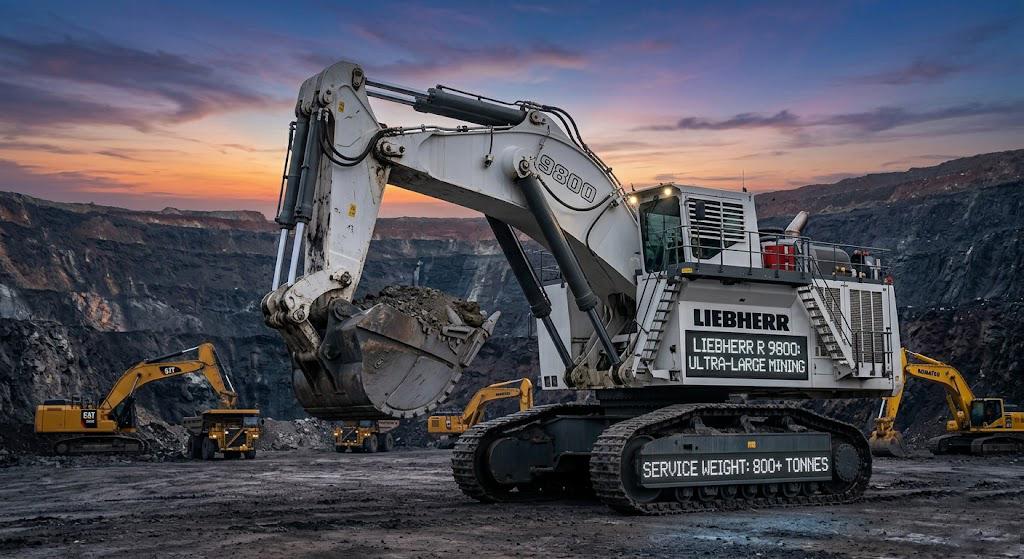
This kind of business was previously out of reach for new market entrants. The mining truck market has been dominated by Caterpillar, Komatsu, Liebherr and other leading players for decades. It is almost impossible for new players to catch up with their accumulated technology advantages in engines and gearboxes.
But electrification has completely replaced the entire power system. The examination subjects have changed: the old competition focused on internal combustion engines and gearboxes, while now the competition is centered on batteries, motors and electronic control systems, which are exactly the three sectors that China’s manufacturing industry has developed most intensively over the past decade.
Even the most traditional clients have started to place bets on electrification.
Australian mining giant Fortescue plans to purchase 300 to 400 units of 240-ton electric mining trucks to completely eliminate diesel consumption in its iron ore mines. Liebherr won half of the order, and the other half was awarded to XCMG, a Chinese manufacturer that had never entered the supply chain for this tonnage of mining trucks before.
However, a reasonable cost calculation is only the entry ticket. Before these fleets can actually operate, there is a mandatory question to answer: Where does the electricity come from? This is a problem that the passenger vehicle market hardly needs to consider, but mining trucks are completely different. In fact, the power source issue has completely changed the whole business of selling trucks.
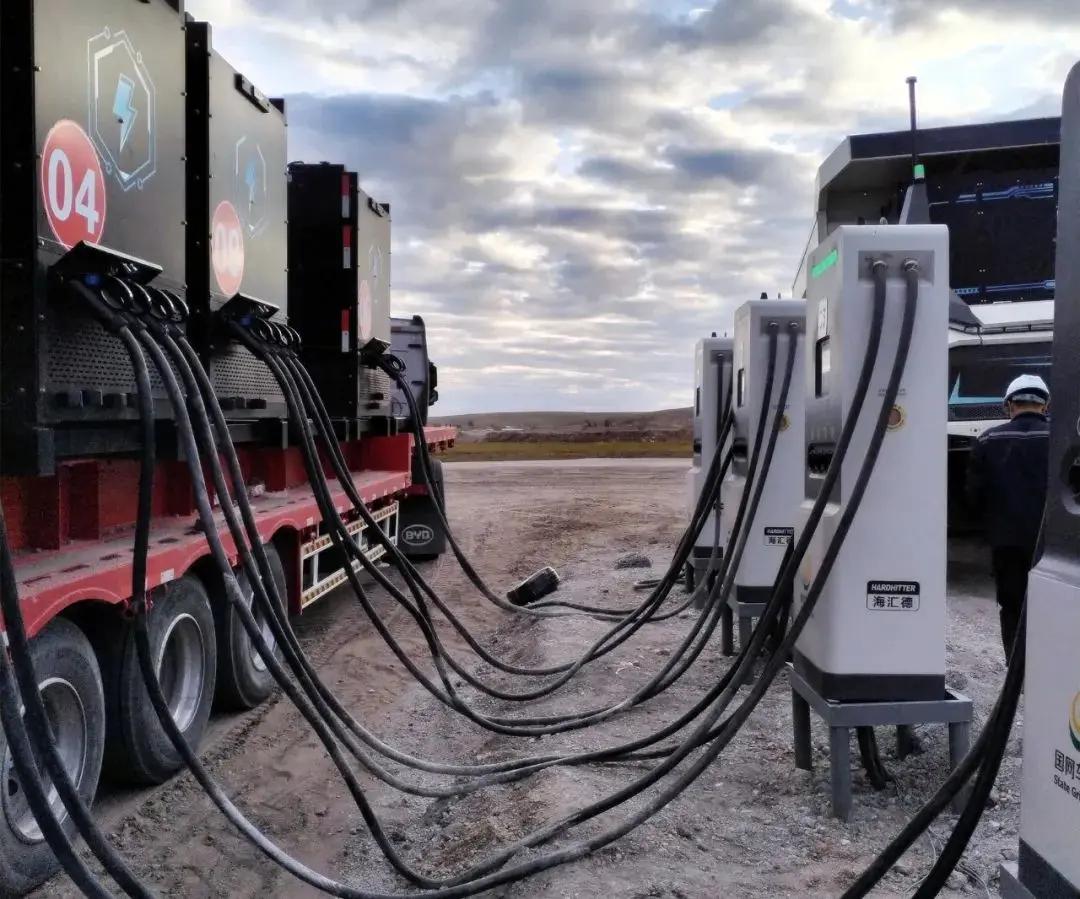
One full charge for an electric heavy-duty truck requires 300 to 600 kilowatt-hours of electricity, which is equivalent to the electricity consumption of an average household for one to two months.
If dozens or hundreds of vehicles are plugged into charging piles at the same time, most overseas power grids will collapse immediately. No matter how well the vehicles are manufactured, if the power supply cannot keep up, the trucks transported to the site will just become a row of huge ornaments.
Therefore, most of the procedures for selling mining trucks to Africa take place before the vehicles are delivered, following several orderly steps: first, conduct an on-site survey to find out how much load the local power grid of the client can support; if the capacity is insufficient, expand the transformers to increase the power grid’s capacity; then erect dedicated power supply lines to deliver electricity to the charging site; for sites with unstable power grids, deploy energy storage cabinets to store excess electricity when supply is sufficient and release power when the trucks need charging; if there is no power grid at all, deploy photovoltaic plus energy storage systems, building the entire power infrastructure from scratch starting with power generation.
该文观点仅代表作者本人,36氪平台仅提供信息存储空间服务。
36kr Europe (eu.36kr.com) delivers global business and markets news, data, analysis, and video to the world, dedicated to building value and providing business service for companies’ global expansion.
© 2024 36kr.com. All rights reserved.


