By 2060, discarded solar panels could total 297 to 402 million tonnes worldwide; recycling them could gen – The Times of India

source

Posted in Renewables | Leave a comment

Yukon Conservation Society wants to bring 'guerilla solar' movement north – CBC

Yukon Conservation Society wants to bring ‘guerilla solar’ movement north  CBC
source

Posted in Renewables | Leave a comment

Solar Panels on Storage Units: Illinois Is Going All In on This No-Brainer – Mother Jones

A community solar array at a Public Storage location in Justice, Illinois.Kari Lydersen/Canary Media

This story was originally published by Canary Media and is reproduced here as part of the Climate Desk collaboration.
Krzysztof Wasowicz, mayor of Justice, Illinois, has some concerns about solar: that it takes up farmland and enriches China. But he’s all-in on the community solar array that was recently deployed at a Public Storage facility in his village, a suburb of Chicago.
The panels are located on otherwise unused roof space and could provide significant savings for Illinoisans who subscribe to the project, while also helping the state meet its goal of 100% clean power by 2050.
“This creates more opportunities for people, job creation, and revenue that can be taxed by our state,” said Wasowicz, who has been mayor of Justice, home to about 12,000 people, since 2007. ​”This is going to be an excellent addition to this village.”
The 763-kilowatt array, which went online in March, is one of 60 planned projects for the rooftops of Public Storage facilities in Illinois. Ten such projects are now online, and once completed, the portfolio will cover 5 million square feet of roof space, provide 44 megawatts of solar capacity, deliver $36 million total savings, and create 300 construction jobs, according to Solar Landscape, a leading developer of rooftop community solar sites nationwide.
Only a fraction of industrial and commercial roof space is currently used for solar, because those projects are generally more expensive to build and interconnect than ground-mounted arrays in rural areas. But thanks to new incentives, developers, utilities, and building owners nationwide are increasingly considering the possibilities.
Federal data analyzed by the solar company Lumen Energy found that commercial, industrial, and school rooftops could host enough panels to provide 581 gigawatts of power, nearly enough to meet the entire country’s energy demand. Cook County, Illinois, which includes Justice, is among the metropolitan areas with the greatest potential, that analysis found.
Mark Schottinger, president and chief legal officer of Solar Landscape, said that working with large companies like Public Storage allows his company to deploy rooftop projects quickly at multiple sites.
“The beauty of commercial-industrial real estate is the speed and scalability,” he said, noting that major logistics, storage, and big-box companies ​”have millions of square feet around the country.”
Community solar allows households, businesses, and organizations to reap savings and support clean energy even if they can’t have their own solar panels. By subscribing to a community solar array, customers get credit on their energy bill for a portion of the solar power generated.
Illinois is among the nation’s leaders in community solar capacity, according to the Solar Energy Industries Association, with more installed than even California. It is among the two dozen states that have laws enabling community solar, which typically leads to more arrays than in states without specific policies.
Illinois’ 2016 clean energy law created generous incentives for community solar, leading to a boom in projects of up to 2 MW each. An energy law passed last fall made the incentives available for projects of up to 10 MW.
Most of the state’s community solar has been built on rural land or industrial brownfields. About a fifth of the arrays are on rooftops, with the rest being ground-mounted. The rooftop arrays are concentrated in the Chicago area, and rooftops are an increasing priority for community solar, according to Paul Kovacs, project execution manager for distributed energy resources for utility ComEd, which serves northern Illinois.
Solar developers are still in the ​”early innings” of using rooftops for community solar. But ​”it’s growing exponentially.”
At a July 30 event promoting the Justice project, Melissa Washington, ComEd’s senior vice president for government relations and external affairs, called rooftop community solar ​”an elegant solution” for deploying clean energy to meet rising demand.
She listed three mandates for the utility: supplying power to businesses and residents, keeping electricity affordable, and addressing climate change—a necessity underscored by violent storms three days earlier that had left many ComEd customers without power.
Rooftop community solar, she said, ​”checks the box for every single one of those three critical priorities.” The utility plans to have over 400 community solar arrays in service by the end of this year, she added. Kovacs said about 100 of those will be on rooftops.
In a typical setup, a company like Solar Landscape develops and owns the array and collects revenue from incentives and subscribers. Those subscribers get savings on their energy bills, the property owner hosting the panels gets lease payments, and the utility gets credit toward renewable energy mandates. The utility works with the developer to make any upgrades needed to connect the array to the grid, which the developer pays for so that costs are not passed on to ratepayers.
The Public Storage projects are part of Illinois’ Community-Driven Community Solar program, meant to incentivize solar arrays whose subscribers are predominantly local households and small businesses or nonprofits, as opposed to a few large subscribers hogging the savings.
Under state law, owners of community solar can sell renewable energy credits to utilities for revenue that makes the financing equation more favorable for all the partners involved. The incentives are awarded through a highly competitive process, and proposals gain points for being in designated low-income or environmental justice census tracts, having a large proportion of local subscribers, involving the community in design and planning, and hiring through the state’s workforce training programs, among other factors. The community solar credits are also worth $5 more per megawatt-hour for rooftop installations.
The Justice project earned points for making charitable contributions and for hosting a workforce training program in conjunction with the New Jersey–based training and education nonprofit STEP-UP Solar, according to Solar Landscape marketing director Samantha Kanipe.
State incentive programs are critical to facilitating community solar development since the expiration of federal tax credits under the Trump administration’s 2025 spending bill, advocates note. Meanwhile, arrays on industrial and commercial sites, like the Public Storage ones, can still qualify for federal tax credits if they are operational by the end of 2027, or if they started construction by July 4 of this year.
“We began construction on a ton of projects before July 4,” including all the Public Storage ones, said Schottinger of Solar Landscape, noting that his company can build an array like the one in Justice in about six months.
He said his company and other solar developers are still in the ​”early innings” of using rooftops for community solar. But, ​”it’s growing exponentially,” he added. ​”There’s a lot of blank space out there.”
Subscribe to the Mother Jones Daily to have our top stories delivered directly to your inbox.
By signing up, you agree to our privacy policy and terms of use, and to receive messages from Mother Jones and our partners.
Our news will always be free to read, watch, and listen to online. But what is its value?
Unbiased reporting on the issues that billionaire-owned newsrooms won’t touch. Fearless research into the dark corners of government and corporations. Ferociously fact-checked news that focuses on the facts, and the facts alone.
It IS free for you and every reader, viewer, and listener to utilize. But it’s not free for our team to make. So, what’s it worth to you? Let us know by making a donation: Make a one-time donation today to support this work. Or make a monthly sustaining donation to help us plan for the future.
Whatever you choose, know that you’re supporting more independent, investigative journalism in a time when we need it most.
Our news will always be free to read, watch, and listen to online. But what is its value?
Unbiased reporting on the issues that billionaire-owned newsrooms won’t touch. Fearless research into the dark corners of government and corporations. Ferociously fact-checked news that focuses on the facts, and the facts alone.
It IS free for you and every reader, viewer, and listener to utilize. But it’s not free for our team to make. So, what’s it worth to you? Let us know by making a donation: Make a one-time donation today to support this work. Or make a monthly sustaining donation to help us plan for the future.
Whatever you choose, know that you’re supporting more independent, investigative journalism in a time when we need it most.


Subscribe to the Mother Jones Daily to have our top stories delivered directly to your inbox.
By signing up, you agree to our privacy policy and terms of use, and to receive messages from Mother Jones and our partners.
Save big on a full year of investigations, ideas, and insights.
Mother Jones has no billionaires calling the shots—just readers like you making fearless reporting possible
Inexpensive, too! Subscribe today and get a full year of Mother Jones for just $19.95.
Award-winning photojournalism.
Stunning video. Fearless conversations.
Subscribe to the Mother Jones Daily to have our top stories delivered directly to your inbox.
By signing up, you agree to our privacy policy and terms of use, and to receive messages from Mother Jones and our partners.
This site is protected by reCAPTCHA and the Google Privacy Policy and Terms of Service apply.
Copyright © 2026 Mother Jones and the Center for Investigative Reporting. All Rights Reserved.

And we respect that! But maybe you’d consider supporting our work directly? Help fund more journalism that seeks the truth and holds power to account. We can’t do it without you.
We noticed you have an ad blocker on. Can you pitch in a few bucks to help fund Mother Jones’ investigative journalism?
The news you find on our website will always be free to read, watch, and listen to. But it’s not free to make: It takes dozens of reporters and editors, weeks and months of time, and a surplus of research and fact-checking. We promise to always be accessible to you. Could you commit to us?
Make a donation of any amount to support independent investigative journalism that brings you the truth, day after day—for five decades.

The news you find on our website will always be free to read, watch, and listen to. But it’s not free to make: It takes dozens of reporters and editors, weeks and months of time, and a surplus of research and fact-checking. We promise to always be accessible to you. Could you commit to us?
Make a donation of any amount to support independent investigative journalism that brings you the truth, day after day—for five decades.

Sign up for the free Mother Jones Daily newsletter and follow the news that matters.

source

Posted in Renewables | Leave a comment

Valuable insights into Kenya’s solar PV market and the broader East African region – Green Building Africa


I recently interviewed Noah Lukeya, sales manager for LONGi East Africa. Noah was kind enough to provide valuable insights into the solar PV market in Kenya and the broader East Africa region , as well as how LONGi is meeting market requirements across its range of products and services.
Kenya is targeting 100% clean energy by 2030 through policies such as the National Energy Policy 2025–2034 and the Energy (Integrated National Energy Plan) Regulations 2025. From your perspective, how are these developments influencing customer demand and the solar market? What opportunities do they create for LONGi?
Kenya’s energy transition is accelerating under the National Energy Policy 2025–2034 and the Energy (Integrated National Energy Plan) Regulations 2025. Together, these frameworks strengthen long-term energy planning, encourage private investment, and create greater certainty for renewable energy developers, investors and technology providers.
These policy developments are already having a positive impact across the solar value chain.
For investors,the clear Rules around tariffs, licensing, contracts and implementation frame work has given them confidence to commit long term money on renewable energy projects , Currently we are seeing increase in C&I to utility project coming up financed by foreign investors under PPA and PPI models. Additionally, Compare to last 3 years more financial institutions , project developers and individual investor from other countries, are increasingly interested in exploration and investing on renewable energy  evident, with more than 50% increase of new clean energy companies compared to 2023.
For EPC contractors and project developers, the expanding pipeline of renewable energy projects is creating broader business opportunities. As the market continues to mature, customers are placing greater emphasis not only on project execution but also on technology selection, long-term system performance and bankable partners that can support projects throughout their lifecycle.
At the end-user level, both commercial and residential customers are increasingly viewing solar as a long-term strategic investment rather than simply an alternative power source. Rising grid electricity tariffs, combined with the desire for greater energy independence and more reliable electricity supply, are accelerating solar adoption. More businesses are investing in rooftop solar to reduce operating costs, while homeowners are increasingly recognising the long-term economic and sustainability benefits of clean energy.
Above all this, lower Levelized Cost of Electricity (LCOE), high-efficiency and quality products are prioritised and sort after factors. this creates tremendous opportunities for LONGi. Leveraging our industry-leading Back Contact (BC) technology, proven global bankability and extensive experience across utility-scale, C&I and distributed solar projects, we help customers achieve higher energy yield, lower LCOE and long-term system reliability. Beyond high-efficiency modules, LONGi also provides scenario-based solutions and integrated solar-plus-storage offerings for grid-connected, off-grid and hybrid applications. Supported by our local team in Kenya, we work closely with EPCs, distributors and project developers to deliver technical expertise, responsive support and reliable project execution throughout the entire project lifecycle.
Recent regulatory changes are opening transmission and distribution networks to private investment. what changes are you seeing in the development of utility-scale and distributed solar projects? How is LONGi supporting customers under this evolving market environment?
As private participation in transmission, distribution and electricity trading continues to expand, market efficiency is improving and electricity procurement is becoming more competitive and flexible. This is generating clear economic benefits for market participants: developers and investors are able to unlock new revenue streams through diversified project models, while C&I users can better control energy costs and improve long-term operational stability. At the same time, the broader economy benefits from improved energy access, reduced reliance on expensive fossil-based generation, and enhanced energy security, all of which support sustainable industrial growth.
We are seeing increased activity in industrial power projects, private mini-grids, commercial rooftop systems and utility-scale solar farms developed through private financing and a growing demand for faster project execution. Financiers are also increasingly requiring Tier-1 manufacturers with proven stability and reliability such as LONGi, more technical modelling before procurement as investors are seeking long-term returns.
This shift aligns closely with our long-term strategy. Rather than simply supplying modules, we position ourselves as a long-term technology partner, helping customers maximise energy yield, reduce the LCOE and ensure reliable system performance throughout the project lifecycle. Leveraging our industry-leading Back Contact (BC) technology, globally recognised bankability and extensive experience across utility-scale, distributed and commercial & industrial projects, we provide solutions that meet the evolving needs of Kenya’s energy market.
With the expansion of net metering and incentives for rooftop solar, how is demand evolving between residential customers and the commercial & industrial (C&I) sector? Which segment is currently driving the most growth?
Residential solar demand in Kenya remains strong and continues to lead the market. However, with the opening transmission and distribution networks to private investment and increases in tariff on grid, Commercial and Industrial sector is catching up at an exponential pace Commercial rooftop installations are becoming larger, often exceeding several hundred kilowatts. Businesses are consuming far more electricity than households, making the financial returns from solar investments much more attractive.
The economic potential is already being demonstrated across Africa. In Zimbabwe, an 11 MW solar-storage-diesel microgrid for RHA Mining, equipped with LONGi’s high-efficiency modules, officially entered operation this year. The project is expected to reduce diesel consumption and associated carbon emissions by more than 90%, lower electricity costs by approximately 50% compared with conventional diesel generation, and save the customer an estimated RMB 50–60 million in annual fuel costs.
As C&I solar continues to scale, LONGi is well positioned to support this growth with high-efficiency modules, reliable technology and strong lifecycle value, helping businesses achieve greater energy independence while improving the long-term economics of their solar investments.

Kenya’s climate presents challenges such as high temperatures, dust and diverse installation environments. How are LONGi’s latest technologies – including BC modules and scenario-based solutions – helping customers maximise energy yield and long-term reliability? Are integrated solar-plus-storage solutions becoming an increasingly important part of customer discussions?
Dust accumulation and high temperatures is a significant challenge in northern, eastern and some part of coastal region Kenya.
LONGi addresses these challenges through scenario-based product solutions. For example, our Anti-Dust modules are designed to reduce dust accumulation and cleaning frequency, helping customers maintain more stable energy generation while lowering operation and maintenance costs.
At the core of these solutions is LONGi’s Back Contact (BC) technology.BC module is game changer thanks to its high efficiency customers are now able to maximise energy output per area, saving on space, lower balance of system cost and ultimately high returns on the investments.

Learn more about LONGi’s 5A solutions (Anti-Dust, Anti-Shading, Anti-Fake, Anti-Glare and Anti-Fire) HERE
At the same time, solar-plus-storage is becoming an increasingly important part of customer discussions. As solar deployment expands and its share in the power system increases, energy storage becomes more valuable for balancing generation and consumption, improving power reliability and enabling customers to make better use of renewable electricity. This is particularly relevant for C&I, off-grid and hybrid applications in Africa.
LONGi is responding to this trend by extending its capabilities beyond high-efficiency PV through LONGi ONE energy storage system, supporting the growing demand for integrated solar-plus-storage solutions and helping customers achieve more reliable, flexible and cost-effective energy systems.
How does LONGi work with EPCs, distributors and installers in Kenya to ensure reliable product supply, technical support and successful project delivery?
Partnership is central to LONGi’s strategy in Kenya. LONGi work closely with distributors, EPC contractors and installers throughout the project lifecycle from system design, product selection to technical and after-sales support.
For distributors, LONGi provides scenario-based product recommendations according to different end-user needs and application environments, together with delivery coordination, technical and after-sales support to strengthen local market development.
For EPC partners, our support begins well before procurement. LONGi provides pre-sales’ technical consultation and assists with product selection and system design through tools such as PV Master, helping partners optimise solutions for specific project requirements and improve overall system performance.
For Installers, we provide regular technical training, including bi-weekly online sessions and offline hands-on training, covering product knowledge and installation practices.
Behind these partnerships is our local team in Kenya, enabling us to respond quickly to customer and partner needs.
Thank you for your time Noah, we wish you and LONGi all the success in Kenya. 
Author: Bryan Groenendaal


August 10, 2026
July 22, 2026
July 13, 2026
July 15, 2026
July 8, 2026
August 2, 2026
Disclaimer | Privacy Policy | Terms & Conditions | Returns Policy | Intellectual Property | Cookie Policy
© 2019 – 2026 GBA Digital Media Group. All Rights Reserved
Website Design | Website Maintenance
Copyright Green Building Africa 2026.

Subscribe to our weekly Top 5 Stories
"*" indicates required fields

source

Posted in Renewables | Leave a comment

China’s green revolution and what it means for the world – The Week

China’s green revolution and what it means for the world  The Week
source

Posted in Renewables | Leave a comment

New owner fears inherited rooftop solar is failing, but the culprit may be far simpler – Yahoo Tech

New owner fears inherited rooftop solar is failing, but the culprit may be far simpler  Yahoo Tech
source

Posted in Renewables | Leave a comment

Recurrent Energy obtains $695m funding for 330MW Cobalt solar project – Power Technology

The funding includes approximately $484m in debt financing, arranged by Mitsubishi UFJ Financial Group and Nord/LB.
Recurrent Energy, a subsidiary of Canadian Solar, has secured $695m in project financing and tax equity to support the construction of its 330MW Cobalt Solar facility in Riverside County, California, US.
The funding comprises approximately $484m in debt financing, arranged by Mitsubishi UFJ Financial Group (MUFG) and Nord/LB, and a further $211m in tax equity provided by Wells Fargo.
The gold standard of business intelligence.
Find out more
Combine business intelligence and editorial excellence to reach engaged professionals across 36 leading media platforms.
Find out more
The Cobalt Solar project, located around 20 miles west of Blythe, California, is under construction and is planned to begin commercial operations by the end of 2027.
Blattner Energy has been selected as the engineering, procurement, and construction (EPC) provider for the development.
The debt financing package includes construction and term loans, a tax equity bridge loan, and a letter of credit facility.
MUFG managing director Fred Zelaya said: “MUFG is pleased to support Recurrent Energy as they strive to meet the growing energy demands of the US.
“We value the opportunity to help Recurrent Energy augment large-scale renewable energy infrastructure and power capacity.”
Once operational, the Cobalt Solar facility is projected to generate enough electricity to meet the needs of approximately 82,000 homes annually.
Recurrent Energy estimates the project will contribute about $14m in property tax revenue to Riverside County over its lifetime.
Recurrent Energy CEO Dylan Marx said: “We are thrilled to close the project financing and ramp up construction of Cobalt Solar. This project represents a significant addition to the US energy landscape and will contribute meaningfully to meeting the country’s growing electricity demand.
“We appreciate the continued support and collaboration of MUFG, Nord/LB, and Wells Fargo in bringing this initiative forward.”
In a separate development, Recurrent Energy announced that its Carwarp Energy Park near Mildura in Victoria, Australia, has reached commercial operations.
The 150MWac Australian solar park was supported by a long-term power purchase agreement (PPA) with Microsoft.
The site is connected to the National Electricity Market (NEM) through the Victorian transmission network and has approvals in place to add a 120MW battery storage system.
The gold standard of business intelligence.
Find out more
Experience unmatched clarity with a single platform that combines unique data, AI, and human expertise.
Find out more
Give your business an edge with our leading industry insights.


Visit our Privacy Policy for more information about our services, how we may use, process and share your personal data, including information on your rights in respect of your personal data and how you can unsubscribe from future marketing communications. Our services are intended for corporate subscribers and you warrant that the email address submitted is your corporate email address.
View all newsletters from across the GlobalData Media network.
Power industry news, data and in-depth articles on the global trends driving power generation, renewables and innovation
Powered by Pharma Tech Logo
© GlobalData Plc 2026

source

Posted in Renewables | Leave a comment

Solar panel waste could deliver $1tn economic boost through recycling – Engineering and Technology Magazine

Solar panel waste could deliver $1tn economic boost through recycling  Engineering and Technology Magazine
source

Posted in Renewables | Leave a comment

A Connecticut cemetery leased unused land for 7,000 solar panels, but the ground beneath them could becom – The Times of India

source

Posted in Renewables | Leave a comment

Plug-in solar panels are coming – can they actually save you money? – The Telegraph

Plug-in solar panels are coming – can they actually save you money?  The Telegraph
source

Posted in Renewables | Leave a comment

US solar panel makers request a look at surge in Ethiopian exports – solarpowerworldonline.com

Solar Power World
|
U.S. solar panel manufacturers have filed a new tariff circumvention investigation request, this time on product coming from Ethiopia. The filing alleges that manufacturers using Chinese-origin components are exploiting Ethiopia as the latest export site to circumvent antidumping/countervailing duty (AD/CVD) orders on solar products.
There has been an uptick in imported solar cells and panels from Ethiopia in the last year. Toyo recently completed a 4-GW cell factory in the country and has been importing its own cells for use in its 1-GW solar panel assembly plant in Houston, Texas. Origin Solar has also opened a cell factory in Ethiopia that is estimated to have a 4.2-GW annual production capacity. But the obvious increase in exports are seen in finished solar panels, not solar cells. The domestic manufacturers filing the petition with the Dept. of Commerce specifically call out Toyo and Origin Solar.


The companies that submitted the petition are a range of experienced U.S. manufacturers including DYCM Power, First Solar, Qcells, Silfab, Solx, Suniva, Swift Solar and Talon PV. DYCM is allegedly opening a solar panel factory in New York, although no concrete information has been released. First Solar makes thin-film panels throughout the United States; Qcells operates a complex in Georgia; Silfab operates in Washington and South Carolina; Solx is starting up in Puerto Rico; Suniva is working in Georgia and South Carolina; Swift Solar is a perovskite company; and Talon PV is starting up in Texas.
Toyo’s Ethiopian operations. Credit: Google Maps
The companies, typically working under the Alliance for American Solar Manufacturing and Trade banner, are involved with the many AD/CVD requests and orders in the solar industry. The original AD/CVD orders (Solar I) were placed against Chinese silicon solar products in 2012. Producers responded by shifting production to Cambodia, Malaysia, Thailand and Vietnam — triggering new AD/CVD orders (Solar III) in June 2025. A new round of AD/CVD investigations (Solar IV) are ongoing against India, Indonesia and Laos. This Ethiopian investigation, if initiated by the Dept. of Commerce and International Trade Commission (ITC), would be considered Solar V.
The Ethiopia filing alleges that Toyo and Origin Solar are using Chinese-origin wafers to make solar cells in Ethiopia, then assembling those cells into modules in Ethiopia or Vietnam for export to the United States. The petition claims that nearly 70% of the finished solar modules include components and processing that are already subject to existing tariffs.
U.S. imports of solar cells and modules from Ethiopia surged from zero in June of 2025 to over $300 million by year’s end. The petitioners say this surge correlates directly with the initiation of tariffs against imports from Cambodia, Malaysia, Thailand and Vietnam in June 2025 and the India, Indonesia and Laos investigation request in August 2025.
“What we’re seeing in Ethiopia follows a familiar playbook,” said Tim Brightbill, partner and co-chair of the trade practice at Wiley Rein LLP and Alliance representative. “For over a decade, state-subsidized manufacturers have responded to U.S. trade enforcement by relocating minimal finishing operations to the next available country, while continuing to source nearly all their inputs from the same foreign suppliers. American solar manufacturing is at an inflection point: With billions invested, thousands of jobs created, and real capacity coming online, we are not going to stand by and allow serial tariff evasion to undercut that progress.”
The Dept. of Commerce has 30 days to initiate an investigation.
Kelly Pickerel has more than 15 years of experience reporting on the U.S. solar industry and is currently editor in chief of Solar Power World. Email Kelly.


Copyright © 2026 Arrowfly LLC. All Rights Reserved. The material on this site may not be reproduced, distributed, transmitted, cached or otherwise used, except with the prior written permission of Arrowfly LLC
Privacy Policy | RSS

source

Posted in Renewables | Leave a comment

The Moon crossed over Texas for just a few minutes, and the state’s largest solar fleet plunged from 13.8 GW to 0.7 GW before surging back – Energies Media

Energies Media
On April 8, 2024, the Moon caused a twilight to occur during the day in Texas, and the electric grid responded almost instantaneously.
Solar farms typically climb steadily to afternoon output as the sun gets stronger. Rather, ERCOT saw solar generation drop across the state and then rebound just as quickly.
That event is coming again, but this time, it’s a total solar eclipse on August 12, 2026, and it will not reach totality in Texas. The 2024 grid record demonstrates the consequences of solar absence in a solar-dominated system.
Why did generation drop so much and then rise back to the levels in a few hours?
The eclipse moved in from the southwest and headed northeast across the ERCOT area in the middle of the day.
ERCOT had been weeks in preparation for the event. Its predictions predicted that this eclipse would impact solar generation for approximately three hours.
The grid operator worked with solar forecasting vendors before the event. It also cautioned market participants to revise their operating plans accordingly.
That preparation was important because Texas already had a large utility-scale solar fleet. A midday eclipse may take away significant generation much sooner than sunset.
At certain sites, totality was just a few minutes. The Sun was not completely obscured for more than four minutes in Dallas.
But the event across the grid was much longer. Various solar power stations came into and out of the Moon’s shadow at various times.
ERCOT thus made preparations for both sides of the ramp: for the descent into the night and the ascent toward the full light of day.
It was a predictable event, but a ramp still had to be prepared.
The real decline was even more dramatic on ERCOT’s operating charts.
As the eclipse started impacting the system, solar generation was around 13.8 gigawatts. It peaked at just 0.7 gigawatts at 1:36 p.m.
Then the direction turned around.
ERCOT’s chart illustrates how solar generation ramped up quickly as the Moon’s shadow shifted away. Production was back to about the same level by late afternoon.
There has to be an equilibrium between electricity supply and demand at all times. The loss of a key resource during the day can cause problems if other resources are not able to ramp up production quickly enough.
The return presents the reverse problem. Other generators have to step aside as solar generation increases at an unusually high rate.
ERCOT did not anticipate the eclipse as an outage, but rather planned for both events.
It deployed Ancillary Services, committed additional generation and increased available ramping through manual actions.
Those tools helped keep the event manageable. The solar curve was not caused by equipment failure.
The eclipse had a widespread impact on the sun, leading to a sharp drop in the solar fleet.
Photovoltaic panels are directly affected by the incoming solar radiation. If the Sun is blocked by the Moon, then all of the energy that reaches those panels drops off at once.
The key is scale.
At any given point in Texas, totality was just a few minutes. But partial eclipse was sweeping the state for about 3 hours.
It was a broad shadow that connected many solar projects together in an unusually synchronized decline.
ERCOT had predicted the worst statewide effect would be around 1:40 p.m. The minimum measured was at 1:36 p.m.
Sunlight returned to western and central solar facilities as the Moon continued to move northeast. They increased their production again, without restarting the plants.
The rebound was the same physical process going in reverse.
The amount of sunlight reaching the photovoltaic cells rose and the electrical output of the cells rose. Those were part of the high numbers of recoveries that occurred in the afternoon across the fleet.
Unlike regular cloud cover, an eclipse has a predictable time and path. ERCOT could make generation and reserves available in advance, according to the official report.
That preparation does not make solar ramps that go quickly irrelevant. It demonstrates that operators can work around a rare known loss of sunlight.
The August 12, 2026 eclipse offers a reminder, but not a Texas repeat. NASA maps totality across Greenland, Iceland, and Spain.
Parts of the northern United States will see only a partial eclipse. Texas is not in the path of totality for 2026.
The overall lesson remains. Sun-heavy grids require flexibility when the sun changes rapidly, whether by celestial or meteorological means.
In Texas, for a few minutes, the sky made the kind of solar disruption that engineers typically simulate on screens.
The panels behaved as their physics predicted. As the light faded, they produced less, and as the light came back, they produced more.
It wasn’t a malfunction that made the episode remarkable. It was the speed and geographic extent of a shadow that was to be expected.
The Moon made its way across on time, ERCOT was ready, and Texas solar power followed the eclipse like an electric photo.
Daniel García is an Editor-in-Chief with strong expertise in structural work and engineering principles. He combines this technical foundation with deep knowledge of energy, spatial design, and emerging technologies, bringing a forward-thinking and analytical approach to editorial leadership.

source

Posted in Renewables | Leave a comment

China’s 20,000-Mile Solar Trade Route That Battled US Tariffs – Energy Connects

By Bloomberg
Aug 14, 2026
Photographer: Qilai Shen/Bloomberg
To understand President Donald Trump’s latest move to protect US solar manufacturers, it helps to follow the trail of a 20,000-mile trade route running through Kenya and a tiny Indonesian island off the coast of Singapore.
The route allowed companies to obscure manufacturing work done in China and Indonesia to deliver solar panels to the lucrative US market without triggering tariffs, according to an analysis of trade and company data by Bloomberg News. And it was built in less than a year, quickly growing to support trade flows of more than $100 million monthly.
That kind of rapid reshuffling of global trade flows had become common in the solar industry in recent years as US officials tried to crack down on what they say are unfair trade practices employed by China. In response, companies would shift production to a new country — for example to Vietnam then to Indonesia — Washington would follow with a new slate of tariffs, and the firms would seek new places, always staying one step ahead.
The sweeping trade measures ordered by Trump last week are intended to put an end to this game of “Whack-a-Mole” by targeting all countries imposing with tariffs and price floors on imported polysilicon and its derivatives, including wafers, cells and modules. These will be subject to minimum import prices above current market levels along with 15% tariffs beginning Dec. 4.
How the US Is Trying to End Solar Tariff Whack-a-Mole
The China-Africa-Southeast Asia-US trade route shows the lengths companies are willing to go to access the US market, where prices are more than double the global average because of the yearslong battle against Chinese imports. And the route’s success in skirting duties encapsulates why the US government ultimately abandoned its country-specific approach in its aim to protect its solar industry.
Here’s how the trade route operates in practice. 
Trade Data Mismatch   
The first sign of circumvention appeared in March, one month after preliminary US tariffs aimed at Indonesian solar imports took effect. US customs data showed solar panel imports from Indonesia, the largest source of US imports in 2025, dropped sharply, suggesting the tariffs were working. 
However, Indonesia’s export data told a different story. Exports of solar panels from Indonesia to the US did not collapse after the tariffs and recovered from a slowdown that began in late 2025. The discrepancy suggests some shipments leaving Indonesia were not being recorded as Indonesian products when entering the US. 
The explanation lies in US customs rules. Under the “substantial transformation” standard, a product’s origin is determined by where it gains its essential character. For solar panels, past customs rulings have established that solar cells, rather than final assembly, determine country of origin. 
This creates an opportunity for manufacturers. Solar cells account for roughly 50%-60% of a panel’s cost but are relatively lightweight, making them inexpensive to ship long distances. Beginning in January, Indonesian assemblers — all based on the island of Batam, which is turning into a major manufacturing hub due to Trump’s trade war — increasingly sourced cells from Kenya and Nigeria while importing other components from China. At the same time, US imports of solar panels declared as originating from those African countries surged, approaching $100 million per month by June.
An analysis of trade statistics, customs records and corporate filings identified a supply chain linking Chinese wafer producers, newly established solar-cell factories in Africa and panel assembly operations in Indonesia. African factories imported wafers from China, converted them into cells, and shipped the cells to Indonesian manufacturers, which assembled and exported finished panels to the US. 
Indonesia’s government is aware of the discrepancies between the US statistics and its own, and believes they are not significant and the data is relatively in line, said Johni Martha, director general of international trade negotiation at the country’s Ministry of Trade. Indonesia remains committed to ensuring its exports are compliant with international laws, and doesn’t support practices intended to circumvent rules of its partner countries, he said. 
“These differences between export and import statistics cannot serve as a basis for concluding that there has been any misrepresentation of the country of origin of the goods or any attempt to circumvent tariffs,” he said. 
Government officials in the US, Nigeria and Kenya did not reply to requests for comment.
Several of the Kenyan factories appear to have been built only recently. Satellite imagery indicates that production facilities near Nairobi and Mombasa were largely completed between mid-2025 and early 2026. Customs records show these facilities importing wafers from China and exporting cells to Indonesian manufacturers whose export volumes to the US closely matched their imports of cells and other components.
The same pattern appears in Nigeria. A newly emerged solar-cell supplier shipped nearly $100 million of cells to Indonesia in the first half of 2026. Trade records also reveal links between Chinese equipment suppliers, African cell makers and Indonesian assemblers, illustrating a complex supply chain that spans three continents. 
Future Markets
Still, the latest US tariffs may not entirely vanquish the new trade route. The Dec. 4 start date of the new import controls will give companies a few months to continue shipments, although US regulators said they would keep a sharp eye on anyone who seems to be massively ramping up purchases to build up a stockpile before the new order goes into effect. There are also exceptions carved out to allow continued imports for companies that promise to start construction on new US factories by the end of Trump’s term in office.
For Chinese manufacturers, there will still be strong drivers to expand overseas even if the US closes circumvention loopholes. Persistent overcapacity and price wars at home have eroded domestic profit margins to near-zero, while the government and industry itself are focusing on phasing out inefficient capacity and enhancing price discipline.  
Overseas markets offer much better returns. In addition, the global energy transition and the impact of the Iran war also mean more demand for solar energy. China’s clean-tech companies, which dominate the global supply chain, stand to become the biggest beneficiary. 
As such, the motive for going overseas “is not short-term in nature,” said Muyi Yang, a Sydney-based analyst with clean-energy think tank Ember. “So, I would not see every new factory simply as an attempt to get around the latest tariff. Increasingly, companies are looking for future markets and seeking to establish a long-term presence there.”  
As the price threshold in the US is raised, some solar modules originally planned for the US may shift to other markets such as Latin America, the Middle East and Asia-Pacific, which Yang says will become important markets and not merely “export platforms” for Chinese companies.
©2026 Bloomberg L.P.
By Bloomberg News
By subscribing, you agree to the processing of your personal data by dmg events as described in the Privacy Policy.
In this episode of the Energy Connects Podcast, we revisit a conversation with Asheesh Sastry, Managing Director and Senior Partner at Boston Consulting Group (BCG),…
In the next episode of the Energy Connects podcast, host Chiranjib Sengupta speaks to Ashish Khanna, Director General of the International Solar Alliance, as the…
In this exclusive Energy Connects discussion, we sit down with Sean Atkinson, Head of Field Service EMA at Ebara Elliott Energy, to explore the company’s…
Ahead of Global Energy Show Canada, AIQ CEO Dennis Jol speaks to Chiranjib Sengupta about the growing role of industrial and agentic AI in transforming…
Stay informed with the latest energy industry news, insights, events, and updates delivered straight to your inbox.
By submitting, you agree to the processing of your personal data by dmg events as described in the Privacy Statement.
Thank you for your interest someone will be in touch shortly.
Please note, a copy of the Media Kit has been sent to the email address provided.
We apologise, but there was an error with your submission.
Please contact us at sales@energyconnects.com
Member of
Back To Top

source

Posted in Renewables | Leave a comment

China’s Solar Industry Is in Upheaval—The Effects Will Be Global – csis.org

Photo: CN-STR / AFP via Getty Images
Brief by Michael Davidson and Sandy Qian
Published March 12, 2026
Over the past few years, China’s solar industry has entered a period of intense upheaval. Price wars and margin compression have forced industry leaders—including Jinko Solar, Trina Solar, and JA Solar—to report significant losses. These firms, along with LONGi Green Energy and Tongwei—the industry’s top five—slashed their workforce by over 30 percent in 2024. The market is facing industry consolidation and exits not seen in over a decade, as over 40 smaller firms have filed for bankruptcy, been acquired, or exited the market. Chinese regulators are accelerating this process, which will have ripple effects across global solar markets.
Several critical questions arise: Does this phase erode China’s leadership in solar, or entrench it further? Is it a window for others to close the gap, or a prelude to deeper market displacement? And when the current wave of capacity consolidation settles, what will the next global competitive order look like? The answer is already emerging. Rather than opening space for rivals to catch up, the current shocks are forging a more resilient Chinese solar core. By embedding deeper into global value chains and securing a technological lead, China is effectively reshaping the industry’s future trajectory to its own long-term advantage.
China’s first major solar shakeout began in 2012. During the 2009–2010 frenzy, Chinese solar majors expanded rapidly, leveraged by debt, to meet European and U.S. demand, exporting 90 percent of their output. When the 2011 Eurozone crisis hit, solar subsidies were gutted, sharply curbing demand. The sector hit its “darkest hour” in 2012 when U.S. anti-dumping duties and EU trade probes shuttered overseas markets, forcing hundreds of China’s solar firms to cease operations. The crisis peaked in 2013 with the landmark collapse of two solar giants, Suntech and LDK, prompting Beijing to salvage the industry through aggressive domestic installation targets and “Price Commitment” deals with the European Union. The crisis ultimately transformed China’s solar sector from a fragmented landscape into a more consolidated, globally competitive powerhouse.
Today, China is the undisputed global leader in the solar industry. It dominates the solar supply chain—by an extraordinary margin. In 2024, China produced 93.2  percent of the world’s polysilicon, 96.6  percent of wafers, 92.3  percent of photovoltaic (PV) cells, and 86.4  percent of PV modules, as China Photovoltaic Industry Association (CPIA) data show. However, a new wave of crises has once again swept through China’s solar industry, manifesting in a phenomenon the Chinese government has termed “involution” (internal fierce competition) to avoid the more politically charged concept of overcapacity. This occurs alongside growing resistance to Chinese firms “going global” (overseas expansion), as tightening U.S. supply chain tariffs and EU diversified-origin rules increasingly squeeze access to high-value markets.
China’s solar sector has been pushed into a fierce price war as manufacturing capacity far outstrips global demand. In 2024, the world had enough PV manufacturing capacity to produce more than twice the modules actually installed, according to the International Energy Agency. Much of this overshoot stems from China’s 2020 dual-carbon pledge, which spurred local governments to shower the solar industry with land, tax, and financing incentives—drawing in massive capital and triggering repetitive, low-quality investment. Since 2023, prices across the solar value chain have collapsed: Module prices dropped by half in 2023 and a further 25 percent in 2024, while polysilicon prices plunged from RMB 230,000/ton to RMB 65,000/ton in 2023—over a 70 percent decline—followed by another 40 percent drop in 2024, according to data from CPIA annual reports. In 2025, PV product prices fluctuated significantly, with wafers, cells, and modules remaining at depressed levels. Despite CPIA’s efforts to promote industry self-discipline and coordinate production to curb disorderly competition, price pressures have persisted.
The European Union is weaving a complex web of institutional hurdles focused on supply chain resilience and carbon transparency. The Foreign Subsidies Regulation already acts as a selective filter, triggering Chinese withdrawals from some major tenders, while the Net-Zero Industry Act mandates domestic manufacturing targets and caps single-source procurement at 50 percent—though member states retain leeway to bypass these rules for cost reasons. Furthermore, the proposed Industrial Accelerator Act seeks to cement these targets by streamlining permitting and creating “Industrial Acceleration Zones” to fast-track domestic clean-tech production. Additionally, while the Carbon Border Adjustment Mechanism does not directly tax PV modules, it imposes administrative burdens and indirect costs via carbon reporting for aluminum and steel components, gradually eroding Chinese exporters’ price advantage.
Unlike Europe’s attempt to balance trade with domestic growth, the United States has moved toward a more restrictive environment for Chinese solar products. While Section 301 imposes 50 percent tariffs, the actual exclusion is driven by anti-circumvention rulings that target Chinese-affiliated production in Southeast Asia and the Uyghur Forced Labor Prevention Act, which detains shipments at the border over supply chain compliance. These combined measures have effectively decoupled the U.S. market from the Chinese supply chain.
Facing a new downturn, China’s solar industry is reshaping its export strategy. Chinese exports have faced a rising wave of tariffs and other nontariff barriers due to concerns over dumping and unfair competition in multiple regions that are trying to develop their own industries. Total export value fell noticeably, yet monthly shipments remain sizable at the billion-dollar level. Even as trade barriers rise, export capacity keeps expanding, with firms diversifying into new markets to navigate the shifting global landscape. Initially driven by U.S. tariffs, the shift toward exporting intermediate products like wafers and cells—rather than targeted modules—may now help Chinese firms meet the European Union’s diversification requirements as U.S. restrictions on Southeast Asia intensify. At the same time, export destinations are diversifying: For PV cells, the Asia-Pacific region has become the main export market; for PV modules, the European Union remains the largest market by value, though its share is declining, while Asia-Pacific and Middle Eastern countries are rapidly absorbing a growing portion of demand.
Beyond trade, China has been extending its global value chain through overseas investment and manufacturing—potentially helping firms meet the European Union’s diversified origin requirements. Facilities in Indonesia, Vietnam, Malaysia, Saudi Arabia, and beyond help reposition in changing tariff environments, foster local employment, and position Chinese firms not merely as suppliers, but as builders and operators of complete solar ecosystems, embedding themselves deeper into regional markets.
 
In 2004, the global solar patent filing landscape was led by Japan (43.0 percent), with China holding only a minor 13.0 percent share. Just two decades later, the picture looks markedly different: China’s share of global patent applications has surged, reaching around 65.0 percent by 2024, according to CPIA’s 2024-2025 China PV Industry Annual Report. This dramatic transformation underscores how the transfer of the global PV manufacturing hub successfully propelled China into its role as the primary engine for technological advancement in the global solar industry.
China was initially a follower when first-generation solar technologies emerged. By leveraging innovations in manufacturing processes, it steadily boosted conversion efficiency while sharply cutting costs. China’s innovation cycles far outpace the rest of the global solar sector, rapidly advancing across first-generation sub-technologies—and the pace of turnover continues to accelerate. Within less than a decade, China progressed from relying on traditional c‑Si (BSF) cells to deploying large-scale improved c‑Si (PERC) cells, and more recently has been moving toward the widespread adoption of advanced c‑Si (TOPCon) technologies, which grew from 8 percent to 70 percent of the market in just three years.
Chinese solar firms have reached an average conversion efficiency (the proportion of sunlight converted into electricity) of mass‑produced n‑type TOPCon cells of 25.4 percent by 2024, up from 21.8 percent for PERC cells in 2018, as CPIA data show. Over the same period, U.S. First Solar concentrated on thin‑film CdTe technology, upgrading from Series 6 to Series 7 modules, with conversion efficiency rising from roughly 18 percent to 20 percent.
China strategically chose to forgo large-scale development of second-generation thin-film solar technologies. Thin-film cells, such as CdTe and CIGS, suffer from lower efficiency and higher production costs compared with crystalline silicon, making them less competitive in the mass market. By contrast, China’s focus on c‑Si technologies, especially as silicon prices have remained low, has allowed rapid scale-up and global market dominance.
Today, China is leading in third-generation solar technologies, particularly perovskite and tandem cells, positioning itself at the forefront of next-generation photovoltaics. According to the National Renewable Energy Laboratory’s January 2026 PV Best Research‑Cell Efficiency Chart, LONGi Green Energy holds the world record for the highest conversion efficiency in perovskite/silicon tandem technology, achieving 34.85 percent. Meanwhile, the Nanjing University/Renshine collaboration holds the world record for the highest conversion efficiency in perovskite tandem technology, achieving 30.1 percent. Hybrid designs integrating perovskite with silicon systems point to a clear path for next-generation, high-efficiency solar deployment.
China’s solar innovation operates on three intertwined layers. The central government sets strategy, funds R&D, and provides tax and subsidy incentives. Provincial authorities reinforce this with local development plans, land and tax perks, and targeted innovation funds. Guangdong backs perovskite and tandem cells, Zhejiang pushes higher module efficiency, Jiangsu and Anhui offer high-tech manufacturing subsidies, and Shanghai and Beijing support research-intensive pilot projects. Market actors—policy banks, industrial funds, and leading firms—inject capital, drive technology, and collaborate with research institutes, creating a self-reinforcing system that keeps China at the forefront of solar technology.
Provinces with robust industrial infrastructure and deep talent pools have emerged as focal points of technological leadership. Over the past two decades, the majority of valid invention patents (active patents protecting novel technical inventions) in China’s solar industry has been clustered in manufacturing centers such as Jiangsu, Zhejiang, and Anhui, as well as in talent-rich and research-intensive major hubs like Guangdong, Beijing, and Shanghai. These manufacturing centers are not only high-capacity production sites but also innovation engines, generating local ecosystems that complement the breakthroughs coming from major city research labs.
Chinese firms, most of them private, are the core driving force of PV innovation, accounting for over 75 percent of China’s total patent applications in the solar sector. The intense market volatility has exacerbated the technological arms race among solar firms, consequently reshaping the competitive landscape of the solar market. Leading Chinese solar firms are pursuing vertical integration, extending technological advantages and patent coverage across the industry’s core segments—including wafers, cells, and modules—as exemplified by JinkoSolar, Trina Solar, LONGi Green Energy, and JA Solar. Mid-tier players are also growing in size and importance, concentrating their resources on innovation within a single link of the value chain; for instance, Sungrow focuses exclusively on inverters, while Xinte Energy specializes solely in polysilicon.
Despite mounting pressures—from tightening domestic margins to rising trade barriers abroad—China’s position at the center of the global solar ecosystem remains largely intact. To navigate these shocks, Chinese firms have not only shifted export strategies and expanded into emerging markets, but have also embedded themselves deeper in global value chains, and secured an innovation edge that is reshaping the industry’s future trajectory.
Chinese regulators have taken a series of forceful measures to accelerate this process by driving market consolidation, tightening industry oversight, and strengthening enforcement against intellectual property (IP) infringement. In mid‑2025, a strategic acquisition fund was planned to acquire and retire roughly one‑third of the industry’s low‑efficiency polysilicon capacity. By December 2025, the platform was formally established with an RMB 3 billion capital base, backed by major upstream solar producers and the industry association. Concurrently, the Ministry of Industry and Information Technology (MIIT) intensified efforts by issuing the 2025 Annual Polysilicon Industry Special Energy Saving Supervision Task List in August 2025, targeting 41 companies for strict energy efficiency inspections. This was followed in late 2025 by a joint initiative from the National Intellectual Property Administration and MIIT to crack down on IP infringement through export bans and exclusion from state-owned utility procurement, shifting competition toward technological innovation.
The heightened price pressure has pushed global PV module prices to historic lows—often dipping below the 1 RMB/watt mark—making it economically difficult for non-Chinese manufacturers to compete on cost. Consequently, local solar manufacturers across Europe, India, and the United States, whose products are often 50 percent to 100 percent more expensive than imports, are grappling with severe financial losses and bankruptcy risk despite receiving government subsidies. Norwegian Crystals, a crucial silicon ingot supplier, officially declared bankruptcy in late 2023 due to unsustainable price pressure. Following this, Swiss-based solar firm Meyer Burger closed its main German factory in 2024, and despite its strategic shift to the U.S. market, it ultimately closed its U.S. plant and filed for bankruptcy in 2025.
The intense “involution” within China’s solar sector has simultaneously amplified global supply chain risk by cementing its near-absolute monopoly in the upstream segments—polysilicon, wafers, and cells. As a result, non-Chinese manufacturers globally remain heavily reliant on China for cost-competitive upstream materials, hindering their efforts to build localized supply chains. The U.S. domestic module manufacturing capacity grew from 14.5 gigawatts in 2023 to surpass 50 gigawatts in early 2025, yet wafers and cells still rely mostly on imports. This reliance exposes international developers to significant policy uncertainty and escalating compliance costs. In Europe, this manifests as intensified regulatory pressure for supply chain localization, alongside a slowdown in deployment as domestic constraints and cooling demand begin to outpace the influx of Chinese exports. In the United States, the challenge is compounded by a projected fall in demand due to the repeal of the Inflation Reduction Act and a generally anti-renewable federal stance.
This dynamic creates a significant technology gap challenge: Chinese firms are rapidly accelerating their transition to advanced N-type (such as TOPCon, HJT, and BC) and next-generation technologies at a scale and speed unmatched by international competitors. Consequently, global counterparts find that even when their products meet local manufacturing standards, their component efficiency and performance often lag behind China’s latest-generation offerings, leaving them vulnerable to technological obsolescence and market marginalization.
For global solar competitors, the key to success lies not in engaging in a price war, but rather in establishing unique competitive advantages through localization, technological differentiation, supply chain resilience, and the effective utilization of policy incentives. In certain contexts, global suppliers may find that collaboration with Chinese partners—rather than direct competition—helps local firms accelerate to the competitive frontier, with spillover benefits for emerging technology pathways. Competing head-to-head with Chinese suppliers through industry supports and high trade barriers can lead to a protected yet globally uncompetitive industry.
Michael Davidson is a senior associate (non-resident) with the Trustee Chair in Chinese Business and Economics at the Center for Strategic and International Studies and an associate professor at the School of Global Policy and Strategy and the Mechanical and Aerospace Engineering Department at the University of California San Diego. Sandy Qian is a research associate in the School of Global Policy and Strategy at the University of California San Diego.
This report is made possible by general support to CSIS. No direct sponsorship contributed to this report.
CSIS Briefs are produced by the Center for Strategic and International Studies (CSIS), a private, tax-exempt institution focusing on international public policy issues. Its research is nonpartisan and nonproprietary. CSIS does not take specific policy positions. Accordingly, all views, positions, and conclusions expressed in this publication should be understood to be solely those of the author(s).
© 2026 by the Center for Strategic and International Studies. All rights reserved.
Report by Ilaria Mazzocco and Ryan Featherston — October 22, 2025
Report by Scott Kennedy — March 2, 2026
Commentary by Ilaria Mazzocco — January 22, 2026
Center for Strategic and International Studies
1616 Rhode Island Avenue, NW
Washington, DC 20036
Tel: 202.887.0200
Fax: 202.775.3199
 
See Media Page for more interview, contact, and citation details.
For general external relations inquires unrelated to media, please contact [email protected].
©2026 Center for Strategic & International Studies. All Rights Reserved.

source

Posted in Renewables | Leave a comment

What Is Negative Electricity Pricing and What Does It Mean to IPPs? – Programming Insider

Negative electricity prices — where generators pay to offload their power rather than being paid — have moved from a rare market anomaly to a structural feature of European power markets. For independent power producers (IPPs) running solar and wind portfolios, negative pricing erodes revenue in direct proportion to how many hours it occurs. In 2025, several European markets recorded over 500 negative-price hours, with Spain alone exceeding 400 hours in a single spring quarter. Understanding why this happens and how to protect against it is now a core competency for any IPP operating in Europe.

Negative pricing is the market signal that tells generators to stop producing — but many cannot, or choose not to.
Negative prices occur when supply exceeds demand at a given moment, and generators with high ramp-down costs (or contractual obligations to produce) continue generating rather than shutting off. Wind farms with feed-in subsidies that pay per kilowatt-hour generated have an economic incentive to keep producing even at negative prices — the subsidy more than offsets the negative wholesale price. Solar farms with similar structures face the same incentive. The result is that the wholesale price drops below zero, and generators effectively pay the grid operator to accept their electricity.
Negative prices are most concentrated in markets with high renewable penetration, limited interconnection to neighboring markets, and inflexible baseload generation (nuclear, coal). Germany, Spain, the Netherlands, and the Nordic countries record the most negative-price hours. The timing follows the solar generation curve: prices typically go negative during midday hours in spring and early summer, when solar output is highest and heating demand is low 1.
For IPPs, negative pricing erodes revenue at both the project and portfolio level, with cascading effects on investor returns.
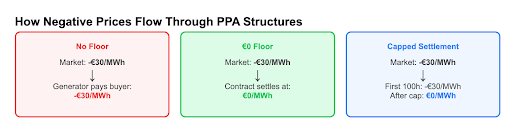
For an IPP operating a 100 MW solar farm at a PPA with no negative-price floor clause, 400 negative-price hours in a year represent approximately 20,000-30,000 MWh of generation that either earns nothing (if the PPA settles at €0) or costs money (if the contract requires the seller to compensate the buyer). At an average negative price of -€10/MWh, the cost is €200,000-€300,000 per year — a direct reduction in project returns.
For IPPs managing portfolios of 500 MW-2 GW across multiple markets, negative pricing compounds. A portfolio with 30% exposure to negative-price hours across three markets can see 3-5% of total annual revenue eroded by negative pricing. This is enough to move a portfolio’s IRR (Internal Rate of Return) below the hurdle rate required by institutional investors.
PPA contracts handle negative pricing in several ways. Contracts with a €0/MWh floor protect the generator: when the market goes negative, the contract settles at zero rather than a negative number. Contracts without a floor expose the generator to the full negative price. Some contracts include negative-price settlement caps: the seller compensates the buyer for a limited number of negative-price hours per year, after which the contract price holds at zero.
 
The growth in negative-price hours is structural, not cyclical. It reflects a fundamental mismatch between renewable capacity growth and grid flexibility.
The growth of solar and wind capacity follows an S-curve, while grid infrastructure and demand flexibility evolve much more slowly. Every gigawatt of new solar capacity adds more generation during the same midday hours, pushing prices further into negative territory. In Spain, solar capacity grew from 15 GW to 34 GW in five years — but the grid’s ability to absorb and transmit that power did not grow proportionally. The result is structural oversupply during peak solar hours that will persist until storage or demand-side flexibility catches up.
Feed-in tariffs and premium-based subsidies that pay per kilowatt-hour generated — regardless of market price — remove the economic signal that would otherwise incentivize generators to curtail during low-price hours. As long as the subsidy exceeds the negative price, the generator profits by producing even when the market price is below zero. This creates a perverse dynamic: subsidized generators contribute to the negative pricing that hurts the entire market, including unsubsidized IPPs.
Storage converts negative pricing from a cost into a revenue opportunity through time-shifting and arbitrage.
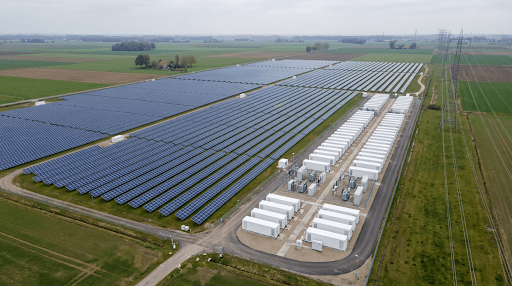
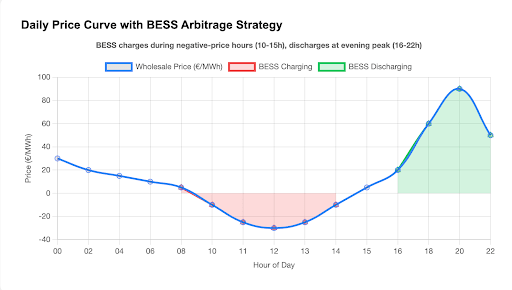
Battery Energy Storage Systems turn negative pricing from a problem into an opportunity. During negative-price hours, the BESS charges — essentially getting paid to absorb electricity. During evening peak hours when prices rise to €80-150/MWh, the BESS discharges and sells at the high price. The spread between negative midday prices and positive evening prices creates an arbitrage revenue stream that can be substantial in markets with high price volatility.
The optimal BESS size depends on the local price pattern: the number of negative-price hours, the depth of negative prices, and the height of the subsequent peak. In Spain, where the spring midday-to-evening spread regularly exceeds €100/MWh, a 4-hour BESS can capture a meaningful portion of the arbitrage opportunity. In Germany, where negative-price events are less extreme but more frequent, a longer-duration BESS (6-8 hours) may be more appropriate.
A 50 MW / 200 MWh BESS co-located with a solar farm in Spain, cycling once per day during the spring season (roughly 120 days), captures approximately 24,000 MWh of arbitrage. At an average spread of €80/MWh (from -€20 to +€60), the annual arbitrage revenue is approximately €1.9 million. This revenue comes on top of the solar farm’s PPA income and directly offsets the losses from negative-price hours.

Sungrow’s PowerTitan BESS platform provides the daily cycling capability that negative-price arbitrage requires. The system’s LFP battery chemistry supports high cycle counts — critical for a revenue strategy that depends on charging and discharging once or more per day across the full year. The liquid-cooled thermal management maintains cell temperatures within the optimal range during frequent cycling, preserving capacity retention over the system’s 15-20 year life.
For IPPs evaluating BESS co-location to manage negative pricing, Sungrow offers containerized storage solutions that integrate with existing solar infrastructure. The integrated EMS handles the automated dispatch logic — charging during low or negative price periods and discharging during peak hours — without requiring manual trading or separate energy management software.
Negative pricing is a structural feature of European power markets, not a temporary anomaly. IPPs that rely solely on PPA revenue without addressing negative-price exposure will see their returns erode as renewable capacity grows. Co-locating BESS with solar assets transforms negative-price hours from a cost into a revenue opportunity. Sungrow’s PowerTitan platform provides the daily cycling capability that negative-price arbitrage requires.

source

Posted in Renewables | Leave a comment

India Adds Record 27 GW Solar Capacity in 1H 2026 – mvapulse.com

⚡ Quick Read
The Indian renewable energy landscape witnessed a monumental shift in the first half of 2026, with the country adding a record 27 GW of solar capacity. According to the Mercom India Research Q2 and 1H 2026 India Solar Market Update, this represents a 49% year-over-year increase from the 18 GW installed during the same period in 2025. The second quarter of 2026 alone saw nearly 12 GW of capacity addition, cementing India’s position as one of the fastest-growing solar markets globally.
Beyond utility-scale growth, the sector is seeing targeted policy interventions. The Union Cabinet has approved the ₹50.7 billion (~$530.20 million) Pradhan Mantri Surya Sarovar Yojana to address challenges in the floating solar segment, including high reservoir engineering costs. State-level support remains aggressive, with Bihar introducing an additional ₹10,000/kW subsidy for residential rooftop solar, complementing the central PM Surya Ghar: Muft Bijli Yojana. Meanwhile, Odisha has amended its 2022 Renewable Energy Policy to include battery energy storage incentives and removed capacity caps on wind projects.
Technological integration is also gaining momentum. A notable case study in Pune saw Western Metal Industries successfully integrate a 600 kW/1.2 MWh BESS with a 500 kW rooftop solar plant, reducing grid dependency by 11.1%. Furthermore, financial activity remains strong, highlighted by Motilal Oswal Group’s ₹15 billion (~$157.20 million) commitment to Inox Clean Energy.
For EPC contractors and developers, the market is shifting from pure-play solar to integrated energy solutions. The rise in BESS adoption, evidenced by Gujarat’s 1,000 MW/4,000 MWh tender, signals a move toward firm, dispatchable renewable power. Developers should monitor the evolving regulatory landscape, particularly the Appellate Tribunal for Electricity’s recent ruling on open access wheeling charges, which impacts captive wind project economics. The focus is now on optimizing project returns through hybrid configurations and leveraging state-specific financial incentives.
The immediate pipeline includes significant tenders, such as the 115 MW floating solar project in Maharashtra and the 1,000 MW BESS tender in Gujarat. As the India renewable energy sector continues to scale, the focus will increasingly move toward grid stability and the commercial viability of storage. Stakeholders must align their procurement and execution strategies with these emerging technical requirements to maintain competitive advantages in a rapidly evolving market.
Aditya Pathre is the Founder of MVApulse and covers India’s renewable energy sector, including solar, wind, battery energy storage systems (BESS), green hydrogen, transmission infrastructure, renewable energy policy and competitive bidding. His reporting focuses on project developments, market trends, government policies and energy transition across India.
India’s Power Sector Intelligence Portal
MVApulse is an independent publication covering India’s renewable energy sector including solar, wind, BESS, transmission, green hydrogen, EPC and power markets.
Copyright © 2026 MVApulse. Powered by Swadi Innovative Technologies Pvt Ltd.

source

Posted in Renewables | Leave a comment

Valuable insights into Kenya’s solar PV market and the broader East African region – greenbuildingafrica.co.za


I recently interviewed Noah Lukeya, sales manager for LONGi East Africa. Noah was kind enough to provide valuable insights into the solar PV market in Kenya and the broader East Africa region , as well as how LONGi is meeting market requirements across its range of products and services.
Kenya is targeting 100% clean energy by 2030 through policies such as the National Energy Policy 2025–2034 and the Energy (Integrated National Energy Plan) Regulations 2025. From your perspective, how are these developments influencing customer demand and the solar market? What opportunities do they create for LONGi?
Kenya’s energy transition is accelerating under the National Energy Policy 2025–2034 and the Energy (Integrated National Energy Plan) Regulations 2025. Together, these frameworks strengthen long-term energy planning, encourage private investment, and create greater certainty for renewable energy developers, investors and technology providers.
These policy developments are already having a positive impact across the solar value chain.
For investors,the clear Rules around tariffs, licensing, contracts and implementation frame work has given them confidence to commit long term money on renewable energy projects , Currently we are seeing increase in C&I to utility project coming up financed by foreign investors under PPA and PPI models. Additionally, Compare to last 3 years more financial institutions , project developers and individual investor from other countries, are increasingly interested in exploration and investing on renewable energy  evident, with more than 50% increase of new clean energy companies compared to 2023.
For EPC contractors and project developers, the expanding pipeline of renewable energy projects is creating broader business opportunities. As the market continues to mature, customers are placing greater emphasis not only on project execution but also on technology selection, long-term system performance and bankable partners that can support projects throughout their lifecycle.
At the end-user level, both commercial and residential customers are increasingly viewing solar as a long-term strategic investment rather than simply an alternative power source. Rising grid electricity tariffs, combined with the desire for greater energy independence and more reliable electricity supply, are accelerating solar adoption. More businesses are investing in rooftop solar to reduce operating costs, while homeowners are increasingly recognising the long-term economic and sustainability benefits of clean energy.
Above all this, lower Levelized Cost of Electricity (LCOE), high-efficiency and quality products are prioritised and sort after factors. this creates tremendous opportunities for LONGi. Leveraging our industry-leading Back Contact (BC) technology, proven global bankability and extensive experience across utility-scale, C&I and distributed solar projects, we help customers achieve higher energy yield, lower LCOE and long-term system reliability. Beyond high-efficiency modules, LONGi also provides scenario-based solutions and integrated solar-plus-storage offerings for grid-connected, off-grid and hybrid applications. Supported by our local team in Kenya, we work closely with EPCs, distributors and project developers to deliver technical expertise, responsive support and reliable project execution throughout the entire project lifecycle.
Recent regulatory changes are opening transmission and distribution networks to private investment. what changes are you seeing in the development of utility-scale and distributed solar projects? How is LONGi supporting customers under this evolving market environment?
As private participation in transmission, distribution and electricity trading continues to expand, market efficiency is improving and electricity procurement is becoming more competitive and flexible. This is generating clear economic benefits for market participants: developers and investors are able to unlock new revenue streams through diversified project models, while C&I users can better control energy costs and improve long-term operational stability. At the same time, the broader economy benefits from improved energy access, reduced reliance on expensive fossil-based generation, and enhanced energy security, all of which support sustainable industrial growth.
We are seeing increased activity in industrial power projects, private mini-grids, commercial rooftop systems and utility-scale solar farms developed through private financing and a growing demand for faster project execution. Financiers are also increasingly requiring Tier-1 manufacturers with proven stability and reliability such as LONGi, more technical modelling before procurement as investors are seeking long-term returns.
This shift aligns closely with our long-term strategy. Rather than simply supplying modules, we position ourselves as a long-term technology partner, helping customers maximise energy yield, reduce the LCOE and ensure reliable system performance throughout the project lifecycle. Leveraging our industry-leading Back Contact (BC) technology, globally recognised bankability and extensive experience across utility-scale, distributed and commercial & industrial projects, we provide solutions that meet the evolving needs of Kenya’s energy market.
With the expansion of net metering and incentives for rooftop solar, how is demand evolving between residential customers and the commercial & industrial (C&I) sector? Which segment is currently driving the most growth?
Residential solar demand in Kenya remains strong and continues to lead the market. However, with the opening transmission and distribution networks to private investment and increases in tariff on grid, Commercial and Industrial sector is catching up at an exponential pace Commercial rooftop installations are becoming larger, often exceeding several hundred kilowatts. Businesses are consuming far more electricity than households, making the financial returns from solar investments much more attractive.
The economic potential is already being demonstrated across Africa. In Zimbabwe, an 11 MW solar-storage-diesel microgrid for RHA Mining, equipped with LONGi’s high-efficiency modules, officially entered operation this year. The project is expected to reduce diesel consumption and associated carbon emissions by more than 90%, lower electricity costs by approximately 50% compared with conventional diesel generation, and save the customer an estimated RMB 50–60 million in annual fuel costs.
As C&I solar continues to scale, LONGi is well positioned to support this growth with high-efficiency modules, reliable technology and strong lifecycle value, helping businesses achieve greater energy independence while improving the long-term economics of their solar investments.

Kenya’s climate presents challenges such as high temperatures, dust and diverse installation environments. How are LONGi’s latest technologies – including BC modules and scenario-based solutions – helping customers maximise energy yield and long-term reliability? Are integrated solar-plus-storage solutions becoming an increasingly important part of customer discussions?
Dust accumulation and high temperatures is a significant challenge in northern, eastern and some part of coastal region Kenya.
LONGi addresses these challenges through scenario-based product solutions. For example, our Anti-Dust modules are designed to reduce dust accumulation and cleaning frequency, helping customers maintain more stable energy generation while lowering operation and maintenance costs.
At the core of these solutions is LONGi’s Back Contact (BC) technology.BC module is game changer thanks to its high efficiency customers are now able to maximise energy output per area, saving on space, lower balance of system cost and ultimately high returns on the investments.

Learn more about LONGi’s 5A solutions (Anti-Dust, Anti-Shading, Anti-Fake, Anti-Glare and Anti-Fire) HERE
At the same time, solar-plus-storage is becoming an increasingly important part of customer discussions. As solar deployment expands and its share in the power system increases, energy storage becomes more valuable for balancing generation and consumption, improving power reliability and enabling customers to make better use of renewable electricity. This is particularly relevant for C&I, off-grid and hybrid applications in Africa.
LONGi is responding to this trend by extending its capabilities beyond high-efficiency PV through LONGi ONE energy storage system, supporting the growing demand for integrated solar-plus-storage solutions and helping customers achieve more reliable, flexible and cost-effective energy systems.
How does LONGi work with EPCs, distributors and installers in Kenya to ensure reliable product supply, technical support and successful project delivery?
Partnership is central to LONGi’s strategy in Kenya. LONGi work closely with distributors, EPC contractors and installers throughout the project lifecycle from system design, product selection to technical and after-sales support.
For distributors, LONGi provides scenario-based product recommendations according to different end-user needs and application environments, together with delivery coordination, technical and after-sales support to strengthen local market development.
For EPC partners, our support begins well before procurement. LONGi provides pre-sales’ technical consultation and assists with product selection and system design through tools such as PV Master, helping partners optimise solutions for specific project requirements and improve overall system performance.
For Installers, we provide regular technical training, including bi-weekly online sessions and offline hands-on training, covering product knowledge and installation practices.
Behind these partnerships is our local team in Kenya, enabling us to respond quickly to customer and partner needs.
Thank you for your time Noah, we wish you and LONGi all the success in Kenya. 
Author: Bryan Groenendaal


August 10, 2026
July 22, 2026
July 13, 2026
July 15, 2026
July 8, 2026
August 2, 2026
Disclaimer | Privacy Policy | Terms & Conditions | Returns Policy | Intellectual Property | Cookie Policy
© 2019 – 2026 GBA Digital Media Group. All Rights Reserved
Website Design | Website Maintenance
Copyright Green Building Africa 2026.

Subscribe to our weekly Top 5 Stories
"*" indicates required fields

source

Posted in Renewables | Leave a comment

A Michigan township that said no to a 2nd big solar project is now in a legal fight – MLive.com

A Michigan township that said no to a 2nd big solar project is now in a legal fight  MLive.com
source

Posted in Renewables | Leave a comment

Pennsylvania homeowner hits repair dead end after leak appears beneath aging solar panels – The Cool Down

© 2025 THE COOL DOWN COMPANY. All Rights Reserved. Do not sell or share my personal information. Reach us at hello@thecooldown.com.
Other companies weren’t willing to step in due to liability concerns.
Photo Credit: Reddit
One homeowner’s rooftop solar system became part of a larger repair mess, including a leaking roof, a stained ceiling, and an ongoing search for solutions.
Solar can be a strong way to trim electricity costs over time, but those financial gains can disappear quickly when the installation is done poorly, or the service agreement leaves too much unanswered, as one Pennsylvania homeowner realized. 
On Reddit’s r/solar forum, the homeowner explained that they had 13-year-old solar panels on a 20-year-old roof. For the past year, there had been a leak beneath their panels, and it had been staining their ceiling. “After each heavy rain, new water stains appear,” they said. 
While there was clearly a problem somewhere, an independent roofing contractor told the homeowner that nothing was wrong with the roof. The solar contractor also tried and failed to fix the leak, and other companies weren’t willing to step in due to liability concerns. 
“I’m at a loss. Should I just get the panels removed and replace the whole roof? I can’t afford that, but the roof has been leaking for a year,” the original poster asked. 
A properly designed rooftop system can help households cut monthly utility costs, but the benefits depend on the installation being done correctly and the roof lasting as long as the panels.
💡These best-sellers from Quince deliver affordable, sustainable luxury for all
Starting at $50
Starting at $99
Starting at $60
Starting at $80
When a roof is already nearing the end of its lifespan, future repairs can become far more complicated and expensive because the array may need to be removed and reinstalled. If the original installer is unresponsive or the contract does not clearly define responsibility for leaks and service, homeowners may find out too late that their options are limited.
In the home-electrification market, consumer confidence depends not only on strong technology but also on quality work and dependable after-sales support.
If you are considering rooftop solar, evaluate your roof first. If the roof is old or already showing signs of wear, replacing it before installation may be far less expensive than trying to work around the panels later.
Homeowners should also ask detailed questions before signing a contract: Who handles leak repairs? Is there a warranty? Will the company remove and reinstall panels for roof work later? What happens if the installer goes out of business or stops servicing older systems?
For homeowners considering solar, EnergySage‘s free tools let you compare competitive bids from local installers without giving up your contact information unless you decide to move forward. That can make it easier to vet installers, compare warranty terms, and ask about roof age before making a big purchase.
If a leak has already appeared, document everything, get an independent roof inspection if possible, and keep written records of all communication with the installer. The sooner the source of the leak is identified, the better the chances of preventing further interior damage.
As for this homeowner, Reddit users recommended several possible courses of action.
“Keep calling around to find someone competent,” one advised
“I had this issue as well with my solar company installer,” another said. “I had to take them to court they paid for my entire roof to be repaired and had to reinstall the solar panels back on.” 
Get TCD’s free newsletters for easy tips, smart advice, and a chance to earn $5,000 toward home upgrades. To see more stories like this one, change your Google preferences here.
© 2025 THE COOL DOWN COMPANY. All Rights Reserved. Do not sell or share my personal information. Reach us at hello@thecooldown.com.

source

Posted in Renewables | Leave a comment

Bat activity jumped 50% over Midwest solar farms as farmers planted nearby fields, and researchers think – The Times of India

source

Posted in Renewables | Leave a comment

Solar owners compare the mistakes they'd avoid, from undersized systems to skipped batteries – Yahoo

Solar owners compare the mistakes they’d avoid, from undersized systems to skipped batteries  Yahoo
source

Posted in Renewables | Leave a comment

India’s solar manufacturing ambitions: The role of AI and smart manufacturing – pv magazine India

India has already established itself as one of the world’s largest solar markets. The bigger opportunity now is to become a serious manufacturing power, not just a large consumer of solar equipment.
We’re seeing encouraging investments across the value chain, from modules and cells to ingots and wafers. That is an important step because long-term competitiveness will come from building a complete manufacturing ecosystem rather than isolated capacities.
The next challenge is technology. Manufacturing solar cells is not simply about installing equipment and adding capacity. It requires deep process expertise, continuous improvement and the ability to improve production independently over time.
If India wants to become a genuine global manufacturing hub, it must invest as heavily in knowledge, talent and R&D as it does in factories. AI will also play an increasingly important role in helping manufacturers optimise processes, improve yields and accelerate learning.
In the long run, success will not be measured by how much we manufacture today, but by our ability to develop the technologies, expertise and innovation ecosystem that will shape the next generation of solar products.
Solar manufacturing begins to resemble semiconductor manufacturing
Modern solar manufacturing has evolved far beyond conventional assembly lines. Today’s high-efficiency cell technologies demand manufacturing environments where micron-level precision, process stability and continuous quality control directly influence product performance.
In many ways, the industry is beginning to resemble semiconductor manufacturing, where manufacturing excellence itself becomes the differentiator. Every stage—from wafer handling to cell processing and module assembly—must operate within tightly controlled parameters to consistently deliver high conversion efficiencies and long-term reliability.
This evolution means that future competitiveness will depend less on production scale alone and increasingly on engineering excellence, automation and digital process control.
AI as the next competitive advantage
There is a lot of discussion around AI replacing jobs. In manufacturing, that misses the point.
The real value of AI is its ability to capture and scale knowledge. Every factory has experienced engineers and operators whose expertise is built over years. AI helps organisations retain that knowledge, apply it consistently and use it to make better decisions.
For India, this is particularly relevant because much of the country’s solar manufacturing capacity is still being built. Unlike mature manufacturing markets, we have an opportunity to incorporate AI and digital tools from the beginning rather than trying to retrofit them later.
Going forward, competitiveness will not be determined by capacity alone. It will depend on who can improve fastest, maintain the highest quality and adapt most quickly to new technologies.
The manufacturers that combine strong engineering talent with AI-driven insights will have a clear advantage in productivity, quality and innovation.
The smart manufacturing advantage
Scale is important, but scale alone is no longer enough.
The manufacturers that succeed globally will be those that can consistently deliver quality, improve processes quickly and move rapidly to the next generation of technologies.
That is where smart manufacturing becomes critical. Integrating automation, AI, analytics and digital quality systems gives manufacturers far greater visibility and control over their operations. It helps improve yields, reduce variability and build more reliable production processes.
India has a natural advantage because much of this capacity is being developed today. Companies can build modern, digitally enabled factories from the outset instead of trying to modernise decades-old facilities.
Ultimately, smart manufacturing is not only about efficiency. It is about building capabilities. The companies that can combine technology, engineering expertise and a culture of continuous improvement will be best positioned to compete globally over the long term.
Can India challenge China’s dominance in solar manufacturing
China’s leadership in solar manufacturing was built over decades through scale, supply chain integration and relentless focus on technology. It would be unrealistic to expect any country to replicate that overnight.
The more relevant question is not whether India can replace China, but whether India can build a strong and globally competitive manufacturing ecosystem of its own.
The opportunity is certainly there. Around the world, governments and businesses are looking to diversify supply chains and reduce concentration risk. India is well positioned to benefit from that shift.
The challenge is that manufacturing is about much more than factories. It requires a network of suppliers, technology partners, research institutions, skilled talent and supporting industries. Building that ecosystem takes time.
India has made significant progress in expanding capacity. The next stage is developing the broader ecosystem that can support innovation and reduce dependence on imported technology and expertise.
With sustained investment and a long-term approach, India can strengthen its position considerably and become an increasingly important player in the global solar manufacturing landscape.
Domestic market provides demand visibility
India’s rise as one of the world’s largest solar markets is a major advantage for domestic manufacturers.
A strong home market provides something every manufacturer values: demand visibility. It creates confidence to invest, expand capacity and adopt new technologies.
However, domestic demand alone is not enough. The real opportunity is to use the scale of the Indian market as a platform for building globally competitive businesses.
If manufacturers can combine the strength of India’s domestic market with world-class manufacturing, technology and innovation, the country has the potential to become one of the most important clean energy manufacturing centres in the world.
The opportunity is not just to meet India’s solar demand. It is to build companies that can compete successfully in any market.
The views and opinions expressed in this article are the author’s own, and do not necessarily reflect those held by pv magazine.
This content is protected by copyright and may not be reused. If you want to cooperate with us and would like to reuse some of our content, please contact: [email protected].
Comments
Please login to comment
The new issue of pv magazine Global is out now!
Available in print and digital – get your copy today!
Tuesday, August 11, 2026
3:00 pm – 4:00 pm CEST, Berlin, Paris, Madrid
Entries open in seven categories: Modules, Inverters, BoS, BESS, Manufacturing, Sustainability, Projects.
April 01 – August 31, 2026
Tuesday, August 25, 2026
10:00 am – 11:00 am CEST, Berlin, Paris, Madrid
Thursday, October 7, 2026
11:00 am – 12:30 pm CEST, Berlin, Paris, Madrid

You have no items in your basket.

source

Posted in Renewables | Leave a comment

China wafer prices hold steady as market weighs early signs of upstream stabilization – pv magazine India

According to the OPIS Global Solar Markets Report released on Aug. 11, Free-On-Board (FOB) China M10 and 210R wafer prices were unchanged week on week at $0.121/pc and $0.134/pc, respectively.
Wafer prices held steady this week as market participants closely monitored early signs of stabilization in the polysilicon market following an Aug. 7 joint initiative by major Chinese producers.
Months of policy efforts targeting low-price competition and overcapacity culminated in the initiative, under which eight major Chinese polysilicon producers—accounting for over 90% of national capacity—pledged strict adherence to full-cost sales requirements and energy-consumption standards, according to the Silicon Branch of the China Nonferrous Metals Industry Association.
Under the initiative, manufacturers pledged to calculate cash, production and full costs in line with the China Photovoltaic Industry Association’s push for a standardized production-cost benchmark across the sector. Signatories also committed to voluntarily phasing out inefficient, energy-intensive capacity under newly enacted national energy-consumption limits.
Polysilicon prices recorded their first increase of 2026, reflecting improved sentiment around new orders amid the recent series of policy efforts. China Mono Premium polysilicon—OPIS’ assessment for mono-grade polysilicon used in N-type ingot production—increased 0.67% week on week to CNY32.100 ($4.76)/kg, according to the OPIS report.
For wafer producers, however, the cost-accounting framework emphasized in the initiative has limited direct relevance, according to an industry source. Because OEM manufacturing is prevalent in wafer production, the industry already relies on mature, standardized formulas for OEM terms, processing fees, and production costs. The critical task for wafer producers is determining how to position themselves amid tentative upstream market recoveries and persistent downstream demand weakness, one source noted.
A trade participant said wafer manufacturers are operating at lower utilization rates and facing deeper losses than polysilicon producers, with production increasingly concentrated among integrated companies and a smaller group of specialized manufacturers running at reduced capacity.
The participant cautioned that a premature rebound in wafer prices following polysilicon’s recovery could slow the industry’s ongoing capacity rationalization. Without additional local-government protection or subsidies, the source said, the approaching maturation of medium- to long-term bank loans would naturally force uncompetitive capacity out of the market.
Beyond wafer manufacturing, China-based PV equipment suppliers are encountering headwinds in international markets.
Unconfirmed industry reports indicate that a major U.S. PV manufacturing expansion project, which had reportedly been sourcing ingot and cell manufacturing equipment from Chinese vendors, has begun a broader compliance audit across its current and prospective global suppliers.
A source familiar with the matter revealed that previous equipment orders placed with Chinese vendors encountered some export shipment hurdles, while remaining unexecuted orders faced regulatory approval bottlenecks.
However, the source noted that the recent U.S. Section 232 determination—which established a minimum import price of $100/kg for ingots and wafers alongside a 15% ad valorem duty on polysilicon derivatives—is expected to accelerate the development of U.S. ingot-pulling and wafer production, historically the primary bottleneck in the domestic supply chain. The source added that the $100/kg floor price equates to approximately $0.10/W, bringing import price thresholds in line with domestic U.S. production costs.
OPIS, a Dow Jones company, provides energy prices, news, data, and analysis on gasoline, diesel, jet fuel, LPG/NGL, coal, metals, and chemicals, as well as renewable fuels and environmental commodities. It acquired pricing data assets from Singapore Solar Exchange in 2022 and now publishes the OPIS APAC Solar Weekly Report.

The views and opinions expressed in this article are the author’s own, and do not necessarily reflect those held by pv magazine.
This content is protected by copyright and may not be reused. If you want to cooperate with us and would like to reuse some of our content, please contact: [email protected].
Comments
Please login to comment
The new issue of pv magazine Global is out now!
Available in print and digital – get your copy today!
Tuesday, August 11, 2026
3:00 pm – 4:00 pm CEST, Berlin, Paris, Madrid
Entries open in seven categories: Modules, Inverters, BoS, BESS, Manufacturing, Sustainability, Projects.
April 01 – August 31, 2026
Tuesday, August 25, 2026
10:00 am – 11:00 am CEST, Berlin, Paris, Madrid
Thursday, October 7, 2026
11:00 am – 12:30 pm CEST, Berlin, Paris, Madrid

You have no items in your basket.

source

Posted in Renewables | Leave a comment

Genesis solar farm near Foxton fast-tracked to power 43,000 homes – NZ Herald

Genesis solar farm near Foxton fast-tracked to power 43,000 homes  NZ Herald
source

Posted in Renewables | Leave a comment

Copper Indium Gallium Diselenide – energy.gov

An official website of the United States government
Here’s how you know
Official websites use .gov
A .gov website belongs to an official government organization in the United States.
Secure .gov websites use HTTPS
A lock ( ) or https:// means you’ve safely connected to the .gov website. Share sensitive information only on official, secure websites.
Funding Opportunities
DOE supports innovative research focused on overcoming the current technological and commercial barriers for copper indium gallium diselenide [Cu(InxGa1-x)Se2], or CIGS, solar cells. A list of current projects, summary of the benefits, and discussion on the production and manufacturing of this solar technology are below.
Since its initial development, copper indium diselenide (CuInSe2) thin-film technology has been considered promising for solar cells because of its favorable electronic and optical properties. It was later found that by substituting gallium (Ga) for indium (In), the bandgap can be increased from about 1.04 electron-volts (eV) for copper indium diselenide (CIS) films to about 1.68 eV for copper gallium diselenide (CGS) films. Optimal devices have been fabricated with only a partial substitution of Ga for In, leading to a substantial increase in overall efficiency and more optimal bandgap. These solar cells are commonly known as a copper indium gallium diselenide [Cu(InxGa1-x)Se2], or CIGS, cells.
Although laboratory-scale cell efficiencies have exceeded 20%, commercial CIGS modules typically have efficiencies between 12% and 14%.
Learn more about the DOE Solar Energy Technologies Office awardees and the projects involving CIGS below.
The benefits of CIGS solar cells include:
Two of the low-cost deposition methods that produce the highest device and module efficiencies were developed in the 1980s. These methods are:
After the CIGS deposition, the junction is formed by chemical-bath deposition of the n-type CdS layer. To finish the solar cell, a high-resistance zinc oxide (ZnO) layer and a high-conductivity n+-type ZnO layer are deposited by either sputtering or chemical-vapor deposition. Laser-scribing processes at different steps in the production process create the individual solar cells connected in series.
Alternative manufacturing techniques have been explored, such as reactive sputtering, magnetron sputtering (Cu, In, and Ga are sputtered while Se is evaporated), and electrodeposition. However, co-evaporation and precursor reaction processes still remain the most popular.
A major increase in device performance was achieved when the ceramic or borosilicate glass substrate was replaced by soda-lime glass. Although soda-lime glass was chosen because it has closer thermal expansion properties to CIGS, it was ultimately determined that the primary advantage of using soda-lime glass results from the diffusion of sodium (Na) ions from the glass into the CIGS absorber layer. Work is currently being done to identify the role of Na in improving CIGS performance and what tolerances CIGS has to the inclusion of Na. Current manufacturing techniques incorporate Na either from soda-lime glass or a separate Na source. Soda-lime glass has an added advantage of being less expensive than previous glass substrates.
All high‐efficiency CIS and CIGS devices use molybdenum (Mo) as the back contact primarily because of its work function and the high reflectivity of the Mo film. These films are typically deposited through direct-current (DC) sputtering. The sputtering deposition process requires precise pressure to control the stress in the film. Because of some inherent problems with the Mo back-contact, such as the possibility of a hole-blocking Schottky diode effect at the interface, other metals have been investigated to replace Mo, but have had limited success.
For more information on CIGS solar cells, visit the Energy Basics website.
Committed to Restoring America’s Energy Dominance.
Follow Us

source

Posted in Renewables | Leave a comment

Lightsource bp finds buyer for 1 GW solar portfolio – pv-magazine-australia.com

Australian renewable energy development business Aula Energy announced it has acquired a 1 GW portfolio of operating solar farms from Lightsource bp and a development pipeline of up to 800 MW of associated battery energy storage projects as the London-headquartered developer shifts focus to hybrid generation and storage projects.
The portfolio of operating assets includes the 200 MW Wellington, 400 MW Wellington North, and the 107 MW West Wyalong solar farms in New South Wales (NSW). Also included is the 210 MW Woolooga solar farm in Queensland and the 90 MW Wunghnu solar farms in Victoria.
Sydney-headquartered Aula, established by investment bank Macquarie in 2023 and planning for a portfolio of about 4 GW across Australia and New Zealand, said the “strategic acquisition” complements its existing portfolio of battery and wind projects, including the 228 MW Boulder Creek and 256 MW Carmody’s Hill wind farms being built in Queensland and South Australia respectively.
“Today we’ve taken another meaningful step in Aula Energy’s growth and aspirational leadership in Australia’s clean energy transition,” the company said. “The acquisition establishes our first operating fleet across the National Electricity Market.”
Lightsource bp Asia-Pacific Chief Operating Officer Adam Pegg said the sale of what are the first utility-scale solar projects developed in Australia by the company, marks a shift in focus for the developer.
“Our strategy in the Asia-Pacific region has evolved significantly since these projects were conceived and we are now focused on developing hybrid renewable projects that combine onshore solar and wind with battery storage to deliver firm, flexible, and low-cost energy,” he said.
Pegg said the acceleration of data centre and AI‑driven load, alongside the emergence of new non‑traditional energy users, is rapidly reshaping the future energy mix in the region and hybrid assets allow for tailored solutions that meet the specific needs of its partners and customers.
“Lightsource bp’s solutions that combine onshore renewables, both solar and wind, with battery storage solutions are well positioned to support that growth with reliable, scalable solutions that can respond to the region’s evolving demand profile,” he said.
Lightsource bp, part of the British oil and gas major bp, said it continues to progress a pipeline of more than 9.5 GW of solar, wind and battery storage in the Asia-Pacific region.
The deal with Aula comes after a previously announced $800 million-plus deal with Chinese state-owned company Beijing Energy International Holding (BJEI) for the solar assets was scrapped early last year after failing to secure approval from the Foreign Investment Review Board.
This content is protected by copyright and may not be reused. If you want to cooperate with us and would like to reuse some of our content, please contact: [email protected].
Comments
Please login to comment
[…] PV Magazine was the first we saw, with ‘Lightsource bp finds buyer for 1 GW solar portfolio’ by David Carroll on 23rd February […]
[…] wasn’t a snap decision. Lightsource bp first tried to sell the same portfolio to Beijing Energy International in late 2023 for a reported $800 million-plus, but the deal […]
[…] In a smaller company-linked move, BP-backed renewables developer Lightsource bp said Australia’s Aula Energy had agreed to buy a 1-gigawatt portfolio of operating solar farms, with a pipeline of up to 800 megawatts of associated battery projects. Asia-Pacific COO Adam Pegg said Lightsource bp was “now focused on developing hybrid renewable projects” that pair generation and storage. (PV Magazine Australia) […]
The new issue of pv magazine Global is out now!
Available in print and digital – get your copy today!
Tuesday, August 11, 2026
3:00 pm – 4:00 pm CEST, Berlin, Paris, Madrid
Entries open in seven categories: Modules, Inverters, BoS, BESS, Manufacturing, Sustainability, Projects.
April 01 – August 31, 2026
Tuesday, August 25, 2026
10:00 am – 11:00 am CEST, Berlin, Paris, Madrid
Thursday, October 7, 2026
11:00 am – 12:30 pm CEST, Berlin, Paris, Madrid

You have no items in your basket.

source

Posted in Renewables | Leave a comment

Genesis solar farm near Foxton fast-tracked to power 43,000 homes – nzherald.co.nz

Genesis solar farm near Foxton fast-tracked to power 43,000 homes  nzherald.co.nz
source

Posted in Renewables | Leave a comment

Shaping Australia's future energy landscape through smarter large-scale solar – techxplore.com

Shaping Australia’s future energy landscape through smarter large-scale solar  techxplore.com
source

Posted in Renewables | Leave a comment

New owner fears inherited rooftop solar is failing, but the culprit may be far simpler – tech.yahoo.com

New owner fears inherited rooftop solar is failing, but the culprit may be far simpler  tech.yahoo.com
source

Posted in Renewables | Leave a comment

IEEFA calls for changes to boost Australia’s C&I solar uptake – pv-magazine-australia.com

Australia continues to be one of the most active markets globally for residential solar but a new report says the rooftop solar potential of the nation’s commercial and industrial (C&I) buildings remains largely untapped with the sector facing “substantial” barriers.
An estimated 22 GW of rooftop solar capacity has been installed atop Australian households but the Institute for Energy Economics and Financial Analysis (IEEFA) said only 5.6 GW of capacity has been rolled out across the country’s C&I sector. This includes capacity installed at sites such as factories, warehouses, retail stores, schools and hospitals. 
In its Unlocking the clean energy potential of Australian business rooftops report, the IEEFA said that the “significant market potential and benefits” of C&I solar, annual installations have flatlined in recent years after an initial growth spurt in the market in the mid-2010s.
“At about 600 MW per year, annual installations in the C&I solar market over the past few years have substantially lagged behind the roughly 2,500 MW per year the residential sector has recorded in the same period,” the report reads.
The IEEFA report shows the technical rooftop potential for solar across the Australia’s C&I areas could be close to 40 GW, and once agricultural areas are included, this could exceed 80 GW by 2050. The independent think tank however warns that some forecasts indicate the figure could fall well short of that potential with CSIRO suggesting slow growth to just 17 GW by mid-century.
The report identifies four distinct barriers to C&I rooftop solar and storage uptake including distorted business-level investment frameworks, with solar and storage projects in businesses are often too big to qualify for residential incentives and too small to qualify for utility-scale incentives.  
The report also highlights “complex and inconsistent” network tariff structures, “fragmented, slow and unpredictable” grid connection process, and an “uneven playing field for network services.”
Johanna Bowyer, lead analyst of Australian electricity at IEEFA and report co-author, said these barriers are preventing the C&I solar sector from reaching its full potential at speed and left unaddressed “will continue to constrain investment, slow down uptake and leave the full potential of C&I solar and storage unrealised.” 
The report recommends a set of solutions to help overcome these hurdles, including improved incentive schemes, reviewed and standardised network tariffs, and a streamlined grid connection process. It also calls for a review of the economic regulation of distribution networks to examine the potential for non-network solutions such as distributed energy resources to compete with traditional poles and wires investment.
“These recommendations offer a set of solutions to enable the C&I sector to be scaled up at pace, helping serve demand as coal exits, and supporting Australia in attaining its emissions reduction goals while reducing energy costs for businesses,” Bowyer said.
This content is protected by copyright and may not be reused. If you want to cooperate with us and would like to reuse some of our content, please contact: [email protected].
Comments
Please login to comment
The new issue of pv magazine Global is out now!
Available in print and digital – get your copy today!
Tuesday, August 11, 2026
3:00 pm – 4:00 pm CEST, Berlin, Paris, Madrid
Entries open in seven categories: Modules, Inverters, BoS, BESS, Manufacturing, Sustainability, Projects.
April 01 – August 31, 2026
Tuesday, August 25, 2026
10:00 am – 11:00 am CEST, Berlin, Paris, Madrid
Thursday, October 7, 2026
11:00 am – 12:30 pm CEST, Berlin, Paris, Madrid

You have no items in your basket.

source

Posted in Renewables | Leave a comment

First-time homebuyers inherited a paid-off $26,000 solar array, then found the roof leaking – The Cool Down

© 2025 THE COOL DOWN COMPANY. All Rights Reserved. Do not sell or share my personal information. Reach us at hello@thecooldown.com.
Solar can be a selling point, but a roof’s age, warranty status, and the likelihood of major maintenance also affect the system’s value.
Photo Credit: iStock
Buying a first home came with an apparent bonus: a fully paid solar panel system. It also came with a far more expensive surprise — a roof that has already started leaking.
So instead of simply benefiting from lower electric bills, the new owners now have to decide whether to leave the panels alone or pay to have them removed and reinstalled so the aging roof can be replaced.
In a post on Reddit, the homeowner said the house included a $26,000 solar installation that was already paid off, but it sat on an older roof that had begun leaking.
That creates a tough financial problem. The panels may still have useful life left, but roof replacement becomes more complicated when a solar system is mounted above the roof. For buyers with little money left after closing, the extra labor and coordination can be difficult to afford.
Want to go solar but not sure who to trust? EnergySage has your back with free and transparent quotes from fully vetted providers in your area.
To get started, just answer a few questions about your home — no phone number required. Within a day or two, EnergySage will email you the best options for your needs, and their expert advisers can help you compare quotes and pick a winner.
The situation highlights an often-overlooked part of home solar: timing. Going solar is one of the best ways to save money on home energy, but it works best when the roof underneath is in good condition. Homeowners who are still exploring installation costs can use EnergySage to get quick solar installation estimates and compare quotes for free.
For many households, rooftop solar can deliver meaningful monthly savings by cutting utility bills and reducing reliance on unpredictable energy prices. A paid-off system can be a valuable asset, especially for first-time buyers trying to manage ongoing housing costs.
But that benefit can shrink quickly when the roof underneath needs major work. If replacing the roof means taking the panels down first, the homeowner may have to spend more money immediately or delay repairs and risk worsening the damage. When leaks are already active, putting the job off can make the roofing costs much steeper.
Solar can be a selling point, but a roof’s age, warranty status, and the likelihood of major maintenance also affect the system’s value. A clean energy upgrade is much more useful when it is paired with a structure ready to support it.
FROM OUR PARTNER
Want to go solar but not sure who to trust? EnergySage has your back with free and transparent quotes from fully vetted providers that can help you save as much as $10k on installation.
To get started, just answer a few questions about your home — no phone number required. Within a day or two, EnergySage will email you the best local options for your needs, and their expert advisers can help you compare quotes and pick a winner.
For readers still interested in rooftop solar, EnergySage offers free tools that let you compare competitive bids from local installers without giving up your contact information unless you decide to move forward with one further.
That kind of comparison shopping can make a major difference, saving some homeowners up to $10,000 on solar purchases and installation. EnergySage’s free services can help people make a more informed decision before signing a contract
Homeowners can also check EnergySage’s solar map, which shows the average cost of a home solar panel system on a state-by-state level, along with details on solar panel incentives for each state. Together, those resources can help readers get the best price for rooftop solar panels and access available incentives.
Adding battery storage to a solar setup is an excellent way to protect your home during outages, save money on energy, and go off-grid. Homeowners who want that extra resilience can explore EnergySage for information about home battery storage options, including competitive installation estimates.
💡Go deep on the latest news and trends shaping the residential solar landscape
Get TCD’s free newsletters for easy tips, smart advice, and a chance to earn $5,000 toward home upgrades. To see more stories like this one, change your Google preferences here.
© 2025 THE COOL DOWN COMPANY. All Rights Reserved. Do not sell or share my personal information. Reach us at hello@thecooldown.com.

source

Posted in Renewables | Leave a comment

China’s 20,000-mile solar trade route that battled US tariffs – The Business Times

Search
Share
[BEIJING] To understand US President Donald Trump’s latest move to protect US solar manufacturers, it helps to follow the trail of a 20,000-mile trade route running through Kenya and a tiny Indonesian island off the coast of Singapore.
The route allowed companies to obscure manufacturing work done in China and Indonesia to deliver solar panels to the lucrative US market without triggering tariffs, according to an analysis of trade and company data by Bloomberg News. And it was built in less than a year, quickly growing to support trade flows of more than US$100 million monthly.
That kind of rapid reshuffling of global trade flows had become common in the solar industry in recent years as US officials tried to crack down on what they say are unfair trade practices employed by China.
In response, companies would shift production to a new country – for example to Vietnam then to Indonesia – Washington would follow with a new slate of tariffs, and the firms would seek new places, always staying one step ahead.
The sweeping trade measures ordered by Trump last week are intended to put an end to this game of “Whack-a-Mole” by targeting all countries imposing with tariffs and price floors on imported polysilicon and its derivatives, including wafers, cells and modules. These will be subject to minimum import prices above current market levels along with 15 per cent tariffs beginning Dec 4.
The China-Africa-South-east Asia-US trade route shows the lengths companies are willing to go to access the US market, where prices are more than double the global average because of the years-long battle against Chinese imports.
Get insights into businesses across South-east Asia
And the route’s success in skirting duties encapsulates why the US government ultimately abandoned its country-specific approach in its aim to protect its solar industry.
The first sign of circumvention appeared in March, one month after preliminary US tariffs aimed at Indonesian solar imports took effect. US customs data showed solar panel imports from Indonesia, the largest source of US imports in 2025, dropped sharply, suggesting the tariffs were working. 
However, Indonesia’s export data told a different story. Exports of solar panels from Indonesia to the US did not collapse after the tariffs and recovered from a slowdown that began in late 2025. The discrepancy suggests some shipments leaving Indonesia were not being recorded as Indonesian products when entering the US. 
SEE ALSO
The explanation lies in US customs rules. Under the “substantial transformation” standard, a product’s origin is determined by where it gains its essential character. For solar panels, past customs rulings have established that solar cells, rather than final assembly, determine country of origin. 
This creates an opportunity for manufacturers. Solar cells account for roughly 50 to 60 per cent of a panel’s cost but are relatively lightweight, making them inexpensive to ship long distances.
Beginning in January, Indonesian assemblers – all based on the island of Batam, which is turning into a major manufacturing hub due to Trump’s trade war – increasingly sourced cells from Kenya and Nigeria while importing other components from China.
At the same time, US imports of solar panels declared as originating from those African countries surged, approaching US$100 million per month by June.
An analysis of trade statistics, customs records and corporate filings identified a supply chain linking Chinese wafer producers, newly established solar-cell factories in Africa and panel assembly operations in Indonesia.
African factories imported wafers from China, converted them into cells, and shipped the cells to Indonesian manufacturers, which assembled and exported finished panels to the US. 
Indonesia’s government is aware of the discrepancies between the US statistics and its own, and believes they are not significant and the data is relatively in line, said Johni Martha, director general of international trade negotiation at the country’s Ministry of Trade.
Indonesia remains committed to ensuring its exports are compliant with international laws, and doesn’t support practices intended to circumvent rules of its partner countries, he said. 
“These differences between export and import statistics cannot serve as a basis for concluding that there has been any misrepresentation of the country of origin of the goods or any attempt to circumvent tariffs,” he said. 
Government officials in the US, Nigeria and Kenya did not reply to requests for comment.
Several of the Kenyan factories appear to have been built only recently. Satellite imagery indicated that production facilities near Nairobi and Mombasa were largely completed between mid-2025 and early 2026.
Customs records showed these facilities importing wafers from China and exporting cells to Indonesian manufacturers whose export volumes to the US closely matched their imports of cells and other components.
The same pattern appears in Nigeria. A newly emerged solar-cell supplier shipped nearly US$100 million of cells to Indonesia in the first half of 2026. Trade records also revealed links between Chinese equipment suppliers, African cell makers and Indonesian assemblers, illustrating a complex supply chain that spans three continents. 
Still, the latest US tariffs may not entirely vanquish the new trade route. The Dec 4 start date of the new import controls will give companies a few months to continue shipments, although US regulators said they would keep a sharp eye on anyone who seems to be massively ramping up purchases to build up a stockpile before the new order goes into effect.
There are also exceptions carved out to allow continued imports for companies that promise to start construction on new US factories by the end of Trump’s term in office.
For Chinese manufacturers, there will still be strong drivers to expand overseas even if the US closes circumvention loopholes. Persistent overcapacity and price wars at home have eroded domestic profit margins to near-zero, while the government and industry itself are focusing on phasing out inefficient capacity and enhancing price discipline.  
Overseas markets offer much better returns. In addition, the global energy transition and the impact of the Iran war also mean more demand for solar energy. China’s clean-tech companies, which dominate the global supply chain, stand to become the biggest beneficiary. 
Therefore, the motive for going overseas “is not short-term in nature”, said Muyi Yang, a Sydney-based analyst with clean-energy think tank Ember. “So, I would not see every new factory simply as an attempt to get around the latest tariff. Increasingly, companies are looking for future markets and seeking to establish a long-term presence there.”  
As the price threshold in the US is raised, some solar modules originally planned for the US may shift to other markets such as Latin America, the Middle East and Asia-Pacific, which Yang said will become important markets and not merely “export platforms” for Chinese companies. BLOOMBERG
Decoding Asia newsletter: your guide to navigating Asia in a new global order. Sign up here to get Decoding Asia newsletter. Delivered to your inbox. Free.
Share with us your feedback on BT's products and services
How BYD disrupted Singapore’s car market – and why the strategy is turning on itself
Vietnam seeks US$76 billion a year from capital markets to ease reliance on banks
Too little, too late? Manila’s billion-dollar bid to ignite its sputtering EV industry
Passing on values comes into focus as Asean’s family businesses hand over the reins
MDDI (P) 046/10/2024. Published by SPH Media Limited, Co. Regn. No. 202120748H. Copyright © 2026 SPH Media Limited. All rights reserved.

source

Posted in Renewables | Leave a comment

France extends tax credit for cleantech industry for 3 years – pv magazine Global

The French government has decided to extend the tax credit for cleantech industry for another 3 years.
Introduced by the 2023 Green Industry Act, the green industry investment tax credit (C3IV) forms part of France’s long-term strategy to accelerate reindustrialization and establish the country as a European leader in cleantech industry.
The C3IV enables companies to develop new industrial projects across four key sectors supporting electrification: batteries, wind power, solar panels and heat pumps. The scheme covers the full value chain, including the manufacture of equipment, components and essential sub-components, as well as the production and processing of critical raw materials required for these technologies. The list of eligible activities is set out in an order dated Aug. 10, 2026, published in the Official Journal on Aug. 12, 2026.
The rules governing the C3IV and procedures for submitting approval applications are available on the impots.gouv.fr website.
The extension of the C3IV is expected to support around 40 projects through 2030, representing approximately €8 billion in industrial investment and the creation of 20,000 direct jobs, at an estimated cost of €1.1 billion ($1.27 billion).
Since its introduction in 2024, the C3IV has supported around 73 projects representing €3.6 billion in investment, subject to completion. These projects are expected to generate nearly €22 billion in total investment. Notable projects include the modernization of Siemens Gamesa’s wind turbine blade plant in Le Havre and the construction of a permanent magnet recycling plant by Carester in Lacq.
A key test for France’s green industrial policy is the country’s effort to rebuild domestic PV manufacturing.
Holosolis is advancing plans for a 5 GW cell and module factory in Hambach, with production targeted for 2027 and a planned ramp-up to full capacity by 2030. The project has secured more than €220 million in initial financing, including €200 million through the C3IV, and has brought in Trina Solar as a strategic technology partner.
Carbon, meanwhile, abandoned its planned 5 GW integrated factory in Fos-sur-Mer in May 2026, citing insufficient regulatory visibility and investor guarantees. The company had previously explored a smaller module assembly plant and partnerships, including with Longi, but ultimately concluded that the absence of clear and predictable European market-preference mechanisms made the full-scale project unviable.
France’s PV manufacturing sector has also experienced a series of high-profile failures.
Photowatt, one of the country’s oldest solar manufacturers, filed for insolvency in 2011 before being acquired by EDF in 2012. More than a decade later, EDF Renewables shut down the company’s Bourgoin-Jallieu manufacturing operations in January 2025 after concluding that the business could not achieve long-term financial balance in a highly competitive global market.
Systovi, which had operated in France since 2008, provides another example. The company entered liquidation in April 2024 after failing to attract a buyer, despite having invested in a new production line and expanded its annual module capacity to 80 MW.
This content is protected by copyright and may not be reused. If you want to cooperate with us and would like to reuse some of our content, please contact: [email protected].
Comments
Please login to comment
The new issue of pv magazine Global is out now!
Available in print and digital – get your copy today!
Entries open in seven categories: Modules, Inverters, BoS, BESS, Manufacturing, Sustainability, Projects.
April 01 – August 31, 2026
Tuesday, August 11, 2026
3:00 pm – 4:00 pm CEST, Berlin, Paris, Madrid
A two-day conference in Austin, Texas, bringing together leaders in US solar manufacturing, equipment specification, and factory execution.
Tuesday, August 18, 2026
7:00 pm – 8:00 pm CEST, Berlin, Paris, Madrid
Tuesday, August 25, 2026
10:00 am – 11:00 am CEST, Berlin, Paris, Madrid
Saudi Arabia is accelerating its clean energy transition—join the SunRise Arabia Clean Energy Conference 2026 in Riyadh to explore how solar PV and energy storage are powering its digital economy.
Thursday, August 27, 2026
5:30 am – 6:30 am CEST, Berlin, Paris, Madrid
pv magazine USA hosts its third multi-day virtual event on advancing U.S. solar and energy storage markets, covering financing, supply chains, and distributed energy’s role in grid resilience.
Thursday, October 7, 2026
11:00 am – 12:30 pm CEST, Berlin, Paris, Madrid
Showcase your brand across all our platforms: from 13 websites in 7 languages to our magazines, daily newsletters, industry events and more. Reach your audience the right way!

You have no items in your basket.

source

Posted in Renewables | Leave a comment

Econergy’s Părău 2 Solar and Storage project in Romania secures €229 million financing – Business Review

Părău 2 will combine a 342 MWp solar photovoltaic power plant with 150 MW of co-located battery energy storage system. The battery system will allow electricity generated on site to be stored and dispatched when the grid needs it, supporting the integration of renewable energy and improving the flexibility of Romania’s electricity system.
Părău 2 also secured the largest capacity award in Romania’s CfD mechanism, 125 MW(ac) at EUR 49.4/MWh for 15 years from commercial operation, expected in late 2027 or early 2028, locking in long-term revenue stability and a strong financing profile.
The financing consortium comprises the European Bank for Reconstruction and Development (EBRD), the Black Sea Trade and Development Bank (BSTDB), Exim Banca Românească S.A., NLB d.d., OTP Bank Plc, and Banca Comercială Intesa Sanpaolo România together with its subsidiary Privredna banka Zagreb d.d. (together, “Intesa”). Approximately EUR 114.4 million of the main facility is supported by an EU InvestEU guarantee. Financial closing is expected within approximately three months, and drawdown remains subject to customary conditions under the financing agreements precedent, which Econergy estimates will be satisfied within approximately three months of signing.

Currently under construction, Părău 2 is expected to enter commercial operation in late 2027 or early 2028. Once operational, the project is expected to increase Romania’s renewable electricity generation capacity, reduce greenhouse gas emissions and support the reliability of the national power system.
Eyal Podhorzer, CEO of Econergy, commented: Securing €229 million on Părău 2 is a milestone for Econergy and for the Romanian market. Six leading international lenders committed to our flagship project on terms that reflect their confidence in how we build and operate, and that gives us the platform to move on the rest of our European pipeline.

Econergy Group is a leading European IPP and active developer specializing in solar PV, Wind, and Energy Storage projects across key European markets, including Germany, the UK, Italy, Spain, Romania, Poland, and Greece. With a robust project pipeline exceeding ~13GW, Econergy is at the forefront of driving Europe’s renewable energy transition. The company’s local teams provide a strategic advantage, ensuring close collaboration with regulatory entities and local communities. Econergy generates revenue across the entire value chain by selling electricity, earning development and operation fees, and selling projects at various stages of development, ensuring a diversified and sustainable income stream.
We use cookies for keeping our website reliable and secure, personalising content and ads, providing social media features and to analyse how our website is used.

source

Posted in Renewables | Leave a comment

Zeeland Township fights to bring lawsuit over solar proposal back to state court – woodtv.com

Zeeland Township fights to bring lawsuit over solar proposal back to state court  woodtv.com
source

Posted in Renewables | Leave a comment

Zeeland Township fighting solar project with lawsuit – woodtv.com

Zeeland Township fighting solar project with lawsuit  woodtv.com
source

Posted in Renewables | Leave a comment

Homeowner's humming AC turned out to have one failed part, not a full system breakdown – The Cool Down

© 2025 THE COOL DOWN COMPANY. All Rights Reserved. Do not sell or share my personal information. Reach us at hello@thecooldown.com.
“If you can test the capacitor you can test the disconnect.”
Photo Credit: iStock
A sudden AC failure during a hot spell can become a big problem fast, even when the culprit is a relatively small part.
That’s what happened to one homeowner after the outdoor unit kept running its fan while the compressor never started and only made clicking and humming noises.
In a Reddit post, the homeowner said a little troubleshooting with “the University of YouTube” led them to remove and test the capacitor, after which they concluded that the capacitor was “indeed dead.”
“My AC stopped working randomly today,” the OP wrote, discussing how the process began, which prompted them to check the outside unit.
That raised a second issue: whether the nearby pullout disconnect also needed to be replaced, since the homeowner said it “doesn’t look great.”
Replies mostly suggested not replacing the disconnect right away.
“If you are comfortable with it, I would suggest turning off the breaker and at least looking at the wire terminals under the plastic cover in the disconnect to see if they are loose or burned,” one commenter recommended.
Another put it more simply: “No, try just the cap first. 9.9999/10 disconnects are fine and last for years.”
FROM OUR PARTNER
Want to go solar but not sure who to trust? EnergySage has your back with free and transparent quotes from fully vetted providers in your area.
To get started, just answer a few questions about your home — no phone number required. Within a day or two, EnergySage will email you the best options for your needs, and their expert advisers can help you compare quotes and pick a winner.
Solar panels can save you more than $50k over their 25-year lifespan, and EnergySage can help you save as much as $10k on installation. Which begs the question — isn’t that worth an email or two?
If you’re dealing with a similar issue, it can help to understand your repair options before paying for a service call.
If the issue turns out to be more serious than a simple part replacement, EnergySage can help you compare efficient heating and cooling solutions and connect you with vetted installers through its heat pump marketplace program — a useful way to understand your HVAC options and slash your energy bills with new, efficient HVACs.
A dead capacitor is often a relatively minor repair, but aging cooling systems can get expensive fast, especially during extreme heat. Even when the fix is straightforward, diagnosing the problem, finding the right part, and confirming everything is safe can push homeowners toward a full replacement.
Upgrading a heating and cooling system can lower utility bills and help protect against rising energy prices. Newer high-efficiency systems, especially heat pumps, can reduce wasted energy while improving comfort in both summer and winter.
Safety was another recurring theme in the discussion. Commenters said the disconnect should be checked carefully before any work is done.
“If you can test the capacitor, you can test the disconnect. Are you getting proper voltage? That’s all you need to know,” one commenter wrote.
Another added that homeowners should “verify that there is no high voltage passing through.”
Anyone troubleshooting the issue should first shut off power at the thermostat, breaker, and outdoor disconnect before opening anything.
If that feels like more than you want to handle, or if the unit is older and struggling, EnergySage can help you compare efficient HVAC paths before you commit.
If you’re not ready to spend up front, Palmetto offers a $0-down HVAC leasing program.
At a lower price point, Merino makes single-room ultra-efficient HVACs for targeted heating and cooling. You can also pair solar panels with electric appliances, such as efficient HVACs, to drive your utility costs even lower. EnergySage makes it easy to find the best solar system and installer for your home and budget.
Symptoms such as a humming or clicking compressor alongside a fan that still spins often line up with a common failure, but they can also be a sign that a cheap fix won’t solve the larger problem.
Get TCD’s free newsletters for easy tips, smart advice, and a chance to earn $5,000 toward home upgrades. To see more stories like this one, change your Google preferences here.
© 2025 THE COOL DOWN COMPANY. All Rights Reserved. Do not sell or share my personal information. Reach us at hello@thecooldown.com.

source

Posted in Renewables | Leave a comment

[Watch] Comstock Metals starts up Nevada solar panel recycling plant – recyclingtoday.com

The 100,000-ton-per-year site includes glass-upgrading systems that support production of higher-specification glass products and plans to add proprietary metals recovery processes.
By DeAnne Toto, Editorial Director
Comstock Metals LLC, a subsidiary of Comstock Inc. that recycles photovoltaic, or solar, panels, has started its industry-scale solar recycling facility in Silver Springs, Nevada. The system has processed panels through every stage of production, completing the final milestone in testing and evaluation of each unit operation. Final integration will be completed later this month, at which point the ramp-up process to the first production milestone will begin.
The company also has installed and tested its glass-upgrading systems ahead of the original production plan, supporting the production of higher-specification glass products.
“We are now ready to finalize integration activities and the start of operations,” Comstock Inc. CEO Corrado De Gasperis says. “Completion of the full start-up milestones brings the full production system online and demonstrates operation from panel intake through the production of final offtake materials. The team is now evaluating multiple processing scenarios and [will] transition from commissioning to full continuous processing over the next few weeks. We anticipate reaching our first production milestone in September.”
“We have now brought the industry-scale production plant online, confirmed that each stage functions as designed and to specification and successfully stress-tested the processes at volumes representing the equipment’s stated capacities,” adds Fortunato Villamagna, president of Comstock Metals. “We are now leveraging the modular nature of the start-up process to train and develop our operating crews as we transition from a 24-hour, five-day-per-week schedule to a 24/7 schedule using 12-hour rotating shifts. These activities remain on schedule through August as we ramp toward our first production milestone of continuously operating at 25 percent of rated capacity.”
Villamagna adds that Comstock Metals also has advanced the development of its proprietary metals recovery processes. “These novel metal extraction technologies should enable the economic recovery of silver and other metals and materials from our industrial offcut stream,” he says. “This work has advanced significantly over the past few months and remains on schedule toward the achievement of our next major milestone, the development of our 1-ton-per-day pilot system.”
The company also has established facilities in Cambridge, Ohio, and Central Valley, California, to serve as hubs for the responsible collection, preparation and aggregation of decommissioned photovoltaic panels for closed-loop recycling in its Nevada facility. 

source

Posted in Renewables | Leave a comment

Zambia: Utility-scale PV capacity commissioned at hydro plant – African Energy

The first solar PV capacity to be added to an operational hydroelectric power plant in Zambia has been commissioned.
Wed 9 September 12.00 BST (GMT+1)
Tagged with:
Pin Power
Pin Zambia
Subscriber only content
An active subscription is required to view this article
Subscribe to African Energy
View subscription options
Issue 546 – 29 July 2026
Pin Nigeria
Pin Power, Commercial & industrial, Renewable energy
Issue 545 – 01 July 2026
Pin Nigeria
Pin Resources, Upstream oil & gas
Issue 544 – 29 June 2026
Pin Power, Strategy & risk, Climate change, Finance & investment
Contact Alex Wark to see an in-person demo of the platform and explore subscription options.
We can answer any questions you may have and discuss how the platform can be best used to help your business.
Tel: +44 1424 721667
Or request a 30 min platform demo
How we source our data
African Energy is a brand of
©Copyright 2026 African Energy
Head Office
4 Bank Buildings
Station Road
Hastings
TN34 1NG
United Kingdom

T: +44 (0)1424 721667

source

Posted in Renewables | Leave a comment

New York City Public Schools installs first EV charging solar canopy – Solar Builder

New York City’s Department of Citywide Administrative Services (DCAS) and New York City Public Schools (NYCPS) have announced the completion of the city’s first solar canopy EV charging station.
Located on Staten Island at the Michael J. Petrides School, the solar canopy project includes six Level 2 EV charging ports. These chargers will support both the city’s wider fleet of electric vehicles, as well as NYCPS focused operations, according to city officials.
“By expanding electric vehicle charging stations, we are taking the next step to building a greener and more sustainable city,” says Deputy Mayor for Operations Julia Kerson. “This project will make green infrastructure more accessible, cut the city’s carbon emissions and lower energy costs for New Yorkers in every borough.”
The new installation is the first new project to see completion under New York City’s newly passed Local Law 63. Enacted in 2024, the law directs DCAS to develop solar canopy pilot programs throughout the Big Apple, with at least one canopy in city-controlled parking lots in each borough.
Funded with more than $250,000 in total investments toward sustainable fleet infrastructure, the new project expands the city’s municipal EV charging network to more than 2,600 individual charging ports, the company says, adding to the largest municipal network in the state.

New York City School District EV charging solar canopy representatives

Bolstering the charging network

New York City’s municipal charging network currently contains 5,970 EVs in total. This new charging project is the city’s second operational solar charging canopy of any kind, building on 2022’s similar project, which directly supported the city’s Department of Correction on Rikers Island.
“This marks the very first solar canopy installation on Staten Island, and with our partners at NYC Public Schools we are taking yet another step forward to advancing the city’s long-term sustainability goals,” says DCAS Commissioner Yume Kitasei. “At DCAS we are committed to building the nation’s leading municipal electric fleet — to do so, we must continue to invest in the infrastructure needed to power that transition.”
The charging canopy will mainly see use from that fleet of nearly 6,000 vehicles, according to Keith Kerman, DCAS Deputy Commissioner and NYC chief fleet officer Keith Kerman. Located on the 43-acre campus of the Michael J. Petrides School, the charging station is a hugely important addition to the city’s renewable energy infrastructure.
“NYC’s fleet operations use a lot of electric power and biofuel every day to serve New Yorkers. With today’s announcement, we expand our capacity to produce that electric power ourselves using solar panels,” Kerman says.  “This new solar canopy will charge electric fleet units and school buses using sunlight while providing additional shade and storm resilience.”
The solar canopy also provides much needed shade and weather protection for school vehicles located under the project. Grid power will serve as a backup source at night, officials say, or when additional charging power is needed.
“Solar power and electric vehicles are an important part of New York City’s clean energy future,” says Louise Yeung, New York City’s chief climate officer. “By pairing renewable energy with EV charging, this project helps reduce emissions while strengthening the city’s ability to power its growing electric fleet. Investments like this show how we can build our public infrastructure cleaner and more resilient, while delivering real benefits to New Yorkers.”

Tags: , , ,


This site uses Akismet to reduce spam. Learn how your comment data is processed.
Other Benjamin Media, Inc Brands:
Compact Equipment | Trenchless Technology | Tunnel Business Magazine | Utility Contractor | Water Finance & Management
©2026 Copyright Solar Builder Magazine   |   Privacy Policy  |   Terms of Serivce

source

Posted in Renewables | Leave a comment

‘Could be an uphill battle’: Wauconda drops action to block proposed solar project – Daily Herald

Based on advice that the village would face an uphill legal battle, Wauconda officials recently dropped action to forcibly annex agricultural property on the north end of town to block a proposed solar project.
Meanwhile, OneEnergy Renewables is refining plans for a solar utility system to be located on 40 acres of a 62-acre site immediately east of the Liberty Lakes subdivision south of Gilmer Road.
In April, village officials took the first step to block the solar proposal, saying it was in the wrong spot because the comprehensive land use plan envisioned the unincorporated area to be low-density housing in the future.
“Initially, in reviewing the law, it appeared that we could be successful,” said Village Administrator Allison Matson.
“However, there is indication from legal precedent that it could be an uphill battle,” she added. “The village is choosing not to expend resources on something that would be unsuccessful.”
Related Article
After dropping that action, the board approved a resolution formally opposing the project, saying it would come as close as about 150 feet from some homes and had concerns about the project’s compatibility with surrounding residential uses.
The resolution asks Lake County, which has jurisdiction in zoning and permits in unincorporated areas, to deny any application seeking approvals needed to proceed with a solar farm.
OneEnergy Renewables is working with county staff on a conditional use permit but has not filed an official application for the Wauconda area project, said Forrest Howk, director of development.
He said roughly 30 of about 75 area residents contacted by the company attended a community meeting OneEnergy held July 30 in Wauconda.
“We’re rolling feedback into a project website” to hopefully be launched soon, he said. “Our next step is to put up the website to maintain a communications platform with everyone.”
According to Howk, the amount of power to be generated hasn’t been finalized but could be up to 10 megawatts.
“We’re trying to keep everyone informed and eager to get everyone’s feedback on how we can improve the project,” he said.
Based in Seattle, the company has offices in Maryland, Colorado, Oregon and Wisconsin. All but two of its 30 Midwest projects are in Wisconsin, according to the company website.
mzawislak@dailyherald.com

source

Posted in Renewables | Leave a comment

Amazfit T-Rex Dual Solar Clears Five Regulators: Architecture Still Decoded – techtimes.com

Zepp Health has quietly pushed its first solar-powered smartwatch through five separate regulatory bodies in five weeks — and none of them have made the technical case easier to decode. The Amazfit T-Rex Dual Solar, confirmed by name in Malaysia’s SIRIM regulatory database, has now cleared Indonesia, South Korea, Malaysia, the Eurasian Economic Union, and, as of August 12, the FCC — making the watch’s launch essentially certain and its architecture still genuinely open.
What a shopper in the outdoor-watch market needs to understand before IFA 2026 opens in Berlin on September 4 is not just whether the device is coming (it is) but what “Dual Solar” actually means for battery life, display technology, and whether it can do something Garmin has spent six years proving is very hard to do.
The paper trail for the A2570 model began in Indonesia, where the Sertifikasi Indonesia database issued Amazfit certificate 125183 to PT Globaltama Sukses Makmur, listing an Amazfit-branded smartwatch manufactured in China. South Korea’s Radio Research Agency followed with verification code RC-hM6-A2570, granted August 4, naming Anhui Huami Information Technology Co., Ltd. as the applicant — the Chinese subsidiary that is Zepp Health’s operative hardware entity — and listing both China and Vietnam as countries of manufacture.
Malaysia’s SIRIM filing, approved August 3 under type approval code RDCX/40N/0726/S(26-4227), was the one that resolved the name question: the A2570 is the T-REX DUAL SOLAR. The Eurasian Economic Union registry added a fourth clearance. The FCC listed model A2570 on August 12, confirming Wi-Fi, Bluetooth, and what appears to be dual-frequency GNSS; battery capacity and solar-panel specifications are held under confidentiality cover.
Five-territory simultaneous regulatory clearance is the standard final-stage signal for a product in production readiness. Devices in this profile typically surface in certification databases four to six weeks before an official announcement. IFA 2026 — the Berlin trade show where Amazfit launched the T-Rex 3 in 2024 — opens September 4 and is the most plausible reveal window.
The regulatory approvals did not appear without context. In June 2026, teardown analysis of the Zepp Health companion app surfaced solar-related code in Zepp app that had not previously appeared in the software. The discovered class names included SolarBatteryChargeRecord, alongside parameters for watch_face_input_power and case_back_input_power. The watch-face parameter was expected for a solar device. The case-back parameter was not.
A few weeks after the code discovery, an unidentified rugged watch appeared briefly on Amazfit Spain’s Instagram account. The device had the chunky round profile and red bezel accent associated with the T-Rex family but lacked the glossy finish that characterizes recent AMOLED-equipped T-Rex models. Observers noted the display appeared to be a lower-power panel — consistent with a solar-first design philosophy.
This is the part of the story that matters most to a buyer considering whether to wait.
Garmin has been shipping solar smartwatches since the Fenix 6 Solar in 2019 — and for six years, every one of them has used a Memory-in-Pixel (MIP) display rather than AMOLED. That is not a design preference; it is a physics constraint.
MIP displays are transflective — they reflect ambient light to render an image, and each pixel contains its own SRAM memory cell that retains its state without continuous refresh. A MIP display draws power only when pixels change. A static watchface in this mode costs almost nothing: total system consumption runs approximately 5 to 10 milliwatts. Against that baseline, photovoltaic cells producing 1 to 10 milliwatts per square centimeter can offset a meaningful share of the watch’s total power budget — and under the right conditions, tip the balance so the watch never depletes.
AMOLED displays work on a fundamentally different principle. Each pixel generates its own light, producing vivid color and deep blacks, but drawing 50 to 100 milliwatts while active. The same solar input that is transformative on a MIP watch is essentially irrelevant against an AMOLED display’s sustained draw.
Garmin has filed patents for solar-AMOLED integration but has never shipped a production device using it. The company has explicitly stated that solar over an AMOLED panel would not deliver meaningful energy gains. Suunto launched the Vertical 1 with solar and a MIP display, then released the Vertical 2 with AMOLED — and dropped solar entirely.
No production smartwatch has shipped a commercially viable solar-charging system paired with a primary AMOLED display.
Two architecturally distinct interpretations of “Dual Solar” have emerged since the Malaysia SIRIM filing named the device. Analysis of both is detailed in dual-display or dual-zone solar coverage by Notebookcheck.
The first, and currently more widely discussed, is that “Dual” refers to a hybrid display arrangement: an AMOLED panel for primary interaction — navigation maps, workout data, full-color visuals — paired with a low-power MIP secondary screen for always-on timekeeping and solar harvesting. This approach would be architecturally unprecedented in production smartwatches, but it would solve the core physics problem: solar cells paired with the MIP layer could harvest energy during the long periods when the AMOLED is off and the MIP is handling passive display duties. The MIP panel’s near-zero static draw is what makes solar contribution meaningful.
The second interpretation, supported directly by the case_back_input_power code parameter, is that “Dual” refers to two solar collection zones on a single-display design: photovoltaic elements embedded in both the watch face and the rear case. Rear-mounted solar cells might seem counterintuitive — the wrist faces down and ambient light does not routinely strike the caseback while worn — but the design is not impractical. Depending on chassis geometry, ambient light can reach the outer edges of the underside. More practically, when a watch is off-wrist and resting on a surface near a window, a rear solar array could harvest light that would otherwise go uncollected. An outdoor athlete leaving a watch on a table during a rest stop or tent meal would benefit from a rear-collection architecture that a face-only design would waste.
Garmin’s Gen 2 solar architecture — introduced with the Fenix 8 Solar and Enduro 3 in 2024 — concentrates cells exclusively on the bezel around the display, eliminating the semi-transparent central overlay that produced a reddish tint on earlier models and claiming up to five times the solar-charging power of previous generation models. The T-Rex Dual Solar, if it ships with rear cells, would be attempting something different from Garmin’s current production architecture — not just catching up.
This question deserves a direct technical answer for buyers comparing specifications.
Garmin’s benchmark for solar contribution assumes three hours per day at 50,000 lux — bright outdoor midday sunlight in an open environment. Under those conditions, Gen 2 solar hardware on an Instinct 3 Solar can achieve what Garmin designates as “unlimited” battery life in Max Battery GPS mode: the watch gains energy faster than it spends it. This is confirmed in the5krunner’s Garmin solar analysis.
Real-world conditions vary significantly. Wrist angle relative to the sun matters: output falls to approximately one-sixth of peak when the wrist points sideways. Cloud cover, canopy, and indoor use all reduce contribution. An experienced endurance athlete who has tested solar watches extensively has noted that for event planning purposes, solar contribution should be treated as a bonus rather than a planning variable — it can extend range meaningfully on multi-day outdoor routes in good conditions, but it cannot be counted on for a race where battery failure has consequences.
The relevant comparison figure: the T-Rex Ultra 2, Zepp Health’s current flagship ($549), carries an 870 mAh battery rated for up to 30 days of typical use without solar. Solar assistance on a device designed around genuinely low power consumption — particularly if the T-Rex Dual Solar uses a MIP secondary display for always-on states — could push that envelope considerably further.
Garmin built its solar advantage systematically. The Fenix 6 Solar (2019) introduced solar. The Fenix 8 Solar / Enduro 3 (2024) introduced Gen 2 — bezel-only cells, no display tint, five times the energy capture. The Instinct 3 Solar (January 2025) brought Gen 2 to the mid-tier lineup. The engineering moat is not just the solar lens; it is the complete system: the MIP display optimized for near-zero static draw, the Maximum Power Point Tracking (MPPT) algorithms managing cell output, the elimination of external RAM on newer processors, the consolidated radio chips — six years of component decisions compounding into a power budget no competitor has yet replicated.
Amazfit has narrowed the feature gap on every other dimension. The T-Rex 3 Pro, at $299, offers a 1.5-inch AMOLED display, dual-band GPS, sapphire glass, titanium construction, and 10 ATM water resistance — specifications that match or exceed what Garmin sells at a significantly higher price. The T-Rex Ultra 2 pushed to $549 with Grade 5 titanium and additional sensor depth. Solar charging has been the one hardware capability that remained exclusively Garmin’s.
If the T-Rex Dual Solar ships with a solar architecture that delivers credible endurance gains — whether through the MIP hybrid or dual-zone approach — it erodes what is currently the last meaningful hardware-level differentiator between Garmin’s outdoor lineup and Amazfit’s. Zepp Health’s Q1 2026 revenue reached $51.5 million, up 33.8% year-over-year, with premium T-Rex models ($399 and $549) accounting for nearly half of all T-Rex unit sales in March and April, and average selling prices rising more than 20% year-over-year. The commercial momentum is already pointing toward the upper end of the outdoor market where Garmin’s solar products live.
Read more: Amazfit Helio Ring 2: Huami Patent Details ECG and Body Composition From One Finger
The T-Rex Dual Solar will collect location data through its dual-frequency GNSS receiver, workout history, heart rate and SpO₂ readings, sleep patterns, stress scores, and step counts. That is a substantial biometric and movement record. Before purchase, buyers should understand the fixed legal framework that governs how the hardware manufacturer handles that data.
Zepp Health Corporation is incorporated in the Cayman Islands as a holding company — with its principal executive offices in Gorinchem, the Netherlands — but the operative entity that designs, manufactures, and operates the hardware is Anhui Huami Information Technology Co., Ltd., headquartered in Hefei, Anhui, China. Under China’s National Intelligence Law (2017), Article 7, all organizations and citizens must support, assist, and cooperate with national intelligence work — an obligation that applies regardless of where a company is incorporated or where its servers are located. China’s Data Security Law (2021) and Cybersecurity Law (2017) add data localization and government-access provisions to the same framework.
Zepp Health’s own privacy policy explicitly acknowledges that “national security requests” can result in the disclosure of personal information. A Mozilla Foundation privacy audit of Amazfit devices found the company’s privacy documentation confusing and rated its overall privacy posture as a concern, specifically citing the national-security disclosure acknowledgment.
In June 2026, the US Senate Special Committee on Aging sent a Senate Aging Committee investigation letter requesting federal investigation into Chinese-manufactured wearable technology, naming Zepp Health and Amazfit specifically. The letter cited a peer-reviewed June 2025 study in the journal npj Digital Medicine that evaluated 17 wearable manufacturers across 24 privacy benchmarks and ranked Xiaomi — Zepp Health’s corporate ancestor — among the highest-risk vendors. The Senate letter is not a regulatory action and does not prohibit purchase; it signals that federal agencies are actively reviewing this category.
No independent security audit of Amazfit smartwatch firmware or data transmission practices has been published. That gap means buyers cannot verify independently whether the data the watch collects remains on their chosen regional server or is accessible to the parent entity under PRC law.
Practical steps that reduce — but cannot eliminate — the structural legal risk include placing Amazfit devices on a segregated IoT network that cannot reach primary home or work infrastructure, reviewing data minimization settings in the Zepp app, and understanding that app-level privacy settings do not modify the operative legal obligations of the hardware manufacturer. Network segmentation limits what a compromised or legally compelled device can access from your environment; it does not change the fact that the device’s data passes through systems subject to Chinese law.
Read more: Fitness Trackers Are a Subpoena Away: EFF Finds Only Apple Encrypts Health Data
The T-Rex Dual Solar fits inside a trajectory Zepp Health has publicly telegraphed. During its Q4 2025 earnings call, CFO Leon Deng confirmed nine new Amazfit products planned for 2026, with additional T-Rex family devices beyond the Ultra 2 explicitly mentioned. Q1 2026 revenue reached $51.5 million — up 33.8% year-over-year — with premium T-Rex models driving the growth.
Regulatory clearance across five jurisdictions simultaneously is a strong signal that hardware production is in its final stage. The standard lead time between this kind of certification sweep and an official announcement is four to six weeks. IFA 2026, running September 4 through 8 at Messe Berlin, falls within that window and has been Amazfit’s preferred venue for flagship outdoor watch debuts. Battery capacity, confirmed display configuration, solar charging specifications, and pricing will remain officially unknown until Zepp Health announces — but those details are unlikely to stay hidden for long.
The engineering question underneath the marketing name is the thing worth watching: whether “Dual Solar” delivers a hybrid AMOLED+MIP configuration that no production wearable has shipped, or a dual-zone collection architecture that expands solar harvesting to the rear case in a single-panel design. The answer will determine whether Amazfit has matched what Garmin spent six years building, or found a different route to the same destination.
The name is still ambiguous, and Zepp Health has not released specifications. Two hardware architectures are consistent with the name and the code evidence found in the Zepp app. The first is a hybrid display arrangement: an AMOLED primary panel combined with a low-power Memory-in-Pixel (MIP) secondary screen whose cells harvest solar energy during always-on states. The second is a dual-zone collection design: photovoltaic cells on both the watch face and the rear case, potentially benefiting off-wrist charging scenarios. Neither architecture has been confirmed. What is confirmed is that the app code referenced both watch_face_input_power and case_back_input_power — suggesting energy input from two distinct physical locations.
A MIP display draws power only when its pixels change state — a static watchface costs almost nothing to maintain, with total system consumption around 5 to 10 milliwatts. Photovoltaic cells on a wrist-worn device produce 1 to 10 milliwatts per square centimeter, which is enough to offset a meaningful share of MIP consumption and, under ideal conditions, prevent depletion entirely. An AMOLED display draws 50 to 100 milliwatts while active because each pixel generates its own light. The same solar input is effectively irrelevant against that sustained draw. This is why Garmin exclusively pairs solar with MIP panels in all production watches, and why Suunto removed solar from the Vertical 2 when it switched to AMOLED.
Five separate regulatory bodies — Indonesia, South Korea, Malaysia, the Eurasian Economic Union, and the US FCC — have cleared model A2570, which Malaysia’s SIRIM database named T-REX DUAL SOLAR. That level of simultaneous multi-territory regulatory clearance indicates hardware in final production readiness. Zepp Health has not issued an official announcement, price, or launch date. The IFA consumer electronics show in Berlin, running September 4 through 8, is the most probable announcement venue based on Zepp Health’s established pattern of using IFA for flagship outdoor watch debuts.
China’s National Intelligence Law (2017) requires all Chinese organizations to support, assist, and cooperate with national intelligence work on demand. This obligation applies to Anhui Huami Information Technology Co., Ltd. — the Chinese subsidiary that manufactures and operates Amazfit hardware — regardless of Zepp Health’s Cayman Islands incorporation or the Netherlands location of its principal offices, or the physical location of its servers. Zepp Health’s own privacy policy acknowledges that national security requests can result in disclosure of personal information. The US Senate Special Committee on Aging requested a federal investigation into Zepp Health and Amazfit specifically in June 2026. No independent security audit of Amazfit devices has been published. Buyers should weigh this fixed legal framework — not just app-level privacy settings — when deciding whether and how to use the device.
ⓒ 2026 TECHTIMES.com All rights reserved. Do not reproduce without permission.
Clicky

source

Posted in Renewables | Leave a comment

Bluetti debuts foldable 500-watt solar panel – rvtravel.com

Bluetti has introduced a 500-watt portable solar panel aimed at RVers, campers and others who need off-grid power without permanently mounting panels to their rigs.
The SORA 500 folds to 22.4 by 17.5 by 3.3 inches and weighs 28.4 pounds, making it compact enough to store in many RV compartments or under a seat or bench. When unfolded, it can provide up to 500 watts of rated solar input for charging portable power stations and other compatible equipment.
The panel uses monocrystalline solar cells and carries an IP67 rating for resistance to dust and water. An MC4 connector allows it to work with a variety of compatible portable power stations and solar generators.
For RVers who camp without hookups, the portable design offers an advantage over permanently mounted rooftop panels. It can be carried away from the RV and positioned in direct sunlight when the rig itself is parked beneath trees or otherwise shaded. It can also be repositioned during the day as the sun moves, potentially improving charging performance.
The folding design allows travelers to store the panel when it is not needed rather than leaving it exposed on the roof. That may also appeal to RVers who do not want to drill mounting holes or permanently modify their RV.
Portable solar panels can be especially useful for boondockers who rely on battery power for lights, electronics, refrigeration and other basic needs while camping away from electrical hookups.
The SORA 500 is now available in the U.S. at a launch price of $799.
RVT1274b
The FREE RVtravel.com newsletter is filled with great RV information, advice, and news written by RV experts, delivered right to your inbox. Never any SPAM and we will NEVER sell your information! When you subscribe, you’ll get three checklists that every RVer should have as a thank you!

Our most popular articles this week:
THE RV GEAR YOU NEED IS ON SALE!​
No, really! Don’t believe us? Check out all RV gear sales here. There are thousands (and thousands and thousands) of items on sale.
Please follow our rules for commenting.


Thank you for the news, RV Travel. Interesting. Can’t decide my reaction to the price. Have a great day and safe travels!
This website utilizes some advertising and affiliate services. As an Amazon Associate we earn from qualifying purchases. We also may earn a small amount from some affiliate links. Regardless of this potential revenue, unless stated otherwise, we only recommend products or services we believe provide value to our readers.
© 2026 RVtravel.com – All rights Reserved.

source

Posted in Renewables | Leave a comment

Tesla's $10.1B Texas Solar Gigafactory: Largest US Investment – News and Statistics – indexbox.io

We use cookies to improve your experience and for marketing. Read our cookie policy Manage cookies
Search across reports, market insights, and blog stories.
Tesla has filed plans with the Texas Comptroller for a proposed $10.1 billion solar manufacturing campus in Fort Bend County, Texas, that would be vertically integrated. The project, named Project Crystal Sun, is slated for a 3,050-acre site near Richmond and, if approved and built as envisioned, would mark the largest single manufacturing investment Tesla has ever proposed.
The total investment breaks down to $1.5 billion for real property and $8.6 billion for manufacturing equipment and other personal property. The Chapter 312 tax application does not specify an annual nameplate capacity for the facility. The filing describes a fully integrated solar manufacturing operation covering the entire silicon-to-module value chain, with equipment for ingot manufacturing, wafer slicing, chemical coating, metallisation and printing, cell testing and quality control, plus automated material handling and cleanroom systems. The scale of the equipment investment points to high-volume automated wafer and cell production rather than just a downstream module assembly plant. The campus would also include chemical storage and delivery systems, utility infrastructure, and environmental and safety systems.
Joe Hennessy, market research analyst at PV Tech Research, commented that this represents a massive investment in US manufacturing, among the largest ever seen for a single site. He noted that Qcells’ Cartersville facility cost roughly $2.5 billion for 3.3GW of integrated PERC capacity, which suggests this new facility could exceed 10GW of capacity on one site.
Tesla is requesting a 10-year property tax limitation under the Texas Jobs, Energy, Technology and Innovation Act to support the project. Once fully operational, the facility is expected to create 9,712 permanent full-time jobs and 1,147 local construction jobs. Construction is planned from 2026 through 2028, with commercial production slated to start in the first quarter of 2029.
Hennessy added that many suppliers have pursued vertical integration in the US this year due to import barriers such as antidumping and countervailing duties (AD/CVD) and the new Section 232 regulations effective in December. He expects this to trigger further upstream investment now that those measures have been announced.
US solar manufacturers are navigating a more complicated trade landscape, with the US Department of Commerce (DoC) pursuing AD/CVD cases on imports from India, Indonesia, and Laos. US manufacturers have also requested the DoC to investigate alleged circumvention involving Ethiopian solar cells from Toyo Solar and Origin Solar using Chinese-origin components, as well as solar cell imports from South Korea involving Hanwha and other producers.
Additionally, last week President Donald Trump imposed a 15% tariff on imports of products containing polysilicon and set minimum prices for polysilicon and its derivatives under Section 232 of the Trade Expansion Act of 1962. These measures take effect on 4 December 2026. Moustafa Ramadan, head of market research at PV Tech Research, called this one of the most significant developments in the US solar sector.
For more on leading PV module suppliers in the global utility-scale market, refer to the PV ModuleTech Bankability Ratings Quarterly report from the PV Tech Research team. The US solar supply chain will be a key topic at the annual PV CellTech USA conference in San Francisco on 13-14 October 2026.
Interactive table based on the Store Companies dataset for this report.
This report provides a comprehensive view of the global solar cells and light-emitting diodes industry, tracking demand, supply, and trade flows across the worldwide value chain. It explains how demand across key channels and end-use segments shapes consumption patterns, while also mapping the role of input availability, production efficiency, and regulatory standards on supply.
Beyond headline metrics, the study benchmarks prices, margins, and trade routes so you can see where value is created and how it moves between exporters and importers worldwide. The analysis is designed to support strategic planning, market entry, portfolio prioritization, and risk management in the global solar cells and light-emitting diodes landscape.
The report combines market sizing with trade intelligence and price analytics. It covers both historical performance and the forward outlook to 2035, allowing you to compare cycles, structural shifts, and policy impacts across countries and regions.
For the global report, country profiles provide a consistent view of market size, trade balance, prices, and per-capita indicators. The profiles highlight the largest consuming and producing markets and allow direct benchmarking across peers.
The analysis is built on a multi-source framework that combines official statistics, trade records, company disclosures, and expert validation. Data are standardized, reconciled, and cross-checked to ensure consistency across time series.
All data are normalized to a common product definition and mapped to a consistent set of codes. This ensures that comparisons across time are aligned and actionable.
The forecast horizon extends to 2035 and is based on a structured model that links solar cells and light-emitting diodes demand and supply to macroeconomic indicators, trade patterns, and sector-specific drivers. The model captures both cyclical and structural factors and reflects known policy and technology shifts.
Each country projection is built from its own historical pattern and the regional context, allowing the report to show where growth is concentrated and where risks are elevated.
Prices are analyzed in detail, including export and import unit values, regional spreads, and changes in trade costs. The report highlights how seasonality, freight rates, exchange rates, and supply disruptions influence pricing and margins.
Key producers, exporters, and distributors are profiled with a focus on their operational scale, geographic footprint, product mix, and market positioning. This helps identify competitive pressure points, partnership opportunities, and routes to differentiation.
This report is designed for manufacturers, distributors, importers, wholesalers, investors, and advisors who need a clear, data-driven picture of global solar cells and light-emitting diodes dynamics.
The market size aggregates consumption and trade data at country and regional levels, presented in both value and volume terms.
The projections combine historical trends with macroeconomic indicators, trade dynamics, and sector-specific drivers.
Yes, it includes export and import unit values, regional spreads, and a pricing outlook to 2035.
The report provides profiles for the largest consuming and producing countries, enabling benchmarking across peers.
Yes, it highlights demand hotspots, trade routes, pricing trends, and competitive context.
Report Scope and Analytical Framing
Concise View of Market Direction
Market Size, Growth and Scenario Framing
Commercial and Technical Scope
How the Market Splits Into Decision-Relevant Buckets
Where Demand Comes From and How It Behaves
Supply Footprint, Trade and Value Capture
Trade Flows and External Dependence
Price Formation and Revenue Logic
Who Wins and Why
Where Growth and Supply Concentrate
Commercial Entry and Scaling Priorities
Where the Best Expansion Logic Sits
Leading Players and Strategic Archetypes
Detailed View of the Most Important National Markets
How the Report Was Built
Largest solar manufacturer globally
Leading monocrystalline silicon producer
Major module and cell producer
High-efficiency cell and module maker
Global manufacturer and project developer
Major player in US and EU markets
Integrated PV product manufacturer
Leading thin-film CdTe manufacturer
World's largest solar cell producer
ABC cell technology leader
Major LED component and display maker
Pioneer and major supplier of LED chips
Historically leading innovator in LED technology
Leading European optoelectronics supplier
High-power LED and automotive lighting
One of world's largest LED chip producers
Major LED packaging and component supplier
Leading Taiwanese LED chip manufacturer
Innovator in WICOP and SunLike technologies
LED components for automotive and IT
IBC cell technology leader
Solar project developer and manufacturer
Integrated PV manufacturer
Historically significant in both fields
Rapidly growing cell and module producer
Solar manufacturing arm of Chint Group
Module manufacturer with US focus
Leading Indian solar manufacturer
LED packaging and lighting solutions
Major LED packaging company
Instant access. No credit card needed.
Online access to 2M+ reports, dashboards, and tables. Trusted by Fortune 500 teams.
IndexBox, Inc.
2093 Philadelphia Pike #1441
Claymont, DE 19703, USA
Contact us
© 2026 IndexBox, Inc

source

Posted in Renewables | Leave a comment

New Hampshire to allow balcony solar starting January 2027 – Valley News

Valley News
Sign up for the Valley News’ morning newsletter and get essential news each day.
With a new state law set to go into effect with the dawn of a new year in 2027, Granite Staters will be able to install so-called “balcony solar” panels for home use.
But a recent panel of experts on these plug-in devices cautions that it might not be as simple as plug-and-play, set-it-and-forget-it.
DIY solar power users still need to do their homework to understand the technology, the safety requirements, and their own home’s potential — and possible limits.
“Make sure you’re doing your homework if you’re just buying some device off Amazon or LinkedIn or whatever,” said Vaughan Woodruff, principal of EquinoxDG, a national consulting firm on solar power.
“Like if you’re just buying that, you don’t know the listing, you don’t know this, you don’t know that, and you’re just plugging in an outdoor outlet, you are taking on the responsibility of that risk,” he added.
Award-winning coverage on breaking news and today’s top stories in and around the Upper Valley. Whether it’s arts, sports, opinion, world news, or our archives and e-editions, you’ll have unlimited access to the Valley News’ content.
Woodruff was part of a webinar on Aug. 5 put on by Clean Energy New Hampshire to help interested parties familiarize themselves with the new law that gives homeowners and renters the right to install plug-in solar panels to offset their power company electric bills.
SB 540, the bipartisan work of the 2026 legislative session, was signed into law by Gov. Kelly Ayotte in early July. It has an effective start date of Jan. 1, 2027.
The law defines “portable solar generation devices” and exempts them from utility interconnection requirements and net metering provisions. The bill also directs the building code review board to update the codes for portable solar devices and authorizes the state Department of Energy to adopt rules regarding interconnection requirements for portable solar generation devices.
Key elements of the law include:
Utility companies are prohibited from charging any extra fees or requiring prior approval for plug-in solar systems that meet safety requirements;
Plug-in systems are capped at 1,200 watts AC output per electrical meter, which is consistent with other state plug-in solar laws;
Systems that meet safety code requirements can be installed by the homeowner or renter without a building permit.
“Anybody who wants to have one of these devices, you can generate your own power cheaply and save money,” said state Sen. David Watters, D-Dover, the primary sponsor of SB 540.
“Plug it in up to 1,200 kilowatts. It’s kind of the average power used for a lot of apartments. No regulation, no net metering, no burdensome costs. Plug it in, save some money,” he added in a social media commentary.
The Clean Energy NH webinar featured presenters Woodruff and Stephan Scherer, founder of Craftstrom, a Houston-based company that develops and sells plug-in solar systems.
It was hosted by Chris Skoglund, director of energy transition at Clean Energy NH, which advocated for the bill.
“We really kind of like began the conversation with Senator Waters and others, and that helped us reach out to Bright Saver and other organizations and build the kind of understanding that was needed to create a bill that is particular to New Hampshire, and we think a great example for how these sorts of bills and these sorts of systems should be considered in the state,” said Skoglund. Bright Saver is a plug-in solar advocacy group.
The webinar featured background on plug-in solar, as well as some technical and safety-ratings discussion.
The units are known as plug-in photovoltaic (PIPV) systems. Compared to the traditional rooftop units installed by a specialized contractor, these systems — also known as “balcony solar” — are more affordable and simpler to install. They are particularly popular in Europe, especially in Germany, where some 5 million units are currently in use.
Simply put, these solar panels plug into an electrical socket, usually an outside plug on a porch or balcony or patio. They create direct current (DC), and then a small micro-inverter converts the DC power into alternating current (AC), which is the type of power a home uses. Basically, electricity flows through your wall plug and into your home’s electrical system.
At a limit of 1200 watts, that generates roughly 3.6 to 4.8 kWh of electricity per day under optimal sunlight, enough to offset or power household appliances like refrigerators, Wi-Fi routers, lights, TVs, laptops, and intermittently run small-to-medium window air conditioners or coffee makers.
There are several factors to consider, however.
Scherer pointed out during the webinar that a panel’s effectiveness can be affected by its location, azimuth (horizontal direction), angle, season, shade, temperature, and overall weather.
Homes have a two-phase electrical system. The solar panel that plugs into that outside outlet will feed electricity into only one phase, so it’s good to know what phase is being fed and what appliances, etc., are on that phase.
Older homes face overload — and potential fire — risks from plug-in solar due to degraded wire insulation, outdated fuse boxes or ungrounded circuits. There is also something called “breaker masking.” This is a safety risk in which a plug-in solar device connects to a shared household circuit, offsetting the load current. The circuit breaker sees less current than is actually flowing through the wires, masking the overload and allowing dangerous overheating to occur without tripping the breaker.
To prevent breaker masking, you need a dedicated branch circuit installed by an electrician, a Power Control System (PCS), or oversized wiring/conductors.
All ranges of plug-in solar panels are available online. Amazon, for instance, features them for as little as $100 up to several hundred dollars.
The new law in New Hampshire comes about as a new safety rating system is being put in place for plug-in solar.
UL 3700 is a standard and testing framework established last year specifically for PIPV. Unlike other UL designations for rooftop solar, UL 3700 governs power generated into standard residential circuits by addressing back-feed, circuit overloads, and shock hazards.
Though not required as a safety rating for all plug-in systems currently for sale, many states with plug-in solar guidelines (such as Maine, Maryland, and Colorado) explicitly reference or require safety compliance like UL 3700 for balcony units.
The New Hampshire law makes no reference to UL 3700, saying the state, in establishing its guidelines, that “Such rules shall not exceed applicable test standards of the American National Standards Institute (ANSI) or Underwriters Laboratory (UL).”
“It’s an umbrella certification. It touches upon subjects that are typically not dealt with in other standards,” said Woodruff. “But before we get to UL 3700, every manufacturer has to go through various other safety certifications that are not being replaced by this.”
One of the largest solar installers in the Granite State — ReVision Energy — hails the advent of plug-in solar here and says it opens a larger discussion.
“Plug-in solar identifies the right problems (permitting and interconnection cost and complexity, and equitable access for renters/apartment dwellers) but doesn’t provide the full scope of a solution,” it said in a recent blog post. “If we can get the cost of full-scale, professionally designed and installed solar down to $1 per watt (as they’ve done in Australia), solar adoption would soar – without anyone having to zip tie a panel to their railing.”
These articles are being shared by partners in The Granite State News Collaborative. For more information, visit collaborativenh.org.
C
Customer Service
603-298-7739
circulation@vnews.com

24 Interchange Dr
West Lebanon, NH 03784

Help support your local news source!
You can now receive the latest newsletter from the Valley News directly in your inbox and never miss a headline.
Forgot password / Create account

source

Posted in Renewables | Leave a comment

Spread across 40 years of American soil under a hammer July sun, 300 gigawatts landed without a ribbon cutting, and the queue already waiting to connect is 2.5 times bigger than everything built so far – Energies Media

Energies Media
The crew arrived before the heat did. By the time the Texas sun was properly dangerous, another block of panels was locked to its steel frame and pointed at the sky. Nobody counted the exact moment it happened. But somewhere in the first half of 2026, a number ticked past a threshold the American electricity industry had never touched. Four decades of work, compressed into a single data point.
Solar in the United States grew the way most revolutions grow: slowly, then all at once. For most of the 2000s, a single large coal plant outweighed the entire national solar fleet. Rooftop panels were a curiosity for early adopters willing to wait a decade for payback. Then something shifted in the manufacturing supply chain, prices fell off a cliff, and the fields began to multiply.
By the time 2025 ended, the country had added 43 gigawatts of new solar in a single calendar year, the fifth straight year it led all other technologies in new power capacity, according to the Solar Energy Industries Association. That pace alone would have seemed science fiction to the engineers who commissioned the first large photovoltaic plants in California’s Mojave back in the 1980s.
In the first three months of 2026, the United States installed 7.8 gigawatts of new solar capacity and surpassed 6 million cumulative solar installations. In that same quarter, 91 percent of all new grid capacity came from solar and battery storage, the highest quarterly share the duo had ever recorded. Every gas turbine, every wind project, every other generating source combined could not match what photovoltaic silicon and lithium iron phosphate batteries were wiring into the national grid.
In California, a single evening in July showed what that buildout means in practice. On July 9, the state’s battery fleet discharged a record 12.99 gigawatts, covering 36 percent of energy demand across the CAISO region at peak. One day later, solar alone hit 23 gigawatts and supplied 72 percent of the region’s electricity, two consecutive days that neither grid operators nor analysts had seen before.
In May 2026, solar generated more electricity than coal for the first time in the United States, contributing 12.8 percent of the country’s electricity against coal’s 12.2 percent, making solar the third largest source of power behind natural gas and nuclear.
That result landed without ceremony. No press conference, no ribbon cutting. Just a month’s worth of meter readings across thousands of farms, rooftops, and carports. The EIA had projected 2026 would be a record year, with developers planning to add 86 gigawatts of new generating capacity, solar making up 51 percent of planned additions and battery storage at 28 percent. Nobody had totaled where all of that would push the cumulative number.
That is the number. SEIA’s July 2026 report confirmed that cumulative installed solar surpassed 300 gigawatts of direct current capacity for the first time. Three hundred gigawatts is roughly equivalent to 300 large nuclear reactors running flat out, enough generating potential to cover peak electricity demand across the entire American South on a sweltering August afternoon.
The pipeline of projects awaiting grid connection exceeded 750 gigawatts as of Q2 2026, the largest queue in SEIA’s dataset history, and 2.5 times the installed base that just made history. Ohio researchers are already developing panels that repair edge damage before hail can freeze a crack from the inside. The third 100 gigawatts did not slow down to wait for the infrastructure around it.
“Solar and storage are no longer emerging technologies,” SEIA said in its public summary. “They are essential parts of America’s energy system.”
Behind the national gigawatt count is a more intimate arithmetic. Six million is not an abstraction. It is six million households, businesses, schools, and warehouses where someone decided the roof above them could do more than keep out the rain. Co-located solar plus storage projects now represent more than 60 percent of all new large-scale solar proposals in the interconnection queue.
The honest caveat is that 750 gigawatts in a queue is not 750 gigawatts on the grid. Interconnection delays, land permitting, tariff uncertainty, and financing pressure will shave that number before any wire is energized. The land debate surrounding large solar projects has drawn real pushback in rural counties from California to the Carolinas.
But 300 gigawatts already stands, wired together one crew, one field, one rooftop at a time, by workers who arrived before the heat did and stayed until the sun was done. That foundation is not theoretical. It is already on the grid, already running, already rewriting what American power looks like from the inside out.
Hugo is an engineer with strong technical expertise and deep knowledge of the space industry. Multilingual from an early age, his writing combines technical clarity with a strong interest in science and energy.

source

Posted in Renewables | Leave a comment

North Carolina county eyes data center moratorium as zoning debate returns – The Cool Down

© 2025 THE COOL DOWN COMPANY. All Rights Reserved. Do not sell or share my personal information. Reach us at hello@thecooldown.com.
Residents are questioning whether industrial-scale projects belong near homes, rivers, or farmland.
Photo Credit: iStock
Debates over large-scale data centers are taking over communities all across the country. In Alamance County in North Carolina, leaders are now considering a temporary pause on all new data centers. 
The topic led officials to reconsider county-wide zoning, a controversial idea that has repeatedly come up over the last few years. 
According to Alamance News, supporters of a moratorium say it would give county commissioners time to sort out both where large server campuses belong and what rules should apply to them.
The outlet reported that during a discussion in early August, Alamance County commissioner Sam Powell, who serves as liaison to the county planning board, said the county’s lack of zoning leaves officials with limited authority when major developments are proposed.
The issue is not limited to data centers. Pushback over a proposed stump dump development and two large housing projects in the region has also renewed calls for county-wide zoning.
Residents and advocates say the county’s current land-use framework may leave officials without enough power to reject projects that otherwise comply with existing requirements.
💡These best-sellers from Quince deliver affordable, sustainable luxury for all
Starting at $50
Starting at $99
Starting at $60
Starting at $80
At the same meeting, Emily Sutton, riverkeeper for the nonprofit Haw River Assembly, asked officials to weigh concerns such as water demand, erosion, and gaps in the county’s regulations, Alamance News reported.
“Zoning is the tool that lets you decide where a facility belongs, what conditions are attached, and what the county gets to say ‘no’ to,” Sutton said, as the outlet reported.
Data centers are the physical backbone of the digital economy, supporting cloud computing and many artificial intelligence tools.
Large facilities can require enormous amounts of electricity to run servers and keep them cool, while some also depend on substantial water use — a combination of demands that can be especially troubling in rural communities with limited infrastructure.
💡These best-sellers from Quince deliver affordable, sustainable luxury for all
Starting at $50
Starting at $99
Starting at $60
Starting at $80
AI can help utilities forecast demand, improve grid efficiency, and support cleaner energy systems by balancing solar and wind power more effectively.
At the same time, that very technology is driving demand for new data centers, which can strain power supplies, raise water concerns, increase local pollution from backup generation, and potentially contribute to higher energy bills if infrastructure costs are passed on to customers.
Residents are questioning whether industrial-scale projects belong near homes, rivers, or farmland — and whether local officials have the legal tools needed to steer them elsewhere.
According to Alamance News, a public hearing will soon be held to discuss data center regulation in the region. The meeting is expected to have a much larger turnout than normal. After hearing from the public, commissioners are expected to continue debating how the county should regulate data centers.
Board members are split on the best next step. Kelly Allen, chairman of Alamance County’s commissioners, said, as the outlet reported, the county may be able to strengthen its current ordinances faster than it could build a zoning system from scratch.
Vice chairman Steve Carter took a similar stance, saying, as The Alamance News reported, that the county should add more “teeth” to its ordinances before moving further.
Get TCD’s free newsletters for easy tips, smart advice, and a chance to earn $5,000 toward home upgrades. To see more stories like this one, change your Google preferences here.
© 2025 THE COOL DOWN COMPANY. All Rights Reserved. Do not sell or share my personal information. Reach us at hello@thecooldown.com.

source

Posted in Renewables | Leave a comment

Towards an equitable future of global photovoltaic waste recycling – nature.com

Towards an equitable future of global photovoltaic waste recycling  nature.com
source

Posted in Renewables | Leave a comment

PVFarm rolls out RE STACK software for utility-scale BESS planning – pv magazine Global

From ESS News
US-based PVFarm, which traditionally has offered large-scale solar PV project design and planning tools, has moved into the energy storage market with a new tool called RE STACK. 
The new platform by the software company, founded in 2001, has now launched for commercial use and offers detailed utility-scale battery energy storage (BESS) layout exploration across manufacturers, sites, and locations.
Among the promised planning solutions for BESS projects, RE STACK tackles manufacturer specifications to explore site layouts, road concepts, and medium-voltage collection topologies before detailed engineering begins, which the company claims saves time and effort.
Maksim Markevich, chief technology officer at PVFARM, answered a range of questions from ESS News after the launch of the BESS tool.
ESS News: What common pain points is RE STACK aiming to solve, and are there real-world examples that may be of interest to ESS News readers?
Maksim Markevich: RE STACK addresses a simple problem: early-stage BESS design is still highly manual and fragmented.
Engineers often move between manufacturer specifications, spreadsheets, CAD, mapping tools and previous projects to answer interconnected questions: 
How much equipment fits? Which block configuration works best? What clearances are required? How should roads be arranged? Where should auxiliary equipment go? How does MV collection change with the layout?
The challenge is not creating one layout; it is exploring enough credible alternatives, quickly enough, to make better early decisions.
One battery manufacturer recently tested RE STACK using customer-provided site boundaries to understand how much equipment it could fit and ultimately supply. Its existing workflow relied primarily on AutoCAD and considerable manual effort. With RE STACK, the team could configure its BESS blocks, test layouts quickly, and then export a layered DXF to continue working within its established engineering workflow.
In another test, a large irregular site showed how something as simple as road orientation could materially change the amount of equipment that fits. Instead of manually rebuilding alternatives, the software can explore road-grid angle and position together to find better-performing layouts.
That is the value we are trying to create: more credible options in less time, while keeping engineers in control of the assumptions.
Is this for a particular region or geography, or is it cross-region and therefore takes into account relevant standards and regulations?
RE STACK is designed to work across regions rather than being tied to one geography.
The software is configurable. Engineers can define equipment dimensions, clearances, setbacks, road dimensions, block arrangements and other project-specific requirements. This allows the same platform to represent different manufacturers, clients, jurisdictions, and project requirements.
We deliberately separate this from automated compliance. RE STACK does not claim to interpret every applicable fire, building, or permitting code and certify that a design is compliant. Engineers remain responsible for selecting and validating the requirements appropriate to their project.
Our job is to make those requirements easier to represent, change, and test—and to keep the assumptions behind the layout transparent.
How does someone learn the software, and is dedicated training required?
We designed RE STACK as a self-service product, so dedicated training should not be required for the core workflow.
An engineer familiar with BESS can import a site, configure equipment and blocks, define roads and layout parameters, generate a layout, and start adjusting it interactively without first becoming a software specialist.
More advanced workflows naturally require some guidance—for example, creating custom equipment configurations, defining individual clearances, importing geolocated KML, KMZ or DXF boundaries, or representing phased deployment.
Our principle is simple: learning the software should be the easy part.
Has RE STACK already adapted to changing requirements during the development process?
Constantly. The product has been developed alongside engineers, developers, EPCs, utilities and equipment manufacturers testing it on real projects. Many capabilities in RE STACK today came directly from cases where our original assumptions did not match how projects are actually designed.
Roads are a good example. Early versions were relatively simple. Real sites pushed us toward more flexible road-grid tuning, site zones, rotation controls and manual adjustments.
The same happened with BESS blocks. We initially thought a library of common configurations might be enough. Manufacturer examples quickly showed otherwise. Batteries, PCS units and transformers are packaged and connected in many different ways, and even a single project may require different arrangements across the site.
That led us toward a flexible block configurator where engineers can define and save their own equipment and configurations rather than being constrained by our assumptions.
This feedback loop is central to how we build RE STACK. BESS is evolving too quickly for engineering software to assume today’s requirements will remain fixed.
Does RE STACK work with any BESS manufacturer, a specific subset, or some other arrangement?
RE STACK is manufacturer-agnostic.
Instead of restricting engineers to a fixed equipment catalog, users can define equipment dimensions, capacities, clearances and block arrangements themselves, then save those configurations for reuse.
This matters because BESS products are changing quickly. Different suppliers package batteries, PCS units, transformers and auxiliary equipment differently, and new configurations continue to enter the market.
We want engineers to be able to model the equipment they are actually evaluating rather than wait for a software vendor to add it to a catalog.
What does RE STACK cost?
RE STACK has a free trial, so engineers can test it on a real project before deciding whether it is useful for their workflow.
The current subscription price is visible directly in the product. However, we are still early in the commercial rollout, and we expect pricing to evolve over the next six months as we learn more about how different customers use RE STACK and what pricing model best supports the market.
Our priority right now is: make it easy for developers and engineers to try the product, get value from it, and help us shape where it goes next.
Following the interview, ESS News signed up to use RE STACK. Current pricing after the free trial is billed at $2,880/year, broken down into $240 per seat/month.

This content is protected by copyright and may not be reused. If you want to cooperate with us and would like to reuse some of our content, please contact: [email protected].
Comments
Please login to comment
The new issue of pv magazine Global is out now!
Available in print and digital – get your copy today!
Entries open in seven categories: Modules, Inverters, BoS, BESS, Manufacturing, Sustainability, Projects.
April 01 – August 31, 2026
Tuesday, August 11, 2026
3:00 pm – 4:00 pm CEST, Berlin, Paris, Madrid
A two-day conference in Austin, Texas, bringing together leaders in US solar manufacturing, equipment specification, and factory execution.
Tuesday, August 18, 2026
7:00 pm – 8:00 pm CEST, Berlin, Paris, Madrid
Tuesday, August 25, 2026
10:00 am – 11:00 am CEST, Berlin, Paris, Madrid
Saudi Arabia is accelerating its clean energy transition—join the SunRise Arabia Clean Energy Conference 2026 in Riyadh to explore how solar PV and energy storage are powering its digital economy.
Thursday, August 27, 2026
5:30 am – 6:30 am CEST, Berlin, Paris, Madrid
pv magazine USA hosts its third multi-day virtual event on advancing U.S. solar and energy storage markets, covering financing, supply chains, and distributed energy’s role in grid resilience.
Thursday, October 7, 2026
11:00 am – 12:30 pm CEST, Berlin, Paris, Madrid
Showcase your brand across all our platforms: from 13 websites in 7 languages to our magazines, daily newsletters, industry events and more. Reach your audience the right way!

You have no items in your basket.

source

Posted in Renewables | Leave a comment

China Solar PV News Snippets: Midea Hiconics Plans RMB 1.65 Billion Private Placement & More – TaiyangNews

Energy storage and electrical equipment provider Midea Hiconics has unveiled a private placement plan to raise up to RMB 1.652 billion from its controlling shareholder, Midea Group. The company said the proceeds will support projects in the new energy and electrical equipment sectors, including capacity expansion and technology upgrades, as it shifts from PV power plant development toward smart energy operations.
The investment plan allocates RMB 437 million to the R&D and industrialization of PV grid-connected inverters for residential, commercial & industrial (C&I), and utility-scale applications. Another RMB 292 million will be directed toward residential energy storage systems, while RMB 184 million will support distributed PV demonstration projects and R&D systems for rural and industrial rooftops. The remaining funds will be used for a high-voltage variable frequency drive project and general working capital.
In an exclusive interview at SNEC 2026, Gerry Liu, General Manager of Hiconics Overseas Platform, detailed the company’s strategy on integrating home appliances with ESS (see Midea Group’s Hiconics Bets On Appliance-ESS Integration). TaiyangNews also covered the company’s exhibits at SNEC and Intersolar Europe 2026.
The National Energy Administration (NEA) has reported that China added 71.77 GW of new grid-connected solar capacity in the first half of 2026, down 66.1% year-on-year. Distributed solar accounted for 42.22 GW, down 62.6% and representing 58.8% of total additions, while centralized PV contributed 29.55 GW, down 70.1%. Within the distributed segment, residential and C&I PV additions reached 21.83 GW and 20.39 GW, respectively.
By the end of June 2026, China’s cumulative grid-connected solar capacity reached 1,271.99 GW, including 696.23 GW of centralized plants and 575.76 GW of distributed systems. Jiangsu led new installations with 8.61 GW, while Yunnan recorded the largest centralized PV additions at 6.70 GW, and Henan led distributed PV additions at 7.58 GW.
A note here: the NEA’s numbers are slightly different from those reported by the CPIA recently. The NEA attributes this variance to a few project exits and a change in methodology.
Huawei Digital Power’s SUN2000-506KTL series inverters, with the domestic model designated SUN2000-460KTL, has received Grid-Forming (GFM) capability certification from TÜV SÜD. According to Huawei, it is the first certification completed under the latest VDE FNN V2.1:2026 quantitative standard.
The certification verifies 5 technical capabilities, including voltage-source characteristics, inertia support, primary frequency regulation precision, and natural response under extreme grid disturbances. These capabilities were validated on an ultra-low-SCR weak-grid test platform using real impedance.
Late last month, Huawei Digital Power’s LUNA2000 S1 residential ESS received TÜV Rheinland’s Safety Mark Level 3 (Prime) certification (see China Solar PV News Snippets).
Chinese energy developer China Resources Power (CR Power) has announced the shortlisted candidates for its 5.4 GW centralized procurement of n-type bifacial double-glass TOPCon modules. Scheduled for delivery from August 2026 to July 2027, the tender saw bid prices fall as low as RMB 0.663/W.
The first lot covers 3 GW of modules rated at a minimum of 620 Wp, with GCL SI, JA, DMEGC Solar, and Huayao PV among the shortlisted bidders, submitting prices ranging from RMB 0.663/W to RMB 0.692/W. The second lot covers 2 GW of modules rated at 710 Wp or higher, with the same group of suppliers bidding between RMB 0.672/W and RMB 0.705/W. The final 0.4 GW lot covers modules rated at 725 Wp or higher, with JA, Huayao PV, and DMEGC Solar submitting bids ranging from RMB 0.696/W to RMB 0.712/W.
CR Power launched this tender in June (see China Solar PV News Snippets).
China’s polysilicon market has seen no price quotations or transactions for 2 consecutive weeks as producers undergo a ‘price reconstruction’ phase. According to the Silicon Industry Branch of the China Nonferrous Metals Industry Association, the market is currently in a wait-and-see period following industry self-regulation, with participants awaiting a new market consensus.
The situation follows price compliance guidance issued by the State Administration for Market Regulation in late July, after which eight major polysilicon manufacturers signed a binding self-regulation agreement committing not to sell products below cost and to phase out energy-intensive capacity (see Eight Chinese Polysilicon Makers Agree To Fair Pricing).
China produced 105,100 tons of polysilicon in July, while wafer output reached 55.26 GW, according to the association. Polysilicon inventories increased by 9,600 tons during the month, including imports and exports, reaching approximately 522,000 tons at the end of July.
TaiyangNews 2024

source

Posted in Renewables | Leave a comment