Scaling up Rooftop Solar Power in India: The Potential of Solar Municipal Bonds – Climate Policy Initiative

India has set an ambitious renewable energy target of 175 GW by 2022, including 100GW of solar power. Of that, the government aims for 60 GW to be utility-scale solar, and the rest to be rooftop solar. Though India has made significant progress on the 60 GW utility-scale solar target, getting to the 40 GW rooftop solar target will be a significant undertaking. As of December 2016, installed capacity of rooftop solar was only ~1.25 GW, which means that ~6 GW would need to be installed every year to reach the 40 GW target by 2022. Filling this gap between the current installment and the 40 GW goal will require an estimated USD 39 billion (INR 3 trillion).
This paper—produced in collaboration between Climate Policy Initiative (CPI), Stockholm Environment Institute (SEI), and Indian Council for Research on International Economic Relations (ICRIER), and funded by the Swedish Energy Agency as part of its support for the New Climate Economy project—proposes the use of municipal bonds to support the scale-up of rooftop solar in India, and details how such bonds could be designed and implemented.
The adoption of rooftop solar is primarily driven by expected savings in electricity costs, the need for an alternative source of electricity, and the desire to mitigate climate change risk. However, three key barriers hinder the growth of this technology in India: high upfront capital expenditure, perceived performance risk, and limited access to debt capital. To address the first two issues, CPI has previously advocated for a third-party financing model.
However, the third-party financing model has had limited success due to inadequate availability of debt capital for project developers. This lack of availability is driven by various factors, including: limited avenues of raising debt capital, already stressed commercial banks in India, concerns on the credit quality of the developer, limited long-term capital opportunities for Indian financial institutions with regard to rooftop solar, and small ticket size of investments leading to high transaction costs.
Municipal financing, via issuance of municipal bonds, has the potential to increase debt availability for rooftop solar project developers and lower rooftop solar costs up to 12%.
In the proposed model, which we are calling “solar municipal bond model” (SMB), a municipal entity would play the role of a finance aggregator for renewable energy project developers. Funds available through a municipal bond would be disbursed to project developers via a Public Private Partnership (PPP) approach, similar to the Design-Build-Finance and Operate (DBFO) model with the financing activity taken care by municipal corporation or corporate municipal entity (CME). By aggregating projects, this model would allow a project developer to access the debt capital markets otherwise difficult to access.
Municipalities have several market advantages in their potential role as finance aggregators for rooftop solar:
Institutional goals and mandates. Municipalities have target-based responsibilities to increase renewable energy deployment under the Solar City Program, so they have a built-in incentive to increase rooftop solar.
Access to debt capital markets. Compared to rooftop solar developers, municipalities are in a better position to access the debt capital market due to their larger balance sheets.
Superior credit profiles. More than half of the rated municipalities – 94 in total – are investment grade (i.e. BBB- or above); whereas almost all rooftop developers are below investment grade. The better credit profile of municipalities compared with project developers can help in raising debt capital at lower costs.
Access to public guarantees. Compared to private project developers, municipalities (as public entities) have relatively better access to public guarantees that are typically required to achieve the risk-reduction necessary to attract institutional investment.
Diverse revenue sources. Municipalities have multiple sources of revenues (e.g. property taxes), which can provide additional security to investors.
Good consumer engagement. Given municipalities’ relatively good proximity with the consumers, the government can quickly facilitate rooftop solar project aggregation.
Innovative transaction structures would be required to facilitate the role of municipalities as finance aggregators. A particularly attractive structure (Figure ES-1) is where a municipality-owned master special purpose vehicle (SPV) or a corporate municipal entity (CME) would raise the bonds and disburse the proceeds of these bonds to SPVs owned by project developers via capital lease arrangements. In our paper, we also provide a detailed roadmap for municipalities to deploy the proposed model.
Transaction Structure to raise Municipal Bond for Rooftop Solar Financing


The SMB model shows considerable promise based on its application to Surat and New Delhi. For Surat and New Delhi, rooftop solar potential is 727 MW with a capital requirement of INR 38.5 billion and 110 MW with a capital requirement of INR 6 billion respectively. By reducing the cost of rooftop solar by up to 12%, a municipal bond would not only make rooftop solar competitive with existing tariffs, but also provide the much needed additional debt capital.
Apart from reduction in the cost of financing, a solar municipal bond also has the potential to mobilize the significant untapped investment into the rooftop solar sector, for example, from domestic institutional investors, which, according to a previous CPI study has an untapped investment potential of USD 56 billion in debt for renewable energy. Issuing municipal bond for solar will also help in building municipalities’ capacity to access the debt capital markets, and utilize an innovative transaction structure for other projects.
Despite its promise, implementation barriers remain, which are described below in the order of how critical they are:
There is no statutory mandate for municipal corporations to promote electricity generation: The municipal functions listed under the 12th Schedule of the 74th Constitutional Amendment do not include power generation. Though Municipal Corporations would play limited roles as financiers in the proposed model, this may prove to be the most significant barrier.
Solar municipal bonds would need to achieve high credit ratings: India’s debt capital market is relatively shallow, as it fails to attract enough investors if the credit rating of the bond is below AA or A+. Hence, high credit ratings of the municipal bonds would be critical to the success of the model.
Municipalities are required to provide minimum equity contribution of 20% of the project cost: According to Section 12 (5) of SEBI’s Regulations, municipalities would need to provide 20% of project costs as equity. Since most municipalities are struggling to meet the investment demand for basic infrastructure services, this regulation will be hard to meet.
Absence of supporting regulations will hinder municipal corporations to act as a financial company: In the proposed transaction structure, proceeds of the bond would be disbursed to projects via capital lease arrangements. Since capital leases are mostly executed by financial entities, in the absence of any specific regulation, municipalities might be reluctant to act as the finance aggregators.
Reluctance of Municipal Corporation to issue bonds: Successful issuance of municipal bond warrants transparency and due diligence in project management and accounting practices of municipal corporations. Many municipal corporations have serious shortcomings on these fronts and have to revamp their current practices before bond issuances.
High transaction cost: One potential downside of the proposed model is that transaction costs could be higher than either self-ownership or third party financing models, mainly due to the novelty of the approach.
This paper, therefore, recommends several focused interventions to address these barriers. Table ES-2 focuses on solutions/recommendations for the most critical barriers, as well as their potential impact and feasibility. Impact is the ability of the proposed recommendation to address the challenge, and feasibility is the likelihood of implementation for the recommendation.
Summary of Barriers and Potential Solutions to improve the feasibility of the proposed model


The proposed SMB model, though radical and futuristic, could be crucial if India wants to achieve its rooftop solar target by 2022. If we are able to successfully address the barriers highlighted in the above table, it will not only help rooftop solar to scale up its growth, but also help municipal corporations to use the similar structure for other priority infrastructure projects.
Next steps include further analysis in future work, particularly on an appropriate incentive mechanism to involve municipal corporations to act as financiers for private projects, which this study does not cover.

Cookie use: We use cookies to personalize content by preferred language and to analyze our traffic. Please refer to our Privacy Notice and Terms of Use for more information.
Enter the destination URL
Or link to existing content

source

Posted in Renewables | Leave a comment

Technological Advances Drive Growth in the Solar Encapsulation Market – openPR.com

Technological Advances Drive Growth in the Solar Encapsulation Market  openPR.com
source

Posted in Renewables | Leave a comment

SpaceX wants to build a massive in-orbit solar power network. A sentient sun. That's going to take a LOT of solar panels. SpaceX ordered equipment from Germany's Singulus to help scale solar cell production toward a staggering 100 GW. The plan? Power St – X

See what’s happening and join the conversation

source

Posted in Renewables | Leave a comment

Solex Energy H1 FY27: A Strategic Pause, Margin Pressure and a TOPCon-Led Growth Plan – Saur Energy

0
By clicking the button, I accept the Terms of Use of the service and its Privacy Policy, as well as consent to the processing of personal data.
Don’t have an account? Signup
Powered by :
Solex Energy has secured a ₹628.37 crore order for N-type TOPCon solar modules even as its consolidated profit after tax (PAT) declined 60.2% year-on-year in H1 FY27.
The company reported H1 FY27 revenue of ₹5,399 million, up 29.9% from the previous year. However, EBITDA increased just 2.1% to ₹622 million, while PAT fell to ₹121 million. EBITDA margin contracted from 14.7% to 11.7%.
The ₹628.37 crore order is for N-type TOPCon 615/620 Wp glass-to-glass G12R solar modules from a global renewable energy group. Solex called it its largest single order secured during FY27.
Other orders include ₹42.47 crore for N-type TOPCon modules, ₹74.77 crore in domestic module orders and two orders worth a combined ₹194.14 crore secured by Solex Energy and its subsidiary, Solex Green Energy.
Q2 revenue grew 77.4% to ₹2,743 million, while EBITDA rose 56% to ₹284 million. PAT, however, declined 32.7% to ₹39 million.
Particulars
Q2 FY27
YoY change
H1 FY27
YoY change
Revenue (₹ Mn)
2,743
0.774
5,399
0.299
EBITDA (₹ Mn)
284
0.56
622
0.021
EBITDA margin
10.40%
-133 bps
11.70%
-303 bps
PAT (₹ Mn)
39
-32.70%
121
-60.20%
EPS (₹)
3.5
-26.70%
10.9
-60.20%
Source: Solex Energy investor presentation. 
Solex attributed the pressure partly to delays in inventory procurement amid uncertainty over the ALMM List-II framework. Procurement was deferred from late May and resumed after regulatory clarity emerged in mid-July, with inventory reaching the company in September.
Q2 finance costs increased 125.2% year-on-year to ₹133 million, while depreciation and amortisation rose 138.9% to ₹106 million.

Source: Solex Energy investor presentation. 
Solex has retained its FY27 revenue aspiration of ₹26,000 million (₹2,600 crore), against ₹16,181 million in FY26. Its PAT aspiration stands at ₹1,264 million.
To achieve these targets, the company needs approximately ₹20,601 million in H2 revenue and ₹1,143 million in H2 PAT, based on its H1 performance.
The company expects manufacturing capacity utilisation to exceed 80% in the second half.
Its order book visibility stood at over ₹4,000 crore as of September 30, 2026. However, only around ₹1,050 crore represents confirmed orders backed by advance payments. The remaining approximately ₹3,000 crore is at an advanced closure stage.
Inventory increased from ₹2,905 million in FY26 to ₹4,340 million at the end of H1 FY27, while cash and cash equivalents declined from ₹1,234 million to ₹518 million.
Solex currently operates a 4 GW solar module manufacturing facility, producing PERC and N-type TOPCon modules.
Its technology roadmap includes:
TOPCon: N-type modules with improved cell efficiency and reduced energy losses.
Rear-contact technology: Collaboration with Germany-based ISC Konstanz to develop advanced cell technologies.
Tandem technology: Research and development through the ISC Konstanz partnership, with commercial production targeted for 2027.
Solar cells: Initial 2.2 GW N-type TOPCon cell manufacturing line planned for 2027.
The company aims to scale module and cell manufacturing capacity to 10 GW each by FY30, alongside 2 GW of ingot and wafer manufacturing and 10 GW of BESS capacity.
Solex has outlined an investment plan of approximately $1.5 billion for its integrated clean energy platform.
Its immediate challenge remains converting order visibility into confirmed contracts and revenue while improving manufacturing utilisation, margins and cash flows.
We are India’s leading B2B media house, reporting full-time on solar energy, wind, battery storage, solar inverters, and electric vehicle (EV)
Quick Links
© 2025 Saur Energy. All Rights Reserved.

source

Posted in Renewables | Leave a comment

India’s Solar Momentum – www.pib.gov.in

India’s Solar Momentum  http://www.pib.gov.in
source

Posted in Renewables | Leave a comment

Chinese manufacturer LONGi to supply tech for Australia's next coal mine-replacing solar farm – Mining Weekly

Search
Enter your search term
*Limited to most recent 250 articles
Use advanced search to set an earlier date range
Where?
With?
When?
Sponsored by   
Saving articles
Articles can be saved for quick future reference. This is a subscriber benefit. If you are already a subscriber, please log in to save this article. If you are not a subscriber, click on the View Subscription Options button to subscribe.
Article Saved
Article Removed
Login
Contact us at [email protected]
Forgot Password
Please enter the email address that you used to subscribe on Engineering News. Your password will be sent to this address.
Content Restricted
This content is only available to subscribers
Early Access Content Restricted
Subscribers enjoy immediate access to the complete video series. Registered viewers will receive email access to each episode as it is released.
Set Default Regional Edition
Select your default regional edition of MiningWeekly.com
Note: When you select a default region you will be directed to the MiningWeekly.com home page of your choice whenever you visit miningweekly.com. This setting is controlled by cookies and should your cookies be re-set you will then be directed to the regional edition associated with the geographic location of our IP address. Should your cookies be reset then you may again use the menu to select a default region.
sponsored by  
Article Enquiry
Chinese manufacturer LONGi to supply tech for Australia’s next coal mine-replacing solar farm
Should you have feedback on this article, please complete the fields below.

Please indicate if your feedback is in the form of a letter to the editor that you wish to have published. If so, please be aware that we require that you keep your feedback to below 300 words and we will consider its publication online or in Creamer Media’s print publications, at Creamer Media’s discretion.

We also welcome factual corrections and tip-offs and will protect the identity of our sources, please indicate if this is your wish in your feedback below.
Email This Article
separate emails by commas, maximum limit of 4 addresses
Sponsored by   
Chinese manufacturer LONGi to supply tech for Australia’s next coal mine-replacing solar farm
LONGi solar panels on a Mongolian solar farm
As a magazine-and-online subscriber to Creamer Media’s Engineering News & Mining Weekly, you are entitled to one free research report of your choice. You would have received a promotional code at the time of your subscription. Have this code ready and click here. At the time of check-out, please enter your promotional code to download your free report.

Email [email protected] if you have forgotten your promotional code.

If you have previously accessed your free report, you can purchase additional Research Reports by clicking on the “Buy Report” button on this page.

The most cost-effective way to access all our Research Reports is by subscribing to Creamer Media’s Research Channel Africa – you can upgrade your subscription now at this link.

For a full list of Research Channel Africa benefits, click here
If you are not a subscriber, you can either buy the individual research report by clicking on the ‘Buy Report’ button, or you can subscribe and, not only gain access to your one free report, but also enjoy all other subscriber benefits, including 1) an electronic archive of back issues of the weekly news magazine; 2) access to an industrial and mining projects browser; 3) access to a database of published articles; and 4) the ability to save articles for future reference.

At the time of your subscription, Creamer Media’s subscriptions department will be in contact with you to ensure that you receive a copy of your preferred Research Report. The most cost-effective way to access all our Research Reports is by subscribing to Creamer Media’s Research Channel Africa – you can upgrade your subscription now at this link.
If you are a Creamer Media subscriber, click here to log in.
16th November 2026
By: Marleny Arnoldi
Online News Editor
Font size: – +
Chinese solar panel manufacturer LONGi will supply 176 MW of its latest Hi-MO 9 back-contact solar modules to a major solar and battery energy storage project on a former coal mine in Australia.
The 176 MW solar farm and 100 MWh battery hybrid project – called Muswellbrook Solar Farm – is being developed by renewable energy developer OX2 on a rehabilitated New South Wales-based coal mine.
Full commissioning and grid connection of the project is expected in 2028.
The Muswellbrook project represents a pivotal milestone in Australia's accelerating energy transition. Located on 482 hectares of land on a rehabilitated former coal mine, this project is one of the premier examples of repurposing legacy fossil-fuel sites into long-term clean energy hubs.
Equipped with approximately 300 000 high-efficiency LONGi photovoltaic modules, the plant is projected to generate roughly 347 GWh/y of clean electricity.
This is equivalent to powering about 52 000 Australian households while avoiding 300 000 tonnes of carbon dioxide-equivalent emissions a year.
During its peak construction phase, the project is also driving local economic growth by creating up to 200 jobs in the Hunter region.
"The Muswellbrook solar farm is a prime example of sustainable land rehabilitation. Supplying our flagship Hi-MO 9 modules to this project proves the market's deep trust in LONGi's technological leadership and product reliability. Our back-contact technology is uniquely designed to deliver maximum energy yield and long-term value, even in challenging environments," says LONGi utility Europe president Leon Zhang.
THE TECHNOLOGY
To maximize energy yield in Australia's high-irradiance, harsh climatic conditions, the project will exclusively feature LONGi’s high-performances Hi-MO 9 bifacial PV modules.
The Hi-MO 9 series represents a massive leap forward in utility-scale solar technology, powered by LONGi’s proprietary HPBC 2.0 (Hybrid Passivated Back Contact) cell technology and premium Tairay silicon wafers. Key technical advantages include superior efficiency, with the technology reaching module efficiencies of up to 24.8% with a sleek, zero-busbar (0BB) front-side design; outstanding low-light performance, with extended power generation during dusk, dawn and cloudy periods; and lower degradation, which is backed by a 30-year power warranty with a yearly linear degradation rate that is 0.05 percentage points lower than standard N-type products, resulting in a 1.5% power increase after 30 years.
The modules also offer exceptional hot climate resilience, featuring a highly stable temperature coefficient of -0.26%/°C, ensuring optimal performance even during peak Australian summer heat.
Australia is one of the world's most dynamic solar markets. With some of the highest solar radiation levels globally, the country is rapidly integrating large-scale hybrid solar and storage assets into its National Electricity Markets.
"Projects such as Muswellbrook, which strategically combine solar generation with large-scale battery storage, are essential for stabilizing the grid, managing peak demand, and replacing retiring coal capacity across Australia," LONGi concludes.
 
Edited by Creamer Media Reporter
Article Enquiry
Email Article
Save Article
Feedback
To advertise email [email protected] or click here
Research Reports
Projects
Latest Multimedia
Latest News
Showroom
ISO-certified Condra manufactures overhead cranes, portal cranes, cantilever cranes and crane components: hoists, drives, end-carriages, brakes and…
ALBIS FLANGES — founded in 1965 — is a petro-chemical approved manufacturer of flanges and fittings in most grades of steel, listed with Sasol,…
Latest Multimedia
sponsored by
Press Office
Announcements
What’s On
Subscribe to improve your user experience…
Option 1 (equivalent of R125 a month):
Receive a weekly copy of Creamer Media’s Engineering News & Mining Weekly magazine
(print copy for those in South Africa and e-magazine for those outside of South Africa)
Receive daily email newsletters
Access to full search results
Access archive of magazine back copies
Access to Projects in Progress
Access to ONE Research Report of your choice in PDF format
Option 2 (equivalent of R375 a month):
All benefits from Option 1
PLUS
Access to Creamer Media’s Research Channel Africa for ALL Research Reports, in PDF format, on various industrial and mining sectors including Electricity; Water; Energy Transition; Hydrogen; Roads, Rail and Ports; Coal; Gold; Platinum; Battery Metals; etc.
Already a subscriber?
Forgotten your password?
MAGAZINE & ONLINE
R1500 (equivalent of R125 a month)
Receive weekly copy of Creamer Media’s Engineering News & Mining Weekly magazine (print copy for those in South Africa and e-magazine for those outside of South Africa)
➕
Recieve daily email newsletters

➕
Access to full search results
➕
Access archive of magazine back copies
➕
Access to Projects in Progress
➕
Access to ONE Research Report of your choice in PDF format
RESEARCH CHANNEL AFRICA
R4500 (equivalent of R375 a month)
All benefits from Option 1
➕
Access to Creamer Media’s Research Channel Africa for ALL Research Reports on various industrial and mining sectors, in PDF format, including on:

Electricity
➕
Water
➕
Energy Transition
➕
Hydrogen
➕
Roads, Rail and Ports
➕
Coal
➕
Gold
➕
Platinum
➕
Battery Metals
➕
etc.
CORPORATE PACKAGES
Discounted prices based on volume
Receive all benefits from Option 1 or Option 2 delivered to numerous people at your company
➕
Multiple User names and Passwords for simultaneous log-ins

➕
Intranet integration access to all in your organisation
Email Registration Success
Thank you, you have successfully subscribed to one or more of Creamer Media’s email newsletters. You should start receiving the email newsletters in due course.
Our email newsletters may land in your junk or spam folder. To prevent this, kindly add [email protected] to your address book or safe sender list. If you experience any issues with the receipt of our email newsletters, please email [email protected]
Copyright © 2026

source

Posted in Renewables | Leave a comment

China: Solar PV & Wind To Lead Power Generation By 2060 – TaiyangNews

CETO 2026 report projects solar PV’s share of China’s installed power generation capacity is projected to rise from 32% in 2025 to 55%–56% by 2060 
The combined share of wind and solar in electricity generation could exceed 74% by 2060 
Grid expansion, storage and demand response will support higher renewable penetration 
Solar PV is projected to become China’s largest source of installed power generation capacity by 2060, accounting for 55% to 56% of the total under the two scenarios outlined in the China Energy Transformation Outlook 2026 (CETO 2026).  
CETO 2026 projects that solar PV’s share will increase from 32% in 2025 to 56% under the Baseline Carbon Neutrality Scenario (BCNS) and 55% under the Ideal Carbon Neutrality Scenario (ICNS) by 2060. Under the latter scenario, solar PV’s cumulative installed capacity could exceed 6 TW, comprising both utility-scale and distributed resources. Wind power’s share is projected to rise from 17% to 29% and 30% in the two scenarios, respectively.  
By the end of 2025, China had 1.2 TW of installed solar PV capacity, with 1.8 TW combined with wind, reaching the halfway mark of its 3.6 TW target for 2035 (see China Sets New Annual Solar PV Installation Record In 2025). 
Wind power and solar PV could jointly account for more than 74% of the country’s total electricity generation by 2060, while non-fossil energy sources are projected to contribute over 95% of the estimated 21,800 TWh to 23,600 TWh of total generation. 
The China Energy Transformation Program launched the CETO 2026 executive summary at COP31, in which it makes these projections. The 4-year program (2021-2027) is jointly funded by the Children’s Investment Fund Foundation (CIFF) and the Danish government, and implemented by the Energy Research Institute (ERI) of the Chinese Academy of Macroeconomic Research. 
The report outlines two scenarios for China’s energy transition under its vision of achieving carbon neutrality before 2060. According to the report, non-fossil energy sources, including wind, solar, hydropower and nuclear, are expected to provide around 50% of China’s electricity generation by 2030, becoming the mainstay of power supply. Their contribution could exceed 80% by 2045, with wind and solar PV accounting for 33%–40% of electricity generation by 2030, compared with 22% in 2025. Their combined share is expected to reach around 60% by 2045. 
By 2060, the two sources could contribute more than 74% of electricity generation, while non-fossil energy sources collectively account for over 95%. The report projects China’s electricity share in the final energy demand to rise from 29.5% in 2025 to 62% to 67% in 2060. 
As per the report’s projections, China’s oil demand will decline after 2026, with oil import dependence falling from 73% to 24% by 2060 under the baseline scenario and potentially reaching zero under the ideal scenario. Additional clean power generation will meet all growth in electricity demand by around 2030, with renewables alone covering the increase from 2035–2040. 
The report identifies 2035–2040 as an important period in China’s transition towards renewable electricity when additional renewable power generation is projected to meet the growth in electricity demand. Wind and solar PV will likely become the primary drivers of electricity growth; however, their contribution is expected to vary across regions. 
In northwestern China, their combined share could exceed 60% of local electricity generation by 2030. According to the report authors, this region will see the power system evolving most rapidly, and energy-transformation pressure will be the greatest. 
To support this transition, China is expected to accelerate the development of large-scale renewable energy projects, aiming for cluster-based development, including in desert and Gobi areas of the Three North. 
The report highlights the Ten-Year Action Plan for Doubling Non-fossil Energy, covering the 2026–2035 period. During the 15th Five-Year Plan period (2026–2030), the plan envisages more than 370 GW of installed capacity through integrated wind, solar PV, energy storage, and transmission projects across the desert and Gobi regions of northern China. 
The plan also envisages around 100 GW of new offshore wind projects and more than 300 GW of additional distributed wind and solar PV capacity during the period. Distribution grids will be able to accommodate more than 900 GW of distributed new energy. 
Vehicle-grid interaction will also reach 50 GW by 2030, and virtual power plants (VPPs) will exceed 50 GW. The country officially targets non-fossil fuel energy to account for 25% of the total energy consumption by 2030 (see China Solar PV News Snippets). 
As variable wind and solar generation grows, analysts identify energy storage, grid expansion, demand response, and inter-regional electricity transmission as key measures to maintain supply stability. 
By the end of 2025, China’s total installed energy storage capacity stood at 213.3 GW, dominated by new-type energy storage technologies (other than pumped hydro) with a 67.8% share at 144.7 GW.  
It projects that China’s zero-carbon power regulation capacity will need to increase to more than 25 times its 2025 level by 2060. 
Inter-provincial and inter-regional electricity transmission volumes are also expected to rise more than fourfold. Thermal power is expected to gradually shift from its traditional generation role towards providing system regulation, peak-load support, and emergency backup when renewable output is insufficient. 
During the 16th Five-year Plan (2031-2035), the energy layout will be further developed and upgraded with integrated hydropower-wind-solar bases in key basins and long-duration energy storage, the report reads. 
Nevertheless, the report stresses that achieving the country’s 2030 and 2060 targets will depend not only on technological innovation and widespread application, but also on greater international cooperation. 
An executive summary of the report is available for free download on the China Energy Transformation Program’s website. The report will be published later. 
TaiyangNews 2024

source

Posted in Renewables | Leave a comment

CRESIRE Consultants Completes Commercial Solar PV Electrical SLD Drafting Project in the UK – openPR.com

CRESIRE Consultants completes UK commercial solar PV electrical SLD drafting and PDF-to-DWG conversion for a 200 kW export-control
Permanent link to this press release:

source

Posted in Renewables | Leave a comment

Vikram Solar Reports Q2 & H1 FY27 results; EBITDA per watt improves by 37% QoQ; Strengthens Business Mix and Order Inflow; 9 GW Cell Facility on Track to Produce First Cell in December 2026 – India Education Diary

Kolkata, India, 16 November 2026: Vikram Solar Limited, one of India’s leading solar photovoltaic module manufacturers, today announced its financial results for the quarter and half year ended September 30, 2026. While volumes saw a transitory dip, Vikram Solar made measurable progress during Q2 FY27 in improving the quality of its business mix, strengthening order inflow and advancing backward integration. DCR contribution nearly tripled sequentially, distribution and retail became a larger part of volumes, and absolute EBITDA per watt improved by approximately 37% over Q1 FY27. The Company also added approximately 1.7 GW of new orders during the quarter.
Operating Highlights
 
A Better, More Diversified Mix 
The quality of volumes improved during Q2 FY27. DCR’s share rose from 7.5% in Q1 FY27 to 22%, while distribution and retail increased from 14% to 44%. At the same time, our dependence on IPP and government volumes have reduced. The change in mix supported better realization, quicker cash cycles and 37% sequential increase in EBITDA per watt.
 
Order Book Focused On Convertibility
The Company added ~1.7 GW of new orders in Q2 FY27 across EPC, government, IPP, C&I and mid-market customers, compared to just 0.8 GW in Q1 FY27, building order visibility to support higher utilization of its expanded capacities in the coming quarters. 
 
9 GW Cell Facility: First Cells Expected in December 2026
The Company’s 9 GW N-type TOPCon solar cell manufacturing facility at Gangaikondan, Tamil Nadu, is on schedule to produce its first cell in December 2026. The full 9 GW capacity will be commissioned in phases thereafter. The facility is expected to strengthen supply-chain control and traceability, support future DCR volumes, and reduce dependence on imported cells. The cell facility is a key part of the Company’s backward-integration roadmap.
 
9 GW Ingot and Wafer Facility: Completing the Integration Chain by FY29
Building on the cell line, the company plans to set up 9 GW of backward-integrated ingot and wafer capacity at the same Gangaikondan site by FY29, extending its integration from module to cell to wafer and transforming Vikram Solar from a component provider into a fully integrated solar manufacturer. The facility decisively addresses India’s national imperative for supply-chain indigenization and reduced import reliance.
 
VSL PowerHive: 7.5 GWh BESS Plant at Oragadam
The Company’s wholly owned subsidiary, VSL PowerHive, is establishing a 7.5 GWh per annum Battery Energy Storage System (BESS) assembly plant at Oragadam, near Chennai, Tamil Nadu, scalable to 15 GWh in later phases. Spread across approximately 1.65 lakh sq. ft., the facility is slated for inauguration in January 2027, with commercial operations expected from April 2027. Building on this, PowerHive will also enter cell manufacturing with 7.5 GWh of capacity from 2028, taking it a step closer to a fully integrated cell-to-system battery ecosystem in India.
 
Mr. Gyanesh Chaudhary, Chairman and Managing Director, said: “Q2 FY27 was a period in which we strengthened the foundations of the business. During the quarter, we were able to significantly improve our revenue mix, which is reflected in the improvement in our EBITDA per watt.  Our DCR share nearly tripled and we added close to 1.7 GW of new orders.  
A major near-term milestone is our 9-GW N-type TOPCon cell facility at Gangaikondan, which is scheduled to produce its first cell in December 2026. This investment will strengthen our domestic supply chain, support higher DCR participation and give us greater control over technology, cost and product availability, and it comes at precisely the moment our reach in the market is expanding fastest. 
Our focus for H2 is clear: convert executable orders, improve asset utilization, deliver increased DCR volumes and commission the cell project in a disciplined manner. We remain positive about the long-term opportunity, but we will measure progress through execution and cash generation.”
 
Ratings and Recognition
Reflecting the strength of these fundamentals, India Ratings and Research has rated the Company’s aggregated bank facilities at IND A+/Stable for long-term and IND A1+ for short-term facilities. Vikram Solar has also been named a Kiwa PVEL Top Performer for the 9th time and a BNEF Tier 1 manufacturer for the 10th consecutive quarter, has received the EcoVadis Platinum Medal for 2026 with a score of 88/100, and been recognized as a Top Brand PV India 2026 for modules by EUPD Research, the latter two for the second consecutive year.
 
About Vikram Solar Limited
Vikram Solar Limited is one of the leading Indian solar module manufacturers, specializing in efficient photovoltaic (PV) module manufacturing, with an international presence across 39 countries. Headquartered in Kolkata, West Bengal, it is one of the largest PV module manufacturers in India. Vikram Solar is a 9th time ‘Top Performer’ in PVEL’s PV Module Reliability scorecard and has been included in the Tier 1 solar PV modules manufacturer list of Bloomberg NEF for 10 consecutive quarters. Vikram Solar Limited has established a pan India presence through an extensive distributor network of 133 authorized distributors and more than 750+ dealers.
© 2025 India Education Diary. All rights reserved.
Powered by: Suryanandan.net

source

Posted in Renewables | Leave a comment

Higher-Wattage PV Modules for Rooftops: Does Higher Power Really Mean Better Efficiency and Generation? [SMM Analysis] – Shanghai Metals Market

Module efficiency reflects its ability to convert solar energy into electricity per unit of surface area. It is calculated using the following formula: Module Efficiency (η) = Pmax ÷ (Module Area × 1,000 W/m²) × 100%, where Pmax represents the maximum power output of the module.
In recent years, driven by the development of TOPCon, HJT and BC technologies, as well as continuous improvements in wafer dimensions and module design, module power output has increased from approximately 400W in earlier generations to more than 600W today.
However, an increase in module wattage does not necessarily indicate an improvement in conversion efficiency. At a similar cell conversion efficiency, increasing the module's overall surface area can also raise its total power output. Therefore, comparing modules solely based on their rated wattage does not provide a comprehensive assessment of their power output per unit area.
For C&I rooftop solar projects, the primary objectives of project owners are to reduce electricity costs and improve overall investment returns. Module selection therefore involves more than simply comparing initial procurement prices. Other important considerations include the self-consumption ratio, revenue from surplus electricity fed into the grid, project payback periods and long-term power generation performance.
In addition, rooftop conditions play an equally important role in determining project feasibility. Key factors include available installation area, building load-bearing capacity, roof structure, orientation and tilt angle, shading conditions, waterproofing requirements and the remaining service life of the building.
For older industrial facilities and colour-coated steel rooftops, particular attention must also be paid to structural safety and potential maintenance risks over the project's operating life.
A comparison of module specifications shows that rated power output and conversion efficiency are not necessarily positively correlated.
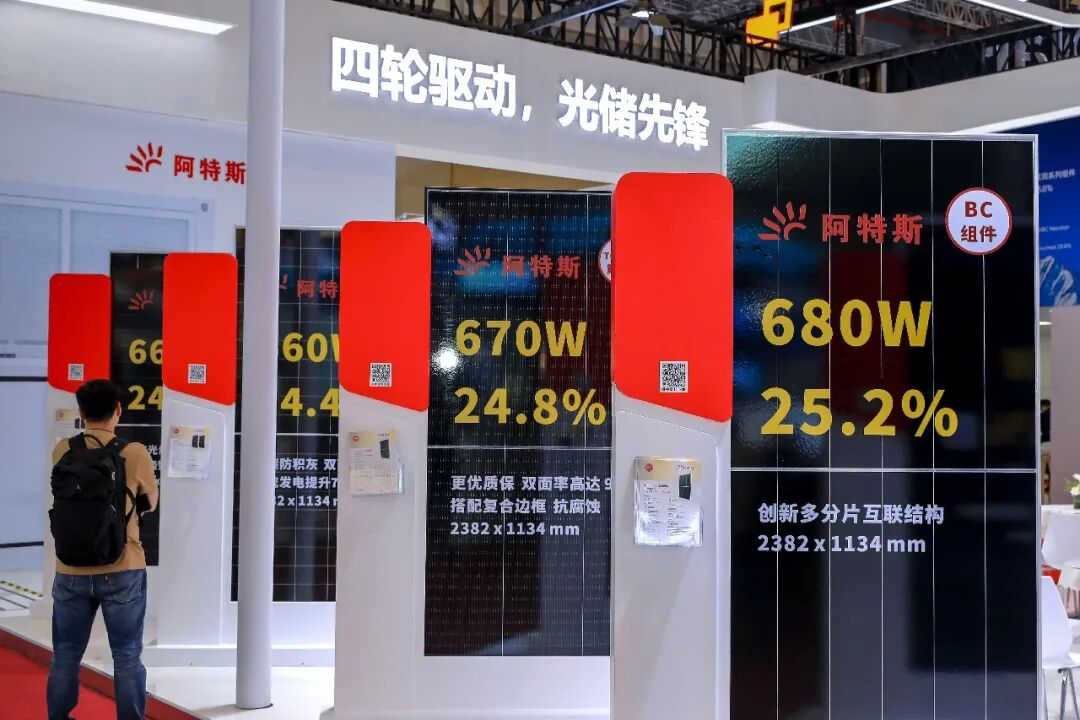
For example, Risen Energy's Hyper-ion Pro HJT module delivers a power output of 740W with a conversion efficiency of 23.8%. By comparison, Aiko's Comet 3N72 BC module has a lower rated power output of 675W but achieves a higher conversion efficiency of 25%.
The 740W module measures 2,384 × 1,303 mm, with a surface area of approximately 3.11 m², while the 675W module measures 2,382 × 1,134 mm, covering approximately 2.70 m².

The comparison shows that the 740W module has a surface area approximately 15.0% larger than that of the 675W module, while its rated power output is only 9.6% higher. Meanwhile, its conversion efficiency is 1.2 percentage points lower (23.8% versus 25%). This indicates that the higher power output of the 740W module is primarily attributable to its larger surface area rather than superior power conversion capability per unit area.
In terms of power output per unit area, the 740W module delivers approximately 238 W/m², compared with around 250 W/m² for the 675W module. In other words, under theoretical conditions involving the same rooftop area and equivalent layout utilisation, the 675W module could achieve approximately 4.9% higher installed capacity. Therefore, for C&I projects with limited rooftop space, installed capacity per unit area may be a more meaningful reference indicator than the rated wattage of an individual module.
Taking a 1MW installation requirement as an example, approximately 1,352 units of the 740W module would be required, covering a total module surface area of around 4,199 m². In comparison, approximately 1,482 units of the 675W module would be needed, with a total module surface area of approximately 4,003 m².
Although the 740W module reduces the required number of modules by approximately 8.8%, its total surface area is actually around 4.9% greater. This demonstrates that while higher-wattage modules can reduce the number of units required for installation, they do not necessarily improve rooftop space utilisation.
Furthermore, larger-format modules place additional requirements on mounting structures. The industry discussion surrounding the so-called "fish-farming module" issue in July primarily focused on oversized modules measuring 2,384 × 1,303 mm, corresponding to the 740W module examined in this article.
Modules of this size impose greater requirements on mounting structures, support span and mechanical load distribution. Under certain installation conditions, issues such as sagging in the middle of the module and water accumulation may occur, potentially increasing long-term reliability risks.
Therefore, module dimensions, installation tilt angles, support structures and mechanical load requirements must be properly matched. The actual advantages of high-wattage modules ultimately depend on the specific rooftop installation conditions.
In addition to rated power output and conversion efficiency, a module's actual power generation performance is also influenced by factors such as temperature coefficient, bifacial power generation capability, installation tilt angle, shading and local climatic conditions.
According to outdoor test results published in August 2026 covering 13 PV modules, the top eight performers in terms of specific energy yield (Wh/W) were all modules rated below 600W. Meanwhile, higher-wattage modules ranging from 625W to 710W did not make the top eight.

The test was conducted in Xi'an over the full 31 days of July, with cumulative solar irradiation reaching 212.77 kWh/m². During the testing period, daytime ambient temperatures ranged from 27.28°C to 34.48°C.
All modules were installed at an elevated height of 2 metres, with consistent installation tilt angles, orientations and electrical connection conditions. In terms of product configuration, the two BC modules adopted monofacial designs, while the remaining TOPCon and conventional P-type modules featured bifacial double-glass structures. The additional power generation from the rear side may therefore have influenced the final ranking in terms of specific energy yield.
Consequently, the test results reflect differences in both technology routes and module bifacial configurations. Actual power generation performance cannot be assessed solely based on module wattage or dimensions.
Under sustained high-temperature conditions, module dimensions and heat dissipation capabilities are also worth considering. For C&I rooftop projects where modules are installed relatively close to the roof surface, the limited ventilation space behind the modules creates different heat dissipation conditions compared with elevated mounting structures used in outdoor testing.
As a result, the high-temperature operating performance and temperature-related power losses of larger-format modules should also be taken into account during module selection.
Looking ahead, continued technological advancements will likely drive PV modules towards larger dimensions and higher conversion efficiencies. However, for rooftop solar projects, end-user selection is gradually moving away from a sole focus on higher module wattage towards a more comprehensive assessment of power output per unit area, actual power generation performance and compatibility with rooftop structures.
For C&I projects with limited rooftop resources, overall rooftop returns depend more heavily on the actual electricity generation achievable per unit of roof area. This can be assessed through a combination of module power density and specific energy yield per watt.
Based on the preceding module specification comparison and outdoor test results, larger-format modules have not demonstrated a clear advantage in either power output per unit area or specific energy yield. This further indicates that an increase in the rated power output of individual modules does not necessarily translate into higher electricity generation returns from rooftop installations.
Therefore, future module competitiveness will depend not only on improvements in individual module wattage, but also on the ability to deliver higher actual power generation within limited rooftop space, while maintaining installation compatibility and overall project economics.
Data Source Statement: Except for publicly available information, all other data are processed by SMM based on publicly available information, market communication, and relying on SMM's internal database model. They are for reference only and do not constitute decision-making recommendations.
Notice: By accessing this site you agree that you will not copy or reproduce any part of its contents (including, but not limited to, single prices, graphs or news content) in any form or for any purpose whatsoever without the prior written consent of the publisher.

source

Posted in Renewables | Leave a comment

City-backed program offers New York homeowners group-priced solar quotes with no obligation to buy – The Cool Down

© 2025 THE COOL DOWN COMPANY. All Rights Reserved. Do not sell or share my personal information. Reach us at hello@thecooldown.com.
Homeowners receive a personalized installation proposal and choose whether to accept it.
Photo Credit: iStock
Homeowners in Rochester, N.Y., have a new opportunity to explore rooftop solar by joining their neighbors to seek competitive installation prices.
Rochester is encouraging eligible homeowners to consider Switch Together, an independently operated program run by Solar United Neighbors and iChoosr, according to the Rochester Beacon.
Only homeowners within Rochester’s city limits can take part in its partnership with Switch Together. The effort helps residents assess solar energy options and potential electricity savings.
Residents can register to find out whether their homes are suitable for solar panels. By bringing homeowners together, the program seeks lower installation prices from local providers.
Registration carries no obligation to buy a solar power system. Homeowners receive a personalized installation proposal and choose whether to accept it.
For homeowners comparing ways to lower electricity bills, $0-upfront solar leases may offer savings of hundreds of dollars per month, depending on their circumstances. EasyHome offers a free explorer tool to estimate potential savings and find vetted local installers.
A request for qualifications issued in September led Rochester to select the collective-purchasing program for the partnership.
Promoting participation costs Rochester nothing, and the city receives no compensation for its role.
With energy prices through the roof, there’s never been a better time to go solar — and EasyHome can help you find the best prices from the best installers in your area.
EasyHome takes the guesswork and headaches out of energy upgrades by showing you estimated savings from a network of vetted local partners. To get started, just enter your ZIP and share a few details about your home — seeing your estimate is really that easy.
An online session on Nov. 19, from 6 to 7 p.m., will introduce residents to solar energy.
For households also interested in storing electricity generated by solar panels, EasyHome offers a way to explore battery storage options alongside its solar resources.
Beyond the panels themselves, battery storage can help households manage electricity costs by allowing you to save electricity for the times when it is most expensive to buy from the grid, as well as provide backup power during outages.
To proceed with Switch Together, homeowners must register and accept an offer by Dec. 16.
Rochester residents considering a solar offer can learn from other New York homeowners’ experiences. These stories cover installation quotes, roof condition, co-op financing, and lease transfers.
• One homeowner received $64,000 solar quotes and learned prepaid leases may inflate prices.
• Another homeowner’s $18,900 solar quote faces complications from a 13-year-old roof.
• A New York co-op secured a $232,000 solar loan without asking owners for more cash.
• A homebuyer inherited a $140-a-month solar lease, but the seller’s credits may not transfer.
Get TCD’s free newsletters for easy tips, smart advice, and a chance to earn $5,000 toward home upgrades. To see more stories like this one, change your Google preferences here.
© 2025 THE COOL DOWN COMPANY. All Rights Reserved. Do not sell or share my personal information. Reach us at hello@thecooldown.com.

source

Posted in Renewables | Leave a comment

India seeks to triple clean energy capacity to 900 gigawatts by 2035, but major hurdles remain – AP News

India seeks to triple clean energy capacity to 900 gigawatts by 2035, but major hurdles remain  AP News
source

Posted in Renewables | Leave a comment

“Turning even light reflected from the ground into electricity”: DGIST develops next-generation bifacial tandem solar cells – Asia Research News |

□ A research team led by Dae-Kue Hwang and Dae-Hwan Kim of the Division of Energy & Environmental Technology at DGIST (President Kunwoo Lee) has developed a high-efficiency bifacial antimony-based (Sb₂(S,Se)₃) thin-film solar cell equipped with a transparent polymer rear electrode. The device converts light entering from both the front and rear sides into electricity.
 
□ To increase the amount of electricity generated by solar cells, it is essential to develop technologies that capture and harness not only direct sunlight but also light reflected and scattered by the ground and surrounding objects. In this regard, two approaches have attracted considerable attention as next-generation solar cell technologies: bifacial structures, which absorb light from both the front and rear sides, and tandem structures, which enhance efficiency by stacking two solar cells that absorb different wavelengths of light. However, a major challenge in realizing efficient bifacial power generation has been the development of a high-performance, highly transparent rear electrode that allows light to pass through while efficiently collecting electrical current.
 
□ The research team addressed this challenge by developing a high-performance transparent rear electrode structure comprising multiple layers of specialized transparent conductive polymers deposited through a solution-based process. In particular, the team added a specific additive (DMSO) to the conductive polymer to precisely control its electrical conductivity. This approach reduced electrical resistance, which impedes the flow of current, by a factor of 10,000 (four orders of magnitude) while maintaining high optical transparency.
 
□ The resulting bifacial antimony-based solar cell achieved power conversion efficiencies of 8.2% under front-side illumination and 3.3% under rear-side illumination. Furthermore, the research team successfully demonstrated a four-terminal tandem structure by placing the antimony-based solar cell on top as the upper cell and combining it with a CuInSe₂ solar cell as the lower cell. The two cells absorb light at relatively different wavelengths.
 
□ By combining the strengths of both solar cells, the tandem device achieved a power conversion efficiency of up to 12.32%. Notably, when both the front and rear sides were illuminated simultaneously at an intensity of 1 sun each, the tandem device achieved a bifacial power density of 18.81 mW/cm². This result demonstrates the device’s ability to convert even scattered light reflected from its surroundings into electricity without waste.
 
□ “This study has conclusively demonstrated not only the feasibility of bifacial power generation using antimony-based solar cells but also their potential for integration into tandem solar cells through the newly developed transparent polymer rear electrode,” stated the research team led by Dae-Kue Hwang and Dae-Hwan Kim of DGIST’s Division of Energy & Environmental Technology. “We plan to further improve solar cell performance by optimizing the interface between the electrode and the light-absorbing layer, as well as the optical structure.”
 
□ This research was supported by the DGIST R&D Program, the InnoCORE Program of the Ministry of Science and ICT (MSIT), the National Research Foundation of Korea (NRF), and the Korea Institute for Advancement of Technology (KIAT). The findings were published in Advanced Materials, a leading international journal in energy and materials science.
Published: 16 Nov 2026
333, Techno jungang-daero, Hyeonpung-myeon, Dalseong-gun, Daegu, 42988

Bringing discovery to light

source

Posted in Renewables | Leave a comment

India’s solar module capacity jumps 15-fold to 116 GW on PLI push – Social News XYZ

Home » General » Business » India’s solar module capacity jumps 15-fold to 116 GW on PLI push

India's solar module capacity jumps 15-fold to 116 GW on PLI push
New Delhi, Nov 16 (SocialNews.XYZ) Projects supported under the Production Linked Incentive (PLI) scheme have contributed around 24 GW to India’s solar module manufacturing capacity, which has expanded nearly 15-fold from about 8 GW to nearly 116 GW, according to a report by NITI Aayog.
The report said around 20.7 per cent of India’s current solar photovoltaic (PV) module manufacturing capacity is directly attributable to PLI-supported projects.
 
It also highlighted that the High Efficiency Solar PV Modules PLI scheme has an outlay of Rs 24,000 crore and aims to promote large-scale domestic production, encourage advanced technologies and reduce dependence on imports.
Cumulative investment under the scheme reached Rs 64,873 crore by March this year.
The expansion in capacity has coincided with a decline in imports and a rise in exports. Solar PV module imports fell from around $4.35 billion in 2023-24 to $2.15 billion in 2024-25.
Exports rose from $83 million in 2021-22 to $1.97 billion in 2023-24 before moderating to around $1.12 billion in 2024-25.
The scheme has also encouraged manufacturers to increase domestic sourcing by linking incentives to local value addition to develop a more integrated solar manufacturing ecosystem.
“Overall, the Solar PV PLI Scheme demonstrates strong early outcomes in investment mobilisation, manufacturing capacity creation, import substitution and export expansion,” the report said.
However, it flagged pressure from falling global module prices, partly due to excess manufacturing capacity and aggressive pricing by Chinese producers.
The scheme’s long-term effectiveness would depend on manufacturers achieving higher domestic value addition, remaining globally cost-competitive, developing capabilities across the wider value chain and sustaining export growth amid changing global market conditions, according to the report.
Additionally, the PLI framework has emerged as one of the country’s most significant industrial policy interventions, with approved applications standing at 791 across 14 sectors, cumulative investment exceeding Rs 2.58 lakh crore and cumulative production/sales crossing Rs 23.79 lakh crore by June 30, according to the government.
Source: IANS

Gopi Adusumilli is a Programmer. He is the editor of SocialNews.XYZ and President of AGK Fire Inc.
He enjoys designing websites, developing mobile applications and publishing news articles on current events from various authenticated news sources.
When it comes to writing he likes to write about current world politics and Indian Movies. His future plans include developing SocialNews.XYZ into a News website that has no bias or judgment towards any.
He can be reached at gopi@socialnews.xyz


Copyright 2026 | AGK FIRE INC| Terms of Service / Privacy Policy | Contact Us

source

Posted in Renewables | Leave a comment

Suzhou’s Most Profit-Savvy Boss Records ¥400M Quarterly Loss: 68-Year-Old Wife Steps Up to Take Charge – 36Kr

At the end of October, Canadian Solar, long known as a “top student”, released a fragmented performance report: in the third quarter of 2026, its single-quarter revenue reached 5.863 billion yuan, down 42.63% year on year; the net profit attributable to shareholders was a loss of 395 million yuan, down 253% year on year.
In the “winter” period of the photovoltaic industry, this figure is not surprising, but it is particularly eye-catching for Canadian Solar. Just a year ago, when the whole industry suffered widespread losses, it made a profit of 1.016 billion yuan against the trend; one year earlier, it earned even more — 2.247 billion yuan, making it one of the rare “counter-cyclical profit-making samples” in the photovoltaic industry.

Source: Visual China
Its past experience is easy to sum up: it made early layout in energy storage and bet on the high-margin U.S. photovoltaic module market, which has also become a major trend for photovoltaic enterprises in recent years. The difference is that Canadian Solar can always turn around in advance when making profits to lay out the next profit point.
This time, an investor’s comment on Xueqiu is very straightforward: even the “good student” has fallen. But some voices say this is a positive financial report: the net inflow of operating cash flow in the third quarter was 775 million yuan, while it was negative in the second quarter; the non-recurring loss narrowed by about 17% month on month; the gross profit margin in a single quarter rose instead of falling.
The official attribution is very simple: the growth of the energy storage business is not enough to offset the reduction in the volume of the photovoltaic module business. To put it plainly, the photovoltaic module business is losing blood, and the energy storage business is making up for it, but the speed of making up cannot catch up with the speed of loss. This tug-of-war is Canadian Solar’s current situation, and it has been trying to level the gap between the two.
What appeared earlier than the financial report problems was the personnel change.
In September, Zhuang Yan, the president of the company, “retired upon reaching the age limit”, and his original term of office was due to expire on December 19, 2026. His successor is Zhang Hanbing, co-founder of the company, 68 years old and the wife of Qu Xiaohua, chairman of Canadian Solar. Zhang Hanbing did not play the role of “chairman’s wife” in the past, and her resume is highly related to keywords such as capital, globalization, and internal control; Zhuang Yan did not leave, but transferred to the chairman of Shenzhen Wencu Technology, a subsidiary, to develop residential energy storage business.
Some media gave a straightforward conclusion: after the top-level design of the organizational structure was transformed, power was obviously concentrated in the founder’s family, and energy storage has changed from the “second growth curve” to the “main force”.
In every business cycle, whenever the founder couple takes back power, the market will always sense a certain signal. But in the business context, this is not a simple power take-back, but more like a “helpless move” in the adjustment period. To put it plainly, Canadian Solar is facing a large number of problems — the realization rhythm of the U.S. joint venture model, the maintenance of energy storage gross profit margin, the stop-loss boundary of photovoltaic module contraction… It is not difficult to understand that every card to be played next requires the risk-bearing capacity at the founder level, as the couple are pushed to the front stage.
Since October, Qu Xiaohua and Zhang Hanbing have received more than 70 institutions one after another, stating that they “are confident in the steady recovery in 2027” and will stick to the three bottom lines of cash flow, risk control and quality. *China Entrepreneur* contacted Canadian Solar regarding the above actions, but as of press time, no reply had been received.
In the past two years, Qu Xiaohua in the public view has been low-key. He rarely accepts media interviews or appears in industry forums, but his “sense of presence” has never been broken, and his personal WeChat official account “Qu Xiaohua Canadian Solar” keeps updating.

Source: Screenshot of WeChat Official Account
In the past, Canadian Solar was used to playing “dislocation” battles, the most typical of which was turning to energy storage when photovoltaic modules were still highly profitable, and the performance of this move was not reflected in the financial statements until 6 years later. Zhang Hanbing’s first move after taking office also follows this “dormant” strategy, for example, selling idle land, plants and equipment in Thailand to two companies under the controlling shareholder to withdraw cash for the listed entity.
People who have successfully gone through several cycles know very well that in the winter survival stage, cash is more important than scale. And this time, in addition to cash, speed is also crucial.
Qu Xiaohua’s ancestral home is Changshu, Suzhou, and the label of “fighter” was attached to him in 2019. That year, he was in a car accident and suffered high paraplegia. 8 months after being injured, he returned to the company again. He said: Since this disaster is destined to happen, I will treat it with an ordinary mind.
At this time, Canadian Solar was already an established company. In November 2006, it was listed on NASDAQ, becoming the first photovoltaic enterprise listed on NASDAQ, earlier than JinkoSolar and JA Solar Technology. In June 2023, Canadian Solar returned to the A-share market. On the listing day, Qu Xiaohua got up slowly from his wheelchair and struck the gong. Since then, words like “willpower” and “Iron Man” have often been associated with him.
But in terms of strategy, Canadian Solar has a completely different style: it never fights hand-to-hand in the most crowded track, and thinks more about “what not to do”.
In the early years, Qu Xiaohua once said: Canadian Solar does not want to be the leader, but only wants to be the last surviving photovoltaic enterprise. There are similar remarks: do not pursue the first place, only pursue first-class performance. Some industry media call this realism, while others say he has extremely strong self-discipline.

Source: Visual China
The most typical example is the latest cycle, when the whole industry was pouring money into expanding TOPCon (Tunnel Oxide Passivated Contact) production capacity and transforming to BC (Back Contact Cell) technology, Canadian Solar stepped on the brake. For the whole year of 2025, its module shipment volume was 24.3GW, a sharp drop from 31.1GW in 2024. The management stated bluntly in the report: adhere to the principle of profit priority, actively compress shipment volume and optimize shipment rhythm.
During the same period, the energy storage business grew rapidly — the large-scale energy storage business achieved sales of 7.8GWh, a year-on-year increase of 20%, with a gross profit margin significantly higher than that of the photovoltaic module business, becoming an important profit source of the company. By the first quarter of 2026, the trend became more obvious, and the large-scale energy storage shipment reached 2.6GWh, a year-on-year increase of 206%.
Canadian Solar seized the favorable position. When several leading photovoltaic companies suffered large losses, Canadian Solar made a profit of more than 500 million yuan. Some media interpreted this as the main business losing blood and the second growth curve being forced to make up for it, but this kind of “dislocation” is exactly the most familiar playing method for Canadian Solar.
In the first prosperous development period of the photovoltaic industry, the mainstream logic was “silicon is king”. Enterprises queued up to set up silicon companies, signed 10-year long orders, and bet all their assets on the upstream industry.
But Qu Xiaohua chose the opposite direction. His logic is very simple: for enterprises to survive and develop, profitability is the key. Photovoltaic products are energy products, and energy must be cheap first to enter the market. Obtaining raw materials at excessively high costs violates this basic rule, “we can’t take opium for temporary pleasure”.
Therefore, at that stage, he restricted the procurement of silicon materials, arranged the production capacity only according to the consumption of one to two months, always kept cash on the books, postponed infrastructure projects, and paid off loans in advance. As a result, he escaped the disaster. A few months later, the price of polysilicon plummeted, enterprises that bet on the upstream were crushed by long orders and inventory, and Suntech Power eventually went bankrupt. Canadian Solar was not seriously injured and became the first among the major photovoltaic enterprises to turn losses into profits.
Subsequently, Europe and the United States launched “dual anti” (anti-dumping, anti-subsidy) investigations against China’s photovoltaic industry, and Canadian Solar once again chose to “take a detour”.
At that time, its industrial structure was an “inverted triangle”, with less production capacity in the more upstream links. Zhuang Yan, then Senior Vice President of Global Sales and Marketing of Canadian Solar, put it very plainly: the company’s module production capacity exceeded 2GW, while the cell production capacity was only 1.4GW, and the rest of the parts needed to be purchased externally.
Moreover, the externally purchased parts were not from China, but all transported to Canadian Solar’s factory in Ontario, Canada for assembly, in order to get closer to the end market. Canadian Solar was not the only one adopting this strategy, but it took one more step than other peers, and the step was towards the downstream industry.
In 2009, it set up a subsidiary in Canada to develop power stations; in March 2015, it acquired Recurrent Energy, a solar business subsidiary of Sharp, for 1.656 billion yuan, becoming the world’s second largest photovoltaic power station developer and operator; in October of the same year, it spent 270 million Canadian dollars to buy three grid-connected power stations owned by KKR in Ontario, with a total capacity of 59.8MW.
It changed from selling modules to selling power stations. It earns three streams of revenue at the same time: “equipment sales + premium from resource development + EPC (Engineering, Procurement and Construction)”. The gross profit margin of this business is much higher than that of the manufacturing industry.
Even though this set of strategies never made Canadian Solar occupy the top position in the industry, it survived every round of big reshuffle. For a long time, it ranked steadily among the top 5 in global shipment volume, and even outperformed LONGi Green Energy, the later “photovoltaic king”, before 2018.
But this does not mean “invincible”. In 2021, the comprehensive gross profit margin of LONGi Green Energy, Trina Solar, JA Solar Technology and JinkoSolar was all above 13%, while that of Canadian Solar was only 9.26%, down 9.21 percentage points year on year. Canadian Solar suffered a loss of 411 million yuan after deducting non-recurring gains and losses, making it the only loss-making one among the five giants in the photovoltaic module industry.
Qu Xiaohua later reviewed the situation very straightforwardly: “This ‘inverted triangle’ model made us suffer losses. But Canadian Solar is not a bookish enterprise after all, we also adjust according to the situation.”
In those two years, Canadian Solar made great efforts to expand upstream. It expanded production capacity of ingot pulling, wafer slicing and cell production, changing the “inverted triangle” into a “trapezoid”, where the downstream production capacity is still more than the upstream, but the level of integration has been significantly improved. In 2022, the company’s non-recurring net profit returned to 2.062 billion yuan, filling the loss pit in just one year.
However, the cost is obvious. When upstream prices rose, Canadian Solar was passive everywhere in that period, and its ranking in global shipment volume declined in the overall industry expansion. In 2025, its global shipment ranking fell out of the top 5. But in that year, it made a profit of 1.016 billion yuan, still adhering to the principle of profit priority.
The ranking fell, but the profit remained, which is Canadian Solar’s choice. Qu Xiaohua once said: Everyone has limited energy, so you have to make trade-offs.
Structural reversal is one of the most important narratives of Canadian Solar in the first half of 2026.
The sales of large-scale energy storage systems reached 6.1GWh, a year-on-year increase of 103.3%; the revenue of energy storage business accounted for 44.26%, exceeding the revenue of photovoltaic modules for the first time in history; in the same period, the revenue of modules fell by 73.59% year on year. The total revenue is shrinking, but the energy storage business ensures that the company is still profitable. The market began to re-examine Canadian Solar’s “retreat” in recent years, and the energy storage layout was made as early as 2017.
When photovoltaic modules were still highly profitable, Qu Xiaohua took the lead in setting up the energy storage department. At that time, the commercialization of energy storage was far from being realized, the domestic energy storage demonstration projects driven by “abandoned wind and photovoltaic power” had just started, and the overseas large-scale energy storage market had not even taken shape. This department existed “quietly” inside the company for six years.
It was not until 2023 that the first batch of energy storage system products rolled off the production line. At the off-line ceremony, Qu Xiaohua called it the “second growth curve”.
This is different from the rhythm of the photovoltaic industry. The generational cycle of a photovoltaic cell is only 2 to 3 years, and one step slower means more risk of being eliminated. The cycle of energy storage projects is much longer, 5 years is already a fast speed from technology reserve, production line construction, certification to customer verification.
Therefore, when the demand for energy storage really exploded and the whole industry swarmed in, Canadian Solar already had production lines and orders in hand. In the first quarter of 2026, this structure realized performance for the first time: the shipment of large-scale energy storage reached 2.6GWh, a year-on-year increase of 206%.

Source: Visual China
While the new business is making up for the gap, personnel adjustments are also carried out under this background.
In May 2026, Qu Xiaohua said he had resigned as CEO of the U.S. listed group, and served as chairman and chief technology officer, focusing on the transformation of technology from concept to product. In September, at the main body of the listed company, Zhang Hanbing took over as president. The two moves are conventional arrangements when viewed separately, but when combined, the decision-making power is being taken back from professional managers to the founder’s family.
Zhang Hanbing is not a sudden appointment, but a person who has been pushed to the front stage. She once worked as a stock trader at Canadian brokerage TD Waterhouse, and from 2005 to
该文观点仅代表作者本人,36氪平台仅提供信息存储空间服务。
36kr Europe (eu.36kr.com) delivers global business and markets news, data, analysis, and video to the world, dedicated to building value and providing business service for companies’ global expansion.
© 2024 36kr.com. All rights reserved.

source

Posted in Renewables | Leave a comment

Garmin Patent Puts Solar Cells Between the Pixels of an AMOLED Screen – Garmin Rumors

No watch by that name. Try the full list below.
Deciding what to buy
Under the hood
For your watch
A newly published Garmin patent application describes a watch screen that charges the battery through the display itself: solar cells built into the screen, sitting in the dark gaps between the pixels so they don’t dim the picture. The application, US 2026/0362887 A1, “Integrated energy-collecting display module,” was filed by Garmin International on May 8, 2025 and published on November 12, 2026. It is written for AMOLED and microLED screens, not MIP.
When Garmin COO Brad Trenkle talked about MIP, AMOLED and solar earlier this month, he described two places the solar cells could go on a watch with a color screen. They can go over the display as a thin, see-through layer, the way they do on Garmin’s MIP solar watches today, which would make an AMOLED screen dimmer. Or they can go in a ring around the display. This application describes a third place: inside the display, between the pixels.
Garmin’s own background section explains why. A see-through solar layer can sit over the pixels, but the application says the screen then “appears dull and lacks brightness and contrast.” Putting solar material only where no light comes out avoids that.
The display is a stack of layers. From the bottom up:
The screen’s own light goes straight up through its color filter and a clear window, so it never passes through solar material. The solar cells sit only over the dark spaces between subpixels, and they send their power to the battery over their own flex cable, separate from the one that drives the screen.
Some daylight lands straight on the solar cells. Light that slips through a window instead passes the color filter, hits one of the reflectors between the subpixels, and can bounce back up into a neighboring solar cell. Garmin says the result is a screen with “greater color depth and increased apparent brightness” than one with a solar layer over the pixels.
The application isn’t tied to one kind of screen. It names organic LED pixels (AMOLED, which Garmin uses on most of its watches now) and microLED, which Garmin already sells on the Fenix 8 Pro MicroLED, as well as microLED with a quantum dot layer.
The solar cells are thin-film amorphous silicon, which Garmin chose for its low cost and low toxicity, with perovskite, CIGS, cadmium telluride and organic solar cells listed as alternatives. The solar layer can be made as its own module and glued on, built straight onto the display, or combined with the color filter and the touch layer in one piece. Garmin describes building the solar cells directly onto the display as the ideal option, since it gives the most room for solar while blocking the least light.
Every Garmin solar watch today leverages an MIP display, from the Instinct 3 Solar to the Enduro 4, Fenix 8 Solar, Tactix 8 Solar and Fenix 9 Pro Solar. Solar also costs thickness: the Fenix 9 Pro Solar is noticeably thicker than the AMOLED Fenix 9 Pro. Amazfit already sells an AMOLED watch with solar on the front, the T-Rex Dual Solar, rated for up to 25 days, or 34 days with three hours a day of sun.
The two inventors named on the application, Wen-Yu Wu and Ching-Hsuan Peng, are both based in New Taipei City, Taiwan.
Stay ahead of Garmin
New watches, upcoming releases, software updates and community apps. The Garmin news that matters, in your inbox every week.
Free with a Garmin Rumors account. Unsubscribe anytime.

Open this as a thread in Discussions · See what else people are talking about →
Join the conversation. A free account lets you comment, reply and say how updates are running.
Sign up freeSign in
No comments yet. Start the conversation.
All discussions →Start a thread
© 2026 garminrumors.com — All rights reserved
Articles, guides, and reviews on this site are written by Garmin Rumors. Reader comments are the only user-generated content here and are moderated under our Moderation Policy.
Garmin Rumors is an independent website and is not affiliated, associated, authorized, endorsed by, or in any way officially connected with Garmin Ltd., or any of its subsidiaries or its affiliates. The official Garmin website can be found at www.garmin.com.
The names “Garmin” as well as related names, marks, emblems, and images are registered trademarks of their respective owners.
The logo of Garmin Rumors and other marks on this site are proprietary and are not designed to resemble or imitate any Garmin trademarks. This website is intended for informational and entertainment purposes only. The content is solely the opinion of the contributors and does not represent the views or opinions of Garmin or any other brands.
We do not sell your data. See our Privacy Policy, Cookie Policy, and Terms of Use.
Get an email with the new version and what changed each time Garmin releases one.
Which updates
Pick at least one.
or
Enter a valid email address.

Enter your email to continue
We’ll create a free Garmin Rumors account so you can manage alerts later. Already have one? Same email, we’ll sign you in.
At least 8 characters.

Not receiving emails yet. The link expires in 24 hours.

Wrong address?

Didn’t get it?

source

Posted in Renewables | Leave a comment

How Emmvee Secured Higher Solar Cell Utilisation Despite G12R Transition? | Suhas Dhonthi – Saur Energy

0
By clicking the button, I accept the Terms of Use of the service and its Privacy Policy, as well as consent to the processing of personal data.
Don’t have an account? Signup
Powered by :
We are India’s leading B2B media house, reporting full-time on solar energy, wind, battery storage, solar inverters, and electric vehicle (EV)
Quick Links
© 2025 Saur Energy. All Rights Reserved.

source

Posted in Renewables | Leave a comment

Riyadh to tender eighth renewable energy round in December – MEED

Wil Crisp
Hormuz crisis sparks regional pipeline project boom
Become a MEED subscriber for unlimited access to:
Alternatively Login to your account
16 November 2026
16 November 2026
16 November 2026
16 November 2026
Subscribe or upgrade your current MEED.com package to support your strategic planning with the MENA region’s best source of business information. Proceed to our online shop below to find out more about the features in each package.
Take advantage of our introductory offers below for new subscribers and purchase your access today! If you are an existing client, please reach out to your account manager.
© MEED MEDIA FZ LLC Company number 18693 (Dubai Creative Clusters Authority) Registered address: GBS building, 6th Floor, Al Falak Street, Dubai Media City, PO Box 25960, Dubai, UAE

source

Posted in Renewables | Leave a comment

Times Dhandho: Sun shines on new recycling boom but can infra keep up? – The Times of India

Join conversation
Share your thoughts in the comments
Be respectful · TOI community guidelines

source

Posted in Renewables | Leave a comment

New glass-to-glass PV module design enables rapid delamination – pv magazine Australia

An international research team, including scientists from the University of New South Wales (UNSW), has developed an induction heating-assisted delamination method for end-of-life PV modules to improve recyclability and facilitate the recovery of individual components.
“We designed a glass-glass photovoltaic module that is easier to take apart at the end of its life,” corresponding author Yonghwan Lee told pv magazine. “Using induction heating, we rapidly separated the layers of our test module and recovered 99.8% of its original mass, including the glass, the silicon cell and the polymer encapsulant.”
Lee said the team was surprised by how quickly and cleanly the silicon cell separated using the new technique and modified module design.
“In our fastest test, the module layers separated in just five seconds. We recovered the cell intact, with no visible polymer residue on its surface, without having to remove the entire encapsulant layer first,” he said.
The researchers first used Comsol Multiphysics simulations to investigate induction heating in passivated emitter and rear contact (PERC) cells and heat transfer through the surrounding module layers. They examined the effects of operating frequency, coil current, coil-to-cell distance and electrode thickness on heating.
They then produced simplified samples comprising a 2 cm × 2 cm PERC cell laminated onto tempered glass with ethylene vinyl acetate (EVA) encapsulant, leaving the rear of the cell exposed. They tested the method using a water-cooled copper induction coil operating at 270 kHz to 300 kHz to rapidly heat the cell’s metal contacts, triggering localised EVA decomposition at the cell-encapsulant interface. The samples were suspended with the cells facing downward to enable gravity-assisted separation.
The tests showed that induction heating created a temperature difference of more than 200 C between the cell and glass at a coil current of 100 A, enabling localised EVA decomposition at the cell interface. With gravity-assisted separation, the cells detached in approximately 14 seconds.
Microscopy revealed no significant polymer residue or structural damage on the recovered cell surfaces, while spectroscopy indicated that the remaining EVA largely retained its chemical structure.
The researchers then fabricated modified glass-glass mini-modules incorporating a single PERC cell, EVA encapsulant and two tempered glass sheets measuring 5 cm × 8 cm and 1 mm thick. Polytetrafluoroethylene (PTFE) release films, each with a central opening measuring 1.8 cm × 1.8 cm, were inserted between the cell and EVA on both sides to allow gases generated during heating to escape. The researchers suspended the mini-modules in a custom support jig and applied induction heating at coil currents of 100 A, 150 A and 200 A.
The modified mini-modules separated in 18.6 seconds at a coil current of 100 A, compared with 8.3 seconds at 150 A and 5.4 seconds at 200 A. The process recovered 99.8% of the total module mass, with negligible losses of glass, cells and release films.
After delamination, the researchers mechanically scraped the EVA from the glass, resulting in less than 10% encapsulant mass loss. Analysis of the recovered cells showed no significant surface residue.
“For us, this points to a way to recycle modules quickly and brings the goal of 100% material recovery closer,” Lee said. “Our next step is to apply the process to full-size commercial PV panels and scale it up for use in commercial recycling operations.”
The researchers presented their findings in “Inductive heating for photovoltaic module recycling and near-complete component recovery,” which was published in Communications Materials. The research team included scientists from South Korea’s Korea Electronics Technology Institute (KETI) and Australia’s UNSW.
This content is protected by copyright and may not be reused. If you want to cooperate with us and would like to reuse some of our content, please contact: [email protected].
Comments
Please login to comment
The new issue of pv magazine Global is out now!
Available in print and digital – get your copy today!
Monday, November 23, 2026
11:00 am – 12:00 pm CEST, Berlin, Paris, Madrid

You have no items in your basket.

source

Posted in Renewables | Leave a comment

Homeowner says solar installer folded and inverter maker won't take calls about a suspected failure – Yahoo Tech

An apparently defunct solar panel installer and an unreachable equipment manufacturer left one homeowner unsure where to turn for help with a suspected inverter failure.
The homeowner's contract with a solar installer covered both panels and an inverter, according to their Reddit post.
"The inverter seems to be broken, and we were hoping we could get a technician to look at it or set the wheels in motion to get it replaced," they wrote.
With the installer apparently out of business, the homeowner tried contacting the inverter manufacturer, but they had been unable to speak to anyone. They said they needed an EIN number before their query could be handled.
"Does anyone have any experience with something like this?" they asked. "Can anyone provide suggestions as to what I might be able to do?"
A solar installer in the thread said they dealt with a similar case. Their customer also needed an inverter swap, but because they were a qualified solar professional with an EIN number, they had no trouble getting the support service on the phone.
That led one commenter to suggest finding a technician willing to work on a system installed by a different company.
Meanwhile, another noted that when calling the inverter company, they should select an option saying they are a homeowner, which would put them through to an AI agent. From there, they should be able to get transferred to a representative.
While stories like this might put some off a solar installation, there are still plenty of reputable companies around, and the technology can provide significant savings on energy bills and reduce reliance on grid-provided energy. For example, some $0-upfront solar leases may save owners hundreds of dollars per month, depending on the home and arrangement. EasyHome offers a free explorer tool to estimate possible savings and find vetted local installers.
A manufacturer-specific forum could offer more targeted guidance, commenters suggested. One also advised finding out whether the inverter model was still available.
For homeowners evaluating a new setup, EasyHome also offers battery storage exploration options. Comparing solar and battery configurations can help households manage electricity costs and provide backup power during outages, while keeping equipment and service needs part of the conversation.
Other solar owners have also struggled to get help with equipment problems after companies closed or installers declined repairs.
• After their solar company folded, a homeowner received a free inverter but faced installation hurdles.
• A New York homeowner discovered 24 incorrect solar inverters, prompting upgrades and a $2,500 offer.
• A homebuyer's underperforming solar array produced one-third of the expected power, while installers declined help.
• In Rhode Island, apparently functional solar equipment produced just 5 kWh despite clear skies.
• One solar owner's system continued working without internet despite the manufacturer's bankruptcy.
Get TCD's free newsletters for easy tips, smart advice, and a chance to earn $5,000 toward home upgrades. To see more stories like this one, change your Google preferences here.
AI
Audio
Computing
Gaming
Home Entertainment
Phones
Puzzle hints
Science
Streaming
VPN
Wearables
Deals
Advertise (opens in new tab)
About our ads (opens in new tab)
Licensing (opens in new tab)
Careers (opens in new tab)
Help (opens in new tab)
Feedback (opens in new tab)
Sitemap (opens in new tab)
© 2026 Yahoo. All rights reserved.

source

Posted in Renewables | Leave a comment

PVH AxoneDuo Infinity: Advanced Solar Tracker Designed for Maximum Terrain Adaptability and Installation Efficiency – SolarQuarter

PVH AxoneDuo Infinity: Advanced Solar Tracker Designed for Maximum Terrain Adaptability and Installation Efficiency  SolarQuarter
source

Posted in Renewables | Leave a comment

Solar blinds drew over $240,000 in preorders before the renter-friendly model was scrapped – The Cool Down

© 2025 THE COOL DOWN COMPANY. All Rights Reserved. Do not sell or share my personal information. Reach us at hello@thecooldown.com.
The indoor model ultimately disappeared.
Photo Credit: iStock
Solar-powered window blinds promised apartment renters a way to generate electricity without rooftop panels, attracting more than $240,000 in preorders. 
But the indoor model ultimately disappeared, leaving renters without a feasible option to make the most of solar energy. 
The Wild Line (@wildline_YT) YouTube channel told the story of how Ukrainian entrepreneur Yevgen Erik launched SolarGaps on Kickstarter in 2017, raising $102,000 in just over 30 days.
A microinverter made electricity from solar cells on the Venetian-blind slats that were usable in the home. A motor and sensor kept the slats angled toward the sun. According to SolarGaps, a roughly 10-square-foot window could produce 100 to 150 watts during peak sunshine.
However, the company acknowledged “critical mistakes” in its mechanism and electronics in a Kickstarter update cited in the video. Customers waited years for the product.
The company redesigned the blinds, fulfilling original backers’ orders by September 2021, according to Wild Line. However, it eventually dropped the indoor model to focus on custom exterior installations for commercial buildings in Europe.
💡These best-sellers from Quince deliver affordable, sustainable luxury for all
Starting at $50
Starting at $99
Starting at $60
Starting at $80
A National Renewable Energy Laboratory study cited by Wild Line found rooftop solar was not an option for 49% or more of U.S. households, with renting, shared roofs, shade, and insufficient roof space all creating barriers.
SolarGaps’ launch specifications acknowledged that indoor installation cut power output in half. Meanwhile, indoor blinds offered limited cooling benefits because they caught sunlight after it had entered the home. Electricity production also suffered, as window glass filtered the incoming light, and frames and other obstructions shaded the solar cells.
While the company initially claimed the system could produce about 500 kilowatt-hours annually, Wild Line estimated roughly 225 kilowatt-hours using vertical-solar benchmarks. At 18 cents per kilowatt-hour, that would amount to about $41 annually.
Renters would have needed landlord approval to install the exterior blinds, which required mounting brackets and cables routed through a wall or window frame. Moving outdoors improved the system’s prospects but still involved the building modifications tenants had hoped to avoid.
Simpler plug-in panels offer another way to generate solar electricity. Wild Line featured Bright Saver’s 180-watt California kit, priced at $285 and occupying about the same 10-square-foot footprint as the blinds.
The video noted Utah’s 2025 legislation helped launch a wave of state laws permitting balcony solar to plug into household outlets without utilities charging interconnection fees. Wild Line reported that 10 states had adopted such laws.
Elsewhere, Germany’s SolarMarkise has developed a retractable solar awning rated at 1.8 kilowatts to shade patios and restaurant terraces, the video noted.
For homeowners pursuing smaller projects, one commenter on the video described replacing decorative shutters with small panels on four of their Montana home’s eight windows, then adding portable power stations for backup during outages.
“I was able to upgrade one window at a time and pay as I went and never borrowed or owed any money during this project,” they wrote.
The solar-blind company’s troubles show how installation hurdles can complicate small-scale solar projects. 
• In the U.K., a plug-in solar kit with battery storage awaited lawmakers’ approval.
• In Texas, commenters urged a renter to start with portable solar for backyard power.
• A U.K. buyer considered switching to plug-in panels after their pricier installer stopped responding.
• In Tennessee, a $1,400 Anker solar kit could trim a homeowner’s power bill by $100.
Get TCD’s free newsletters for easy tips, smart advice, and a chance to earn $5,000 toward home upgrades. To see more stories like this one, change your Google preferences here.
© 2025 THE COOL DOWN COMPANY. All Rights Reserved. Do not sell or share my personal information. Reach us at hello@thecooldown.com.

source

Posted in Renewables | Leave a comment

India's Solar Cell Rush: Are Smaller Players Joining Hands to Survive? – Saur Energy

0
By clicking the button, I accept the Terms of Use of the service and its Privacy Policy, as well as consent to the processing of personal data.
Don’t have an account? Signup
Powered by :
India’s solar manufacturing industry may be approaching an important inflection point. After several years in which module assembly offered a relatively accessible entry into the business, manufacturers are discovering that moving up the value chain into solar cells requires a very different level of capital, technology and operational expertise. Increasingly, some are choosing not to make that journey alone.
The latest example is the 50:50 joint venture between EPC firm Solarworld Energy Solutions and Rays Power Infra to establish a 2.4 GW TOPCon solar cell manufacturing facility in Madhya Pradesh, with an estimated investment of Rs 1,000 crore. The partnership is particularly interesting because both companies have substantial exposure to the EPC and solar project development businesses, but are now pooling resources to secure a position in cell manufacturing.
The arrangement also reflects a change in Solarworld’s original plans. The company has redirected funds earmarked from its IPO and pre-IPO proceeds for an earlier 1.2 GW cell manufacturing proposal towards the larger joint venture. Solarworld has committed up to Rs 100 crore in equity and a further Rs 320 crore in project financing, while Rays Power will contribute up to Rs 100 crore in equity.
It is not the first such collaboration. In October 2023, Jupiter International and renewable energy developer AmpIn Energy Transition announced a joint venture to establish up to 1.3 GW of cell and module manufacturing capacity in Odisha. The facility was commissioned in April 2026. The arrangement combined Jupiter’s manufacturing experience with AmpIn’s renewable project portfolio, providing an important potential captive market for the output. Interestingly, both the firms are unlisted, and have not had the benefit of tapping the public markets for funds that might have changed the picture perhaps. 
The two partnerships offer different models, but point towards the same underlying challenge: the difficulty of independently financing and sustaining an increasingly capital-intensive manufacturing business.
The cost of going it alone
The economics of solar cell manufacturing are becoming more demanding just as competition intensifies. Unlike module assembly, cell manufacturing requires substantially greater investment, process expertise, technology upgrades and sustained utilisation to generate acceptable returns.
The problem is compounded by an increasingly crowded domestic market. According to most estimates, India’s module manufacturing capacity is headed towards 250 GW  by this year end from 233 GW by June, while utilisation was estimated at just 35–40%. Cell capacity, meanwhile, remained substantially lower at barely 45 GW by October, highlighting the structural imbalance between downstream assembly and upstream manufacturing.
For companies that entered the market primarily through EPC or module manufacturing, the choices are becoming more complicated. Building an independent cell plant requires substantial fresh capital at a time when margins are under pressure and access to equity markets cannot be taken for granted. Partnerships offer a way to share the investment, pool capabilities and potentially secure a more predictable supply of cells.
The next deadline could be even more demanding
The urgency is also being driven by policy. ALMM List-II, which mandates the use of approved domestic solar cells, became effective from June 1, 2026. A limited exemption for net-metering and open-access projects runs until December 31, 2026, bringing these segments under the requirement from January 1, 2027.
But the bigger challenge could arrive in June 2028, when the government plans to extend the ALMM framework to ingots and wafers through List-III. This would require cells used in covered projects to be manufactured using approved domestic wafers. Importantly, manufacturers seeking wafer-listing will also need equivalent ingot manufacturing capacity.
This does not necessarily mean every cell manufacturer must own its own wafer and ingot facilities. They could procure from approved domestic suppliers. However, it creates another layer of supply-chain dependency and raises questions about who will have the capital and scale to establish the upstream manufacturing base.
Will backward integration become a survival test?
There is a possibility that the new requirements will indirectly accelerate consolidation in an industry that has attracted a large number of entrants. Companies with stronger balance sheets, established manufacturing operations and access to capital could be better positioned to integrate backwards. Others may increasingly depend on partnerships, contract manufacturing or long-term supply arrangements to remain competitive.
Yet, it would be premature to conclude that only fully integrated manufacturers will survive. Specialisation, efficient operations, technology partnerships and reliable access to domestic inputs could still offer viable alternatives to owning every stage of the value chain.
The question is whether India’s solar manufacturing industry is heading towards a field dominated by a handful of vertically integrated giants, or whether smaller players can find ways to collaborate and compete without replicating the entire manufacturing chain. In fact, we would argue that there is perhaps a case for firms seeking to get their cell manufacturing started by 2028 to relook those plans, as by then even the cell market could be facing oversupply issues. 
For now, Solarworld–Rays Power and AmpIn–Jupiter may be early markers of a more pragmatic approach to an increasingly difficult business. The next two years will reveal whether such partnerships are enough to navigate India’s growing manufacturing ambitions, or merely a first step towards a much wider industry shake-up.
We are India’s leading B2B media house, reporting full-time on solar energy, wind, battery storage, solar inverters, and electric vehicle (EV)
Quick Links
© 2025 Saur Energy. All Rights Reserved.

source

Posted in Renewables | Leave a comment

Blue Elephant Energy reaches financial close for Germany’s largest agri-PV project with tracker-mounted modules – construction under way – TradingView

EQS-Media / 16.11.2026 / 08:00 CET/CEST
16.11.2026 CET/CEST Dissemination of a Press Release, transmitted by EQS News – a service of EQS Group.
The issuer is solely responsible for the content of this announcement.
The EQS Distribution Services include Regulatory Announcements, Financial/Corporate News and Press Releases.
2434814 16.11.2026 CET/CEST

Disclaimer

Select market data provided by ICE Data Services. Select reference data provided by FactSet. Copyright © 2026 FactSet Research Systems Inc.Copyright © 2026, American Bankers Association. CUSIP Database provided by FactSet Research Systems Inc. All rights reserved. SEC filings and other documents provided by Quartr.© 2026 TradingView, Inc.

source

Posted in Renewables | Leave a comment

Jupiter Targets 8.5 GW Solar Cell Capacity By April 2027 – Saur Energy

0
By clicking the button, I accept the Terms of Use of the service and its Privacy Policy, as well as consent to the processing of personal data.
Don’t have an account? Signup
Powered by :
We are India’s leading B2B media house, reporting full-time on solar energy, wind, battery storage, solar inverters, and electric vehicle (EV)
Quick Links
© 2025 Saur Energy. All Rights Reserved.

source

Posted in Renewables | Leave a comment

60% of home battery installs rated ‘substandard’ by regulator – pv magazine Australia

More than 60% of batteries and about 23% of solar systems installed under the Small-scale Renewable Energy Scheme (SRES) during the 2025–26 financial year were rated as “substandard” while less than 1% of both were deemed “unsafe,” according to a new report from the Clean Energy Regulator (CER).
The CER has published its annual inspection report for the 2025–26 financial identifying installation trends, risks and common areas of non-compliance.
Across the reporting period, the CER completed a record 6,554 inspections, including 3,425 solar battery systems and 3,129 solar inspections.
Just 23.11% of the inspected solar systems were rated as substandard – that is, the installation contains faults that need to be rectified – and 0.93%, or 29 of the 3,129 inspected installs were found to be unsafe – not safe to remain in operation as is.
Of the battery energy storage systems (BESS) inspected, 61.19% were found to be substandard while 0.95% were rated as unsafe.
Critically, the report reveals the common areas of non-compliance identified are almost entirely the result of poor workmanship rather than faulty products.
The most common issues leading to a solar system being rated substandard included incorrectly sized or fitted cabling and conduits, improper bonding or earthing of solar panel frames and other equipment, incompatible or incorrectly installed DC connectors, and improperly fitted mounting structures.
Out of the 29 solar systems deemed unsafe under the 2025–26 inspection program, 16 were due to unsafe installation work, 12 were due to a third-party incident such as weather damaging the system, and one was attributed to a product recall.
The main causes for a battery system being rated substandard included missing or incorrect labelling, incorrectly configured or missing wiring, insufficient rated circuit protection, and inadequate physical protection for cables and the battery.
Of the 32 battery systems rated unsafe, 23 related to unsafe installation work including loose connections, eight were due to a product recall, and one related to a third-party incident.
The CER said the inspection results are being used to support early intervention, targeted education and compliance actions against installers demonstrating ongoing non-compliance.
The regulator said since 1 July 2025 it has communicated with more than 830 installers regarding adverse inspection outcomes and their obligations under the scheme. This includes 716 initial advisory letters to installers for first time non-compliance, and 121 warning letters to installers with repeated non-compliance.
“Our message to installers is simple – do it once and do it well,” the regulator said. “There are serious consequences for repeated non-compliance. We can suspend installers from participating in the scheme if they have three or more inspection reports with adverse findings, or three or more written statements containing false or misleading information.”
This content is protected by copyright and may not be reused. If you want to cooperate with us and would like to reuse some of our content, please contact: [email protected].
Comments
Please login to comment
The new issue of pv magazine Global is out now!
Available in print and digital – get your copy today!
Monday, November 23, 2026
11:00 am – 12:00 pm CEST, Berlin, Paris, Madrid

You have no items in your basket.

source

Posted in Renewables | Leave a comment

NITI Aayog Report PLI Scheme Adds 24 GW to Solar Module Capacity – Asianet Newsable

New Delhi [India], November 16 (ANI): Projects supported by the Production Linked Incentive (PLI) scheme have contributed around 24 GW to India's solar module manufacturing capacity, which has expanded nearly 15-fold from approximately 8 GW to nearly 116 GW, according to a report by NITI Aayog. The report stated that approximately 20.7 per cent of India's current solar photovoltaic (PV) module manufacturing capacity is directly attributable to PLI-supported projects, highlighting the scheme's contribution to strengthening domestic manufacturing capabilities.
The High Efficiency Solar PV Modules PLI scheme has an outlay of Rs 24,000 crore and aims to promote large-scale domestic production, encourage advanced technologies and reduce dependence on imports. Cumulative investment under the scheme reached Rs 64,873 crore by March 2026. The expansion in manufacturing capacity has coincided with a decline in imports and an increase in exports. Solar PV module imports fell from approximately USD 4.35 billion in 2023-24 to USD 2.15 billion in 2024-25. Exports rose from USD 83 million in 2021-22 to USD 1.97 billion in 2023-24, before remaining relatively strong at around USD 1.12 billion in 2024-25, the report said.
It noted that the scheme had also encouraged manufacturers to increase domestic sourcing by linking incentives to the level of local value addition. The report said this approach was aimed at developing a more integrated solar manufacturing ecosystem within the country. “Overall, the Solar PV PLI Scheme demonstrates strong early outcomes in investment mobilisation, manufacturing capacity creation, import substitution and export expansion,” the report said. However, the assessment noted that employment generation and production-related outcomes were still evolving, as several manufacturing facilities were in the process of scaling up capacity. It also flagged pressure from falling global module prices, partly due to excess manufacturing capacity and aggressive pricing by Chinese producers. Supply constraints affecting critical materials and China's continued dominance in global solar supply chains were identified as additional challenges. The report said the scheme's long-term effectiveness would depend on manufacturers achieving higher domestic value addition, remaining globally cost-competitive, developing capabilities across the wider value chain and sustaining export growth amid changing global market conditions.
Stay updated with all the latest Business News, including market trends, Share Market News, stock updates, taxation, IPOs, banking, finance, real estate, savings, and investments. Track daily Gold Price changes, updates on DA Hike, and the latest developments on the 8th Pay Commission. Get in-depth analysis, expert opinions, and real-time updates to make informed financial decisions. Download the Asianet News Official App from the Android Play Store and iPhone App Store to stay ahead in business.
 

source

Posted in Renewables | Leave a comment

Heir says solar panel company is withholding money owed unless they sign a 13-year deal and waive claims – The Cool Down

© 2025 THE COOL DOWN COMPANY. All Rights Reserved. Do not sell or share my personal information. Reach us at hello@thecooldown.com.
The company’s panels that were attached to the house were blocking the property’s transfer.
Photo Credit: iStock
A homeowner’s heir said a rooftop solar contract was complicating the transfer of their late mother’s home.
The agreement described in a Reddit post started at $99.01 a month, with payments increasing by 1.9% annually. The poster’s mother signed the 20-year solar power purchase agreement in 2018.
Their mother kept paying the solar company and their electricity provider despite receiving no electricity from the solar system for almost a year during 2023 to 2024. Because of that, the company owed the family money, but they wouldn’t release it until a new 13-year agreement was signed.
“Is there anything else I can do before I sign my life away?” the poster asked.
Despite this problematic situation, residential solar can still lower electricity costs, and some $0-upfront leases may save households hundreds of dollars monthly, depending on their circumstances. For households comparing that possibility with long-term contract obligations, EasyHome offers a free explorer tool to estimate potential savings and find vetted local installers.
The poster said the proposed 13-year agreement would cut the monthly bill to a flat $79, with no yearly increases. It would also require releasing the solar company from any claims connected to the relationship or the installation. 
They noted they could not get help through the Better Business Bureau or Contractors State License Board because they had not signed the original agreement.
The company’s panels that were attached to the house were blocking the property’s transfer into the heir’s name, despite the solar company’s recognition of them as successor trustee of the house and, by extension, the panel system.
With energy prices through the roof, there’s never been a better time to go solar — and EasyHome can help you find the best prices from the best installers in your area.
EasyHome takes the guesswork and headaches out of energy upgrades by showing you estimated savings from a network of vetted local partners. To get started, just enter your ZIP and share a few details about your home — seeing your estimate is really that easy.
Several commenters urged the heir to seek legal help before agreeing to release the claims.
“Have you asked them for a buyout amount to just purchase the system and get out of the PPA altogether?” one commenter asked.
Some considered the $79 monthly payment with no annual increases attractive. Another warned that a buyout could cost nearly as much as the remaining contract payments while ending the solar company’s warranty coverage.
For households comparing equipment options alongside contract obligations, EasyHome also lets users explore battery storage. Pairing solar with batteries can help manage electricity costs and provide backup power during outages, adding another consideration when evaluating a proposed system and its long-term terms.
Other families have run into solar contract problems after a death or while buying a home. 
• After her husband’s death, a widow faced solar debt and silence from the company.
• A California homebuyer entered escrow before discovering a 25-year solar PPA costing $240 monthly.
• A New York homebuyer assumed a $140 monthly solar lease, but credits might not transfer.
• A homebuyer received a surprise $500 bill after purchasing supposedly paid-off solar equipment.
• In Texas, a “no bill” solar pitch allegedly resulted in $620 monthly payments.
Get TCD’s free newsletters for easy tips, smart advice, and a chance to earn $5,000 toward home upgrades. To see more stories like this one, change your Google preferences here.
© 2025 THE COOL DOWN COMPANY. All Rights Reserved. Do not sell or share my personal information. Reach us at hello@thecooldown.com.

source

Posted in Renewables | Leave a comment

Suzhou’s Most Profit-Savvy Boss Records ¥400M Quarterly Loss: 68-Year-Old Wife Steps Up to Take Charge – eu.36kr.com

At the end of October, Canadian Solar, long known as a “top student”, released a fragmented performance report: in the third quarter of 2026, its single-quarter revenue reached 5.863 billion yuan, down 42.63% year on year; the net profit attributable to shareholders was a loss of 395 million yuan, down 253% year on year.
In the “winter” period of the photovoltaic industry, this figure is not surprising, but it is particularly eye-catching for Canadian Solar. Just a year ago, when the whole industry suffered widespread losses, it made a profit of 1.016 billion yuan against the trend; one year earlier, it earned even more — 2.247 billion yuan, making it one of the rare “counter-cyclical profit-making samples” in the photovoltaic industry.

Source: Visual China
Its past experience is easy to sum up: it made early layout in energy storage and bet on the high-margin U.S. photovoltaic module market, which has also become a major trend for photovoltaic enterprises in recent years. The difference is that Canadian Solar can always turn around in advance when making profits to lay out the next profit point.
This time, an investor’s comment on Xueqiu is very straightforward: even the “good student” has fallen. But some voices say this is a positive financial report: the net inflow of operating cash flow in the third quarter was 775 million yuan, while it was negative in the second quarter; the non-recurring loss narrowed by about 17% month on month; the gross profit margin in a single quarter rose instead of falling.
The official attribution is very simple: the growth of the energy storage business is not enough to offset the reduction in the volume of the photovoltaic module business. To put it plainly, the photovoltaic module business is losing blood, and the energy storage business is making up for it, but the speed of making up cannot catch up with the speed of loss. This tug-of-war is Canadian Solar’s current situation, and it has been trying to level the gap between the two.
What appeared earlier than the financial report problems was the personnel change.
In September, Zhuang Yan, the president of the company, “retired upon reaching the age limit”, and his original term of office was due to expire on December 19, 2026. His successor is Zhang Hanbing, co-founder of the company, 68 years old and the wife of Qu Xiaohua, chairman of Canadian Solar. Zhang Hanbing did not play the role of “chairman’s wife” in the past, and her resume is highly related to keywords such as capital, globalization, and internal control; Zhuang Yan did not leave, but transferred to the chairman of Shenzhen Wencu Technology, a subsidiary, to develop residential energy storage business.
Some media gave a straightforward conclusion: after the top-level design of the organizational structure was transformed, power was obviously concentrated in the founder’s family, and energy storage has changed from the “second growth curve” to the “main force”.
In every business cycle, whenever the founder couple takes back power, the market will always sense a certain signal. But in the business context, this is not a simple power take-back, but more like a “helpless move” in the adjustment period. To put it plainly, Canadian Solar is facing a large number of problems — the realization rhythm of the U.S. joint venture model, the maintenance of energy storage gross profit margin, the stop-loss boundary of photovoltaic module contraction… It is not difficult to understand that every card to be played next requires the risk-bearing capacity at the founder level, as the couple are pushed to the front stage.
Since October, Qu Xiaohua and Zhang Hanbing have received more than 70 institutions one after another, stating that they “are confident in the steady recovery in 2027” and will stick to the three bottom lines of cash flow, risk control and quality. *China Entrepreneur* contacted Canadian Solar regarding the above actions, but as of press time, no reply had been received.
In the past two years, Qu Xiaohua in the public view has been low-key. He rarely accepts media interviews or appears in industry forums, but his “sense of presence” has never been broken, and his personal WeChat official account “Qu Xiaohua Canadian Solar” keeps updating.

Source: Screenshot of WeChat Official Account
In the past, Canadian Solar was used to playing “dislocation” battles, the most typical of which was turning to energy storage when photovoltaic modules were still highly profitable, and the performance of this move was not reflected in the financial statements until 6 years later. Zhang Hanbing’s first move after taking office also follows this “dormant” strategy, for example, selling idle land, plants and equipment in Thailand to two companies under the controlling shareholder to withdraw cash for the listed entity.
People who have successfully gone through several cycles know very well that in the winter survival stage, cash is more important than scale. And this time, in addition to cash, speed is also crucial.
Qu Xiaohua’s ancestral home is Changshu, Suzhou, and the label of “fighter” was attached to him in 2019. That year, he was in a car accident and suffered high paraplegia. 8 months after being injured, he returned to the company again. He said: Since this disaster is destined to happen, I will treat it with an ordinary mind.
At this time, Canadian Solar was already an established company. In November 2006, it was listed on NASDAQ, becoming the first photovoltaic enterprise listed on NASDAQ, earlier than JinkoSolar and JA Solar Technology. In June 2023, Canadian Solar returned to the A-share market. On the listing day, Qu Xiaohua got up slowly from his wheelchair and struck the gong. Since then, words like “willpower” and “Iron Man” have often been associated with him.
But in terms of strategy, Canadian Solar has a completely different style: it never fights hand-to-hand in the most crowded track, and thinks more about “what not to do”.
In the early years, Qu Xiaohua once said: Canadian Solar does not want to be the leader, but only wants to be the last surviving photovoltaic enterprise. There are similar remarks: do not pursue the first place, only pursue first-class performance. Some industry media call this realism, while others say he has extremely strong self-discipline.

Source: Visual China
The most typical example is the latest cycle, when the whole industry was pouring money into expanding TOPCon (Tunnel Oxide Passivated Contact) production capacity and transforming to BC (Back Contact Cell) technology, Canadian Solar stepped on the brake. For the whole year of 2025, its module shipment volume was 24.3GW, a sharp drop from 31.1GW in 2024. The management stated bluntly in the report: adhere to the principle of profit priority, actively compress shipment volume and optimize shipment rhythm.
During the same period, the energy storage business grew rapidly — the large-scale energy storage business achieved sales of 7.8GWh, a year-on-year increase of 20%, with a gross profit margin significantly higher than that of the photovoltaic module business, becoming an important profit source of the company. By the first quarter of 2026, the trend became more obvious, and the large-scale energy storage shipment reached 2.6GWh, a year-on-year increase of 206%.
Canadian Solar seized the favorable position. When several leading photovoltaic companies suffered large losses, Canadian Solar made a profit of more than 500 million yuan. Some media interpreted this as the main business losing blood and the second growth curve being forced to make up for it, but this kind of “dislocation” is exactly the most familiar playing method for Canadian Solar.
In the first prosperous development period of the photovoltaic industry, the mainstream logic was “silicon is king”. Enterprises queued up to set up silicon companies, signed 10-year long orders, and bet all their assets on the upstream industry.
But Qu Xiaohua chose the opposite direction. His logic is very simple: for enterprises to survive and develop, profitability is the key. Photovoltaic products are energy products, and energy must be cheap first to enter the market. Obtaining raw materials at excessively high costs violates this basic rule, “we can’t take opium for temporary pleasure”.
Therefore, at that stage, he restricted the procurement of silicon materials, arranged the production capacity only according to the consumption of one to two months, always kept cash on the books, postponed infrastructure projects, and paid off loans in advance. As a result, he escaped the disaster. A few months later, the price of polysilicon plummeted, enterprises that bet on the upstream were crushed by long orders and inventory, and Suntech Power eventually went bankrupt. Canadian Solar was not seriously injured and became the first among the major photovoltaic enterprises to turn losses into profits.
Subsequently, Europe and the United States launched “dual anti” (anti-dumping, anti-subsidy) investigations against China’s photovoltaic industry, and Canadian Solar once again chose to “take a detour”.
At that time, its industrial structure was an “inverted triangle”, with less production capacity in the more upstream links. Zhuang Yan, then Senior Vice President of Global Sales and Marketing of Canadian Solar, put it very plainly: the company’s module production capacity exceeded 2GW, while the cell production capacity was only 1.4GW, and the rest of the parts needed to be purchased externally.
Moreover, the externally purchased parts were not from China, but all transported to Canadian Solar’s factory in Ontario, Canada for assembly, in order to get closer to the end market. Canadian Solar was not the only one adopting this strategy, but it took one more step than other peers, and the step was towards the downstream industry.
In 2009, it set up a subsidiary in Canada to develop power stations; in March 2015, it acquired Recurrent Energy, a solar business subsidiary of Sharp, for 1.656 billion yuan, becoming the world’s second largest photovoltaic power station developer and operator; in October of the same year, it spent 270 million Canadian dollars to buy three grid-connected power stations owned by KKR in Ontario, with a total capacity of 59.8MW.
It changed from selling modules to selling power stations. It earns three streams of revenue at the same time: “equipment sales + premium from resource development + EPC (Engineering, Procurement and Construction)”. The gross profit margin of this business is much higher than that of the manufacturing industry.
Even though this set of strategies never made Canadian Solar occupy the top position in the industry, it survived every round of big reshuffle. For a long time, it ranked steadily among the top 5 in global shipment volume, and even outperformed LONGi Green Energy, the later “photovoltaic king”, before 2018.
But this does not mean “invincible”. In 2021, the comprehensive gross profit margin of LONGi Green Energy, Trina Solar, JA Solar Technology and JinkoSolar was all above 13%, while that of Canadian Solar was only 9.26%, down 9.21 percentage points year on year. Canadian Solar suffered a loss of 411 million yuan after deducting non-recurring gains and losses, making it the only loss-making one among the five giants in the photovoltaic module industry.
Qu Xiaohua later reviewed the situation very straightforwardly: “This ‘inverted triangle’ model made us suffer losses. But Canadian Solar is not a bookish enterprise after all, we also adjust according to the situation.”
In those two years, Canadian Solar made great efforts to expand upstream. It expanded production capacity of ingot pulling, wafer slicing and cell production, changing the “inverted triangle” into a “trapezoid”, where the downstream production capacity is still more than the upstream, but the level of integration has been significantly improved. In 2022, the company’s non-recurring net profit returned to 2.062 billion yuan, filling the loss pit in just one year.
However, the cost is obvious. When upstream prices rose, Canadian Solar was passive everywhere in that period, and its ranking in global shipment volume declined in the overall industry expansion. In 2025, its global shipment ranking fell out of the top 5. But in that year, it made a profit of 1.016 billion yuan, still adhering to the principle of profit priority.
The ranking fell, but the profit remained, which is Canadian Solar’s choice. Qu Xiaohua once said: Everyone has limited energy, so you have to make trade-offs.
Structural reversal is one of the most important narratives of Canadian Solar in the first half of 2026.
The sales of large-scale energy storage systems reached 6.1GWh, a year-on-year increase of 103.3%; the revenue of energy storage business accounted for 44.26%, exceeding the revenue of photovoltaic modules for the first time in history; in the same period, the revenue of modules fell by 73.59% year on year. The total revenue is shrinking, but the energy storage business ensures that the company is still profitable. The market began to re-examine Canadian Solar’s “retreat” in recent years, and the energy storage layout was made as early as 2017.
When photovoltaic modules were still highly profitable, Qu Xiaohua took the lead in setting up the energy storage department. At that time, the commercialization of energy storage was far from being realized, the domestic energy storage demonstration projects driven by “abandoned wind and photovoltaic power” had just started, and the overseas large-scale energy storage market had not even taken shape. This department existed “quietly” inside the company for six years.
It was not until 2023 that the first batch of energy storage system products rolled off the production line. At the off-line ceremony, Qu Xiaohua called it the “second growth curve”.
This is different from the rhythm of the photovoltaic industry. The generational cycle of a photovoltaic cell is only 2 to 3 years, and one step slower means more risk of being eliminated. The cycle of energy storage projects is much longer, 5 years is already a fast speed from technology reserve, production line construction, certification to customer verification.
Therefore, when the demand for energy storage really exploded and the whole industry swarmed in, Canadian Solar already had production lines and orders in hand. In the first quarter of 2026, this structure realized performance for the first time: the shipment of large-scale energy storage reached 2.6GWh, a year-on-year increase of 206%.

Source: Visual China
While the new business is making up for the gap, personnel adjustments are also carried out under this background.
In May 2026, Qu Xiaohua said he had resigned as CEO of the U.S. listed group, and served as chairman and chief technology officer, focusing on the transformation of technology from concept to product. In September, at the main body of the listed company, Zhang Hanbing took over as president. The two moves are conventional arrangements when viewed separately, but when combined, the decision-making power is being taken back from professional managers to the founder’s family.
Zhang Hanbing is not a sudden appointment, but a person who has been pushed to the front stage. She once worked as a stock trader at Canadian brokerage TD Waterhouse, and from 2005 to
该文观点仅代表作者本人,36氪平台仅提供信息存储空间服务。
36kr Europe (eu.36kr.com) delivers global business and markets news, data, analysis, and video to the world, dedicated to building value and providing business service for companies’ global expansion.
© 2024 36kr.com. All rights reserved.

source

Posted in Renewables | Leave a comment

Online rumours about Chinese e-waste imports dismissed as “fake news” – Thai PBS World

Thai Public Broadcasting Service
145 Viphavadi Rangsit Rd.,
Talat BangKhen, Laksi,
Bangkok 10210, Thailand
145 Vibhavadi Rangsit Rd, Bangkok 10900
© 2026 Thai PBS World. All rights reserved.
Share
The government today rejected online rumours claiming that Thailand has agreed to import electronic waste from China, explaining that a recently approved bilateral project is strictly an 18-month knowledge-transfer programme on recycling electric vehicle (EV) batteries and solar panels.
Speaking at Government House at 9.15am today, Deputy Government Spokeswoman Lalida Persvivatana claimed that social media reports alleging that the Cabinet had approved the dumping of Chinese e-waste in Thailand are completely false.
She explained that, on October 27, the Cabinet endorsed a draft agreement under the Lancang-Mekong Cooperation Special Fund. One of the initiatives aims to build capacity in Thailand’s recycling industry, to support the circular economy and green industries, specifically targeting the future management of spent EV batteries, solar panels and domestic e-waste.
“With EV adoption rising rapidly in Thailand, the country will inevitably face long-term challenges in recycling batteries and solar panels,” Lalida said, adding that “This 18-month project is solely for training and knowledge development, not importing foreign waste.”
She stressed that Thai law strictly prohibits both any importation of electronic waste, insisting that Prime Minister Anutin Charnvirakul’s administration is taking uncompromising action against illegal waste dumping.
Under Anutin’s directive, a dedicated committee, chaired by Commerce Minister Suphajee Suthumpun, has been leading ongoing crackdowns, including tighter import-export inspections, factory audits and legal reforms to impose stiffer civil and criminal penalties on polluters, including deportation for foreign offenders.
While welcoming public scrutiny, Lalida urged media outlets and social media users to verify facts, rather than distorting partial information for views and likes, adding that the government has no intention of turning Thailand into “the world’s dumping ground.”
She also reiterated the administration’s commitment to environmental and public health protection, noting that Foreign Affairs Minister Sihasak Phuangketkeow will lead international talks later this month to address heavy metal contamination, including elevated arsenic and mercury levels in the Kok and Sai rivers.
Senate election fraud allegation comes closer to Anutin
Tuk-tuks might no longer operate in inner Bangkok
What are effective strategies to fact check information online?
Thai PM’s first official visit to Indonesia in 15 years
Thailand’s Phra Mahathat Temple eyes UNESCO World Heritage status

source

Posted in Renewables | Leave a comment

Heir says solar panel company is withholding money owed unless they sign a 13-year deal and waive claims – Yahoo Finance

Heir says solar panel company is withholding money owed unless they sign a 13-year deal and waive claims  Yahoo Finance
source

Posted in Renewables | Leave a comment

PLI scheme adds 24 GW to India’s solar module manufacturing capacity: NITI Aayog – BioEnergy Times

PLI scheme adds 24 GW to India’s solar module manufacturing capacity: NITI Aayog
EV adoption unlikely to slow India’s road-fuel demand growth before 2034: BNEF
Meta signs multi-year green steel certificates deal with Stegra
‘High SAF costs and limited supply remain major hurdles to aviation decarbonisation’: Asia Pacific Airlines chief
US fuel ethanol inventories decline slightly to 24.3 million barrels
Prahlad Joshi offers joint fuel testing amid Karnataka ethanol blending dispute
Ethanol blending controversy: Joshi cites OMC tests to counter Karnataka findings
Keralam inspects petrol pumps, sends E20 samples for laboratory testing
Oil companies reject Karnataka’s claim of 26–31% ethanol in petrol, question testing procedure
Declaration puts biogas and biomethane on global climate agenda at COP31
Telangana: Malkajgiri converts hotel food waste into cooking gas for Indiramma canteen
GAIL proposes Rs 123-crore municipal waste-based CBG plant in Bengaluru
Uttar Pradesh turns crop residue into economic opportunity through CBG production
Proposed CBG plant at Sainik School Kazhakootam faces opposition from parents, alumni
Chevron to restart Iowa biodiesel plant after two-year shutdown
Chevron decision to restart Iowa biodiesel facility displays power of robust renewable fuel standard blending levels
Marine biodiesel demand could exceed 12 billion litres by 2031 under IMO net-zero framework: IEA
Thailand’s biodiesel production, consumption expected to rise 22% in 2026: USDA
Indonesia plans to restart 600,000-tonne biodiesel plant to support B50 programme
Germany restricts subsidies for electricity generated from industrial wood
Privilege Biksons Boilers secures 185 TPH boiler and 32 MW turnkey cogeneration EPC order from Shri Halasiddhanath Sugar Factory
Biomass burning, vehicles major contributors to Delhi’s worsening air pollution
Corncob and African birch wood blend offers potential for sustainable solid biofuel production
Andhra University study finds seasonal variations in plankton biomass along Visakhapatnam coast
Meta signs multi-year green steel certificates deal with Stegra
Mercedes-Benz, HyIron partner to scale up green hydrogen-based iron production
Uniper and VNG starts production of green hydrogen
UAE-based Sahamco unveils $25 billion green hydrogen and ammonia project in Morocco
India commissions 8,000 tonnes of annual green hydrogen capacity as mission gathers pace
‘High SAF costs and limited supply remain major hurdles to aviation decarbonisation’: Asia Pacific Airlines chief
Phillips 66, United Airlines deliver 11 million gallons of sustainable aviation fuel
TotalEnergies to supply sustainable aviation fuel to DHL Express at Paris-CDG
Tecnicas Reunidas secures FEED contract for 66,000-tonne e-SAF plant in Sweden
APSAC, ISCC join hands to promote SAF certification across Asia-Pacific
India’s solar module manufacturing capacity has increased nearly 15 times, from around 8 GW to nearly 116 GW, with projects supported by the Production Linked Incentive (PLI) scheme contributing about 24 GW, according to a NITI Aayog report, ANI reported.
The report said PLI-supported projects account for around 20.7% of the country’s total solar photovoltaic (PV) module manufacturing capacity, reflecting the scheme’s contribution to expanding domestic production.
The High Efficiency Solar PV Modules PLI scheme has an allocation of Rs 24,000 crore. It aims to increase domestic manufacturing, promote the use of advanced technology and reduce dependence on imported solar modules. Total investment under the scheme stood at Rs 64,873 crore by March 2026.
The increase in domestic manufacturing has been accompanied by a fall in imports and growth in exports. Imports of solar PV modules declined from around USD 4.35 billion in 2023-24 to USD 2.15 billion in 2024-25.
India’s solar module exports increased from USD 83 million in 2021-22 to USD 1.97 billion in 2023-24. They remained relatively strong at around USD 1.12 billion in 2024-25, the report said.
The scheme has also encouraged manufacturers to source more materials and components from within the country. Incentives are linked to the extent of domestic content used in production, with the aim of building a stronger and more connected solar manufacturing industry.
The report said the scheme had delivered encouraging initial results in attracting investment, increasing manufacturing capacity, reducing imports and expanding exports.
However, it noted that the impact on employment and production was still developing, as several manufacturing units were gradually increasing their output.
The assessment also highlighted challenges from falling global solar module prices, partly due to excess manufacturing capacity and aggressive pricing by Chinese manufacturers. Limited availability of some important materials and China’s continued dominance in the global solar supply chain were other concerns.
According to the report, the scheme’s long-term success will depend on manufacturers increasing the use of domestically sourced materials, keeping production costs competitive, expanding their capabilities across the solar manufacturing chain and maintaining export growth amid changing global market conditions, ANI stated.
JOIN OUR MAIL LIST

Please Select “I agree to get email updates” options.
Email field is required to subscribe.

You Have Successfully Subscribed to the Newsletter
JOIN OUR MAIL LIST

Please Select “I agree to get email updates” options.
Email field is required to subscribe.

You Have Successfully Subscribed to the Newsletter

BioEnergy Times brings the latest News & Information from India & around the world related to the BioFuels and BioEnergy.
Contact us: news@bioenergytimes.com

© Copyright 2026 BioEnergy Times

source

Posted in Renewables | Leave a comment

India’s Solar Module Capacity Surges 15-Fold To 116 GW On PLI Push – Sarkaritel.com

India’s solar photovoltaic module manufacturing capacity has increased nearly 15-fold, from around 8 GW to nearly 116 GW, with projects supported under the Production Linked Incentive (PLI) scheme contributing approximately 24 GW. A NITI Aayog report highlighted the scheme’s role in attracting investment, reducing imports and strengthening domestic solar manufacturing.
New Delhi, Nov 16: India’s solar photovoltaic (PV) module manufacturing capacity has surged nearly 15-fold to around 116 GW, from approximately 8 GW, with support from the Production Linked Incentive (PLI) scheme, according to a report by NITI Aayog.
Projects supported under the scheme have contributed around 24 GW of manufacturing capacity, accounting for approximately 20.7% of India’s current solar module manufacturing capacity.
The expansion reflects the growing role of domestic manufacturing incentives in strengthening India’s solar energy supply chain and reducing dependence on imported modules.
The High Efficiency Solar PV Modules PLI Scheme, with an approved outlay of ₹24,000 crore, aims to promote large-scale domestic manufacturing, encourage advanced technologies and reduce dependence on imports.
According to the NITI Aayog report, cumulative investment under the scheme reached ₹64,873 crore by March 2026.
The scheme also encourages manufacturers to increase domestic sourcing by linking incentives to local value addition. This approach is intended to develop a more integrated solar manufacturing ecosystem in India.
The expansion in domestic manufacturing capacity has coincided with a decline in solar PV module imports and an increase in exports, although export values moderated in 2024-25.
The decline in imports indicates a shift towards domestic sourcing, while the rise in exports reflects the growing international presence of India’s solar module manufacturers.
The NITI Aayog report said the scheme had delivered strong early outcomes in investment mobilisation, manufacturing capacity creation, import substitution and export expansion.
Despite the expansion in domestic manufacturing, the report flagged challenges arising from falling global solar module prices. These have been partly driven by excess manufacturing capacity and aggressive pricing by Chinese producers.
The long-term effectiveness of the scheme will depend on manufacturers achieving higher domestic value addition, maintaining global cost competitiveness and developing capabilities across the wider solar manufacturing value chain.
Sustaining export growth amid changing international market conditions will also remain important for the sector.
The government has described the broader PLI framework as one of India’s most significant industrial policy interventions.
As of June 30, approved applications under the scheme stood at 791 across 14 sectors. Cumulative investment exceeded ₹2.58 lakh crore, while cumulative production and sales crossed ₹23.79 lakh crore.
The solar PV manufacturing programme is part of this broader effort to strengthen domestic industrial capabilities, attract investment and improve India’s position in global manufacturing supply chains.
The expansion of India’s solar module manufacturing capacity to nearly 116 GW highlights the growing contribution of the PLI scheme to domestic production and investment. However, sustaining this momentum will require greater local value addition, competitive manufacturing costs, deeper supply-chain capabilities and stronger export performance.

source

Posted in Renewables | Leave a comment

Karnataka Explores 1,500 MW Floating Solar Potential – Construction World

The Karnataka Power Corporation (KPCL) has invited bids for feasibility studies, bathymetric surveys and the preparation of detailed project reports (DPRs) for the proposed floating solar photovoltaic projects. The studies are intended to identify locations that are technically viable and environmentally sustainable for future development.
Energy and Tourism Minister KJ George said the state was assessing the potential for floating solar projects across suitable reservoirs. He said the programme aimed to make productive use of reservoir surfaces while supporting the state’s broader renewable energy objectives.
Floating solar projects use photovoltaic panels installed on specially designed structures that are anchored in reservoirs or other suitable water bodies. The installations can generate renewable electricity while limiting the need for land acquisition, making them an option for areas where land-based solar development may face constraints.
The proposed assessments will examine reservoir characteristics, water depths and seasonal variations in water levels. They will also evaluate the technical and economic feasibility of the projects before decisions are taken on their future development. The findings from the surveys and reports are expected to provide the basis for identifying suitable sites and determining the scale of projects that can be installed at each location.
KPCL’s invitation for bids marks the preliminary stage of the initiative. The feasibility work will help establish whether the targeted reservoirs can support floating structures and associated power infrastructure while maintaining environmental and operational suitability. Karnataka is pursuing the assessment as part of its efforts to broaden its renewable energy portfolio and improve the productive use of existing water resources.
The Karnataka government is exploring the development of 1,500 MW of floating solar power projects across suitable reservoirs and other water bodies as part of efforts to expand renewable energy generation and strengthen long-term energy security. The initiative could allow the state to add solar capacity without requiring large tracts of land. The Karnataka Power Corporation (KPCL) has invited bids for feasibility studies, bathymetric surveys and the preparation of detailed project reports (DPRs) for the proposed floating solar photovoltaic projects. The studies are intended to identify locations that are technically viable and environmentally sustainable for future development. Energy and Tourism Minister KJ George said the state was assessing the potential for floating solar projects across suitable reservoirs. He said the programme aimed to make productive use of reservoir surfaces while supporting the state’s broader renewable energy objectives. Floating solar projects use photovoltaic panels installed on specially designed structures that are anchored in reservoirs or other suitable water bodies. The installations can generate renewable electricity while limiting the need for land acquisition, making them an option for areas where land-based solar development may face constraints. The proposed assessments will examine reservoir characteristics, water depths and seasonal variations in water levels. They will also evaluate the technical and economic feasibility of the projects before decisions are taken on their future development. The findings from the surveys and reports are expected to provide the basis for identifying suitable sites and determining the scale of projects that can be installed at each location. KPCL’s invitation for bids marks the preliminary stage of the initiative. The feasibility work will help establish whether the targeted reservoirs can support floating structures and associated power infrastructure while maintaining environmental and operational suitability. Karnataka is pursuing the assessment as part of its efforts to broaden its renewable energy portfolio and improve the productive use of existing water resources.
The Ministry of Heavy Industries (MHI) has received 22 bids for 10 GWh of advanced chemistry cell (ACC) manufacturing capacity under the Production Linked Incentive (PLI) scheme. The bidders include Reliance Industries, ACME Solar Holdings, Amara Raja Advanced Cell Technologies, Exide Energy Solutions, JSW Neo Energy and Vikram Solar. The capacity has been earmarked for Grid-Scale Stationary Storage (GSSS) applications. It forms part of the government’s broader target of establishing 50 GWh of ACC manufacturing capacity under the National Programme on Advanced Chemistry Cell Battery Storage…
Prime Minister Narendra Modi has cited the electrification of the Indian Railways as an example of accelerated execution under his administration. Addressing the media at a Diwali Milan programme at the Bharatiya Janata Party headquarters in New Delhi, he compared the pace of infrastructure development and welfare delivery over the past decade with earlier periods. Modi said railway electrification began in the 1930s but had reached only 30 per cent completion by 2014, after about 90 years of work. He said the project would have taken several more decades at the earlier pace, while claiming th..
Northern Railway’s Jammu Division has raised the speed limit on Railway Bridge No. 232 in the Kandrori-Pathankot Cantt Block Section from 30 kmph to 45 kmph after extensive restoration and rehabilitation work. The bridge is located in the Bhogpur Sirwal-Pathankot Cantt Section and carries both UP and DN lines. The bridge’s protection walls were damaged during severe floods in 2024, prompting the imposition of a 20 kmph speed restriction from August 1, 2024. During the 2025 floods, the restriction was tightened on safety grounds to Stop Dead and 10 kmph. It was later relaxed in stages to 20..
Get daily newsletters around different themes from Construction world.
Don’t miss out on valuable insights and opportunities
to connect with like minded professionals

A-303, Navbharat Estates, Zakaria Bunder Road, Sewri (West), Mumbai – 400 015, Maharashtra, India
By creating an account, you agree to our Terms and Conditions and have read and acknowledge the Privacy Policy

test
Don’t miss out on valuable insights and opportunities
to connect with like minded professionals

By creating an account, you agree to our
Terms and Conditions and have read and acknowledge the Privacy Policy

test

source

Posted in Renewables | Leave a comment

Alpex Solar H1 revenue falls 2.02%, Q2 profit drops 61.65% – Power Peak Digest


Alpex Solar Limited reported revenue of Rs 885.01 crore for the first half (H1) of financial year 2026-27 (FY27), down 2.02% year on year (YoY) from Rs 903.24 crore in the corresponding period of the previous fiscal. Profit for the half-year stood at Rs 60.06 crore, a decline of 36.74% from Rs 94.95 crore in H1 of FY26.
Quarterly results
For the second quarter (Q2) ended September 30, 2026, revenue from operations was Rs 381.59 crore, down 27.03% YoY from Rs 522.92 crore in Q2 of FY26. On a quarter-on-quarter (QoQ) basis, revenue fell 24.20% from Rs 503.42 crore in the first quarter (Q1) of FY27.
Profit for the quarter was Rs 20.20 crore, down 61.65% YoY from Rs 52.67 crore a year earlier. Compared with the preceding quarter, profit declined 49.34% from Rs 39.87 crore in Q1 FY27.
Segments
The company has disclosed five operating segments under the management approach: solar panels, solar pumps, engineering, procurement and construction (EPC), solar cells, and independent power producers (IPP). The revised segment reporting has been adopted from the current financial year and reflects how the chief operating decision maker (CODM), identified as the company’s chief executive officer (CEO), reviews and evaluates business performance.
Cell plant
In its financial results, Alpex Solar outlined its manufacturing expansion plans, including a 2.2 GW G12R third-generation tunnel oxide passivated contact (TOPCon) solar cell manufacturing facility. The company expects the facility to commence commercial production shortly.
IPO proceeds
Alpex Solar completed its initial public offering (IPO) during the financial year ended March 31, 2024. The IPO comprised a fresh issue of 64,80,000 equity shares with a face value of Rs 10 each at an issue price of Rs 115 per share, including a share premium of Rs 105, and aggregated Rs 74.52 crore. The shares were listed on the EMERGE platform of the National Stock Exchange of India Limited (NSE), which caters to small and medium enterprises, on February 15, 2024.
The company estimated total IPO offer expenses at Rs 11.59 crore, excluding taxes, which were charged to the Securities Premium Account in accordance with Section 52 of the Companies Act, 2013. According to the financial disclosures, Alpex Solar had earmarked Rs 66.94 crore of net IPO proceeds for utilisation, of which Rs 66.01 crore has been utilised, while about Rs 0.93 crore remained unutilised.
Of the proceeds, the company reported using Rs 19.56 crore for capital expenditure to upgrade and expand its existing solar module manufacturing facility by adding 750 MW of capacity. It also used Rs 20.50 crore for working capital requirements and Rs 13.94 crore for general corporate purposes.
Preferential issue
The company also disclosed the utilisation of funds raised through a preferential allotment in September 2025. It made an offer worth Rs 261.16 crore to identified investors, comprising 10,77,800 equity shares aggregating Rs 130.63 crore and 10,77,000 fully convertible warrants worth Rs 130.53 crore, at an issue price of Rs 1,212 each.
The offer received subscriptions worth Rs 260.17 crore, while Rs 0.99 crore remained unsubscribed and lapsed. The warrants are convertible into an equal number of fully paid-up equity shares within 18 months of allotment.
Alpex Solar received Rs 32.63 crore, representing 25% of the total warrant subscription amount, with the remaining 75% payable by warrant holders on exercise. Of the total proceeds, Rs 97.90 crore represents the balance consideration receivable on exercise of the warrants, and this amount was not available for utilisation as of the reporting date.
Germany’s thyssenkrupp nucera has been awarded a Front-End Engineering and Design (FEED) study for a 260 MW green hydrogen project in India, its first engagement in the country’s hydrogen sector. The FEED contract has been signed with Juno Joule Green Energy Private Limited, which, along with SELECT Energy GmbH, is developing an integrated green hydrogen…
Read More thyssenkrupp nucera wins FEED contract for 260 MW hydrogen project
The Ministry of Power has released the draft National Electricity Data Sharing Framework, 2026, and invited comments from stakeholders within 30 days. The framework seeks to standardise and streamline data sharing across India’s electricity sector, covering generation, transmission, distribution and market operations. Stakeholders can submit comments until July 21, 2026. According to the Ministry, operational…
Read More Power Ministry issues draft National Electricity Data Sharing Framework 2026
INOXGFL Group has expanded its renewable portfolio, with subsidiary Inox Clean Energy completing the acquisition of Vibrant Energy from Macquarie Corporate Holdings for around Rs 5,000 crore. The transaction, completed in four months, adds a 1,337 MW portfolio of solar and hybrid assets. The acquired portfolio supplies power to commercial and industrial (C&I) consumers across…
Read More Inox Clean Energy acquires Vibrant Energy for ~Rs 5,000 crore
NTPC Green Energy Limited (NGEL), a subsidiary of NTPC Limited, has signed a Memorandum of Understanding (MoU) with CtrlS Datacenter Limited to develop renewable energy projects of 2 GW or more for supplying round-the-clock (RTC) renewable power to CtrlS facilities across India.  The agreement was signed in New Delhi on October 31, 2025, by Sarit…
Read More NTPC Green signs MoU with CtrlS Datacenter for 2 GW renewable power supply
Ocean Winds (OW) has submitted its first planning consent application for onshore works to Aberdeenshire Council for the 2 GW Caledonia offshore wind project in Scotland.  This follows the completion of the project’s environmental impact assessment (EIA), which includes detailed studies of both onshore and offshore infrastructure. The onshore component of the Caledonia project includes…
Read More Ocean Winds submits planning application for 2 GW offshore wind farm
India and Bhutan have commissioned the 1,020 MW Punatsangchhu II hydroelectric project, increasing Bhutan’s hydropower capacity by almost 40 per cent. India has also extended a Rs 40 billion concessional line of credit for Bhutan’s energy projects, reflecting deeper cooperation in the power sector. Prime Minister Narendra Modi visited Bhutan from 11 to 12 November…
Read More India and Bhutan inaugurate Punatsangchhu II hydropower project
Your email address will not be published. Required fields are marked *


Subscribe To Our Newsletter
Contact Us
[email protected]
© 2026 Power Peak Digest. All rights reserved.

source

Posted in Renewables | Leave a comment

India's Solar Module Capacity Reaches 116 GW, PLI Projects Add 24 GW – BW Businessworld

India’s Solar Module Capacity Reaches 116 GW, PLI Projects Add 24 GW  BW Businessworld
source

Posted in Renewables | Leave a comment

UK homeowner's heat pump uses 8,000 kWh a year, but 2 meters complicate solar plans – The Cool Down

© 2025 THE COOL DOWN COMPANY. All Rights Reserved. Do not sell or share my personal information. Reach us at hello@thecooldown.com.
“Then you have one standing charge and zero headaches.”
Photo Credit: iStock
One U.K. homeowner had the unusual situation of two electricity meters serving the house. With that setup, they wondered how to best use a potential solar panel and battery system. 
The homeowner turned to Reddit for advice about taking advantage of the separate tariffs, asking whether switching solar panels and batteries between the supplies would be practical and legal.
As the homeowner explained, one of the meters serves the main house, while the other is attached to the power used in an extension on the property. 
The heat pump draws about 8,000 kilowatt-hours a year from the extension’s supply, which has little other usage. Electricity use on the main house meter is roughly 3,000 kilowatt-hours annually.
They considered connecting the solar and batteries to one meter during the summer and then switching them to the other during winter. Summer electricity use on the heat pump‘s supply is very low, and most of the heat pump’s consumption occurs in winter. 
A residential solar panel system can lower electricity bills, and some $0-upfront solar leases may offer savings of hundreds of dollars per month, depending on the household and terms. EasyHome offers a free explorer tool to estimate potential savings and find vetted local installers.
“If I dedicate them all to run the heat pump during winter, it’ll be massively oversized during summer and I’ll be exporting over 90% of what I generate,” the original poster continued. “If I dedicate all the panels to meter 1, I’ll still have a massive bill for running the heat pump. Or I could compromise and do a bit of both but not really impact either bill to any significant degree.”
However, one person suggested a potentially simpler solution. 
With energy prices through the roof, there’s never been a better time to go solar — and EasyHome can help you find the best prices from the best installers in your area.
EasyHome takes the guesswork and headaches out of energy upgrades by showing you estimated savings from a network of vetted local partners. To get started, just enter your ZIP and share a few details about your home — seeing your estimate is really that easy.
“Rewire it so it’s all through one meter,” they said. “Then you have one standing charge and zero headaches.”
While that seems like a sensible approach, the original poster mentioned they wanted to find out whether they were missing an opportunity to save money with the unconventional metering system. 
Regardless of the metering arrangement in your home, solar panels and battery storage are an effective one-two punch to slash energy bills, become more energy independent, and reduce reliance on grid-provided power, which still heavily relies on polluting fuel sources. 
For households weighing energy storage alongside panels, EasyHome can help. Combining solar with the right battery setup can help manage electricity costs and provide backup power during outages.
Other U.K. homeowners are also trying to match heat pumps, solar panels, and batteries to their electricity needs. 
• One homebuyer weighed heat pumps and batteries for an affordable all-electric renovation.
• At one home, a 32kWh backup battery was able to run a heat pump for 16 hours.
• A battery-only electricity setup was explored after the owner ruled out solar panels.
• A homeowner’s 16kWh battery fell short of daily needs, but switching tariffs could cost more.
• U.K. solar users said falling electricity export rates are making home batteries increasingly important.
Get TCD’s free newsletters for easy tips, smart advice, and a chance to earn $5,000 toward home upgrades. To see more stories like this one, change your Google preferences here.
© 2025 THE COOL DOWN COMPANY. All Rights Reserved. Do not sell or share my personal information. Reach us at hello@thecooldown.com.

source

Posted in Renewables | Leave a comment

R2R Green Energy Strengthens Its Position as a Flexible Solar Panel Manufacturer – EIN News

R2R Green Energy Strengthens Its Position as a Flexible Solar Panel Manufacturer  EIN News
source

Posted in Renewables | Leave a comment

India's solar manufacturing hits 116 GW as PLI scheme boosts domestic output – The Economic Times

India’s solar module manufacturing capacity has expanded significantly due to the Production Linked Incentive scheme. The country has seen a reduction in imports while simultaneously increasing its exports of solar PV modules. Approximately 20.7 percent of current manufacturing capacity can be linked to PLI-supported projects, reflecting strong investment mobilization. However, employment generation and production-related outcomes continue to evolve as facilities scale up.

(Catch all the Business News, Breaking News and Latest News Updates on The Economic Times.)
Subscribe to The Economic Times Prime and read the ET ePaper online.
(Catch all the Business News, Breaking News and Latest News Updates on The Economic Times.)
Subscribe to The Economic Times Prime and read the ET ePaper online.

Hot on Web
In Case you missed it
Top Searched Companies
Top Calculators
Top Commodities
Top Prime Articles
Top Story Listing
Top Definitions
Top Slideshow
Private Companies
Latest News
Follow us on:
Find this comment offensive?
Choose your reason below and click on the Report button. This will alert our moderators to take action
Reason for reporting:
Your Reason has been Reported to the admin.
Log In/Connect with:
Will be displayed
Will not be displayed
Will be displayed
Stories you might be interested in

source

Posted in Renewables | Leave a comment

LONGi at COP31: Four Enabling Pathways to Advance Global Green Development – ACROFAN USA

LONGi at COP31: Four Enabling Pathways to Advance Global Green Development  ACROFAN USA
source

Posted in Renewables | Leave a comment

Localising Critical PV Components: Why Domestic Junction Box Manufacturing Matters to India’s Solar Supply Chain – Energetica India Magazine

Junction boxes illustrate that India can move quickly from import dependence to competitive domestic supply in mid-stream components once policy signals and market demand align.
November 16, 2026. By News Bureau

DEK & Mavericks’ Ajay Rawat Explains the Future of Renewable EPC

IB Solar Targets 1 GW Solar Cell Capacity and BESS Expansion, Says Abhinav Mahajan

Solis’ Honey Raza Explains the Shift Towards Solar-Plus-Storage Solutions in India

Credence Solar’s Jinto Joseph Explains the Company’s Manufacturing Growth Strategy

Mohammed Saif Zaveri, JRST Technology, Explains Journey Towards Domestic Ingot Manufacturing

source

Posted in Renewables | Leave a comment

India's solar module capacity jumps 15-fold to 116 GW on PLI push – IANS LIVE

New Delhi, Nov 16 (IANS) Projects supported under the Production Linked Incentive (PLI) scheme have contributed around 24 GW to India’s solar module manufacturing capacity, which has expanded nearly 15-fold from about 8 GW to nearly 116 GW, according to a report by NITI Aayog.
The report said around 20.7 per cent of India’s current solar photovoltaic (PV) module manufacturing capacity is directly attributable to PLI-supported projects.
It also highlighted that the High Efficiency Solar PV Modules PLI scheme has an outlay of Rs 24,000 crore and aims to promote large-scale domestic production, encourage advanced technologies and reduce dependence on imports.
Cumulative investment under the scheme reached Rs 64,873 crore by March this year.
The expansion in capacity has coincided with a decline in imports and a rise in exports. Solar PV module imports fell from around $4.35 billion in 2023-24 to $2.15 billion in 2024-25.
Exports rose from $83 million in 2021-22 to $1.97 billion in 2023-24 before moderating to around $1.12 billion in 2024-25.
The scheme has also encouraged manufacturers to increase domestic sourcing by linking incentives to local value addition to develop a more integrated solar manufacturing ecosystem.
“Overall, the Solar PV PLI Scheme demonstrates strong early outcomes in investment mobilisation, manufacturing capacity creation, import substitution and export expansion,” the report said.
However, it flagged pressure from falling global module prices, partly due to excess manufacturing capacity and aggressive pricing by Chinese producers.
The scheme’s long-term effectiveness would depend on manufacturers achieving higher domestic value addition, remaining globally cost-competitive, developing capabilities across the wider value chain and sustaining export growth amid changing global market conditions, according to the report.
Additionally, the PLI framework has emerged as one of the country’s most significant industrial policy interventions, with approved applications standing at 791 across 14 sectors, cumulative investment exceeding Rs 2.58 lakh crore and cumulative production/sales crossing Rs 23.79 lakh crore by June 30, according to the government.
–IANS
ag/
IANS India Private Limited
D5-6, Third Floor, Block D
Sector-3, Noida, Uttar Pradesh
Phone: +91-120-4822400, 4822415, 4822416
Email: dakul.s@ians.in, marketing@ians.in

source

Posted in Renewables | Leave a comment

ClearVue wins Singapore solar project – The Australian

ClearVue wins Singapore solar project  The Australian
source

Posted in Renewables | Leave a comment

Homeowner says solar installer folded and inverter maker won't take calls about a suspected failure – The Cool Down

© 2025 THE COOL DOWN COMPANY. All Rights Reserved. Do not sell or share my personal information. Reach us at hello@thecooldown.com.
They said they needed an EIN number before their query could be handled.
Photo Credit: iStock
An apparently defunct solar panel installer and an unreachable equipment manufacturer left one homeowner unsure where to turn for help with a suspected inverter failure.
The homeowner’s contract with a solar installer covered both panels and an inverter, according to their Reddit post.
“The inverter seems to be broken, and we were hoping we could get a technician to look at it or set the wheels in motion to get it replaced,” they wrote.
With the installer apparently out of business, the homeowner tried contacting the inverter manufacturer, but they had been unable to speak to anyone. They said they needed an EIN number before their query could be handled.
“Does anyone have any experience with something like this?” they asked. “Can anyone provide suggestions as to what I might be able to do?”
A solar installer in the thread said they dealt with a similar case. Their customer also needed an inverter swap, but because they were a qualified solar professional with an EIN number, they had no trouble getting the support service on the phone.
That led one commenter to suggest finding a technician willing to work on a system installed by a different company.
Meanwhile, another noted that when calling the inverter company, they should select an option saying they are a homeowner, which would put them through to an AI agent. From there, they should be able to get transferred to a representative. 
With energy prices through the roof, there’s never been a better time to go solar — and EasyHome can help you find the best prices from the best installers in your area.
EasyHome takes the guesswork and headaches out of energy upgrades by showing you estimated savings from a network of vetted local partners. To get started, just enter your ZIP and share a few details about your home — seeing your estimate is really that easy.
While stories like this might put some off a solar installation, there are still plenty of reputable companies around, and the technology can provide significant savings on energy bills and reduce reliance on grid-provided energy. For example, some $0-upfront solar leases may save owners hundreds of dollars per month, depending on the home and arrangement. EasyHome offers a free explorer tool to estimate possible savings and find vetted local installers.
A manufacturer-specific forum could offer more targeted guidance, commenters suggested. One also advised finding out whether the inverter model was still available.
For homeowners evaluating a new setup, EasyHome also offers battery storage exploration options. Comparing solar and battery configurations can help households manage electricity costs and provide backup power during outages, while keeping equipment and service needs part of the conversation.
Other solar owners have also struggled to get help with equipment problems after companies closed or installers declined repairs.
• After their solar company folded, a homeowner received a free inverter but faced installation hurdles.
• A New York homeowner discovered 24 incorrect solar inverters, prompting upgrades and a $2,500 offer.
• A homebuyer’s underperforming solar array produced one-third of the expected power, while installers declined help.
• In Rhode Island, apparently functional solar equipment produced just 5 kWh despite clear skies.
• One solar owner’s system continued working without internet despite the manufacturer’s bankruptcy.
Get TCD’s free newsletters for easy tips, smart advice, and a chance to earn $5,000 toward home upgrades. To see more stories like this one, change your Google preferences here.
© 2025 THE COOL DOWN COMPANY. All Rights Reserved. Do not sell or share my personal information. Reach us at hello@thecooldown.com.

source

Posted in Renewables | Leave a comment

EDP Renewables breaks ground on 250 MW Arkansas solar farm backed by Meta – Energies Media

Energies Media
The clean energy transition has resulted in a number of companies that are not operating in the energy industry becoming financially involved with energy companies and backing them as they execute energy projects that will provide clean electricity for the general population. The reason for this, especially from the United States’ perspective, is that companies understand the importance of the nation reaching its clean energy targets and reducing carbon emissions, and so are actively participating in assisting the nation reach its targets. It was recently revealed that EDP Renewables broke ground on a 250 MW Arkansas solar farm backed by Meta.
Meta is one of the most recognizable companies in the world focused on technology and advancing social media platforms. However, as Artificial Intelligence becomes more sophisticated, the demand for electricity is putting companies in a position where they need to be involved in energy projects that can guarantee a reliable supply of electricity.
EDP Renewables is a global leader in renewable energy and the fourth largest wind energy producer. Importantly, the company is not just focused on wind generation, as it has also been involved in groundbreaking solar energy projects over the years.
EDP Renewables North America is headquartered in Houston, Texas. It owns 61 wind farms, 29 solar parks, and energy storage systems throughout North America. According to reports, the company has developed more than 12,900 megawatts (MW). It operates more than 12,300 MW of onshore utility-scale renewable energy projects.
According to a press release from EDP Renewables, the company recently celebrated the groundbreaking of Cypress Knee Solar, a 250-megawatt solar energy project in Chicot County, Arkansas. The project is supported by a long-term power purchase agreement with Meta. It represents a significant investment in Arkansas’ energy future, local economy, and energy infrastructure.
It is interesting to witness how much the solar energy industry has evolved to the point where massive companies are investing millions of dollars in facilities that were once deemed a risky investment. When operational, the Cypress Knee Solar facility is expected to help deliver new power generation to the grid while supporting continued economic growth in the region.
Because of how massive a project this is, it is expected to be completed by 2028 and generate an estimated $25 million in new revenue for Chicot County over its lifetime. With more than 1,000 employees, EDPR NA’s highly qualified team has a proven capacity to execute projects across the continent.
EDP Renewables has accumulated a tremendous amount of success, which means that every project the company pursues must push boundaries and further improve its portfolio. Breaking ground at Cypress Knee Solar marks an essential milestone for the project and for Arkansas’ growing role in America’s energy future. The United States deserves huge credit for fostering an environment where each state is incentivized to participate in the clean energy transition and help the nation reach its set objectives.
As energy demand continues to rise, projects like Cypress Knee Solar help strengthen grid reliability while creating jobs, generating meaningful local revenue, and delivering long-term benefits to the communities that host them. The company is pleased to be partnering with Meta and local stakeholders to advance new energy infrastructure that supports economic growth and American energy independence.
For Meta, the project is integral as it supports the company’s commitment to matching 100% of its annual electricity use with clean and renewable energy generation. Once operational, the facility will contribute tax revenue that can help fund schools, infrastructure improvements, emergency services, and other community priorities.   
Prince is a versatile writer focused on energy, automotive, environmental, and general news topics. He makes complex technical and policy issues clear, engaging, and accessible for a broad audience.

source

Posted in Renewables | Leave a comment

India's solar module capacity reaches 116 GW as PLI scheme adds 24 GW – BusinessLine

 -318.56
 -155.05
+ 69.00
+ 525.00
 -2,124.00
 -318.56
 -155.05
 -155.05
+ 69.00
+ 69.00
+ 525.00
Interactives
Interactive reads from
the businessline desk
India’s solar module manufacturing capacity has expanded to nearly 116 GW, with PLI-supported projects contributing around 24 GW. | Photo Credit: iStockphoto
Projects supported by the Production Linked Incentive (PLI) scheme have contributed around 24 GW to India’s solar module manufacturing capacity, which has expanded nearly 15-fold from approximately 8 GW to nearly 116 GW, according to a report by NITI Aayog.
The report stated that approximately 20.7 per cent of India’s current solar photovoltaic (PV) module manufacturing capacity is directly attributable to PLI-supported projects, highlighting the scheme’s contribution to strengthening domestic manufacturing capabilities.
The High Efficiency Solar PV Modules PLI scheme has an outlay of Rs 24,000 crore and aims to promote large-scale domestic production, encourage advanced technologies and reduce dependence on imports. Cumulative investment under the scheme reached Rs 64,873 crore by March 2026.
The expansion in manufacturing capacity has coincided with a decline in imports and an increase in exports. Solar PV module imports fell from approximately USD 4.35 billion in 2023-24 to USD 2.15 billion in 2024-25.
Exports rose from USD 83 million in 2021-22 to USD 1.97 billion in 2023-24, before remaining relatively strong at around USD 1.12 billion in 2024-25, the report said.
It noted that the scheme had also encouraged manufacturers to increase domestic sourcing by linking incentives to the level of local value addition. The report said this approach was aimed at developing a more integrated solar manufacturing ecosystem within the country.
“Overall, the Solar PV PLI Scheme demonstrates strong early outcomes in investment mobilisation, manufacturing capacity creation, import substitution and export expansion,” the report said.
However, the assessment noted that employment generation and production-related outcomes were still evolving, as several manufacturing facilities were in the process of scaling up capacity.
It also flagged pressure from falling global module prices, partly due to excess manufacturing capacity and aggressive pricing by Chinese producers. Supply constraints affecting critical materials and China’s continued dominance in global solar supply chains were identified as additional challenges.
The report said the scheme’s long-term effectiveness would depend on manufacturers achieving higher domestic value addition, remaining globally cost-competitive, developing capabilities across the wider value chain and sustaining export growth amid changing global market conditions.
Published on November 16, 2026
Copyright© 2026, THG PUBLISHING PVT LTD. or its affiliated companies. All rights reserved.
BACK TO TOPArrow Icon
Comments have to be in English, and in full sentences. They cannot be abusive or personal. Please abide by our community guidelines for posting your comments.
We have migrated to a new commenting platform. If you are already a registered user of TheHindu Businessline and logged in, you may continue to engage with our articles. If you do not have an account please register and login to post comments. Users can access their older comments by logging into their accounts on Vuukle.
Terms & conditions  |  Institutional Subscriber

source

Posted in Renewables | Leave a comment

PLI helps boost India's solar capacity to nearly 116 GW – NewsBytes

PLI helps boost India’s solar capacity to nearly 116 GW  NewsBytes
source

Posted in Renewables | Leave a comment

'Orwellian' footpath warning as rural solar farm opposition intensifies – Beccles & Bungay Journal

Share
Share
Find, save and share Public Notices that affect you in the area.
The Public Notice Portal carries statutory public notices published in local newspapers and is the fastest and most effective way of finding out what is happening in YOUR neighbourhood.
A planned solar farm capable of powering thousands of homes is facing fresh criticism, with opponents claiming walkers could be forced through an “Orwellian” corridor lined with security fencing and CCTV cameras.
The latest concerns centre on public footpaths crossing a proposed 130-acre solar farm at Chediston Hall, near Halesworth.
Campaigners have highlighted a holding objection submitted by Suffolk County Council Public Rights of Way Team, which says the scheme would have a detrimental impact on the existing network of footpaths.
View of Herne Hill Farmhouse and the development site on approach from the East along Footpath 8 (Image: East Suffolk Council)
The objection raises concerns about the proposed siting of a substation near Wissett Footpath Three, the potential for the route to become a fenced corridor, and a lack of detail on crossings, signage, and safety measures.
The authority said it would be prepared to review its objection if those matters were addressed.
The solar farm, proposed by Neo Environmental on behalf of Sky UK Development Ltd, would generate enough electricity to meet the annual needs of about 13,300 homes.
The scheme would neighbour the existing solar farm and be created to the west, north, and east of Chediston Hall (Image: Neo Environmental)
Among the raft of objections lodged against the plans, one local warned the development would transform one footpath from a countryside walk to an “industrial corridor”.
One objector said the route would be “sandwiched between security fencing on either side, with CCTV cameras for that added Orwellian feeling”.
They added: “This represents a vast, tragic, and devastating loss of amenity and access to open space currently enjoyed by the residents of Chediston, Halesworth and the surrounding area.”
Access would be from the south via the existing road that serves Chediston Hall and links to Chediston Street / B1123. (Image: Google Maps)
The concerns echo observations made by East Suffolk Council’s landscape team, who acknowledge that footpaths running through the site are particularly vulnerable to change and warned against “tunnelling” users through enclosed routes where they currently enjoy far-reaching countryside views.
Opponents also argue one of the most important aspects of the scheme remains unanswered – how the electricity generated would reach the National Grid.
Planning documents state the solar farm would connect to Halesworth Main substation via a new underground cable, but add that the precise route “is unconfirmed at this stage” and “does not form part of the proposals subject to this planning application”.
Share
This website and associated newspapers adhere to the Independent Press Standards Organisation’s Editors’ Code of Practice. If you have a complaint about the editorial content which relates to inaccuracy or intrusion, then please contact the editor here. If you are dissatisfied with the response provided you can contact IPSO here
© 2001-2026. The Beccles & Bungay Journal is owned and operated by Newsquest Media Group Ltd, an audited local newspaper network.
Visit newsquest.co.uk to view our policies, terms and legal agreements.
The Echo Building, 18 Albert Road, Bournemouth, England BH1 1BZ. Registered in England & Wales | 01676637
Data returned from the Piano ‘meterActive/meterExpired’ callback event.
As a subscriber, you are shown 80% less display advertising when reading our articles.
Those ads you do see are predominantly from local businesses promoting local services.
These adverts enable local businesses to get in front of their target audience – the local community.
It is important that we continue to promote these adverts as our local businesses need as much support as possible during these challenging times.

source

Posted in Renewables | Leave a comment

PLI-backed projects contribute 24 GW to India's 116 GW solar manufacturing capacity: NITI Aayog – Big News Network.com

New Delhi [India], November 16 (ANI): Projects supported by the Production Linked Incentive (PLI) scheme have contributed around 24 GW to India’s solar module manufacturing capacity, which has expanded nearly 15-fold from approximately 8 GW to nearly 116 GW, according to a report by NITI Aayog.
The report stated that approximately 20.7 per cent of India’s current solar photovoltaic (PV) module manufacturing capacity is directly attributable to PLI-supported projects, highlighting the scheme’s contribution to strengthening domestic manufacturing capabilities.
The High Efficiency Solar PV Modules PLI scheme has an outlay of Rs 24,000 crore and aims to promote large-scale domestic production, encourage advanced technologies and reduce dependence on imports. Cumulative investment under the scheme reached Rs 64,873 crore by March 2026.
The expansion in manufacturing capacity has coincided with a decline in imports and an increase in exports. Solar PV module imports fell from approximately USD 4.35 billion in 2023-24 to USD 2.15 billion in 2024-25.
Exports rose from USD 83 million in 2021-22 to USD 1.97 billion in 2023-24, before remaining relatively strong at around USD 1.12 billion in 2024-25, the report said.
It noted that the scheme had also encouraged manufacturers to increase domestic sourcing by linking incentives to the level of local value addition. The report said this approach was aimed at developing a more integrated solar manufacturing ecosystem within the country.
“Overall, the Solar PV PLI Scheme demonstrates strong early outcomes in investment mobilisation, manufacturing capacity creation, import substitution and export expansion,” the report said.
However, the assessment noted that employment generation and production-related outcomes were still evolving, as several manufacturing facilities were in the process of scaling up capacity.
It also flagged pressure from falling global module prices, partly due to excess manufacturing capacity and aggressive pricing by Chinese producers. Supply constraints affecting critical materials and China’s continued dominance in global solar supply chains were identified as additional challenges.
The report said the scheme’s long-term effectiveness would depend on manufacturers achieving higher domestic value addition, remaining globally cost-competitive, developing capabilities across the wider value chain and sustaining export growth amid changing global market conditions. (ANI)

ANI
16th November 2026, 14:35 GMT+11
New Delhi [India], November 16 (ANI): Projects supported by the Production Linked Incentive (PLI) scheme have contributed around 24 GW to India’s solar module manufacturing capacity, which has expanded nearly 15-fold from approximately 8 GW to nearly 116 GW, according to a report by NITI Aayog.
The report stated that approximately 20.7 per cent of India’s current solar photovoltaic (PV) module manufacturing capacity is directly attributable to PLI-supported projects, highlighting the scheme’s contribution to strengthening domestic manufacturing capabilities.
The High Efficiency Solar PV Modules PLI scheme has an outlay of Rs 24,000 crore and aims to promote large-scale domestic production, encourage advanced technologies and reduce dependence on imports. Cumulative investment under the scheme reached Rs 64,873 crore by March 2026.
The expansion in manufacturing capacity has coincided with a decline in imports and an increase in exports. Solar PV module imports fell from approximately USD 4.35 billion in 2023-24 to USD 2.15 billion in 2024-25.
Exports rose from USD 83 million in 2021-22 to USD 1.97 billion in 2023-24, before remaining relatively strong at around USD 1.12 billion in 2024-25, the report said.
It noted that the scheme had also encouraged manufacturers to increase domestic sourcing by linking incentives to the level of local value addition. The report said this approach was aimed at developing a more integrated solar manufacturing ecosystem within the country.
“Overall, the Solar PV PLI Scheme demonstrates strong early outcomes in investment mobilisation, manufacturing capacity creation, import substitution and export expansion,” the report said.
However, the assessment noted that employment generation and production-related outcomes were still evolving, as several manufacturing facilities were in the process of scaling up capacity.
It also flagged pressure from falling global module prices, partly due to excess manufacturing capacity and aggressive pricing by Chinese producers. Supply constraints affecting critical materials and China’s continued dominance in global solar supply chains were identified as additional challenges.
The report said the scheme’s long-term effectiveness would depend on manufacturers achieving higher domestic value addition, remaining globally cost-competitive, developing capabilities across the wider value chain and sustaining export growth amid changing global market conditions. (ANI)

ASSOCIATES
BIG NEWS NETWORK.COM
PRODUCTS & SERVICES
FOLLOW US
Copyright © 1998-2025 Big News Network All rights reserved. ISSN: 2616-6917

source

Posted in Renewables | Leave a comment