Growing plants in combination with energy production is still only being trialled in Czechia. Among the pioneers are raspberry plants complemented by a photovoltaic power plant with a capacity of 9.6 kilowatts. However, the state is already preparing subsidies for agrivoltaics.
The extensive Školky Litomyšl nursery complex, established in the town of 10,000 people in the Pardubice Region shortly after the Second World War, is among the largest nursery operations in Czechia. It offers everything from plants for small gardens to those for large parks.
Its 50 employees grow fruit trees, conifers, flowers, heather and Canadian blueberries. More than 95 percent of production remains in Czechia. In recent years, however, the company’s grounds have become a modern testing ground for green energy.
It was bought by Tomáš Brýdl, who gradually began modernising the ageing complex. “It had great potential,” he explains. The first addition was a large garden centre, where the nursery installed photovoltaics instead of conventional shading.
The metal structures used for shading, from which fabric or reed mats are hung, now also arch over plants in containers, commonly known as flowerpots. They protect them from direct sunlight, hail and heavy rain. “We thought that instead of protective nets, we would place photovoltaic panels on the structures, as we did at the sales greenhouse,” Brýdl explains.
“A friend alerted me to what was then a new way of generating electricity, which he had seen at a trade fair in Munich, Germany. Combining crop growing and electricity generation was ideal for us,” Brýdl says. But he soon encountered a problem. It was impossible to find a domestic manufacturer of structures for photovoltaic panels, while foreign offers were too expensive.
Brýdl and his colleagues therefore set about making the structure themselves. “Technically, anything can be devised, but at the beginning there has to be an idea that makes it all fit together,” he adds. Soon afterwards, he founded an agrivoltaics manufacturing company, and the newly established Bragen joined forces with Czech company Metal Trade Comax, which produces rolled steel profiles in Litovel near Olomouc.
The company began testing various structures at the Školky Litomyšl site. “As co-owner of Bragen and owner of Školky Litomyšl, I am in an ideal position. On one side, I have plant-growing specialists, and on the other, designers and technicians,” he says.
Agrivoltaics combines crop cultivation with electricity generation from sunlight, but panels can only be installed above certain plants. Others will die, while the size or shape of the fruit changes in others.
Tomáš Brýdl is not alone in looking for new ways to earn additional income in agriculture. Czech farmers, orchard growers and nursery operators have faced rising costs in recent years, particularly energy costs. Agrivoltaics could help them with this.
At times of high electricity prices, an own power source can deliver savings. Thanks to electricity sharing, surplus energy can also be used within the local community. Interest in renewable sources is therefore gradually growing among farmers.
The Czech Statistical Office states that four percent of farmers currently generate electricity and heat from renewable sources. The most common source is the sun, used by 30 agricultural entities to generate heat and by a further 348 to generate electricity.
Data from the Agricultural Association of the Czech Republic show that its members earned more than half of their total profit last year from electricity generation. These were medium-sized businesses, with profits mostly coming from the sale of electricity generated by biogas plants. According to the Czech Biogas Association, 579 biogas plants operate in Czechia. However, their numbers may decline as support comes to an end, and photovoltaics could partly replace them.
Bragen has calculated that the capacity of agrivoltaic panels on one hectare can reach up to 0.9 megawatts. Annual generation can be estimated using the rule that one installed kilowatt produces approximately 950 kilowatt-hours of electricity. One hectare can therefore generate approximately 855 megawatt-hours annually, equivalent to the average annual consumption of more than 280 households.
Agrivoltaics was opened up by an amendment to the Agricultural Land Fund Protection Act, which came into effect last summer. Since the new year, a decree on agrivoltaic generation has been added, setting out rules for how the combination of crop cultivation and electricity generation should work. For example, land no longer needs to be removed from the agricultural land fund.
In Czechia, solar installations may be built above vineyards, hop fields, orchards, nurseries, areas with “flowerpots”, or truffles. In addition to these horizontal panels, there are also vertical ones that resemble fences. However, crop cultivation must remain the primary activity on the plot, and agrivoltaics applicants must, among other things, submit a plan for restoring the area after the photovoltaic power plant reaches the end of its life.
The first pilot projects will show which crops are suitable for cultivation under panels in Czechia. “We are monitoring developments in other countries, but it is always necessary to take account of specific climatic conditions and solar radiation potential. This is naturally different in Italy or southern France than in Central Europe,” explains Milan Kroulík, who works on agrivoltaics at the Czech University of Life Sciences Prague.
“I believe that by the end of 2025 we could see the first construction permits for agrivoltaics, and the first projects implemented in 2026,” says Jiří Bím, head of permitting processes and agrivoltaics at the Solar Association. He estimates that it could expand to 3,000 hectares.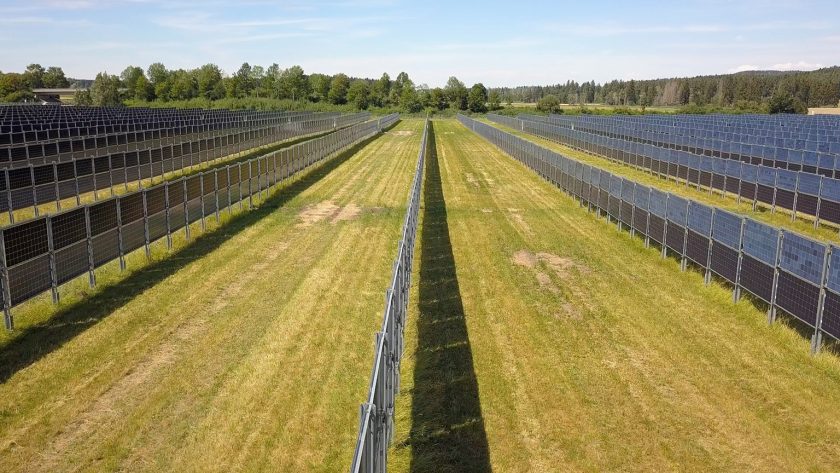
Illustrative photo
One of Czechia’s agrivoltaics “laboratories” is the raspberry plantation at Školky Litomyšl. Behind the large sales hall, 72 plants of the Polka variety grow under the panels, while the same number grow “without panels” a short distance away. This makes it possible to compare the effect of the panels on the plants.
In cooperation with the Research Institute of Agricultural Engineering, the Czech University of Life Sciences Prague and the Research and Breeding Institute of Pomology Holovousy, the Litomyšl operation monitors a wide range of fruit, plant and soil characteristics. There are many different measuring instruments, cables and other sensors around the installation, monitoring the local microclimate, moisture and erosion. Sugar content and appearance are crucial for the fruit.
“We have completed only the first harvest so far, and it will take several more months for all the data to be processed,” explains Petr Zaal, Bragen’s commercial and marketing director. Nevertheless, the first results show that fruit from both locations is similar. “They tasted the same, but I understand that many aspects need to be compared for an assessment,” Zaal says.
However, findings so far from the Czech University of Life Sciences Prague’s experimental area, whose raspberry variety composition matches the planting in Litomyšl, indicate that these berries may be suitable. Fruit quality has so far been comparable.
A short distance from the raspberries in Litomyšl, flowerpots stand beneath photovoltaics. The semi-transparent panels on the structure are not yet generating electricity, but they have already proven their worth. In May last year, a supercell hit Litomyšl, flooding streets in half the town, while falling hail damaged some plants at the nursery. But those beneath the panels survived the heavy rainfall. This is why the company plans to proceed most rapidly with agrivoltaic installations for plants grown in containers.
Further demonstration installations for various crops are being built on the other side of the site. “We want interested parties to be able to come here and see with their own eyes how plants and panels coexist,” Zaal says.
The individual structures differ in height, capacity, panel type and degree of shading. While those for orchards reach up to four metres, 2.5 metres is sufficient for berries. The company intends to offer installations for orchards, plantations, the aforementioned container-grown plants and berries. It also plans to build photovoltaic fences and animal enclosures.
The main obstacle to wider deployment of agrivoltaics remains its cost, which runs into tens of millions of Czech crowns. Zaal mentions three financial models most commonly used.
The first option is for a power plant to be financed by an investor who leases an orchard or other agricultural land. While the farmer takes care of production, the investor looks after the panels and electricity sales.
Another option is so-called PPA contracts (a Power Purchase Agreement is a long-term contract for the supply of renewable energy at a fixed or indexed price, author’s note). These are agreements usually with large companies seeking to secure green energy as part of their sustainability targets.
The final option is for the farmer to use the electricity directly. This is suitable, for example, for energy-intensive sectors such as fruit growing.
Zaal acknowledges that agrivoltaics are currently not worth acquiring for small and medium-sized farmers. The payback period is around 20 years. The high cost is due to complex structures that are often made to order. The panels are also less powerful than those in conventional photovoltaic power plants, so they generate less electricity.
Subsidies could help get agrivoltaics off the ground. The Czech State Environmental Fund is already planning support, with funding to come from the Modernisation Fund. The specific parameters are not yet known, but subsidies should be available the year after next.
Martin Ludvík, chairman of the Fruit Growers’ Union, points out that support should focus primarily on growers. “If the aim is to support farmers, they should receive higher investment support than solar investors who do not operate in agriculture,” he argues. According to preliminary information from industry sources, the planned support should take precisely this direction.
Litomyšl is also waiting to see what form the support will take. However, it plans to install photovoltaic panels above containers even without state aid, because of the aforementioned protection for plants. In the coming years, the farm combining electricity generation and crop cultivation is set to expand from its current 9.6 kilowatts to a maximum capacity of six megawatts.
Panels with a maximum capacity of three megawatts are to be installed above raspberries and blueberries. Ornamental conifer plantations will be covered by 1.5 megawatts of agrivoltaics, while panels with the same maximum capacity will be built above a hazelnut orchard.
Part of the electricity is to be consumed directly on site, with Tomáš Brýdl initially expecting this to account for ten percent. Near the nursery site in Litomyšl, Saint-Gobain ADFORS also has a manufacturing plant. One of the town’s largest employers, it produces and processes non-woven glass fibres for industry and construction, and electricity from its neighbour will be useful to it.
“Their factory is only one and a half kilometres away, so we would run our own cables. It is ideal because, in summer, during peak agrivoltaic generation, the factory also needs cooling while melting glass all day,” he says. They are now jointly negotiating the final form of the PPA project.
Bragen has several pieces of advice for interested parties. “I understand that when a young progressive winemaker approaches his grandfather, who has tended the vineyard all his life, he will not be thrilled by the prospect of covering it. But the key is to talk about it,” says Petr Zaal. In Litomyšl, he says, interested parties can inspect the installations in person. Discussions, webinars and meetings will help them better understand both the benefits and pitfalls of the solution. Programmes on the topic are organised by both the Modern Energy Association and the Solar Association.
Another important step, he says, is finding the courage to try agrivoltaics. But the foundation is to start with one hectare; embarking on 50 is an unnecessary risk. “Many farmers are concerned about the complexity of the entire process, but when they see examples of successful implementation, they gain more confidence,” he explains. It is also important to find suitable partners and installation experts. “The farmer must have the final say,” he adds.
This article is a machine translation of the Czech original and has not yet been fully reviewed. In case of any doubt, please refer to the Czech version.
reuters.com, 24 August 2026, 03:51
reuters.com, 23 August 2026, 22:20
reuters.com, 23 August 2026, 12:03
reuters.com, 23 August 2026, 07:55


