Author | Qiao Yujie
Editor | Yuan Silai
This article has 2600 words, with an estimated reading time of 5 minutes
36Kr learned that Shanghai Starwing Core Energy Technology Co., Ltd. (hereinafter referred to as “Starwing”), an enterprise focused on space photovoltaic cells and certified materials, has recently completed its Pre-A round of strategic financing. This round of financing was jointly invested by Junda Co., Ltd., Shanghai Future Industry Fund, Lingang Blue Bay Capital, Nanxun Luyao, and industry investors related to the co-founders of Xinyang Semiconductor, while the old shareholder Zhongke Shenguang continued to increase its stake. The funds will be mainly used for technical iteration, space environment tests and on-orbit satellite verification, to accelerate the commercial implementation of space perovskite photovoltaic cells and space-grade CPI flexible packaging substrate materials.
(Source/Enterprise)
Shanghai Starwing Core Energy Technology Co., Ltd. was founded in January 2026. Its core R&D and founding team originates from the scientific research system of Shanghai Institute of Optics and Fine Mechanics, Chinese Academy of Sciences. The team members cover multiple directions such as aerospace optoelectronic materials, perovskite optoelectronic devices, CPI functional films, and aerospace-grade reliability verification, with full capabilities ranging from underlying material and device process R&D, space environment adaptation, to on-orbit measurement verification and commercial aerospace engineering implementation.
Industry forecasts that by 2031, the global scale of low-orbit on-orbit satellites is expected to exceed 300,000. With the continuous mass launch of spacecraft such as low-orbit broadband communication, high-resolution remote sensing, and space computing platforms, the areal density of traditional rigid solar wings generally reaches 20 to 30 kg/kW, accounting for 35% to 40% of the total satellite weight, which is increasingly difficult to adapt to the requirements of the new generation of satellites for light weight, miniaturization and high payload ratio.
Against this background, flexible retractable solar wings are developing rapidly. Under the same power generation area, the storage volume of flexible solar wings can be reduced by more than 60% compared with rigid solutions, and the specific power-to-mass ratio can also be greatly improved.
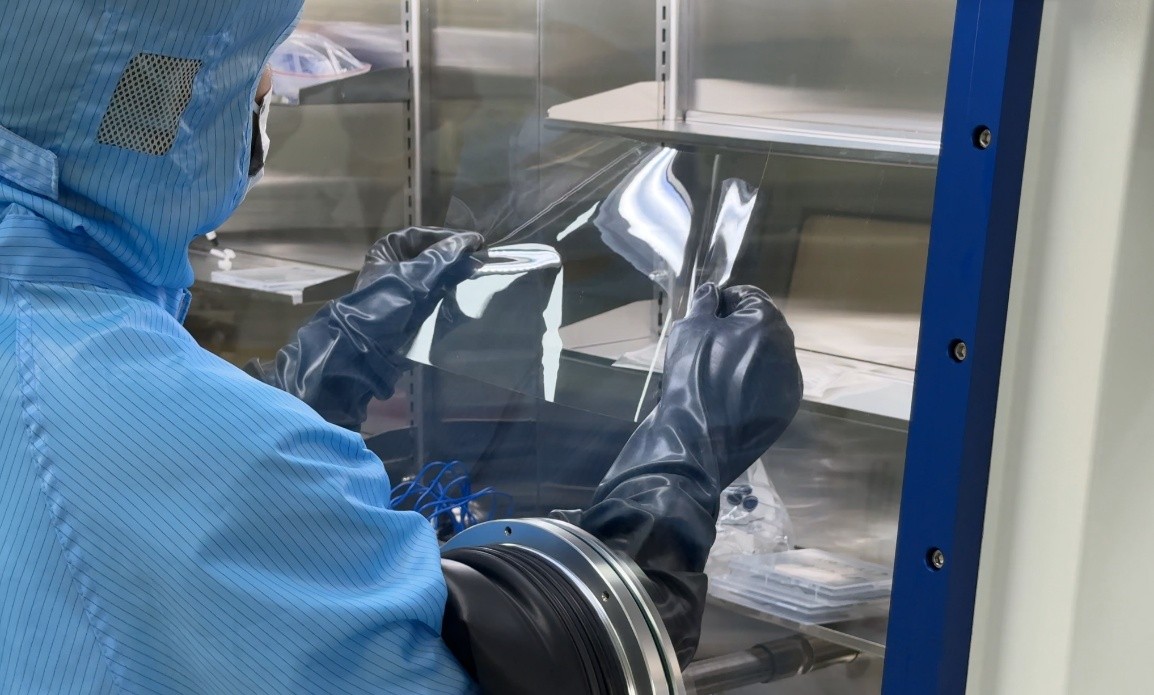
At present, space photovoltaic technology mainly evolves along two routes. One is the packaging material upgrading route, that is, using CPI flexible polyimide packaging film to replace the traditional cerium glass cover plate. Compared with glass packaging, CPI can further reduce weight by more than 40%, and the bending radius can be ≤5mm, which can significantly reduce the areal density of solar wings, reduce the storage volume, be more suitable for retractable flexible structures, and be compatible with various cell technology routes such as perovskite and crystalline silicon.
Starwing SCPI packaging materials (Source/Enterprise)
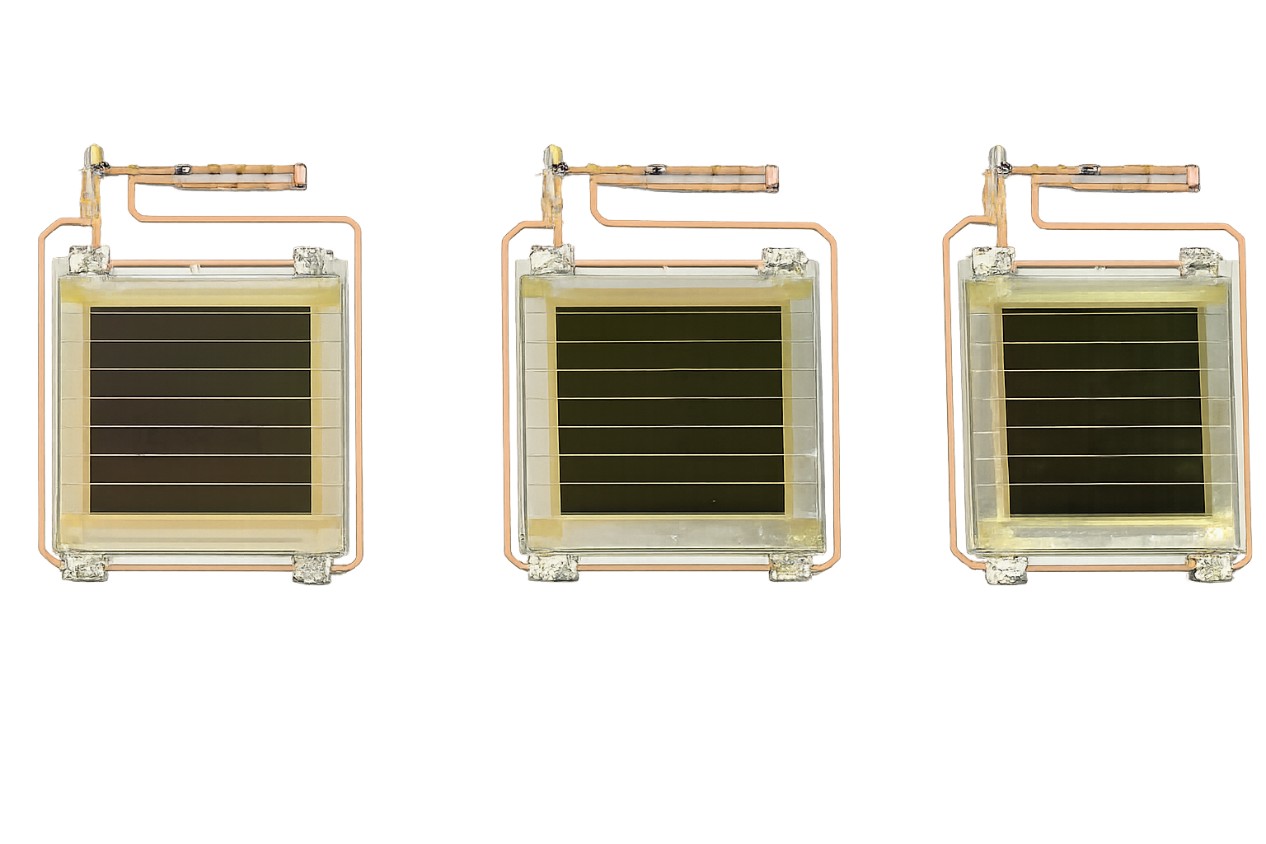
The other is the battery material iteration route. The theoretical efficiency of single-junction perovskite cells can reach 33.7%, which is expected to break through the efficiency upper limit of traditional silicon-based cells. At the same time, it has good low-light response characteristics, and the specific power-to-mass ratio of the module can reach several times that of traditional silicon-based solutions, with natural advantages in light weight and thin profile.
Starwing lightweight single-junction perovskite cell module (Source/Enterprise)
Starwing further integrates the two technical routes, adopts space-grade CPI (SCPI) flexible substrates, develops perovskite cells for space scenarios, and builds the next-generation flexible solar wing solution.
At the perovskite cell end, the space environment faces extreme conditions such as thermal shock, proton radiation, atomic oxygen, and vacuum ultraviolet, which requires special adaptation for material formula, cell structure and preparation process. Starwing has carried out intrinsic stability modifications such as component optimization of perovskite absorption layer, interface defect passivation, and ion migration inhibition for space applications, and advanced the aerospace-grade environment simulation assessment to the R&D stage. Simulation data shows that after the product completes 4000 thermal shock cycles in the range of -120°C to 120°C, the cell efficiency retention rate can remain above 90%.
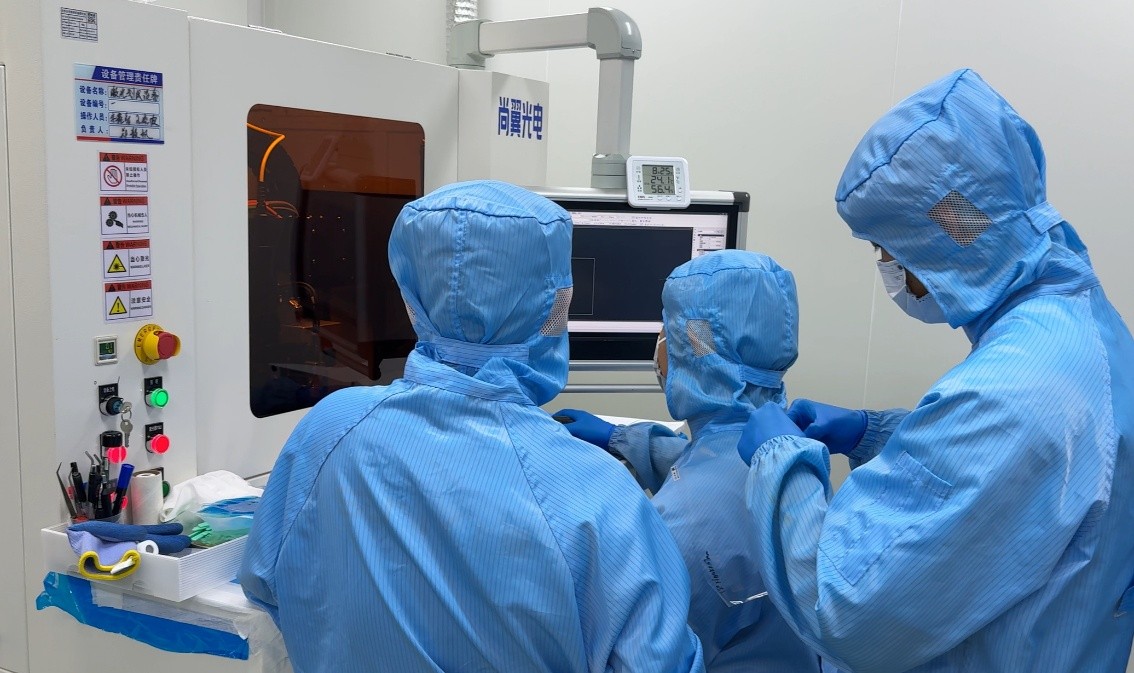
Starwing laser scribing operation console (Source/Enterprise)
At the CPI material end, Starwing is one of the few domestic enterprises that have mastered space-grade CPI material technology. According to the company, its relevant technical level can match similar products in the United States, and it has mastered the complete process flow from material formula to preparation. Compared with the traditional cerium glass packaging system, Starwing’s CPI solution can reduce the areal density of solar wings by 40% to 55%; under the low-orbit orbital working condition, it can help reduce the comprehensive launch cost of a single satellite by about 15% to 20%.
At present, Starwing has completed multiple rounds of sample development and ground space environment simulation tests, and completed the on-orbit verification of CPI thin films with Jietai Aerospace, a joint venture of Junda Co., Ltd., and the relevant on-orbit data verification project has been approved.
In October this year, Starwing plans to carry the perovskite flexible photovoltaic space on-orbit verification on the Ziwei spacecraft to further verify the adaptability and stability of the product in the complex space environment.
Aerospace-grade CPI production line planning of Jietai Aerospace, a joint venture between Starwing and Junda Co., Ltd. (Source/Enterprise)
In terms of commercialization, as an important space photovoltaic member unit of Shanghai’s “Star Hub Plan” computing constellation, Starwing is currently continuously improving its sample delivery capability, providing standardized flexible photovoltaic modules and integrated solar wing solutions for commercial satellite manufacturers and satellite platform enterprises, and simultaneously promoting global layout.
The following is an excerpt of the communication between 36Kr and Wu Zhengyu, CEO of Starwing:
36Kr: What are the technical difficulties for perovskite to enter space? Will the common large-area yield problem in the ground stage also affect its application in space?
Wu Zhengyu: The space environment is completely different from the ground environment. Perovskite needs to face various extreme conditions such as thermal shock, proton irradiation, vacuum ultraviolet, and atomic oxygen during on-orbit operation. Therefore, before it can be truly applied in space, it must first complete space environment simulation and adaptation on the ground, including formula optimization, redesign of cell structure and adjustment of production process.
On this basis, further real on-orbit carrying verification is required. The verification is mainly divided into two levels: one is to check whether the material itself can withstand the space environment, and the other is to verify from an engineering perspective whether it can really be integrated into the satellite power supply system, and evaluate the actual power generation benefit and life performance.
Under the conditions of high temperature and high voltage in space, the system tends to adopt the design idea of high voltage and low current. In order to reduce the series current, we will actively control the area of the perovskite cell to avoid the current rise caused by too large size. For example, the cell size is set to 5cm × 5cm instead of square meter level. This size selection enables us to adopt some equipment and processes that are too costly to afford in large-scale ground production, so as to significantly improve the yield. High-end preparation methods that were not cost-effective in commercial terms in the past may instead have feasibility and obvious advantages in high-value space application scenarios.
36Kr: What technical problems are faced when CPI is used for perovskite cell protection? How does Starwing solve them?
Wu Zhengyu: We are one of the earlier enterprises in the world to explore the preparation and protection development of perovskite cells on CPI flexible substrates. The reason why we chose this route is that we judge that light, thin, flexible and large-area solar wings will become an important form of space photovoltaics in the future. Compared with the traditional rigid small solar wing with aluminum honeycomb panel structure, if we want to further expand the area of the solar wing in the future, we must rely on more lightweight and rollable cell materials.
CPI itself is a very huge material system, with thousands of formula combinations. The team needs to systematically screen and conduct in-depth research on these candidate materials, and even carry out independent innovation, to finally find or develop CPI products that are truly suitable for the space environment. It needs to focus on meeting the requirements of UV radiation resistance, atomic oxygen erosion resistance, proton irradiation resistance and thermal shock resistance.
At the same time, the supporting coating, adhesive, stretching film-forming process of CPI, as well as the interface adaptation between CPI and the perovskite layer, are also key links. These problems need to be continuously optimized in the process of process development and actual on-orbit verification. At present, there is no mature on-orbit application scheme for CPI-based perovskite cells in the industry, so we also need to promote technical iteration through continuous on-orbit verification.
36Kr: What is the planned on-orbit verification schedule of CPI combined with perovskite?
Wu Zhengyu: Our strategy is “small steps, fast progress”, promoting it in stages. The first phase of verification has been completed through the “Tianyan 27” mission in May this year, focusing on investigating the tolerance and protection characteristics of CPI films in the space environment alone. At present, we have obtained stable data for up to three months and released it through public channels. This is also a systematic verification we carried out for the independent space service performance of CPI materials.
In the second stage, we will further verify the actual protection effect of CPI films on the perovskite light absorption layer. The relevant carrying plan is arranged on the Ziwei B300 spacecraft, and we are currently waiting for the launch window.
The third phase plans to carry out comprehensive on-orbit verification of the overall structure of CPI perovskite cells and flexible solar wings before the end of the year, and gradually realize the full-chain space verification from materials, devices to systems.
This article is originally produced by「乔钰杰」, For reprint or content cooperation, please click Reprint Instructions ;Unauthorized reprint will be held accountable.
The pictures in this article are from:企业授权
36kr Europe (eu.36kr.com) delivers global business and markets news, data, analysis, and video to the world, dedicated to building value and providing business service for companies’ global expansion.
© 2024 36kr.com. All rights reserved.


